#IGPPExpertTalks – AI Special Series | The AI Transition: Education, Employment and India's Future
What ongoing #protests in India are reflective of? Are they just political protests or they reflect deeper systemic issues?
What is the role of AI #technology and #policy in this state of #anxiety we are facing as #society?
What happens when technology changes faster than our education systems and #public #institutions?
In the upcoming episode of #IGPPExpertTalks – AI Special Series, Mr. Rohit Kumar (@rohitkr_RK), Co-founder of The Quantum Hub (@TQH_Policy) and Young Leaders for Active Citizenship (YLAC), joins Dr. Manish Tiwari (@ManishTiwari), Director, Institute for Governance, Policies and Politics (@IGPPVMF), to examine how AI is transforming education, employment and opportunity and what these changes mean for India's future.
Watch the full episode on 23rd July 2026 | 05:00 PM IST
To know more about us, visit: https://t.co/JxVFY9QpBH
@ranjana_kush | @AnkurTi76797199 | @vikas_IGPP
#IGPPExpertTalks #AI #Protests #Students #ArtificialIntelligence #Education #Employment #FutureOfWork #PublicPolicy #TechnologyPolicy #AIGovernance #DigitalEconomy #Youth #Skills #IndiaAI #IGPP
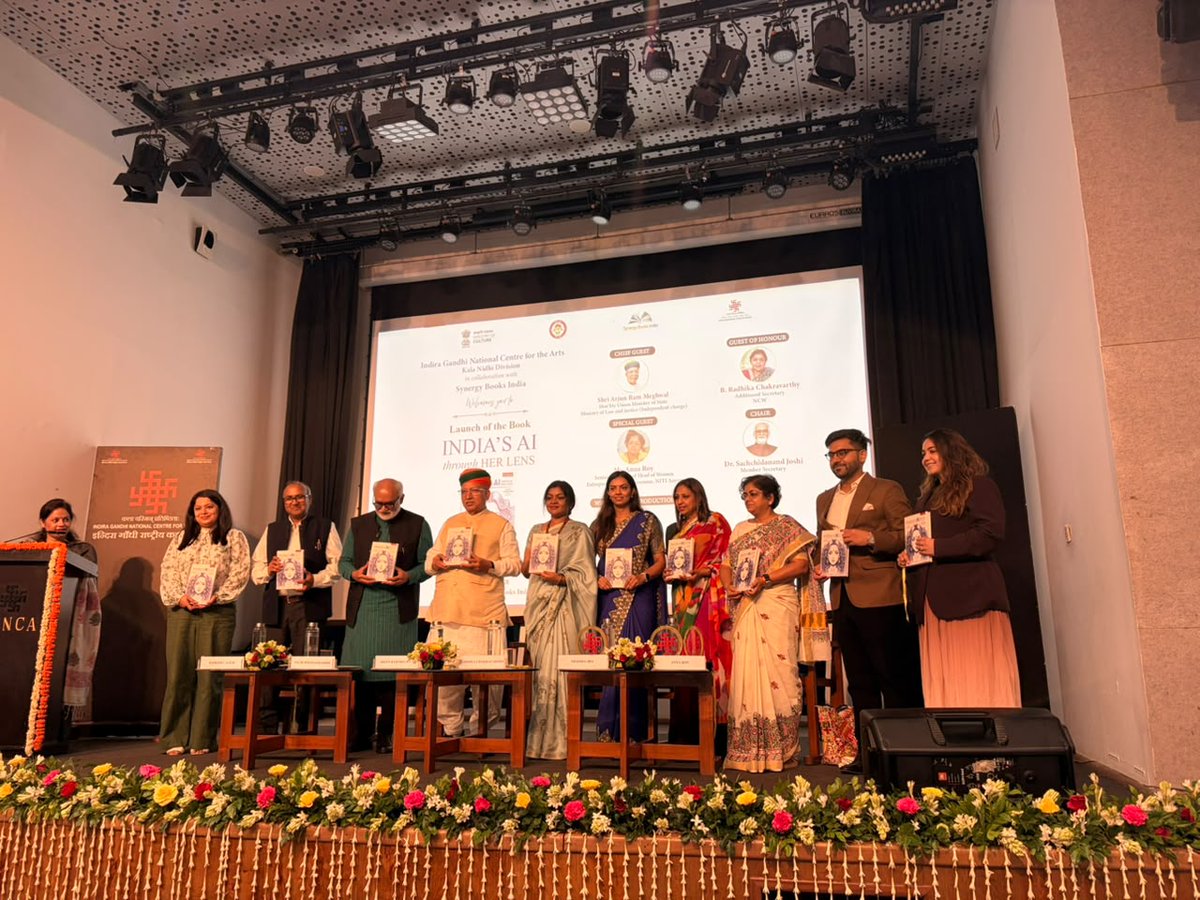
The Quantum Hub (TQH) was honored to support the launch of ‘India's AI Through Her Lens’ a book by Ms. Nimisha Jha last week. Nimisha Jha brings over 14 years of experience in governance, public administration, and policy design to India's AI Through Her Lens, offering a timely perspective on building an inclusive and accountable AI ecosystem. The book’s focus is in line with TQH’s continued efforts under the Women in Digital Economy Network (WiDEN) to cast a gender lens to India’s digital story.
Presented by the Indira Gandhi National Centre for the Arts (@IGNCA), Kala Nidhi Division, and Synergy Books India, the discussion centered on the urgent need for policy-driven frameworks that ensure AI systems remain inclusive, equitable, and accountable.
We thank the esteemed dignitaries- Shri Arjun Ram Meghwal (Hon'ble Union Minister of State for Law & Justice), Smt. Savitri Thakur (Hon'ble Union Minister of State for Women & Child Development), Ms. Anna Roy (Senior Advisor, NITI Aayog), Dr. Sachchidanand Joshi (Member Secretary, IGNCA), and Prof. (Dr.) Ramesh C. Gaur (Dean, IGNCA) - for sharing their insights on steering technology toward a fair and representative future.
Thank you to everyone from the policy, tech, and development sectors who joined the conversation.
#PublicPolicy #TechGovernance #ResponsibleAI #WomenInLeadership #TheQuantumHub
The Quantum Hub (TQH) is expanding! We are looking for a Manager in New Delhi to anchor our growing Tech Policy practice.
At @tqh_policy, we work at the intersection of research, governance, and impact. As tech frameworks evolve rapidly, this role offers a platform to lead client-facing engagements, shape robust advocacy strategies, and direct research on critical issues like AI regulation, data privacy, and platform governance.
We are looking for someone with:
◾️6–8 years of experience in public policy, law, or tech regulation.
◾️An advanced degree or equivalent track record in the technology policy landscape.
◾️Strong analytical thinking and communication skills to navigate a fast-paced environment.
If you are passionate about emerging technologies and engaging with key institutional stakeholders on policy questions, we would love to hear from you.
How to apply:
Please submit your resume, a writing sample (max 8 pages), and two references through the application link below.
Details and application form: https://t.co/8Vv2ywprA9
Please share this within your network or tag individuals who might be a good fit!
#TechPolicy #PublicPolicy #Hiring #AIRegulation #DataPrivacy #PolicyJobs #TQH
On 30 June 2026, Lightstorm launched I-2SEA in Hyderabad, a new submarine cable system connecting India's East Coast directly to Singapore and Malaysia, and built to give Hyderabad's fast-growing AI and cloud ecosystem a direct, resilient route to the world.
The Quantum Hub was privileged to have supported Lightstorm on this landmark announcement.
The programme opened with a keynote from Amajit Gupta, Founder, CEO and Managing Director of Lightstorm, who reframed connectivity as the foundation of the AI era, followed by Staffan Göjeryd, Partner and General Manager, Network Acquisition at @Microsoft , on the role of digital infrastructure in enabling the AI economy.
Phani Nagarjuna, Founding CEO of AIKaM (Telangana AI Mission, @AiTelangana), joined as Guest of Honour and grounded the discussion in India's national AI ambitions. The official launch of I-2SEA was led by Laura Williams, Consul General at the U.S. Consulate General, Hyderabad (@USAndHyderabad), alongside Phani Nagarjuna, followed by the signing of the formal declaration by all consortium partners, @Microsoft, @tata_comm, @Singtel, @NEC and ACPL.
The event closed with a fireside discussion on 'The AI Economy: Cloud, Connectivity and Enterprise Opportunity', moderated by @PwC's Vinish Bawa with leaders from @nokia, @Ciena and @FujitsuOfficial.
A recurring theme across the event was that while India is investing heavily in AI compute and cloud infrastructure, the next phase of digital growth will depend equally on strengthening the underlying connectivity layer through greater resilience, route diversity and collaboration between government and industry.
#Lightstorm #I2SEA #AIEconomy #SubmarineCables #DigitalInfrastructure #HyderabadTech #TechLaunch #TheQuantumHub
#CRFLive
Session 1: India's Future Digital Economy – Evolution, Future & Inclusion moderated by @sanjeevahlu, DF, CRF
The key takeaways are:
- Dr. Deepak Mishra, @ICRIER: India's digital future rests on the pillars of Connect, Harness, Protect, Innovate & Sustain and "The antidote to AI pessimism is informed analysis, evidence, and good data."
- Mr @TamalBandyo : #UPI has transformed banking efficiency, while #CBDC should complement India's evolving #digitalPayments ecosystem.
- Ms @BhartiAparajita: Digital inclusion goes beyond connectivity. Trust, #DigitalLiteracy and strong grievance redressal remain essential.
- Prof. @kathuria_rajat : Digital Public Infrastructure is an institution built on trust. The next phase of India's digital journey must focus on productivity, innovation and research.
@ikigailaw | @tqh_policy | @sanjeevahlu
#CRFEvent #DigitalEconomy #DigitalIndia #PublicPolicy #AI #DigitalPublicInfrastructure #PanelDiscussion #ChintanResearchFoundation
Startup Central | With spam and scam messages still a major concern, why is WhatsApp prioritising usernames??
"WhatsApp's intent is perhaps fair, but the government's question is also legitimate..." Rohit Kumar of Quantum Hub explains the arguments from both sides
Full interview - https://t.co/bOe2BqoaiB
@SumitaKareer@rohitkr_RK #Meta #WhatsApp
🚨Why the Indian govt is turning up the heat on Big Tech
MeitY Secretary S. Krishnan has framed the government's concerns around platform architecture rather than isolated incidents.
Policy experts, however, caution against interpreting the recent developments as a coordinated offensive against technology companies.
Rohit Kumar, Founding Partner at public policy firm The Quantum Hub (TQH), said each intervention has been triggered by a distinct regulatory concern.
"The recent flurry of government interventions is driven by specific developments rather than a coordinated crackdown. But these episodes also expose a deeper gap in India's legislative armour," he said.
"As digital services have evolved rapidly, our regulatory framework has struggled to keep pace, leaving regulators to respond through ad hoc measures rather than clear, predictable rules."
By @AihikS
https://t.co/aV1wOlgsz4
The Anthropic blackout exposes an uncomfortable reality: if access to frontier AI can be switched off even for close partners, what exactly are those alliances worth?
For India, this complicates an otherwise compelling argument that our comparative advantage lies primarily in becoming the world’s leading AI use-case economy rather than building foundational capabilities ourselves. Unfortunately, what is economically efficient is not always geopolitically sufficient.
I wrote in the @IndianExpress last Friday on why we should treat this episode as a warning sign, and why India’s AI sovereignty debate needs to become more operationally precise. The right response should not be a panic-driven push for self-sufficiency across the entire value chain, but a sharper assessment of which parts of the AI stack create strategic exposure and require domestic capability. Not all dependencies are equal, and neither should our policy response be. Getting this wrong risks imposing costs on Indian businesses without meaningfully improving resilience or security.
P.S. There is also a lesson here for American technology companies. Decades of trust can unravel quickly if customers begin to believe that access ultimately depends on political decisions taken elsewhere. If governments and firms begin factoring geopolitical continuity into procurement decisions, the long-term cost to US technology leadership may be larger than is currently visible. Perhaps this is a signal for American tech to ramp up advocacy back home.
You can read the piece here: https://t.co/QucrUbnB0U
@tqh_policy
How do you build a #DigitalEconomy that is innovative, inclusive, and future-ready?
It starts with the right conversation.
Join an eminent panel as they explore India's digital journey from its evolution and future to the opportunities that lie ahead.
📅 7 July 2026
📍 The Dome, Ambassador Hotel, New Delhi
🕰️ 9:30 am onwards
🔗 https://t.co/OqmLWINmdw
Seats are filling up. Register now!
@ikigailaw | @kathuria_rajat | @ICRIER | @BhartiAparajita | @tqh_policy | @TamalBandyo | @priyadarshi_crf | | @Abhijit_M007 | @pol_rutuja
#CRFEvent #DigitalEconomy #DigitalIndia #PublicPolicy #AI #DigitalPayments #PanelDiscussion #ChintanResearchFoundation
Coming Up @ 7 PM | Startup Central
Why is the government tightening the screws on Big Tech?
With Meta's Instagram and WhatsApp, along with Telegram, under increased government scrutiny, what does this mean for users, platforms and digital regulation?
Rohit Kumar decodes the bigger picture👇
@SumitaKareer@rohitkr_RK@tqh_policy
Rather than pursuing an immediate UK-style ban, experts suggest the country may first look to strengthen existing frameworks, evaluate the implementation of the DPDP Act and build a more comprehensive child online safety ecosystem tailored to Indian realities.
By @ind_bos
Read More - https://t.co/DndQI1X2Cc
Kazim Rizvi - @_DialogueIndia | Aparajita Bharti - @tqh_policy | Sonam Chandwani - @kslegal
#socialmedia #socialmediaban
Beyond connectivity: who is truly participating in the digital economy?
NCAER collaborated with @tqh_policy to convene a discussion on India’s Transformation: The Evolving Landscape of Digital Inclusion, a jointly produced research report that draws on NCAER’s IHDS-III data to examine how people access, use, and benefit from digital technologies. NCAER faculty, @DibyasreeG along with @garimaagar54890, presented key findings from the report.
The event brought together research scholars, industry experts, and civil society representatives for a series of sessions, including a panel discussion featuring voices from the field. Participants explored emerging challenges and opportunities and identified pathways for the next chapter of India’s digital inclusion journey.
@BhartiAparajita | @sonakshi_93 | @Pallavi_Econ | @SonaldeDesai
Read the report: https://t.co/QIuxDB8c2J
How can online safety frameworks evolve in the age of AI?
At the ISB Governance Summit 2026, our colleague Sidharth Deb joined a panel on AI for Safer Digital Futures: Protecting Women and Children Online in the Age of AI, alongside V Neeraja IPS (Special DGP, National Crime, Punjab), MRINALINI DARSWAL(IAS cum Commissioner-cum-Secretary, Women & Child Development, Govt. of Odisha) , and Siddharth Pillai (Co-founder and Directior, RATI Foundation).
The discussion examined the growing challenges of ensuring online safety in an increasingly AI-enabled digital ecosystem. Drawing on The Quantum Hub's research on online safety for women and children in India, Sidharth highlighted the importance of moving beyond reactive approaches towards safety-by-design frameworks that account for the realities of how people access and use technology.
The panel also explored the need for stronger institutional coordination, accessible reporting mechanisms, digital literacy, and proactive risk assessment as AI reshapes online experiences.
Thank you to the Bharti Institute of Public Policy, ISB, for convening this timely conversation.
@BIPP_ISB
भारत में इंटरनेट यूजर्स 103 करोड़ के पार.. फिर भी 27.5% परिवार अब भी ऑफलाइन।
मोबाइल पहुंच और डिजिटल पहुंच के बीच की खाई कितनी बड़ी है? नए अध्ययन के आंकड़े बताते हैं पूरी तस्वीर
#DigitalIndia#InternetUsers#NCAER#DataReport#India
“Just released: new from IHDS-III (2022-24) 📢
Manish Sabharwal just released a report on “The Evolving Landscape of Digital Inclusion in India” jointly produced by NCAER in collaboration with @tqh_policy. The report highlights the layered and evolving nature of digital participation in India where mobile-first internet access has both expanded access and limited the quality of digital participation.
Read the full report here: https://t.co/QIuxDB8c2J
@ihdscorner | @TeamLease
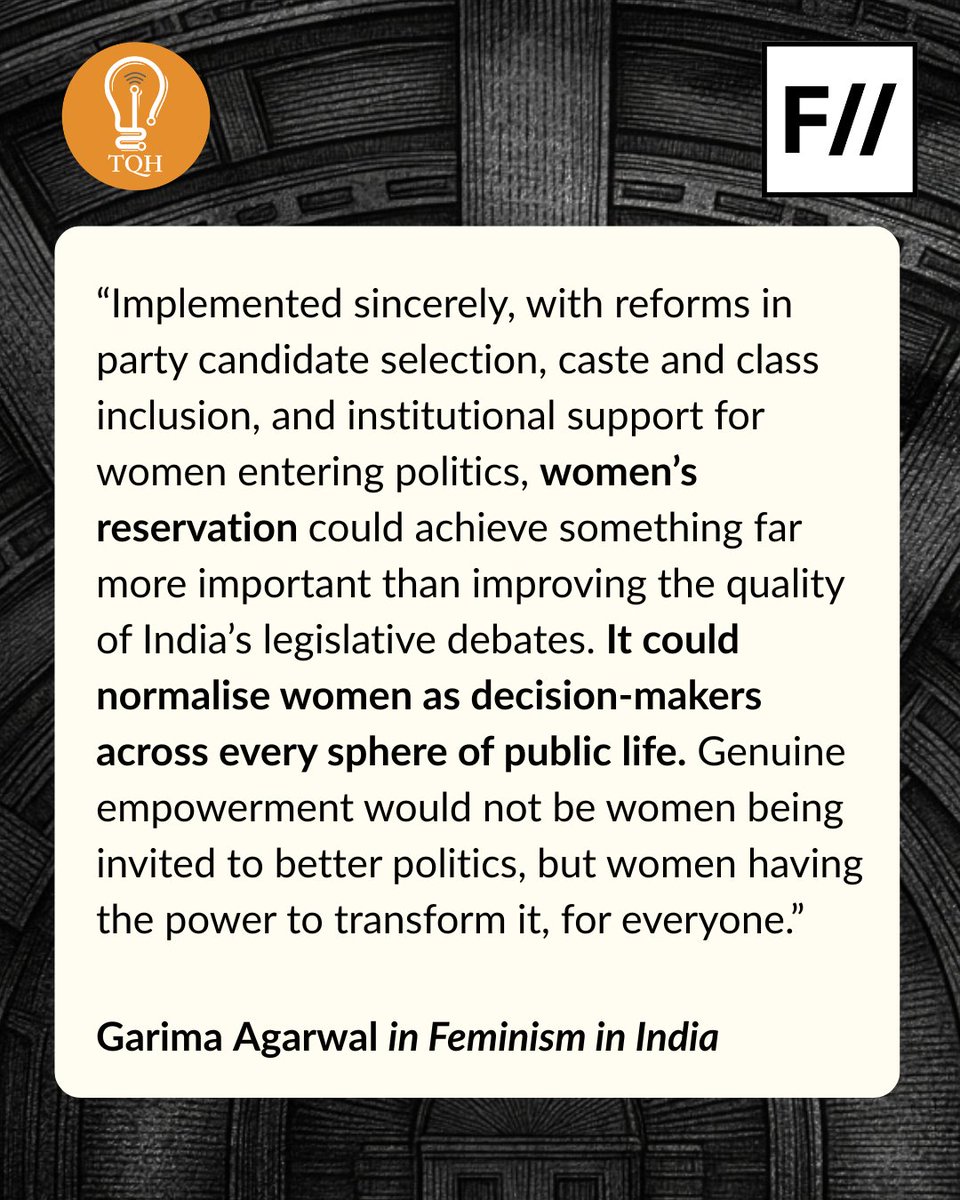
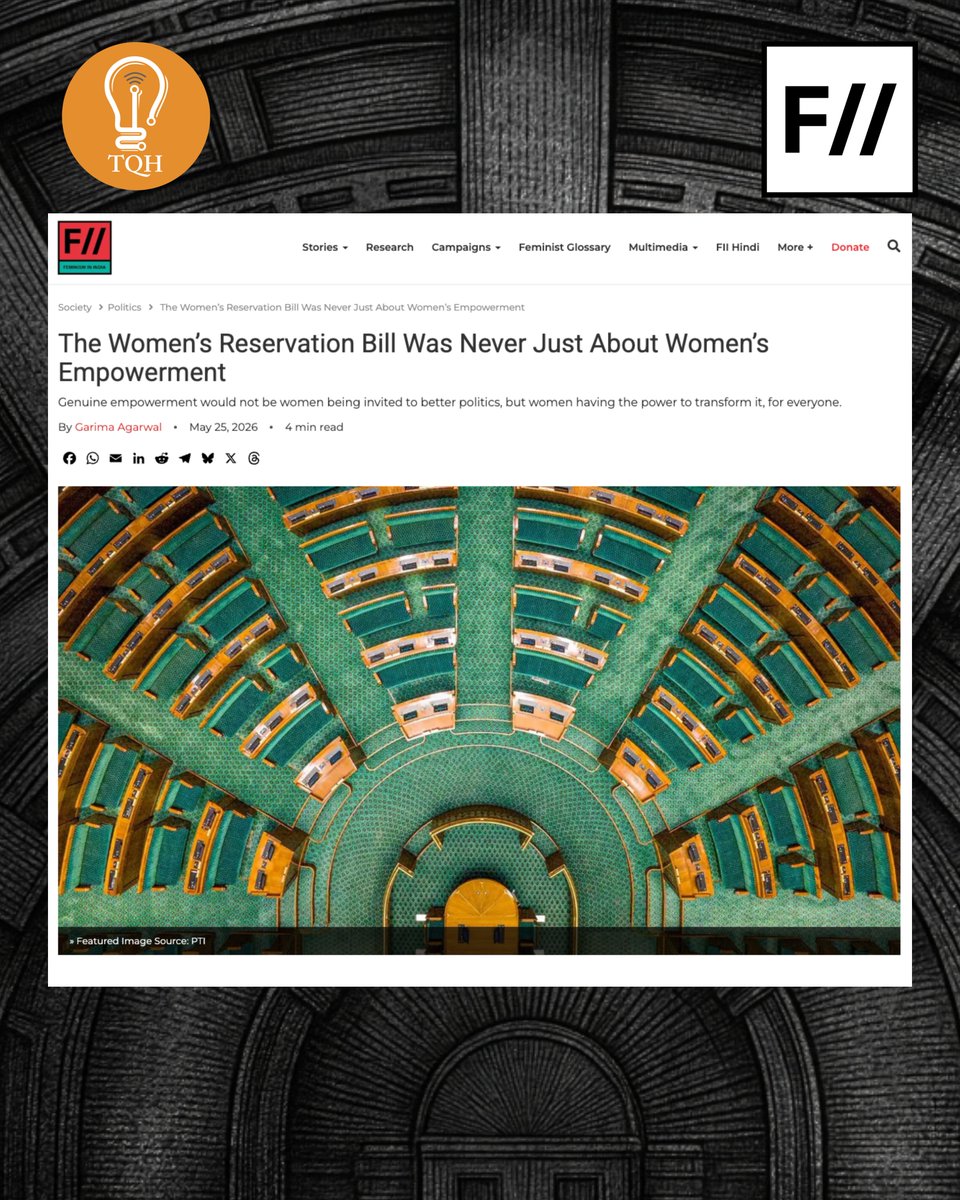
What happens when women's political representation becomes conditional on larger political battles?
In this piece for @FeminismInIndia, our colleague Garima Agarwal examines how the debate around women's reservation has often focused on what women can do for politics, rather than women's right to political power itself.
A timely reflection on representation, empowerment, and who gets to shape public decision-making.
Read the piece here: https://t.co/TklFCEwayD
#womensreservation #india #politics #gender
Last week at TQH & @ylacofficial, our colleagues, Salil and Arun led interactive sessions exploring different ways AI can help streamline workflows and improve day-to-day work. The discussions, demos, optimised workflows, Personal ‘AI councils’ and shared innovations sparked plenty of curiosity (and a lot of “I’m definitely trying this” moments).
A good reminder that learning new things is always more fun when it happens together! Good vibes were coded :)
#3. Expanding oversight over news and current affairs
The proposed framework risks centralising control over what qualifies as news and how it is regulated, without sufficient safeguards. This creates a real risk of overreach - particularly in contexts where speech is critical of those in power. In a digital environment where information flows rapidly and widely, broad and discretionary oversight mechanisms can have chilling effects on free expression and democratic debate.
#4. A more prescriptive approach to AI labelling
AI labelling is certainly important, but regulation in this space should focus on outcomes - ensuring users are meaningfully informed - rather than prescribing specific, feature-level mandates. The proposed change also comes soon after the earlier framework was introduced, requiring platforms that had already begun implementing “prominent visibility” labelling to rework their systems. Such rapid shifts risk increasing compliance costs and undermining regulatory predictability.
While the Ministry’s intent is certainly appreciated, it is important to ensure that regulation does not undermine the ecosystem it aims to protect. We hope our inputs help refine the draft amendments.
#TechPolicy #DigitalRights #ITRules #PlatformRegulation
Yesterday, we submitted our inputs on the proposed amendments to the IT Rules, 2021.
The intent to strengthen online safety is important. But some of the proposed changes risk creating more uncertainty than clarity - and could have far-reaching consequences for how the internet is governed in India.
#1. When soft law becomes hard obligation
The proposal effectively makes compliance with advisories and SOPs a condition for safe harbour. This is a significant shift. Advisory instruments are typically non-binding and often issued without formal consultation. Turning them into enforceable obligations risks undermining due process and introducing legal uncertainty for platforms.
#2. Conflating duty of care with safe harbour
There is an important distinction between removing illegal content and designing safer systems. Safe harbour protects platforms from liability for user content, provided they act on notice. Duty of care, on the other hand, is about proactively building safer products. Linking such system-level responsibilities to loss of safe harbour creates a flawed enforcement model. We need a distinct framework for duty of care that is calibrated to systemic risks...🧵🧵
#ITRules #PlatformRegulation #TechPolicy