This AI just exposed the BIGGEST legal insider trading operation in America.
A platform called GovGreed built a seven-layer machine learning system that cross-references every stock trade disclosed by every sitting politician against the bills their committees control, the campaign donations they receive, and the companies their votes directly impact.
It scored all 540 politicians currently in Congress. And the numbers are crazy:
56% of every stock purchase made by Congress in the last 16 months was on a stock directly affected by a bill the buyer later voted on. That is 6,170 out of 11,016 total purchases.
More than HALF of all congressional stock buys are on companies whose fate that same politician is about to decide.
343 of 540 Congress members actively trade stocks while holding access to nonpublic legislative information.
That is 63.8% of the entire legislature making market bets with an informational edge that would put any hedge fund manager in prison.
The AI identified 752 active "Triple Signals" in the current Congress. A Triple Signal fires when three conditions line up at once:
The politician sits on the committee controlling a bill, they traded stock in a company affected by that bill, AND they received campaign contributions from that same industry.
Bills carrying these insider indicators pass at 5.4 TIMES the normal rate.
Now look at the individual leaderboard:
- Nancy Pelosi's estimated portfolio sits at $194 million with a Greediness score of 98.1 out of 100
- Ro Khanna made 13,231 trades across 800+ different tickers
- Michael McCaul made 32,302 trades and filed 6,670 of them late
- Thomas Suozzi filed 86.4% of his trades late with an average delay of 396 days, meaning his disclosures landed over a YEAR after he made the trade
And then there is Lisa McClain, the fourth-ranking Republican in the House. She has made 1,443 trades in three years, more than 98% of all politicians tracked.
She violated the STOCK Act twice in a single year, disclosing up to $900,000 in trades months after the legal deadline. Her husband bought up to $250,000 in Elon Musk's xAI, which quietly converted into SpaceX equity before last Friday's $2 trillion IPO.
The penalty for all of this? A $200 fine.
The number of Congress members ever prosecuted under the STOCK Act since it passed in 2012? Zero.
And the cruelest part is this:
A bill to ban congressional stock trading was introduced in January 2026. It has bipartisan support. Over 80% of American voters want it passed.
But Congress is sitting on it, because the people who would have to vote yes are the same people making millions from the system staying exactly the way it is.
They write the insider trading laws, they exempt themselves from enforcement, they trade on the information those laws generate, and when they get caught, they pay a fine that is basically nothing.
The AI didn't discover anything Congress was hiding. It just organized what was already public into a pattern so obvious that nobody can pretend it isn't there anymore.
You know what winners do?
They look in the mirror.
They self-evaluate.
They make corrections.
They create a plan—then they take action.
Winners don’t waste time making excuses.
They find solutions.
That’s how growth happens.
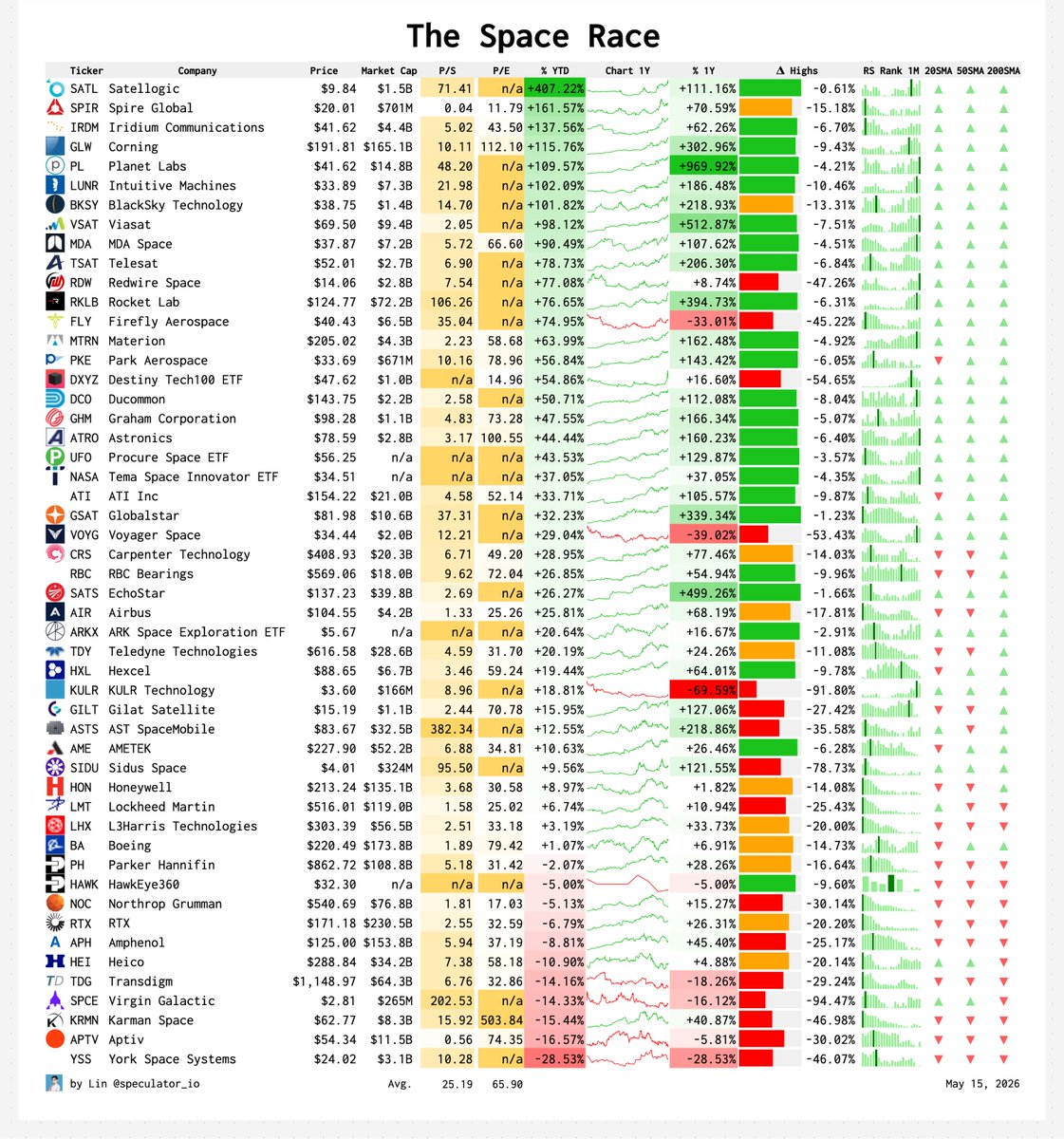
SpaceX $SPCX is planning to go public on June 12.
It's the biggest IPO in history and will instantly reprice the entire space sector.
These are the key space sectors to watch:
Launch Service Providers
$RKLB Rocket Lab
$FLY Firefly Aerospace
Space Imaging
$PL Planet Labs
$SATL Satellogic
$GSAT Globalstar
$BKSY BlackSky Technology
$SPIR Spire Global
$HAWK HawkEye 360
Satellite Communications
$ASTS AST SpaceMobile
$GSAT Globalstar
$SIDU Sidus Space
$SATS EchoStar
$IRDM Iridium Communications
$ETL Eutelsat
$TSAT Telesat
$GILT Gilat Satellite Networks
$VSAT Viasat
Space Infrastructure
$RDW Redwire Space
$LUNR Intuitive Machines
$MDA MDA Space
$VOYG Voyager Space
$YSS York Space Systems
Speciality Materials
$CRS Carpenter Technology
$MTRN Materion
$HXL Hexcel
$ATI ATI
$GLW Corning
$PKE Park Aerospace
Aerospace & Defense
$RTX RTX Corporation
$LMT Lockheed Martin
$KTOS Kratos Defense & Security
$VOYG Voyager Space
$LHX L3Harris Technologies
$NOC Northrop Grumman
$BA Boeing
$AIR Airbus
$HO Thales
Space Components
$TDY Teledyne Technologies
$APH Amphenol
$KRMN Karman Space
$RBC RBC Bearings
$PH Parker Hannifin
$AME AMETEK
$VELO Velo3D
$GHM Graham
$HEI Heico
$DCO Ducommun
$ATRO Astronics
This is it.
Everything learned spending millions on longevity.
From: Your Immortal Unc and Auntie.
To: Our Immortal nieces and nephews.
0. Sleep is the world's most powerful drug.
1. Be in your bed for 8 hours
2. Same bedtime every night, any time before midnight
3. Don’t eat right before bed
4. Calm foods for dinner
5. No screens 1 hour before bed
6. Avoid added sugar (be aware it’s in everything)
7. Avoid all things in an American convenience store
8. Avoid fried foods
9. Shoes off at the door
10. Eat whole foods, particularly veggies fruits nuts legumes berries
11. Walk a little after meals or air squats
12. Get your heart rate high routinely
13. Lift heavy things
14. Stretch daily
15. Water pik, floss, brush, tongue scrape, morning and night
16. Make an effort to drink water
17. Get sunlight when you wake up (UV is low)
18. Protect skin in midday sun
19. Stand up straight
20. See at least one friend once a week
21. Avoid plastic where you can (in all things)
22. Circulate air in rooms
23. When stressed, breathe, learn to calm your body
24. Go to the dentist
25. Avoid sitting for long times
26. Protect your hearing, the world is too loud
27. Alcohol is bad for you
28. Finish coffee before noon
29. Avoid bright lights after sunset
30. If obese, look into a GLP
31. Sleep in a cold room
32. Texting while driving is dangerous
33. Turn off all notifications
34. Limit social media use
35. Don’t smoke anything
36. If you struggle to sleep, read a physical book before bed
37. 1 hour before bed have a calm wind down routine: bath, read, light walk, listen to music
38. The body is a clock and loves routine. Have a daily morning and evening schedule.
39. Avoid long distance travel where you can
40. Baby steps first: incorporate new things slowly
41. Do less… most things don’t work.
Bonus points if you get your blood checked.
Start here, it will change your life.
AOC vient d'expliquer qu'on ne peut pas "gagner" un milliard de dollars. Que c'est mathématiquement impossible. Que tout milliardaire est forcément un voleur, un abuseur de lois du travail, un payeur sous-évalué.
Ce niveau d'ignorance économique de la part d'une élue qui légifère sur l'économie devrait nous faire hurler.
Reprenons depuis le début, parce qu'apparemment c'est nécessaire.
Un milliardaire n'est pas quelqu'un qui a un milliard de dollars en cash sur son compte. Un milliardaire est quelqu'un dont le marché évalue les actifs (principalement des parts d'entreprise) à un milliard ou plus.
Elon Musk n'a pas "pris" 800 milliards à quelqu'un. Il a créé Tesla, SpaceX, Starlink, Neuralink, xAI. Le marché évalue ces entreprises à plusieurs trillions cumulés. Il en détient une fraction. C'est ça, sa "fortune".
La question fondamentale qu'AOC ne se pose jamais : d'où vient la valeur ?
La valeur n'est pas un gâteau fixe qu'on se partage. La valeur est créée. Quand SpaceX divise par 10 le coût du lancement orbital, ce n'est pas du vol, c'est de la création pure. Avant Musk, lancer un kilo en orbite coûtait 50K$. Aujourd'hui 1.5K$.
Cette création de valeur est mesurable, vérifiable, et bénéficie à toute l'humanité. L'internet par satellite couvre des zones que les États ont été incapables de connecter en 50 ans. Les voitures électriques ont forcé toute l'industrie auto à se réinventer.
Maintenant, la question centrale qu'AOC évite soigneusement : qui devrait allouer les ressources dans une société ?
Parce que l'argent, fondamentalement, c'est ça. Un signal d'allocation. Décider où va le capital, le travail, l'énergie, le temps humain.
Trois options historiques :
L'État (bureaucrates élus ou nommés)
Les comités citoyens (démocratie directe)
Les entrepreneurs qui ont prouvé leur capacité d'allocation par leurs résultats
L'option 1 a été testée massivement au 20ème siècle. URSS, Chine maoïste, Venezuela, Cuba, Corée du Nord. Résultat : famines, pénuries, effondrement. Des dizaines de millions de morts. L'allocation étatique est un désastre empirique total.
L'option 2 n'a jamais existé à grande échelle pour des raisons mathématiques. Le calcul économique nécessaire pour allouer les ressources d'une économie moderne dépasse les capacités cognitives d'une assemblée. Hayek l'avait démontré dès 1945 (The Use of Knowledge in Society).
L'option 3, c'est le marché. Et le marché récompense ceux qui allouent bien. Ceux qui allouent mal font faillite, perdent leur capital, sortent du jeu. Les survivants sont par sélection darwinienne les meilleurs allocateurs disponibles.
Elon Musk est riche parce qu'il a prouvé, sur 25 ans, qu'il alloue mieux le capital que 99.9999% de l'humanité. PayPal. Tesla. SpaceX. Starlink. Chaque fois, il a pris du capital et l'a transformé en infrastructure civilisationnelle.
La vraie question n'est pas "pourquoi Musk a tant", c'est : "pourquoi n'a-t-il pas plus ?"
Sérieusement. Si on veut maximiser la création de valeur pour l'humanité, on devrait vouloir que les meilleurs allocateurs aient accès à plus de capital, pas moins.
Donner 100 milliards à AOC pour qu'elle les redistribue selon sa vision morale, c'est garantir leur destruction. Donner 100 milliards à Musk, c'est probablement obtenir des bases martiennes, de l'énergie quasi-gratuite, et une révolution robotique.
Le préjugé d'AOC, c'est que la richesse est un péché moral. C'est une vision théologique, pas économique. Elle traite le capital comme un stock à confisquer, pas comme un flux à orienter vers les usages les plus productifs.
Et c'est là que sa thèse devient grotesque : "vous payez les gens moins que ce qu'ils valent."
Définition de "ce qu'ils valent" selon AOC : ce qu'AOC pense qu'ils devraient toucher. Définition selon le marché : ce qu'un autre employeur est prêt à leur offrir.
Si Tesla payait ses ingénieurs en dessous de leur valeur, ces ingénieurs partiraient chez Google, Apple, Meta. Ils restent. Donc la rémunération est compétitive. Mécanisme de base que tout étudiant en L1 d'éco comprend.
Le pattern fondamental : AOC, et toute la classe politique qui pense comme elle, n'a jamais alloué une seule ressource productive de sa vie. Jamais embauché en assumant le risque salarial. Jamais investi son capital dans un projet incertain. Jamais créé une entreprise qui survit.
Et pourtant elle veut décider qui peut posséder quoi.
C'est l'équivalent de quelqu'un qui n'a jamais joué aux échecs voulant arbitrer un tournoi de grands maîtres en réécrivant les règles à mi-partie.
Ce qui est triste, c'est que cette vision a un coût massif. Chaque fois qu'on taxe les meilleurs allocateurs, on détourne du capital de ses usages productifs vers des usages politiques (subventions, clientélisme, projets vanity étatiques).
La France en sait quelque chose. 50 ans de redistribution, ISF, exit tax, taxe à 75%. Résultat : zéro géant tech, fuite des cerveaux, dette à 113% du PIB, croissance atone.
AOC veut nous vendre le même poison en plus grand format.
La conclusion est inconfortable mais nécessaire : nous avons besoin de plus de milliardaires, pas moins. Plus d'allocateurs prouvés. Plus de capital concentré entre les mains de ceux qui ont démontré qu'ils savent le faire fructifier pour l'humanité.
Et nous avons besoin de moins d'AOC. Moins de gens qui n'ont rien construit, qui n'ont rien risqué, qui n'ont rien créé, mais qui veulent décider à la place de ceux qui font.
Le mythe ce n'est pas "le mythe d'avoir mérité son milliard". Le mythe c'est qu'une députée de 36 ans qui n'a jamais géré un budget supérieur à son staff parlementaire ait la moindre légitimité à théoriser sur l'allocation du capital mondial.
NOTES: PTJ on trading, investing, macro
Core trading philosophy
-You make the biggest money by riding a major trend for a very long time.
-Trading is like boxing: most of the time you are jabbing, feeling out the market, waiting for a clean opening.
-The real money comes from a few “knockout” opportunities.
Examples:
Bitcoin in 2020.
Short two-year notes in 2022.
Precious metals moves.
Potential yen rally setup.
Trader vs investor
-Investors can win by believing in a long-term compounding story.
-Buffett represents the ideal investor mindset: believe in America, tolerate 50% drawdowns, let compounding work.
-PTJ says he envies that belief system but does not naturally have it.
-His own approach is more trench warfare: daily, active, defensive, alpha-driven trading.
-His fund reportedly had a negative correlation to the S&P 500, so he sees his returns as alpha, not beta.
Compound interest
-He now deeply respects Buffett as “the OG of compound interest.”
-Buffett understood compounding at age nine.
-PTJ says he underappreciated compounding for much of his own career.
Charlie Munger’s key contribution: moving Buffett from cheap “50-cent dollars” toward great companies that compound.
Risk management
-Every great trader or investor is first and foremost a risk manager.
-Liquidity is central: “You’re only worth what you can write a check for tomorrow.”
-Seeing Brother Hunt go from one of the richest men in the world to nearly bankrupt after silver collapsed (within weeks) permanently shaped PTJ’s view.
->He learned never to trust any asset blindly.
-Avoid being trapped in illiquid positions when volatility explodes.
-AI worries him because the world is deploying it with little risk management despite huge tail risks.
Market opportunities
-Big opportunities usually come from:
-Markets getting too carried away.
-An imbalance lasting too long.
-A central bank doing something wrong.
-A government doing something wrong.
-Crowded complacency.
-An undervalued, underowned asset finally getting a catalyst.
Catalyst framework
His ideal macro trade seems to need:
1. Something underowned.
2. Something undervalued.
3. Something “way out of whack.”
4. Market complacency.
5. A catalytic moment.
Example: yen.
Yen is grossly undervalued.
Japan has a huge positive net international investment position.
Much of its foreign exposure is in the US and unhedged.
->A new dynamic, “Japan first” political leader could be the catalyst. (which just got elected. See Buffett major buys into this year)
He compares potential currency appreciation to what happened under Reagan, Thatcher, or Trump-style leadership shifts.
Example:2022 two-year note trade
-He believed there was too much fiscal stimulus.
Powell stayed too easy for too long.
-Once Biden reappointed Powell, PTJ saw it as “go time” to short two-year notes.
-The logic: the Fed would have to normalize policy.
Bubbles and valuation
Valuation matters.
-Buying the S&P 500 at very high valuations historically leads to poor or negative 10-year returns.
-He mentions an S&P P/E around 22 as historically dangerous for forward returns.
-The S&P is excellent over 100 years, but that includes periods when valuations were extremely low.
-Starting valuation drives long-term returns.
-Today’s market is harder because valuations are high.
-He sees public equities, private equity, real estate, and infrastructure as much more heavily owned than in 2007 to 2008.
-Private equity exposure in institutional portfolios has risen materially, creating more illiquidity risk.
Execution
-Execution is about buying when there is fear and selling when there is euphoria.
-“Am I buying when there’s blood on the ground?”
-“Am I selling when there’s complete elation?”
-Great execution requires intense focus on intraday highs/lows and pain points.
-You need a plan before the market opens.
-The plan should be self-executing when volatility hits.
-Being two or three hours late can be materially costly.
-Information overload damages execution quality.
Information overload
-Modern trading is harder because there is too much incoming information.
-Emails, news, and signals distract from observing price, fear, greed, and positioning.
-In the pit-trading era, he could focus more purely on market behavior.
-Today, macro traders must fight distraction to maintain execution quality.
Traits of great traders
-He thinks great traders are about 70% born, 30% made.
-Key traits:Type A personality.
-Intense curiosity.
-Love of competition.
-Love of games.
-Natural probability thinking.
-Emotional resilience.
-Ability to act under maximum fear or greed.
->Trading is another form of probability theory.
Lessons from Eli Tullis
-Eli was excellent at sensing maximum fear and maximum greed.
-He waited patiently for emotional extremes.
-After a huge loss in cotton, Eli remained composed and confident.
-Lesson: when things get brutal, you cannot emotionally collapse.
-You must wear confidence and believe you can come back.
Daily process
-He plans around the US open and close.
-He reserves time before and after the close to map out the next day.
-He thinks ahead to Tokyo, Hong Kong, and London.
-He wakes during the night to watch London open and do analytical work.
-The rhythm is constant because macro is global.
-Communication as trading skill
-Journalism-style writing helped him as a macro trader.
Put the conclusion first.
-Identify who, what, where, when, why, and how.
Rank information by importance.
-Trading requires principal component analysis of many variables.
-The most important variable changes over time.
-The trader’s job is to know what matters most right now for a given instrument.
Macro framework
-Markets are interconnected capital flows.
-Trading means understanding global flows and positioning across asset classes.
-Central banks and governments often create the biggest dislocations.
-The best trades often arise when policy error meets positioning imbalance.
-You must constantly ask: what is actionable now?
AI and markets
-AI is an exogenous risk variable.
-He sees AI as a major tail risk because it is being built with a “build, break, iterate” model.
-That model works for ordinary technology, but not when the “break” could cause catastrophic social damage.
-He believes AI should be regulated.
-He specifically argues all AI-generated content should be watermarked.
-AI could cause major workforce disruption within a few years.
-From a risk-manager’s lens, AI is currently under-managed.
Passion and longevity
-Trading keeps his mind sharp.
-He sees trading as mental therapy.
-He wants to keep working because “you retire, you die.”
-He still trades because he loves markets, competition, and the ability to make money to give away.
Best distilled PTJ trading rules
-Ride big trends as long as possible.
-Protect liquidity above everything.
-Never trust an asset blindly.
-Be a risk manager first.
-Wait for extreme fear or extreme greed.
-Look for underowned, undervalued, complacent setups with catalysts.
-Policy errors create big trades.
-Valuation matters, especially for long-term equity returns.
-Have a plan before volatility arrives.
-Execute when others freeze.
-Focus on what matters most right now.
-Avoid information overload.
-Trading is probability, not certainty.
ANTHROPIC JUST PROVED MOST PEOPLE HAVE NO IDEA HOW TO PROMPT CLAUDE.
Their applied AI team dropped a 24 minute free workshop.
Not a creator who reverse engineered it.
Not a Reddit thread.
ANTHROPIC.
The people who wrote the weights.
And what they showed is uncomfortable.
There are 6 elements to a properly structured Claude prompt.
Most people are using 1.
Maybe 2.
That is not a skill issue.
That is an information issue.
And it has been quietly costing you every single day.
The outputs that felt slightly off.
The responses you had to rewrite 4 times.
The prompts that worked once and never again.
All of it traces back to the same 6 missing elements.
The people who watch this 24 minute workshop tonight will understand something about Claude that most daily users still do not know exists.
The people who skip it will keep getting 30% of what the tool is actually capable of and wonder why the results never quite land.
I watched it twice.
Then I built a Claude Skill that applies all 6 elements to every prompt automatically.
No more thinking about structure.
No more guessing what Claude needs.
The framework runs in the background every single time.
Full breakdown and skill setup is below.
Bookmark this now.
Watch the workshop first.
Then read the guide.
This is the one that compounds.
Follow @cyrilXBT for the exact prompt architecture, Claude skills, and systems I use to get outputs most people do not believe came from one person working alone.
$2.1 billion in perfectly timed oil bets across five presidential announcements in six weeks.
Every one flagged. Every report filed. Every committee briefed. Bottled water: sparkling. Minutes: distributed.
Zero prosecutions in fourteen years. I pulled the case files.
https://t.co/mOopCRF8V1
Basit ve güzel bir anlatımla " tüm çokgenlerin dış açılarının toplamının neden 360 derce olduğunun ispatı. Hiç bir çocuk bu şekilde anlatıldığında bunu unutmaz.
Top Performers in US Stock Market since 2000
I want to share a self-hosted stock research tool that identifies and visualizes the most powerful price moves in US equity market from 2000 to current date. It processes raw daily OHLCV data for over 12,000 US tickers — including delisted stocks — and surfaces the top 7% performers each year for in-depth chart study.
Github link: https://t.co/5u4KpuhhSx
The project is inspired by the trading methodology of Kristjan Kullamägi (Qullamaggie), which focuses on learning from stocks that made exceptional gains in a short period of time. By studying these historical moves in detail — their price structure, volume behavior, and timing — traders can develop a sharper eye for recognizing similar setups as they form in real time.
This is also a use case for my open-source charting platform. https://t.co/QCg04LytjE
If you find this project helpful, welcome to buy me a coffee. https://t.co/txMJM1c0tM
Disclaimer
Stock data and any statistics or charts derived from it are not guaranteed to be 100% accurate or complete. You are responsible for independently verifying the accuracy and suitability of the data before using it for any purpose.