@NorCalHKYplayer@JUSTcatmeme It is troubling to see the amount of ignorance on how power lifting competitions work and how much calibrated comp plates weigh....
@TomerPersico Israel is in fact a demonic and uniquely evil state because it's the only state that denies property rights based on race and has been engaged in a systematic 8-decade genocidal campaign to erase goyim from Palestine. Gaza is just the latest manifestation
https://t.co/ky0hwa41ei
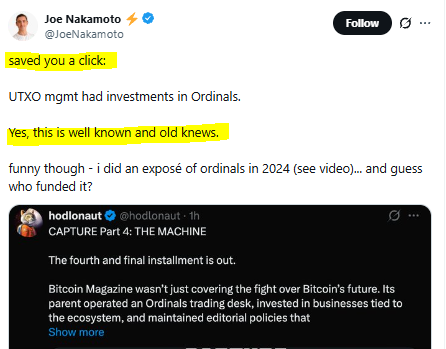
A pattern is emerging in the responses to CAPTURE: The Machine.
Joe Nakamoto: “Saved you a click. Old news.”
Now Jonathan Bier, CEO of Farside Investors, posting as @FarsideInsights: “TLDR. Already widely publicised.”
Same straw man. Same dismissal. Reduce an investigation to one already-public fact, then declare the entire thing old news.
But that's precisely the point of CAPTURE. The individual facts were often public. What matters is the picture that emerges when you put the editorial conflicts, disclosure failures, policy exemptions, financial arrangements, institutional relationships, and timelines together.
Break that picture back into isolated facts, and each becomes easier to dismiss.
Worth noting: Bier sits on Brink's board, administers Bitcoin developer grants, and personally answered questions for the CAPTURE investigation about Brink's internal governance.
He's not an outside observer of the institutional structures this series examines.
Don't trust. Verify.
“Saved you a click.”
What a remarkable phrase from someone in Bitcoin.
Joe just:
Reduced a documented investigation to one somewhat familiar fact.
Pretended it's the entire investigation.
Declared it old news.
Told people not to bother reading.
Don't examine the evidence. Don't follow the sources. Don't verify the claims.
Just trust an influencer's summary.
Quite the evolution from “don't trust, verify.”
CAPTURE Part 4: THE MACHINE
The fourth and final installment is out.
Bitcoin Magazine wasn’t just covering the fight over Bitcoin’s future. Its parent operated an Ordinals trading desk, invested in businesses tied to the ecosystem, and maintained editorial policies that exempted parts of that same business.
Then came an $80,000/month marketing contract, with an option for Nakamoto Inc. to buy BTC Inc at a valuation tied to its earnings, in a window that included the OP_RETURN fight. Nakamoto exercised the option.
Readers were not consistently told about these commercial relationships.
A documented investigation into the commercial interests and media infrastructure surrounding the Bitcoin Core controversy.
https://t.co/yJ7vBoYoVf
hodlonaut's CAPTURE series is investigative journalism at its best, and the latest piece shows why it matters. In June 2025, Bitcoin Core merged a change lifting the default limit on OP_RETURN data over sustained objection from many node operators. A major Bitcoin publication covered that fight while its parent company's fund held stakes in businesses the change favored. The parent was also under a contract that tied its sale price to its earnings from those months and barred it from discussing the relationship with the press. The publication's disclosure page promised quarterly updates. The last one is dated March 2024.
Almost all of it was on the public record. Readers just never had it in front of them, and it took four articles to put it in one place, because nothing in the structure asks anyone to.
What he documents in practice, I have been documenting structurally at https://t.co/F536OjCpAz. Bitcoin's development runs through a handful of merge keys on one implementation, with no independent specification of its rules. Its funding is concentrated in a small number of funders. There are no binding rules for conflicts of interest and no consequence when one goes undisclosed. A record nobody is obligated to act on protects nobody, so outsiders end up catching each conflict by hand, after the fact, one at a time. His series shows what a single round of that costs.
None of this requires bad people, and these are not bad people. Good people inside that structure will keep producing what his series records.
Bitcoin Commons (@BtcCommons) goes past research and documentation. It is a full stack built to replace that structure, and it is not a toy node or a technical curiosity. The node is built from the Orange Paper, a formal specification of consensus that no single codebase owns. On funding, we are building @joinplebly, which is designed to open development funding to the people who run and depend on the software, so a few large donors are not deciding what gets built. A new coordination model for the codebase commons keeps power visible and accountable to the people who depend on it. And @DecodeBitcoin, an AI review layer built on seventeen years of Bitcoin's development record, acts as a neutral arbiter that judges every change on its merits and keeps getting sharper on Bitcoin over time.
Each piece targets a specific failure, the ones I have mapped in the structure and the ones hodlonaut keeps finding in practice. Bitcoin will always have stewards. Commons is built so they answer to the people running the network.
Coldcard trying to dunk on Ledger for a third party hack is a BOLD move.
I can’t wait to see Coinkite and NVK both sued into oblivion. What an absolute disgrace.
@barkmeta No. No. We don't know what that means.
YOU don't know what that means.
Nobody knows what it means, and nobody is going to buy your worthless course.