If you want your OpenClaw or Hermes Agent to be able to have perfect total recall of all 10,000+ markdown files, GBrain is here to help.
It's exactly my OpenClaw/Hermes Agent setup. MIT-licensed open source. Hope it helps you build your mini-AGI.
https://t.co/yFpFU4pn5b
I'm Boris and I created Claude Code. Lots of people have asked how I use Claude Code, so I wanted to show off my setup a bit.
My setup might be surprisingly vanilla! Claude Code works great out of the box, so I personally don't customize it much. There is no one correct way to use Claude Code: we intentionally build it in a way that you can use it, customize it, and hack it however you like. Each person on the Claude Code team uses it very differently.
So, here goes.
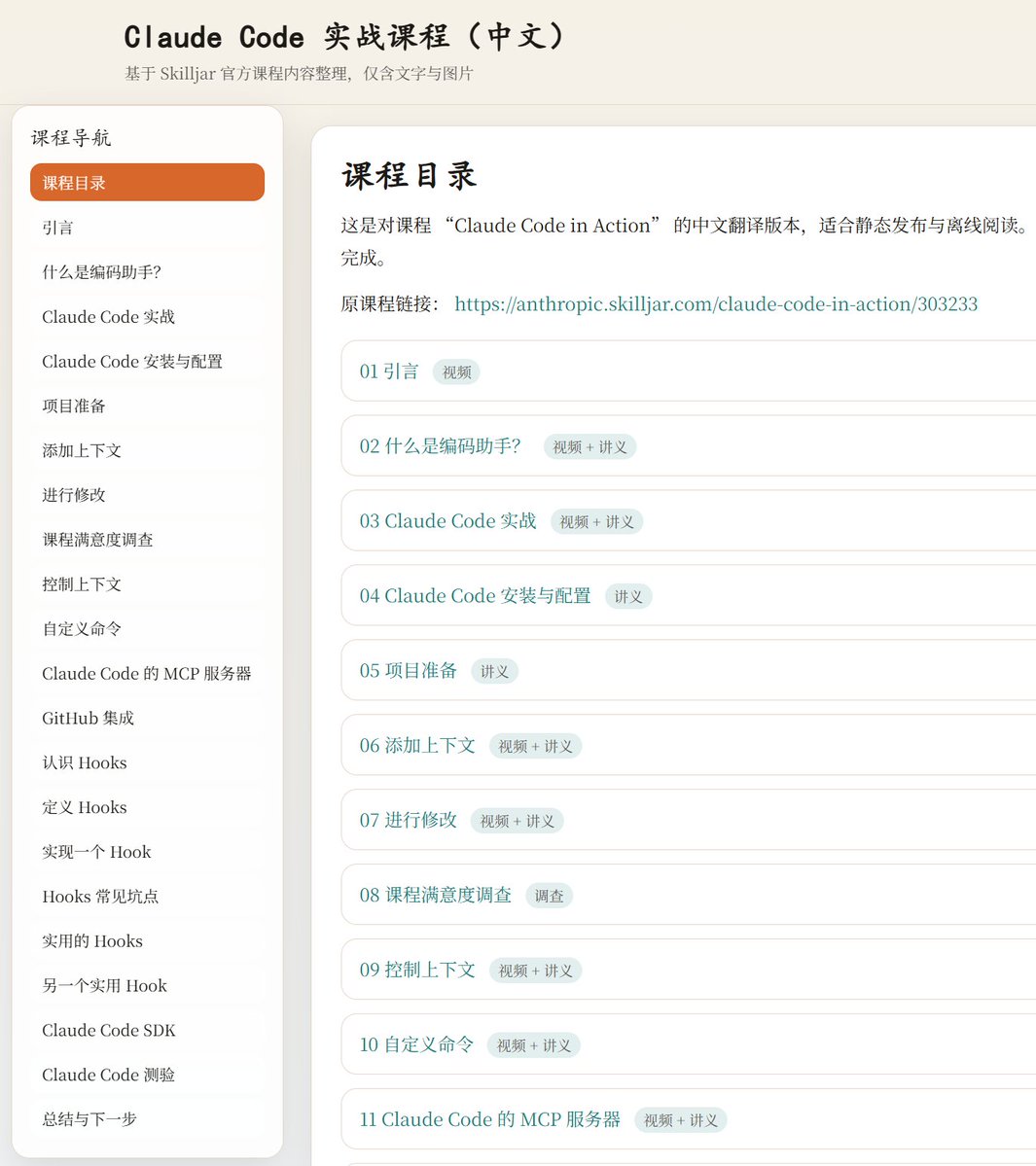
I'm thrilled to announce the definitive course on Claude Code, created with @AnthropicAI and taught by Elie Schoppik @eschoppik. If you want to use highly agentic coding - where AI works autonomously for many minutes or longer, not just completing code snippets - this is it.
Claude Code has been a game-changer for many developers (including me!), but there's real depth to using it well. This comprehensive course covers everything from fundamentals to advanced patterns.
After this short course, you'll be able to:
- Orchestrate multiple Claude subagents to work on different parts of your codebase simultaneously
- Tag Claude in GitHub issues and have it autonomously create, review, and merge pull requests
- Transform messy Jupyter notebooks into clean, production-ready dashboards
- Use MCP tools like Playwright so Claude can see what's wrong with your UI and fix it autonomously
Whether you're new to Claude Code or already using it, you'll discover powerful capabilities that can fundamentally change how you build software.
I'm very excited about what agentic coding lets everyone now do. Please take this course!
https://t.co/HGM8ArDalK
How long have you been "planning to understand" how modern LLM inference works?
We just gave you a readable version of SGLang you can finish over the weekend.
Introducing mini-SGLang ⚡
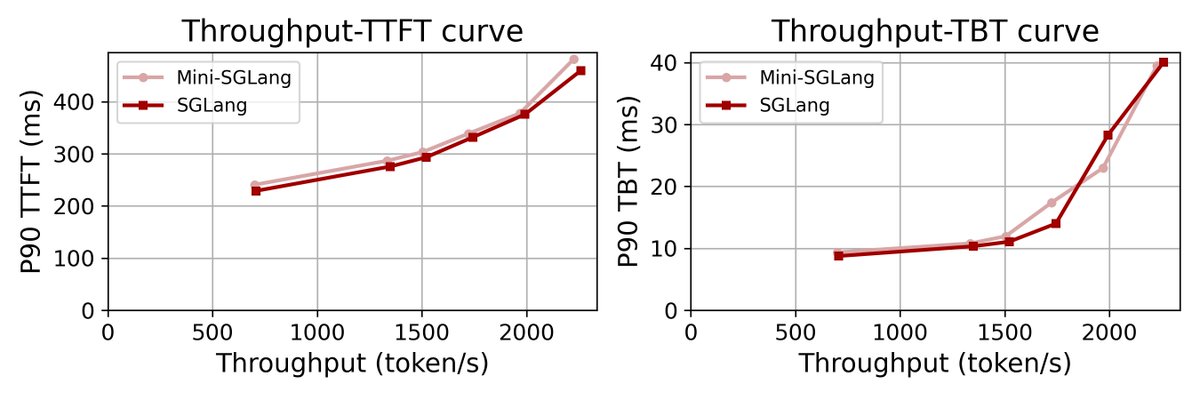
We distilled SGLang from 300K into 5,000 lines. Kept the core design, cut the complexity. Without sacrificing performance — nearly identical to SGLang online.
It is built for engineers, researchers, and students who want to see how inference really works and learn better from code than papers.
⭐ Star us on GitHub: https://t.co/Nk5NCXXdTz
🧵 (1/3)
What you'll learn:
1. Overlap Scheduling
2. FlashAttention-3 + FlashInfer kernels
3. Radix Cache & Chunked Prefill
4. Tensor Parallelism
5. JIT CUDA kernels
6. OpenAI-compatible API
We included the building blocks and implementation details we learned from building SGLang.
📖 Read the technical blog for more details: https://t.co/EV5Qs0yeez
🧵 (2/3)
Join us for Day 2 of AI Dev Days!
We’re covering Agent HQ, VS Code, Visual Studio 2026, GitHub Copilot Coding Agent, and app modernization—plus highlights from Microsoft Ignite & GitHub Universe, and a hands-on AI dev tools lab. https://t.co/vrLyUa1bs5
Nvidia CEO Jensen Huang on Elon Musk and @xAI
“Never been done before – xAI did in 19 days what everyone else needs one year to accomplish.
That is superhuman – There's only one person in the world who could do that – Elon Musk is singular in his understanding of engineering.”
We're excited to release OME, which is a Kubernetes operator for enterprise-grade management and serving of Large Language Models (LLMs). It optimizes the deployment and operation of LLMs by automating model management, intelligent runtime selection, efficient resource utilization, and sophisticated deployment patterns. such as PD Disaggregated, Multi-Node Serving, Single Node Serving, and much more, OME is deeply integrated with frontier SGLang Serving technologies, such as cache awareness load balancing, DeepEP, and much more.
New on the Anthropic Engineering blog: how we built Claude’s research capabilities using multiple agents working in parallel.
We share what worked, what didn't, and the engineering challenges along the way.
https://t.co/k3Gzd4HkLg
TL;DR: we are excited to release a powerful new open-weight language model with reasoning in the coming months, and we want to talk to devs about how to make it maximally useful: https://t.co/nZ5JQ19CN6
we are excited to make this a very, very good model!
__
we are planning to release our first open-weigh language model since GPT-2.
we’ve been thinking about this for a long time but other priorities took precedence. now it feels important to do.
before release, we will evaluate this model according out our preparedness framework, like we would for any other model. and we will do extra work given that we know this model will be modified post-release.
we still have some decisions to make, so we are hosting developer events to gather feedback and later play with early prototypes. we’ll start in SF in a couple of weeks followed by sessions in europe and APAC. if you are interested in joining, please sign up at the link above.
we’re excited to see what developers build and how large companies and governments use it where they prefer to run a model themselves.
New Anthropic research: Tracing the thoughts of a large language model.
We built a "microscope" to inspect what happens inside AI models and use it to understand Claude’s (often complex and surprising) internal mechanisms.
We’re excited to introduce our newest state-of-the-art model: Command A!
Command A provides enterprises maximum performance across agentic tasks with minimal compute requirements.
Join us here for an AMA after the livestream! From 10:30–11:30 AM PT, the team behind today’s ships will answer your questions.
Reply below with your questions.
I just shared a new article, "The State of Reasoning Models", where I am exploring 12 new research articles on improving the reasoning capabilities of LLMs (all published after the release of DeepSeek R1): https://t.co/1YNqfKFSn7
1. S1: Simple test-time scaling
2. Test-Time Preference Optimization
3. Thoughts Are All Over the Place
4. Trading Inference-Time Compute for Adversarial Robustness
5. Chain-of-Associated-Thoughts
6. Step Back to Leap Forward
7. Scaling up Test-Time Compute with Latent Reasoning
8. Can a 1B LLM Surpass a 405B LLM?
9. Inference-Time Computations for LLM Reasoning and Planning
10. Inner Thinking Transformer
11. Test Time Scaling for Code Generation
12. Chain of Draft
It's been a very active Q1 2025 on the reasoning model research front for sure!
Happy reading!