“Não gosto de circular a bola apenas por circular. Cada ação precisa acontecer no tempo certo.”
Na filosofia de jogo de Fàbregas, a prioridade do tempo sobre o espaço: não basta ocupar o espaço certo; é preciso reconhecer e aproveitar o momento certo para agir.
Search "youth soccer pyramid" and you'll find the same diagram everywhere: rec at the bottom, the "elite" leagues in the middle, the pros at the top.
It's wrong, and it's costing American players. 🧵
Football as a ball sport?
Not exactly.
The most significant challenge I have as a coach is to break a player’s poor habit of ball fixation.
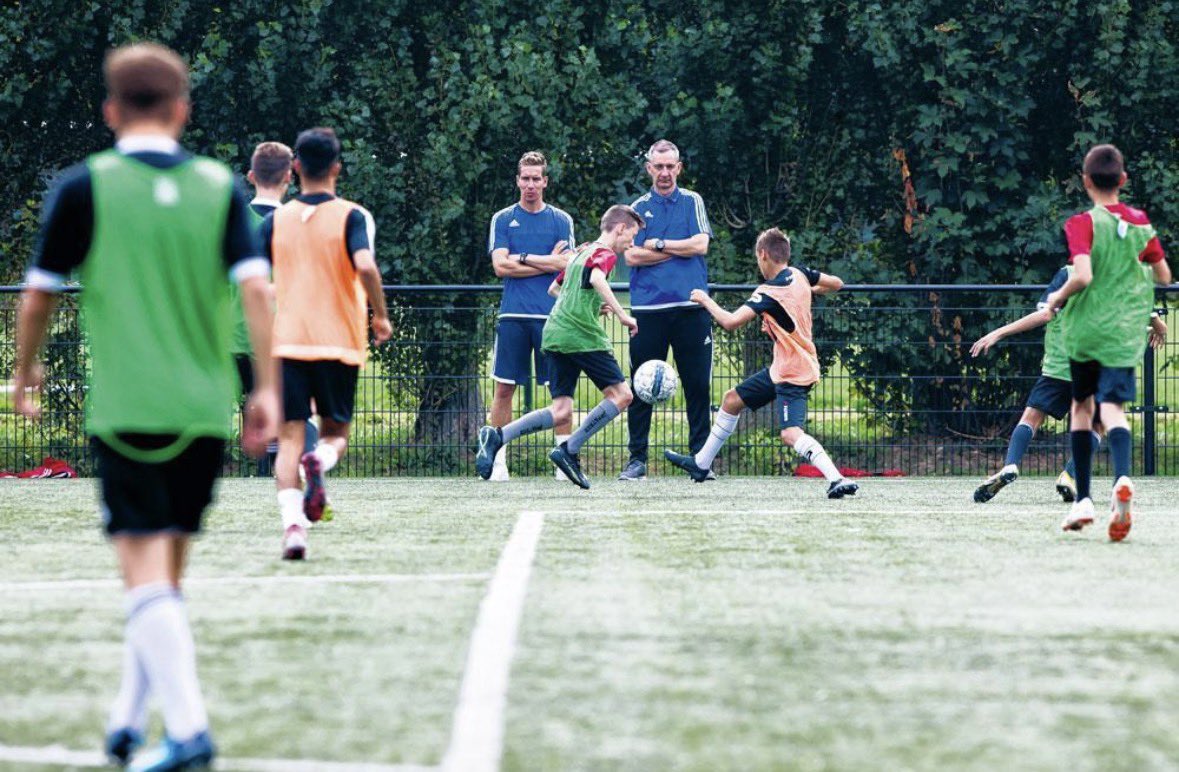
Instead we teach football as a space sport. Where is the space and how can we exploit it with and without the ball?
#TOVO
If you believe that children cannot learn “technical skills” in context (although in fact it is where they learn more profoundly)…
🙏 Please provide the origin of your thinking and any research in the last 75 years that supports your claim.
Let’s look closer, no?
#TOVO
We talk about ‘developing players’, as if coaches, clubs or federations produce development. We can’t. Players develop themselves by perceiving, acting, adapting & learning through experience. Our job isn’t to manufacture talent, but create environments where development emerges.
Sebastian Pocognoli as the new Scotland boss? Yes please.
Did a fantastic job for Tony Bloom at USG, preferring a 3-4-1-2 system
“The game I like to play is a dominant one, with and without the ball. High pressing, counter-pressing, but also real mastery in possession.”
The idea that you need 'elite level', expensive players to play a small-space relational game is strange.
The most prevalent current examples of effective small -space relationism are found *outside* the Top 5 leagues.
If anything, players suited to this style are undervalued.
Javier Aguirre y Julián Quiñones
A veces la mejor respuesta táctica no está en mover a un jugador, sino en entender todo lo que aporta donde está.
La respuesta de Aguirre merece ser escuchada.
True development happens when training mirrors the chaos of the game: split-second decisions, perceptual cues, spatial awareness under fatigue & pressure.
Players who train with high cognitive fidelity see faster, choose smarter, & execute better.
Train like you play.
#TOVO
"Guardiola expressed the same idea from a different angle. “There are two kinds of coaches,” he said, paraphrasing Lillo, “those who begin their attack from their own penalty box and those who begin it when their rivals take their goal kick.” The line is often read as an argument for pressing. It is also an argument about the build-up. If you begin your attack from your own penalty box, you must be able to read the opponent’s shape from the first pass and know, before the ball has crossed the halfway line, which route forward the opponent has made available." - Page 50, 'ball (2026) available from https://t.co/vfNWk4vh3T or Amazon
Hard to accept. (Perhaps the deepest assumption in youth sports to break.)
▪️You do not have to run traditional “skill drills” to develop skills.
Once you realize this, your trainings improve immediately. And your players will have more fun, challenge and growth.
#TOVO
Do you have a methodology?
A training methodology is the overarching philosophy and system that guides how athletes are developed over time.
✔️ It defines the principles, beliefs, and processes behind training.
A methodology answers questions such as:
▪️What is the purpose of training?
▪️How do athletes learn best?
▪️What behaviors are important?
▪️What style of play is desired?
▪️How should coaches teach, communicate & evaluate?
A methodology is therefore the framework for decision-making. It shapes everything from coaching language and session design to feedback, culture, intensity, and long-term player development.
It is less about individual exercises and more about the logic behind them.
In simple terms:
Methodology = the “why” and “how” behind training.
A methodology creates consistency of thinking.
#TOVO
#intelligentfootball
“When a child plays in the street, he learns in a playful environment that favours creativity. Today he plays in an environment that tends to undermine his creativity & the relationships he plays from”- Fernando Diniz