First trailer for ‘THE SOCIAL NETWORK’ sequel, starring Jeremy Strong, Jeremy Allen White and Mikey Madison.
The film follows an engineer who becomes a whistleblower on Facebook's most guarded secrets.
In theaters on October 9.
My biggest takeaways from @benedictevans:
1. We’re in 1997 for AI—it’s as big a deal as the internet or mobile, and only as big a deal as the internet or mobile. We’re at the stage where most stuff kind of doesn’t work yet, most of what people will build hasn’t been built, and it’s not clear how any of it will work when it does. Some people in tech have bought clusters of Mac Minis, while even among 13-to-18-year-olds, only about 15% to 20% are daily active users of AI. The companies that win may not exist yet, and the use cases that matter most are probably invisible to us today.
2. Every technology wave brings ways to ruin people’s lives, deliberately or by accident, and we need to be conscious of that without panicking. Every wave of technology—databases in the 1970s, social media in the 2010s, AI today—creates new ways to harm people. We need to be conscious of these risks, build safeguards, and hold people accountable. But we also can’t let fear of potential harms stop us from capturing the benefits. The goal is thoughtful deployment, not paralysis.
3. Things will probably be okay—but “on average” hides a lot of individual pain. We’ve been automating jobs and creating new jobs since 1800. Each time, you can see the jobs that will disappear but not the new jobs, because they don’t exist yet. We go through frictional pain, dislocation, people lose jobs, towns get hollowed out, and it all sucks. But we come through richer, and we’re not worried about crops failing anymore.
4. If you’re worried about your job, the worst thing you can do is stick your head in the sand and declare AI evil. Yes, some professions face major questions, particularly if you’re an associate or would have been thinking about becoming one. The pyramid structure of professional services may fundamentally change. What helps is submerging yourself in AI, understanding what you can do with it, how it changes things, and how you can be a great hire in this new environment. That may still not be enough, but it’s the only path forward.
5. The history of accounting shows us how automation often increases employment rather than decreasing it. Despite adding machines, punch cards, mainframes, databases, ERP systems, cloud software, spreadsheets, and PCs, the number of accountants keeps going up. This is the Jevons paradox: when you make something cheaper or easier, you don’t do the same amount of work for less money. You often do vastly more because the ROI changes.
6. Distribution is becoming a more valuable moat as software gets easier to build, which favors incumbents. As AI makes building software cheaper and faster, the market gets noisier. More products launch, more companies compete for attention, and breaking through becomes harder. This means distribution—the ability to reach customers and get them to use your product—matters more than ever.
7. Foundation AI model companies won’t have lasting pricing power, and value will likely accrue up the stack. The models don’t seem to have network effects, so there’s no winner-takes-all dynamic. If you have indefinite competition between three to six foundation model providers, and the models look like undifferentiated commodities to users, why would anyone have pricing power? The current pricing chaos—people spending $1.5 million on inference in a month—is temporary disequilibrium, like someone getting a $50,000 mobile data bill in 2010. The steady state will look different.
8. OpenAI and Anthropic are buying consultancies and PE firms. This seems counterintuitive—aren’t these the companies that should need consultants least? But the reality is that companies don’t have people sitting around waiting to reimagine all their internal workflows and figure out which could be automated with AI. That’s a project requiring five to 10 people spending months working it out, then actually implementing it across vertical and horizontal systems.
9. The fundamental question isn’t whether AI automates your job—it’s whether your profession is a "task" or a job. Some jobs are just tasks, and when you automate the task, the job disappears (i.e. elevator attendants). But in most professions, the task you think you’re being paid for isn’t actually what you’re being paid for. McKinsey doesn’t get hired to produce a 75-slide deck—they get hired to walk through your enterprise, understand the politics, talk to customers, and figure out what you actually need to do. The deck is just the artifact.
10. The anti-AI backlash is real, and a fuzzy mass of different concerns, some real and some not—much like the social media backlash. There are tangible concerns: electricity bills went up in some places, though this applies to very few locations objectively. The water consumption issue is largely false; data centers use about 0.017% of U.S. water consumption. There are real questions about jobs, though economists can’t yet find clear consensus in the data about AI’s employment impact. There’s also the culture war over AI-generated content and “AI slop.” The challenge is that all of this creates political pressure even when the underlying facts are unclear or contested.
Personal update: I've joined Anthropic. I think the next few years at the frontier of LLMs will be especially formative. I am very excited to join the team here and get back to R&D. I remain deeply passionate about education and plan to resume my work on it in time.
The collaborative music video from Swedish rapper Yung Lean and GENER8ION transcends the boundaries of a regular music video — it’s an extraordinary visual feast. The choreography was created by the legendary French choreographer Damien Jalet.
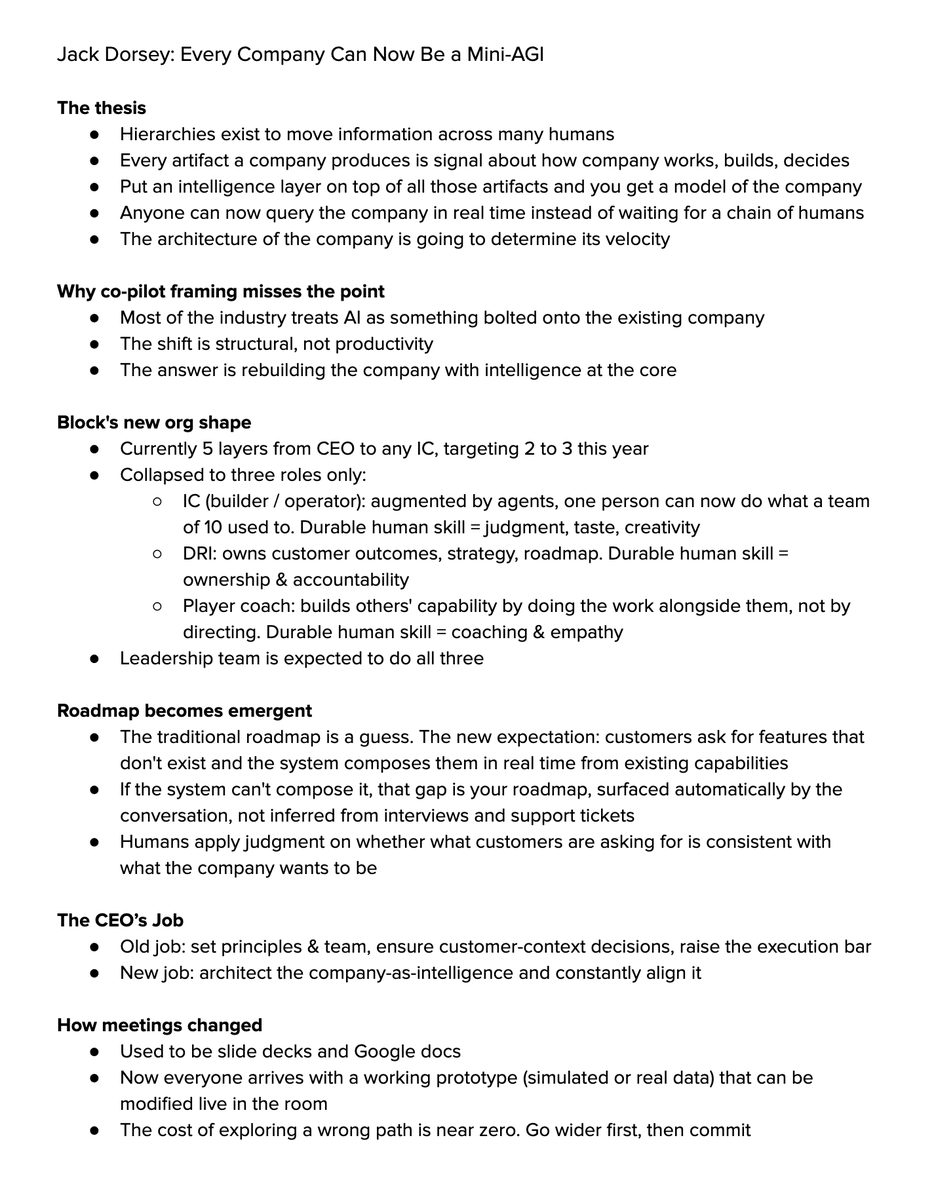
The more enterprises I talk to about AI agent transformation, the more it’s clear that there is going to be a new type of role in most enterprises going forward. The job is to be the agent deployer and manager in teams. Here’s the rough JD:
This person will need to figure out what are the highest leverage set of workflows on a team are (either existing or new ones) where agents can actually drive significantly more value for the team and company.
In general, it’s going to be in areas where if you threw compute (in the form of agents) at a task you could either execute it 100X faster or do it 100X more times than before. Examples would be processing orders of magnitude more leads to hand them off to reps with extra customer signal, automating a contracting review and intake process, streamlining a client onboarding process to reduce as many straps as possible, setting up knowledge bases than the whole company taps into, and so on.
This person’s job is to figure out what the future state workflow needs to look like to drive this new form of automation, and how to connect up the various existing or new systems in such a way that this can be fulfilled. The gnarly part of the work is mapping structured and unstructured data flows, figuring out the ideal workflow, getting the agent the context it needs to do the work properly, figuring out where the human interfaces with the agent and at what steps, manages evals and reviews after any major model or data change, and runs and manages the agents on an ongoing basis tracking KPIs, and so on.
The person must be good at mapping the process and understanding where the value could be unlocked and be relatively technical, and has full autonomy to connect up business systems and drive automation. This means they’re comfortable with skills, MCP, CLIs, and so on, and the company believes it’s safe for them to do so. But also great operationally and at business.
It may be an existing person repositioned, or a totally net new person in the company. There will likely need to be one or more of these people on every team, so it’s not a centralized role per se. It may rile up into IT or an AI team, or live in the function and just have checkpoints with a central function.
This would also be a fantastic job for next gen hires who are leaning into AI, and are technical, to be able to go into. And for anyone concerned about engineers in the future, this will be an obvious area for these skills as well.
Tiger Global just valued a bagel shop at $300 million. And the math actually makes sense if you stare at it long enough.
PopUp Bagels started in 2020 out of a kitchen in Westport, Connecticut. Adam Goldberg was baking bagels for neighbors during the pandemic. Five years later, Tiger Global closed a deal in late March that values the company at 5x what it was worth five months ago.
The unit economics are what caught Tiger's attention. Average transaction over $24. Five bagel varieties. Three schmears. 55 total SKUs while competitors run 200-300. Stores are 1,000-1,200 square feet. Each location hires 10-15 employees instead of the 50-60 a typical QSR needs. No ice machines. No soda fountains. No fryers.
They don't sell individual bagels. You buy packs of three, six, or twelve. You grip, rip, and dip. That constraint does two things simultaneously: it raises average order value above the threshold where a small-format store prints money, and it creates a ritual that photographs well. Every customer becomes a content creator.
The franchise math: $330K-$810K to open, $35K franchise fee, 6% royalty. They've signed 300 franchise units with fewer than 15 operators. That's roughly 20 stores per operator. Experienced multi-unit franchisees running large territories, not first-timers buying a single shop. About 30 locations open now, targeting 100 by end of 2027.
Celebrity investors include Paul Rudd, JJ Watt, Michael Phelps, Michael Strahan. Stripes bought a majority stake in 2023 and brought in a real CEO, Tory Bartlett, in late 2024. Adam Sandler has a dedicated phone at one of the New York shops to call in orders. They literally call it "the Sandler Phone."
Here's what Tiger Global sees. The same firm that backed Meta, invested in OpenAI and Waymo, has been exiting 85+ companies from its most recent fund to concentrate on fewer, higher-conviction bets. They looked at a bagel company and decided it belonged in that concentrated portfolio.
The $300 million number only works if you believe 300 franchise locations actually open and hit the projected unit economics. At an estimated $6M revenue per location and 18% margins, 100 operating stores would generate roughly $108M in systemwide profit. At 300, you're approaching the kind of numbers that make $300M look cheap.
The real question is whether the hype survives national scale. PopUp Bagels built its brand on scarcity, long lines, and social media energy. Every franchise system in history has faced the tension between exclusivity and expansion. Levain Bakery, funded by the same firm Stripes, is the closest comparable, and it stayed small.
Tiger's betting the ritual travels. That the 1,100 square foot format, the five-SKU simplicity, and the $24 average ticket create something that works in Tampa the same way it works in Greenwich Village.
If they're right, this is the most capital-efficient restaurant concept of the decade. If they're wrong, it's a $300 million lesson in the difference between a brand and a business.
this is one of those stories that sounds fake but is inspirational
teenagers frustrated with calorie tracking build cal ai, use chatgpt to teach them code, lean into viral short-form content instead of fundraising, grow to ~15m downloads and $30m+ in revenue, and sell to MyFitnessPal while one of them is still in school
this story breaks brains because it goes against the script you were handed: get credentials, raise capital, move to silicon valley, wait your turn
- ai removes the skill excuse
- the internet removes the geography excuse
- distribution replaces the funding round
the onus shifts back to the individual
please don't wait
this is the best window in history to ship your ideas, learn in public, and keep the upside