Congratulations to the AACR Trailblazer Cancer Research Grants recipients, supported by @pfizer. AACR’s largest-ever grant program has awarded 15 early-stage and mid-career investigators $1million each to establish novel, highly creative research projects. https://t.co/dXsYggjXmw
Landing pad insertion + recombinase mediated integration is an exciting area! A major difference is the presence of residual scar sequences post integration when using recombinases, as opposed to usually "scarless" HDR mediated integrations. PRIME posted that poster last fall, would be great if they could share more details!
The size of new DNA sequences that can be integrated into the human genome is a foundational constraint for engineering and enhancing human cells. In a new collaborative study, we’ve now almost doubled the maximum size of DNA sequences that can be efficiently inserted into primary human cells.
https://t.co/9Dho2VDbEo
We hope GLIDE-editing may be of use for research and clinical applications requiring integration of ever larger, more powerful DNA sequences into the human genome. None of this is possible without the support of our funders, @theNCI, @NIH New Innovator Award, @arcinstitute, @parkerici, @BWFUND, the Weill Foundation, and the Cancer League (11/11)
This has been a long running collaborative effort, run by exceptional future PhD students Courtney Kernick and Lauren Chow, and an entire team between Brian Shy’s and Greg Allen’s Labs at @UCSF and @GladstoneInst and our group @Stanford and @arcinstitute (10/11)
6/6 Thanks to everyone who helped out with this project, particularly @Roth_Lab, @Satpathology, @satijalab, and John Blair as well as everyone who has helped run big Perturb-seq experiments and make them publicly accessible. There’s more in the preprint
https://t.co/7TVtetp4wy
@AustinMHartman Rapid and huge effort from Austin, see his writeup for more details, and our collaborators, @Satpathology and @satijalab.
https://t.co/pnbkhW4Ix4
6/6 Thanks to everyone who helped out with this project, particularly @Roth_Lab, @Satpathology, @satijalab, and John Blair as well as everyone who has helped run big Perturb-seq experiments and make them publicly accessible. There’s more in the preprint
https://t.co/7TVtetp4wy
Genome wide perturb seq creates powerful perturbations x transcripts datasets. This unveils new biology - but also reveals new off-target effects. New work from @AustinMHartman, a massively talented PhD student in our lab, systematically identifies seed driven off-target effects in genome-wide perturb seq exps. (1 of 3) https://t.co/6kg7cJjCQr
Our systematic analysis uncovered known off-targets in previous genome-wide perturb seq exps, as well as strongly suggests some proposed new pathway members, such as within TCR signaling, are driven by seed-driven off-target binding of known regulators rather than new biology. (2 of 3)
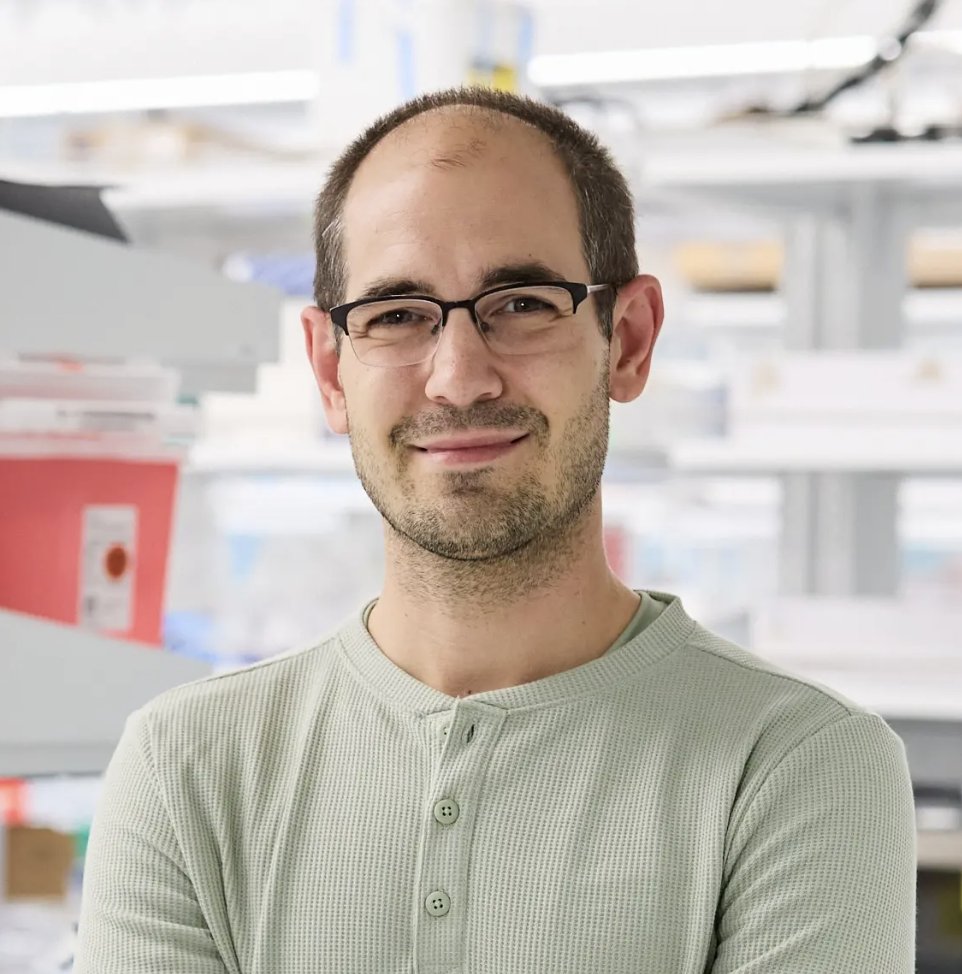
Congratulations to Arc Innovation Investigator Theo Roth (@Roth_Lab) on receiving a 2026 @MichelsonMedRF Next Generation Grant.
Theo's team is using combinatorial genetic engineering to create immune cell states not found in nature.
https://t.co/S6lCh5zJPa
Excited to present the first major work after starting our lab at Stanford and the Arc this year: CRISPR-All, a unified genetic perturbation language for programming any major type of genetic perturbation simultaneously, in any combination, at genome scale, in human cells.