Hey @kunalb11 maybe the amount of credit required to burn for a mask in @CRED_club can be reduced, so that people can contribute more. 15000 for one mask is way too much.
WARNING
Massive AI hype being built in a sudden burst
(and most of it fake)
1) A scary article: I was surprised to read a long article on Twitter (X) claiming it's just 6-12 months before a Covid-like event changes this world. It claims this will be the AI-event, where most white-collar jobs worldwide would be gone, because AI is that good now. That article got 100 M plus views. Clearly, people are spooked (naturally). So the psy-op has worked.
(and I saw other similar dark articles too)
2) Suddenly many influencers are pushing the same narrative, and it so turns out that media reported many are being paid heavy sums by AI firms to push their story (that AI singularity is arriving). But if AI is "revolutionary", does it need an influencer push? No. This should be a clear signal it's hyped.
3) A correction in IT stocks' and SaaS stock's prices is suddenly creating a doom scenario about these companies dying any moment now, with second- and third-order effects on entire economy. Stock investors who haven't studied AI technicals are automatically assuming it's all over, dead, gone, finished. WRONG. NO.
4) What is the truth, and what's most likely to happen?
In my opinion, based on years of observing AI trends, reading and learning AI technology, and doing AI at various levels, my take is as follows. I urge you to read this, and preserve your sanity. Please don't panic, nothing catastrophic is happening anytime soon.
A) IPO pressure: AI firms are going crazy pushing their God-narrative, as many giant IPOs are lined up soon. They need public to buy their paid subscriptions or else the story goes kaput. So they are creating a false hype. It's shameful, anti-social and deeply hurtful.
(Almost all AI firms released doom-scenarios just before their next funding rounds; investors who haven't learnt technology fall for it; pure FOMO. This playbook is so repetitive it's comical)
B) OpenAI is spooked: Sam Altman has lost the lead he temporarily managed to build against Google and others, and now his loss-making enterprise isn't the darling of any investor any more. He's terrified.
C) Elon Musk's Grok does not have the traction in consumer space anyway near what's needed to make it a profit-making entity. So with many other capex-heavy AI firms. But the GPU / TPU hungry AI ops need more capex each day, not less. It's a dead-end for most except cash rich Googles.
D) Enterprise AI is patchy, lagging, slow, choppy: Anyone who has ever built a company, or run a large department, or consulted a business enterprise knows how random, undefined, tacit, and unstructured most of the real world work actually is. No way is AI ever going to replace humans doing those very complex things on a daily basis. No way. Not tomorrow, not in 10 years. NO.
(I am not even beginning to get into 'regulated' industries' needs)
E) Consumer AI is cool, but has limits: The more AI regular humans (of all ages) use, the more the artificiality of it becomes apparent to anyone. The novelty cannot sustain the commercial numbers needed to make AI (foundation models) profitable. OpenAI and Perplexity would never have given free tiers for most Indians otherwise. They desperately need folks to stick to this opium.
F) LLMs aren't solved, Hallucinations aren't zero: The structure of any LLM is such that it will ALWAYS hallucinate, no matter how much fine-tuning humans do. In most sensitive business operations, you cannot allow LLMs to control the core data at all. Can you run an airline with a Generative AI system (LLM-based) that's 98% accurate? Can you run a precision-mfg. operation at 97% accuracy? Can you run a financial services firm with 95% accuracy? NO. NEVER. So the deterministic, old-fashioned computer software ERP will go nowhere. Nowhere at all. LLMs will be good as a top layer on those ERPs to glean insights, nothing more.
[ None can 'train away' hallucinations in a probabilistic LLM model, using larger datasets. You are actually claiming I'll build a dice that lands a 4, or a 6, each time ]
G) Agents aren't magical, humans aren't going anywhere: Multi-step agentic AI is being touted as the final solution where one founder sitting alone can run 100 agents and build an empire. Try doing that once, experience the frequent breakdowns, see the regular edges and new complexities, and you will realize that other than the most mundane of tasks, nothing else will be seamless. Yes, Voice AI agents are good, and many in the developing world are now deploying those, but that's hardly a cutting-edge technology that'll replace all humans.
H) IT and SaaS firms are going nowhere: Ironically, the more AI happens in enterprises, the more will be the need for humans to supervised and orchestrate those bits and pieces of AI, to ensure nothing flies off the rails. The complex software code that Claude and Codex can write only changes the nature of work for the human coders who now have to check the AI code thoroughly for the many edge cases in real world. The nature of IT and SaaS work will change, some companies that can't innovate and adapt will vanish, but many new ones will emerge in their place. (Yes, there'll will be some much-deserved disruption in short-term, and the non-innovating IT firms will have deserved every bit of it)
I) If IT and SaaS are dead, why are AI firms hyping: Ask this simple question - if AI is indeed killing IT and SaaS, then why are AI firms spending massive sums hyping their wares? They need spend nothing and still earn the spoils. But they know the truth.
J) The China angle: Models from China - many of them open-sourced - are getting better and more competitive. Many of them are cheaper, or free (for now). OpenAI complained recently that they are stealing from American models (via "distillation"). Imagine, just imagine - OpenAI that stole entire internet work of creative work is complaining the Chinese are stealing from it. A dacoit crying that thieves broke into his house. Rich. You think these are signs of singularity? Ha! The judicial backlash on stolen content and profiteering off of it hasn't even begun in most jurisdictions.
(now imagine what happens to American LLM-makers when Chinese models gain traction everywhere)
K) Downside of mindless AI already visible: Take just one example: In education everywhere, students, parents and teachers are all realizing that mindless AI use is harming the process of learning, not aiding it. The sensible, guarded and limited way AI should be brought into pedagogy hasn't even been given a proper thought. Students are just doing "cognitive offloading", and turning into non-thinking beings. This is bound to collapse sooner than later. Humans as species don't learn this way - it's a long, tortuous and slow process, always.
L) AI is normal technology: Serious researchers from the AI field have for years argued that AI is being hyped unnecessarily out of proportion, turned into Snake Oil like propositions, and most of AI's predictive powers are anyway not better than that of astrology. AI's ability to talk to use like humans has totally stumped normal people, and anthropomorphism has kicked in. Since no ERP talked to use like a human would, the computer revolution came about without the singularity fears.
M) AI in law and judiciary: The impact will be on the grunt work. It will be cut down substantially. But no judge will outsource their cognition to AI, now will any lawyer. The fact that an LLM can read a complex document fast and summarise it means nothing if it hallucinates. And LLMs will forever hallucinate; that's their structure. (so you'll need humans to sign off on LLM outputs)
N) Enterprise AI's lessons: Every company that has mindlessly gone in on AI has learnt that employees just stopped using it if it didn't adapt to the existing workflows. AI cannot magically alter anything: it can speed things up (with hallucinations), it can generate beautiful stuff (needed or not) and it can help save some time, but the company-to-company needs are so different, it cannot be force-fit on all in one shot. (that is what foundation LLM firms are trying to do). Remember: Enterprise work is not just code. It’s messy data, old legacy systems, compliance needs, multiple integrations, business context, human complexities, and more. Services firms are going nowhere.
O) AI has no solutions for the human situation: Fertility rates everywhere are dropping. Humans are being converted into permanently marketable selves. Consumption comfort has made us soft, and our morality is totally adrift. AI doesn't solve any of this, it just force-multiplies most of it. We built it. It reflects what we are.
5) So what should you do?
a) Read up on AI. Its technical side. How LLMs are created. What they just cannot do. What they can. Why they aren't superhuman at all. Why AI is a good but normal set of technologies.
b) Think why regulated industries (at least 25) cannot hand over their future to AI, LLMs, and GenAI.
c) Check the history of Indian IT and how it kept rebooting itself to suit a new era (from Y2K, to outsourcing, to SaaS backend support, to much more).
d) Check how human societies eventually revolt when artificiality starts overpowering natural human interactions.
e) Be prepared for more hype and nonsense. Sadly, the AI firms won't stop at it at all. They need more humans to subscribe to their paid tiers, and fear seems to be the chosen weapon. Tragic.
[I am subscribed to more than 10 such paid AI tools currently, and know exactly what's good and what's not, and why no singularity is arriving]
f) Adapt your work, and bits of it, to AI tools that can adjust to the workflow well. Let your discretion be supreme.
g) If AI is the shiny new tap, IT is the plumbing behind it.
Remember:
Elon Musk's predictions have mostly gone wrong
Geoffrey Hinton's predictions have gone wrong
Mustafa Suleyman's predictions have gone bust
Yet they keep predicting.
Sad part:
We are living in an age of bullshit. And LLMs are excellent bullshitting machines. The reason the AI Bros are continuing doing so is no one is holding them accountable for their nonstop lies.
But what about AGI:
If AGI is ever built, it won't be by any one company. The technology diffuses rapidly each day. So multiple AGIs in multiple hands. Goes without saying governments will capture (claim) that technology almost immediately. If that day ever arrives, UBI is happening too.
Finally:
Your brain, running on just 20 watts, continues to outthink LLMs fueled by the energy of an entire planet. Never underestimate yourself. And stop falling prey to AI hype.
@IndiGo6E Hey @IndiGo6E the resolution that you have provided over the chat is something that I have already tried, there is no option to apply voucher. Please look into it at the highest priority as its blocking travel plans. @DGCAIndia#Indigoairlines
Hey @IndiGo6E I have an indigo voucher and I’m unable to use it, as on the payments page there is no option available to pay via voucher. Please help here, this is after we followed all the steps enlisted by you while booking from the indigo official website.
@DGCAIndia
A few random notes from claude coding quite a bit last few weeks.
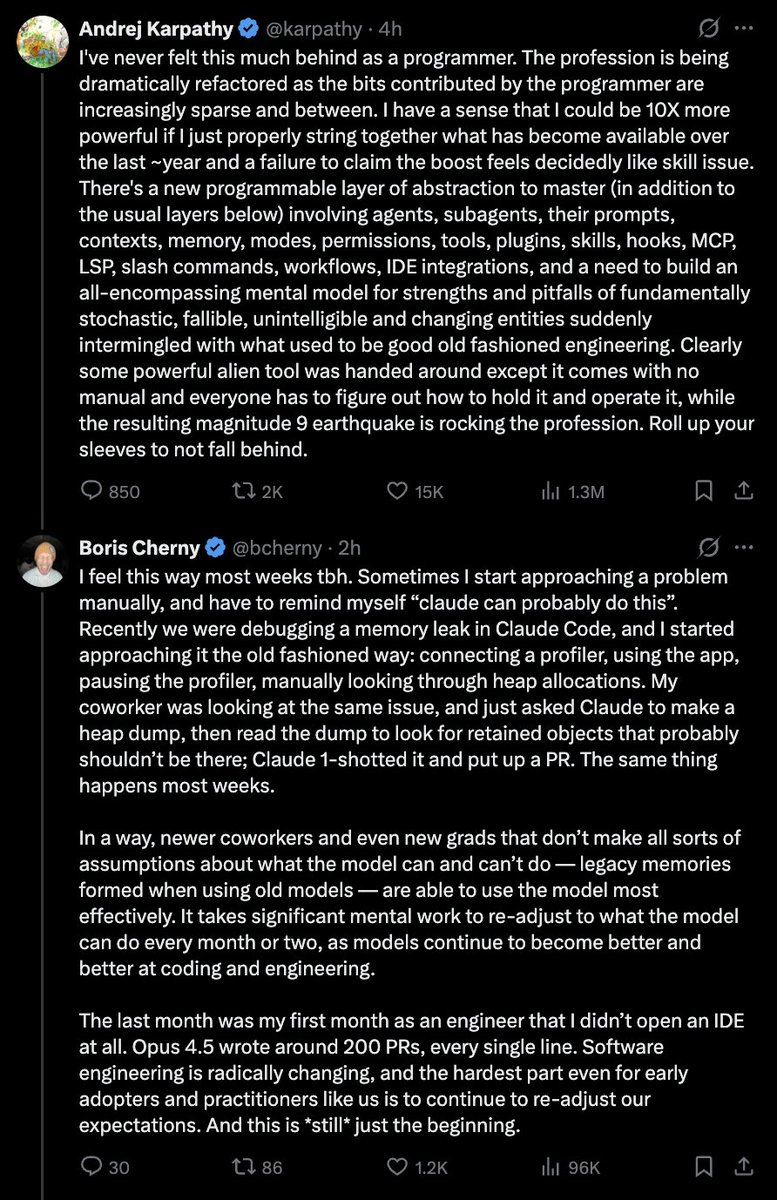
Coding workflow. Given the latest lift in LLM coding capability, like many others I rapidly went from about 80% manual+autocomplete coding and 20% agents in November to 80% agent coding and 20% edits+touchups in December. i.e. I really am mostly programming in English now, a bit sheepishly telling the LLM what code to write... in words. It hurts the ego a bit but the power to operate over software in large "code actions" is just too net useful, especially once you adapt to it, configure it, learn to use it, and wrap your head around what it can and cannot do. This is easily the biggest change to my basic coding workflow in ~2 decades of programming and it happened over the course of a few weeks. I'd expect something similar to be happening to well into double digit percent of engineers out there, while the awareness of it in the general population feels well into low single digit percent.
IDEs/agent swarms/fallability. Both the "no need for IDE anymore" hype and the "agent swarm" hype is imo too much for right now. The models definitely still make mistakes and if you have any code you actually care about I would watch them like a hawk, in a nice large IDE on the side. The mistakes have changed a lot - they are not simple syntax errors anymore, they are subtle conceptual errors that a slightly sloppy, hasty junior dev might do. The most common category is that the models make wrong assumptions on your behalf and just run along with them without checking. They also don't manage their confusion, they don't seek clarifications, they don't surface inconsistencies, they don't present tradeoffs, they don't push back when they should, and they are still a little too sycophantic. Things get better in plan mode, but there is some need for a lightweight inline plan mode. They also really like to overcomplicate code and APIs, they bloat abstractions, they don't clean up dead code after themselves, etc. They will implement an inefficient, bloated, brittle construction over 1000 lines of code and it's up to you to be like "umm couldn't you just do this instead?" and they will be like "of course!" and immediately cut it down to 100 lines. They still sometimes change/remove comments and code they don't like or don't sufficiently understand as side effects, even if it is orthogonal to the task at hand. All of this happens despite a few simple attempts to fix it via instructions in CLAUDE . md. Despite all these issues, it is still a net huge improvement and it's very difficult to imagine going back to manual coding. TLDR everyone has their developing flow, my current is a small few CC sessions on the left in ghostty windows/tabs and an IDE on the right for viewing the code + manual edits.
Tenacity. It's so interesting to watch an agent relentlessly work at something. They never get tired, they never get demoralized, they just keep going and trying things where a person would have given up long ago to fight another day. It's a "feel the AGI" moment to watch it struggle with something for a long time just to come out victorious 30 minutes later. You realize that stamina is a core bottleneck to work and that with LLMs in hand it has been dramatically increased.
Speedups. It's not clear how to measure the "speedup" of LLM assistance. Certainly I feel net way faster at what I was going to do, but the main effect is that I do a lot more than I was going to do because 1) I can code up all kinds of things that just wouldn't have been worth coding before and 2) I can approach code that I couldn't work on before because of knowledge/skill issue. So certainly it's speedup, but it's possibly a lot more an expansion.
Leverage. LLMs are exceptionally good at looping until they meet specific goals and this is where most of the "feel the AGI" magic is to be found. Don't tell it what to do, give it success criteria and watch it go. Get it to write tests first and then pass them. Put it in the loop with a browser MCP. Write the naive algorithm that is very likely correct first, then ask it to optimize it while preserving correctness. Change your approach from imperative to declarative to get the agents looping longer and gain leverage.
Fun. I didn't anticipate that with agents programming feels *more* fun because a lot of the fill in the blanks drudgery is removed and what remains is the creative part. I also feel less blocked/stuck (which is not fun) and I experience a lot more courage because there's almost always a way to work hand in hand with it to make some positive progress. I have seen the opposite sentiment from other people too; LLM coding will split up engineers based on those who primarily liked coding and those who primarily liked building.
Atrophy. I've already noticed that I am slowly starting to atrophy my ability to write code manually. Generation (writing code) and discrimination (reading code) are different capabilities in the brain. Largely due to all the little mostly syntactic details involved in programming, you can review code just fine even if you struggle to write it.
Slopacolypse. I am bracing for 2026 as the year of the slopacolypse across all of github, substack, arxiv, X/instagram, and generally all digital media. We're also going to see a lot more AI hype productivity theater (is that even possible?), on the side of actual, real improvements.
Questions. A few of the questions on my mind:
- What happens to the "10X engineer" - the ratio of productivity between the mean and the max engineer? It's quite possible that this grows *a lot*.
- Armed with LLMs, do generalists increasingly outperform specialists? LLMs are a lot better at fill in the blanks (the micro) than grand strategy (the macro).
- What does LLM coding feel like in the future? Is it like playing StarCraft? Playing Factorio? Playing music?
- How much of society is bottlenecked by digital knowledge work?
TLDR Where does this leave us? LLM agent capabilities (Claude & Codex especially) have crossed some kind of threshold of coherence around December 2025 and caused a phase shift in software engineering and closely related. The intelligence part suddenly feels quite a bit ahead of all the rest of it - integrations (tools, knowledge), the necessity for new organizational workflows, processes, diffusion more generally. 2026 is going to be a high energy year as the industry metabolizes the new capability.
I have no idea what happened in Kolkata in the Messi event. But I couldn't help thinking that we Indians really do not like sport. We like stars.
What else could explain the millions, and I mean millions of dollars we spend to fly in superstars, when they will not even play a proper match.
I am ok with paying whatever it takes to bring in a top football team to play in India, like Messi did in 2011 or Tata Steel did for a long time in the 80s and 90s.
But getting them to come here just to shake hands and pose for pictures defies all reason. They will sell real estate, take pictures with every sponsor and go back with more money in two days than say the I League used to spend in a year.
I don't blame the organizers for getting into this, its a really profitable business, because the politicians are getting serious free mileage and the sponsor is spending his, or his company's money to fulfil his childhood fantasy. The journalists are overawed just to be there with a generational superstar, lots of folks are spending a reported Rs 10 lacs for a handshake and a photo op and the real estate guys are busy pushing deals.
That's millions of bucks spent on a footballer, whose closest attempt at action would be kicking a few footballs at the crowd or dribbling for a few minutes. Money that is desperately desperately needed elsewhere in actual football. Real camps, matches, ground level sponsorships. Or even to revive a football league.
And then we expect India to be better at sport!
If cricket wants to take its place as a genuinely global sport, it must stop this farcical business of ensuring India and Pakistan are always in the same group.
All are aware that it is a money spinner for the broadcasters, and that all the member countries approve & benefit, but it risks not being taken seriously in comparison to other global sports.
If you did this with Argentina Brazil in football or even USA France in basketball, there would be an uproar.
Take the hit once, and you'll discover that cricket is bigger than just one rivalry, which currently is not even close to being the most riveting rivalry in the sport. And the sport will gain so much more credibility as a truly Olympic sport.
Really proud of the DeepLearningAI team. When Cloudflare went down, our engineers used AI coding to quickly implement a clone of basic Cloudflare capabilities to run our site on. So we came back up long before even major websites!
That India’s balcony people now know more about Mamdani than any Indian chief minister is a natural outcome of the huge cultural surplus America has over us. We are interested in America and America has no interest in us. I don’t want to stretch a metaphor too much but maybe resistance to western culture in the samosa people is a form of cultural tariff.
DNS is perhaps the largest eventually consistent system in the world.
A single request travels through recursive resolvers, root servers, TLDs, and authoritative name servers, with caching at every layer to make it feel instant.
The fact that this happens billions of times a second, across every corner of the globe, with so many independent actors cooperating without a central authority, is wild.
And don't even get me started on how the internet itself works. Packets, literally just light pulses, race across networks and switches to reach the right machines, processes, and threads in milliseconds.
It almost feels magical.
Vector databases are incredibly interesting and will likely see wider adoption in the industry just like how SQL and NoSQL are used today.
it’s a good time to understand how embeddings and vector search work—especially for semantic search and RAG. @milvusio#vectorDB
Your everyday spends deserve extraordinary returns. Introducing @PhonePe X @HDFC_Bank Credit Cards – Ultimo and Uno.
Earn 10% reward points* on UPI payments at ease. Unlock exclusive offers across shopping, dining, travel, and more.
Explore Now: https://t.co/kvAMEXb6t1
Given the escalation of the conflict last week, at PhonePe we initiated active DR drills, with heightened cybersecurity measures on our network firewall. This evening, 100% of our traffic across all our services was being served through a new data center. Unfortunately, the Monday evening peak traffic exposed a network capacity shortfall due to which transactions started failing. We have now rebalanced our traffic across our other sites and are seeing the recovery. Our apologies for this. We assure to take these learnings and further strengthen our systems.
Hey @IndiGo6E facing issues in rescheduling my flight from your website. Its charging me more than my fare difference. Please DM me at the earliest a I need to reschedule at the earliest.
The stark difference between our calm & measured spokespersons like the Foreign Secretary and officers Qureshi and Singh, & the kind of rabble rousing braggadocio from top leaders in the updates from Pakistan tell you the difference between an evolved democracy and a failed state.
Very proud of the way we handled it.