Royal Stuart Society is interested in the Royal House of Stuart, supporting research in Stuart History and upholding monarchy. Events, lectures, commemorations.
#OnThisDay in 1811 Princess Louise Amelie of Baden was born as the daughter of Charles, the future Grand Duke of Baden, and Stéphanie de Beauharnais. On 9 November 1830, she married her first cousin Gustav, Prince of Vasa and they had two children.
She died on 19 July 1854.
Thomas Beauchamp Earl of Warwick, hero of Crecy and Poitiers, founder member of the Order of the Garter and fighting companion of the Black Prince (from his tomb at St Mary’s Church, Warwick).
‘Bee-autiful’ gold pendant from Bronze Age Crete 🐝 ❤️
Minoan jewellery inspired by nature 3,800 years ago!
The ‘Malia Bee Pendant’ is said to represent a pair of bees placing a drop of honey into a honeycomb.
Heraklion Archaeological Museum
#Archaeology
June 4, 1394 – The Death of Mary de Bohun, Mother of Henry V
On June 4, 1394, Mary de Bohun, wife of Henry IV and mother of the future Henry V, died at the age of about 26. Her death occurred at Peterborough while she was giving birth to her sixth child, a daughter who also did not survive.
Born around 1369 or 1370, Mary was the daughter and co-heiress of Humphrey de Bohun, one of England's most powerful nobles. Her marriage to Henry Bolingbroke in 1380 brought him vast estates and strengthened his position among the English nobility. Although Henry would later seize the throne from Richard II and become King Henry IV in 1399, Mary did not live to see her husband crowned.
Mary's most enduring legacy was her children, especially her eldest son, Henry, who would become the celebrated King Henry V and lead England to victory at the Battle of Agincourt. Contemporary accounts describe Mary as pious and devoted, and her early death was a personal tragedy for her family.
She was buried at Leicester Abbey, where her tomb became a place of remembrance. Though she never wore a crown, Mary de Bohun played a crucial role in the founding of the Lancastrian dynasty, as the mother of one of England's most famous medieval kings.
#OTD #OnThisDay #OnThisDate #BritishHistory #EnglishHistory #England #DarkAges #HenryV #History #MiddleAges #EuropeanHistory #historyfacts #HistoricMoment #historywillremember #Medieval
4 June 1738. George III was born in London. He was king of GB from 1769 to 1 January 1801 when he became king of the UK of Great Britain and Ireland until his death in 1820. Unlike his 2 Georgian predecessors he spoke English as his 1st language and never visited Hanover.
@Dr_TheHistories@archeohistories Schönes Märchen das mit der damaligen Realität nichts zu tun hatte ! Es verschweigt zudem den verzweifelten Versuch Wilhelm II. durch Verhandlungen mit dem russischen Zaren den Ausbruch des ersten Weltkrieges zu verhindern. Der Ausbau d Marine war eine Folge brittischer Blockaden
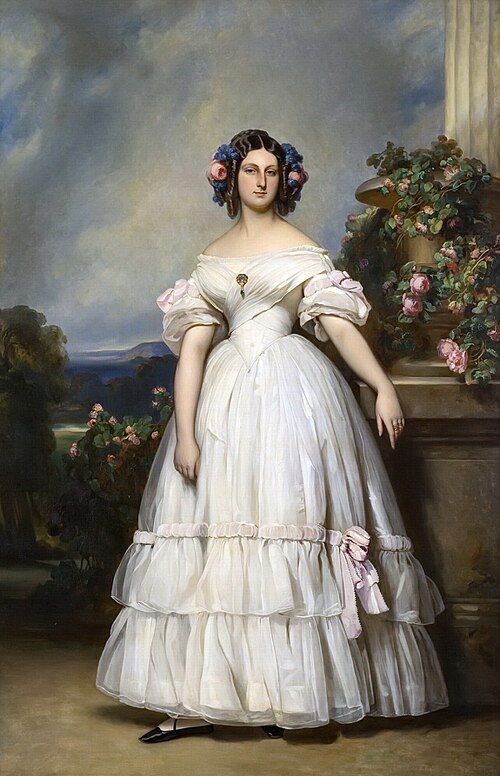
#OnThisDay in 1817 Princess Clémentine of Orléans was born as the daughter of the future Louis-Philippe I, King of the French and Maria Amalia of the Two Sicilies. On 20 April 1843, she married Prince August of Saxe-Coburg and Gotha and they had five children. She died in 1907.
Our very special guests! 🧁☕️
The Queen has hosted a tea party for children supported by Dreams and Wishes, a charity dedicated to helping seriously ill children and their families build precious memories.
🫖🥪 After travelling by horse-drawn carriage from The Royal Mews, the children sat down to sandwiches and cakes with Her Majesty at Clarence House.
The Queen’s Equerry, Major Treasure, also set the children to task with a treasure hunt… leading to the stash of chocolate coins hidden under the Grenadier Guards’ hats! 💂
Dreams and Wishes was established in 2011 and is entirely volunteer-run, with a dedicated team committed to making every child’s wish a reality.
June 3, 1594 – Death of John Aylmer, Bishop of London
On June 3, 1594, John Aylmer, one of the most influential churchmen of the Elizabethan era, died at Fulham Palace, the historic residence of the Bishops of London. He was approximately 73 years old.
Born in 1521, Aylmer was educated at University of Cambridge and became a noted scholar and Protestant reformer during a period of intense religious upheaval in England. During the reign of Queen Mary I, when Protestantism was suppressed, Aylmer fled into exile on the continent. Following the accession of Elizabeth I in 1558, he returned to England and became a leading supporter of the Elizabethan Religious Settlement.
In 1577, Aylmer was appointed Bishop of London, a position he held for the remainder of his life. As bishop, he worked vigorously to enforce conformity within the Church of England, opposing both Roman Catholic recusants and the more radical Puritans who sought further reforms. His tenure reflected the challenges of maintaining religious unity in a kingdom still divided by competing beliefs.
Aylmer was also known for his writings, particularly his defense of female monarchy in response to criticisms of women rulers. His work helped provide intellectual support for Elizabeth I's authority during a crucial period in English history.
His death at Fulham Palace marked the end of a long ecclesiastical career that spanned some of the most turbulent religious transformations of the sixteenth century. He was succeeded by new church leaders who continued to navigate the complex religious landscape of Elizabethan England.
#OTD #OnThisDay #OnThisDate #historyfacts #HistoricMoment #history #HistoricDay #Tudor #BritishHistory #England #Tudors #EuropeanHistory #Medieval #Renaissance #ElizabethI
Venice has its sottoporteghi and Toledo its cobertizos. In Great Yarmouth, the alleys dating from past centuries are called Rows. There are 145 of them. Dove Row is No 119.
The Princess Royal, as Master of The Corporation of Trinity House, on her way to St Olaves Church, today!
What a sweet gesture she did 🥰🥹🫶🏻
🎥 Marks London reels