The TransUnion opinion distinguishes between risk of future harm in class actions seeking injunctive relief and those seeking $. Risk can establish standing in the former, not in latter. Seems like this will affect data breach litigation.
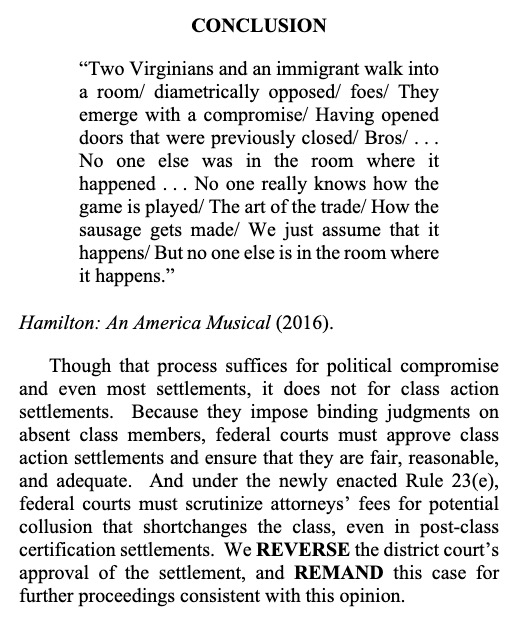
CA9: Bluetooth factors apply to post-certification settlements and fee agreements; Rule 23(e)(2) assumes class settlements are invalid.
https://t.co/0CwAGcQJlB
The Star Wars and Hamilton references are a bit gratuitous, but the puns - since this is a case about food companies and oil labeling - are particularly well done.
I'm sure this is very important but they also granted cert in Goldman Sachs v Arkansas Teachers regarding standards for certifying securities class actions
Not in CA5. Neither party claimed the K was ambiguous and CA5 still required the Court to conduct an “extensive analysis” re variations for extrinsic evid. - n.13 even rejects the use of a standard chart. No reason to think a nationwide class invoking a statute would do better.
3. I wonder if that’s right. If correct, that kind of analysis would seem to make many cases involving boilerplate agreements difficult to bring as class actions. Would a similar class action be more successful under a consumer protection statute?
5th Cir: a defendant does NOT waive its personal juris. (Bristol-Myers) defense w/r/t absent class members by failing to raise it @ outset of case, as absent class members aren’t parties before the court before certification. No ruling on whether B-M actually applies, however.
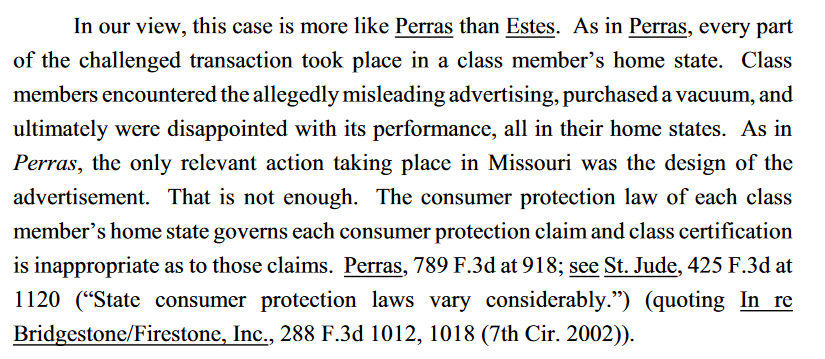
CA8 reverses certification of nationwide class w/ Missouri Merchandising Practices Act claims against MO vacuum company that advertised peak horsepower that could only be achieved in the lab.
https://t.co/WdMHjDzH74
But paid by whom? The American Rule works poorly when fees overwhelm and are paid out of the class's recovery. Percent + lodestar is a viable incentive mainly when the defendant agrees to pay fees separately from the class's recovery.
@NorthwesternLaw@AlisonFrankel@tedfrank@amyekeller asks how you ensure attorneys will continue to stick with class through appeals when their lodestar may outpace what the class could ever hope to gain.
Fitzpatrick: optimal way to compensate contingency fee lawyers is percentage of recovery plus attorneys’ lodestar
Judge Schofield (SDNY) rejects $300,000 agreement between Hausfeld/Scott & Scott and objector represented by John Pentz to drop appeal to Forex Antitrust Litigation.
Is this the first example of the new Rule 23(e)(5)(B) in action, #ComplexLitTwitter? #classactions
Ninth Circuit lets Judge Alsup's standing order barring early settlement talks stand. The judges don't seem to agree with the ban, but Logitech didn't convince them it warrants mandamus relief. https://t.co/xiXt7XoX7S #classactions
This new article by @BYULawSchool's Jarrod Shobe on the unknown-to-many process of statutory codification in the U.S. Congress, forthcoming in the @UCLALawReview, looks fascinating: https://t.co/oVtIsdvVxR
1st Cir. won't hear In re Asacol case again en banc, so its decision limiting certification when class includes uninjured members stands: https://t.co/dwX6HEpj8F #classactions
S.D.N.Y. (Castel) strikes class allegations for lack of numerosity pursuant to rarely invoked Rule 23(d)(1)(D), the classy practitioner's alternative to Rule 12(f). #classactions
Very big deal. The post-distribution accounting requirement is going to generate valuable information for academics and should strongly align counsel's interests with the class. #classactions
The Northern District of California’s just-released “procedural guidance” for class actions is a must-read. Among other things of note: new provisions requiring a public accounting of how settlement funds and attorneys fees are distributed on NDCA website. https://t.co/cVFfZcSPxH