Presented at #ASCO26:
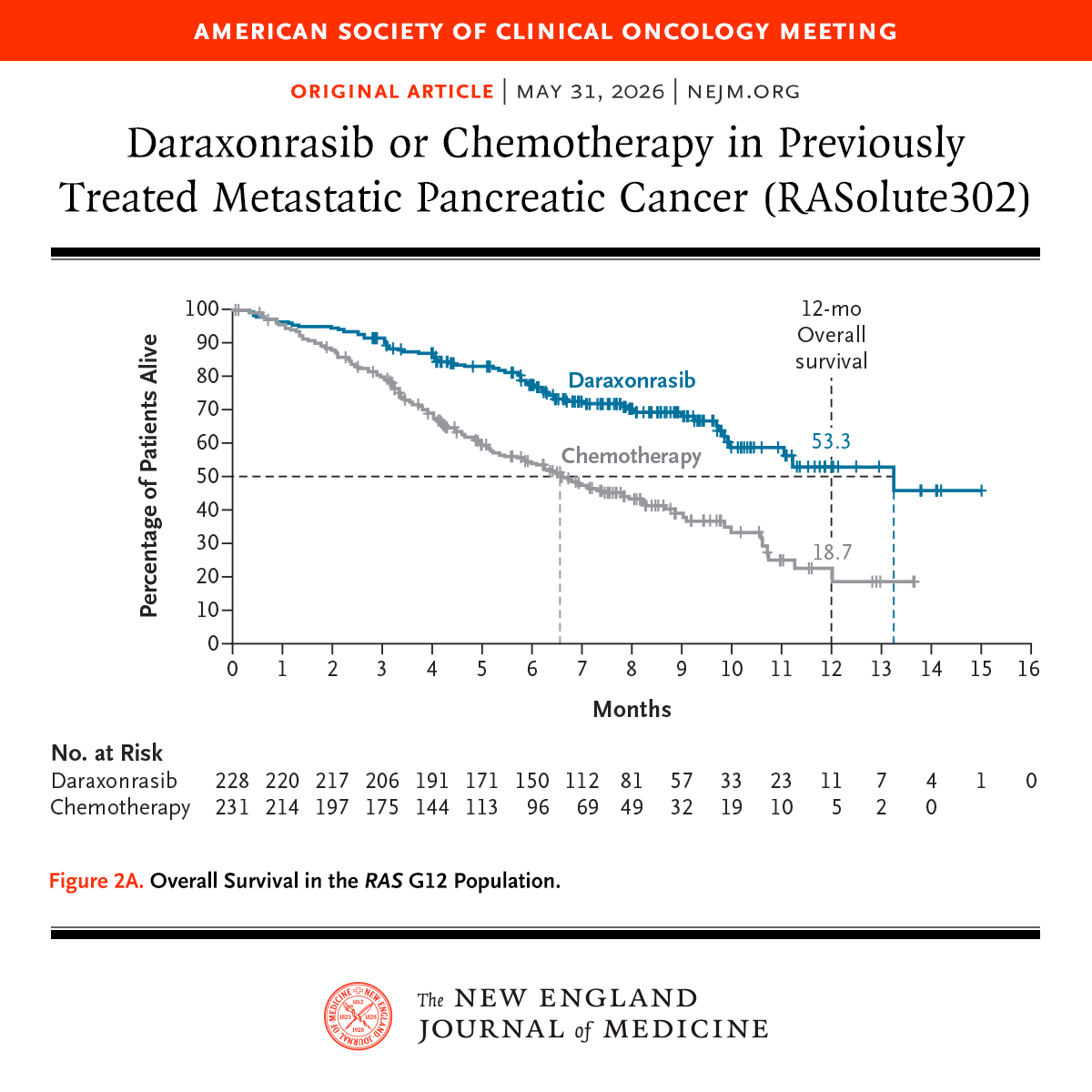
Among patients with previously treated metastatic pancreatic ductal adenocarcinoma, the RAS(ON) inhibitor daraxonrasib led to significantly longer overall survival and progression-free survival than chemotherapy. Full phase 3 RASolute 302 trial results: https://t.co/xwLWBZYRzq
@ASCO
A new era for #MRI! Introducing CS-CAIPI, a novel MRI acquisition approach allowing extreme acceleration with low noise penalty. Compared to existing state-of-the-art DL recons we >doubled accel to 14x with no sig difference in quality! We’ve learned even more since this study started—you will want to read till the end!
https://t.co/qUEe7isYwl
What happens when you put competing neural networks in a Petri Dish and start changing the rules while they adapt?
Last year we released Petri Dish NCA, where neural nets are the organisms that learn during simulation. Today we're releasing Digital Ecosystems: a browser-based platform for interactive artificial life research.
The setup: several small CNNs share a 2D grid, each seeing only a 3x3 neighborhood. No global plan. They compete for territory by attacking neighbours and defending against incoming attacks, learning via gradient descent online while the simulation runs.
What we didn't expect was the role of the learning itself. Gradient descent isn't just optimising each species' strategy. Instead, it acts to stabilize the whole system during simulation. Species that overextend get pushed back by the loss. Species that stagnate get nudged to grow. This means you can push parameters toward edge-of-chaos regimes: a zone characterised by emergent complexity. Letting the neural networks learn acts to hold the complex system together while you explore and interact.
The platform lets you steer all of this interactively. You can draw walls to create niches, erase parts of the system online, and tune 40+ system parameters to explore the most interesting configurations. We find it mesmerizing to watch species carve out territories and reorganise when you perturb them.
Everything runs client-side in your browser, no install needed.
Blog: https://t.co/qOuelxmd6l
Code: https://t.co/pz7ktDCRZS
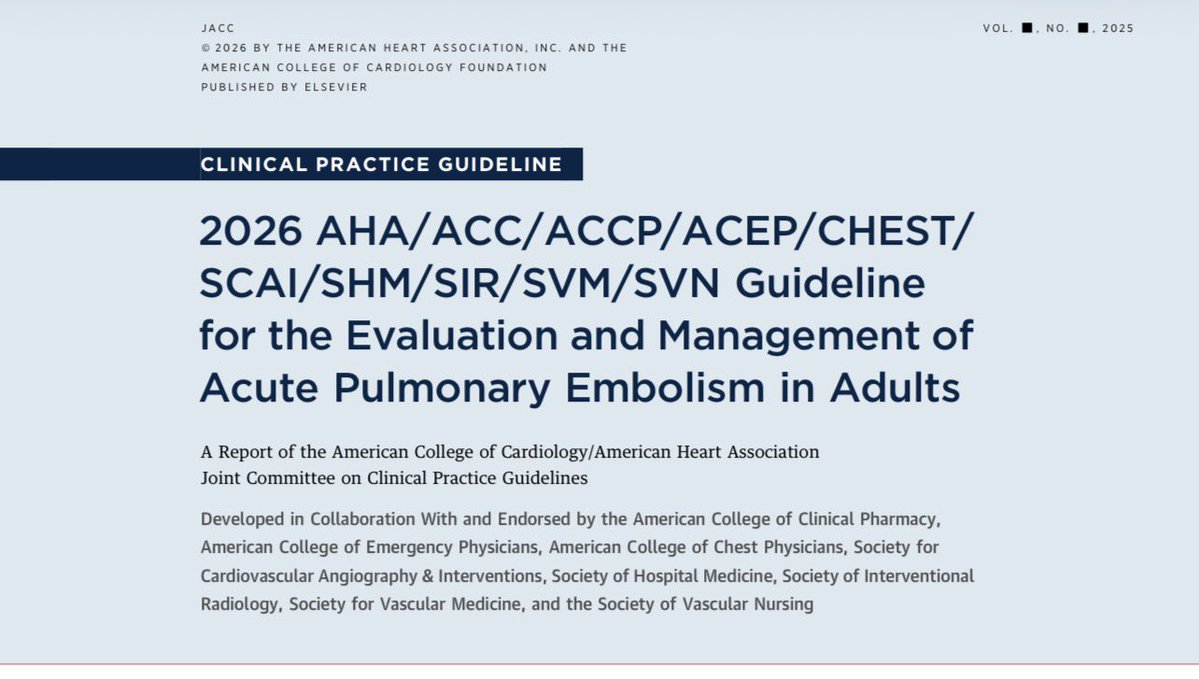
🧵 1/ First ever AHA/ACC/multi-society guidelines re: diagnosis & management of acute PE released today!
2 year effort with 38 authors from 10 specialties.
Link attached & summary in this thread:
https://t.co/uUUyUvz3pR
A paper in Nature presents OpenScholar, an open-source language model that can outperform commercial large language models (LLMs) in performing accurate literature reviews. https://t.co/HhXZfmGAS1
Today in Cell, we published new research showing how AI can help accelerate cancer discovery. With GigaTIME, we can now simulate spatial proteomics from routine pathology slides, enabling population-scale analysis of tumor microenvironments across dozens of cancer types and hundreds of subtypes.
Developed in partnership with Providence and the University of Washington, our hope is that this work helps scientists move faster from data to insight, revealing new links between genetic mutations, immune activity, and clinical outcomes, and ultimately improving health for people everywhere.
Feel like waving the white flag over white matter disease?
Do you grade the degree of small vessel disease, or just mention & hope no one asks for more?
Degree of small vessel disease is important & the Fazekas scale is an easy way to semi-quantitate disease burden
Here’s how to remember it:
Think about how the number looks or feels — it grows in intensity!
Deep White Matter Fazekas:
1 → “1-hit wonder”
Punctate foci — just tiny spots, like little dots.
2 → “2 = two-gether”
Beginning confluence of foci — two dots coming together, mild merging.
3 → “3 is a crowd”
Large, confluent areas — everything blending into a mess, too much white.
Periventricular Fazekas:
1 → “1 is a pencil”
✏️ Pencil looks a number 1 (pencil-thin “cap” or rim along ventricle).
2 → “2 curves into a halo”
⭕ Smooth halo of hyperintensity — picture the roundness of 2 encircling the ventricle.
3 → “3 branches out”
🌿 Irregular fingers of white matter reaching into the deep — the edge of the number 3 look like irregular finger
Now you know the Fazekas score for small vessel disease! Now your knowledge of small vessel disease will be anything but small!
Do Vision-Language Models Have Internal World Models? Towards an Atomic Evaluation
"we introduce WM-ABench, a large-scale benchmark comprising 23 fine-grained evaluation dimensions across 6 diverse simulated environments with controlled counterfactual simulations. Through 660 experiments on 15 latest commercial and open-source VLMs, we find that these models exhibit striking limitations in basic world modeling abilities. For instance, almost all models perform at near-random accuracy when distinguishing motion trajectories. Additionally, they lack disentangled understanding -- e.g., some models tend to believe blue objects move faster than green ones."
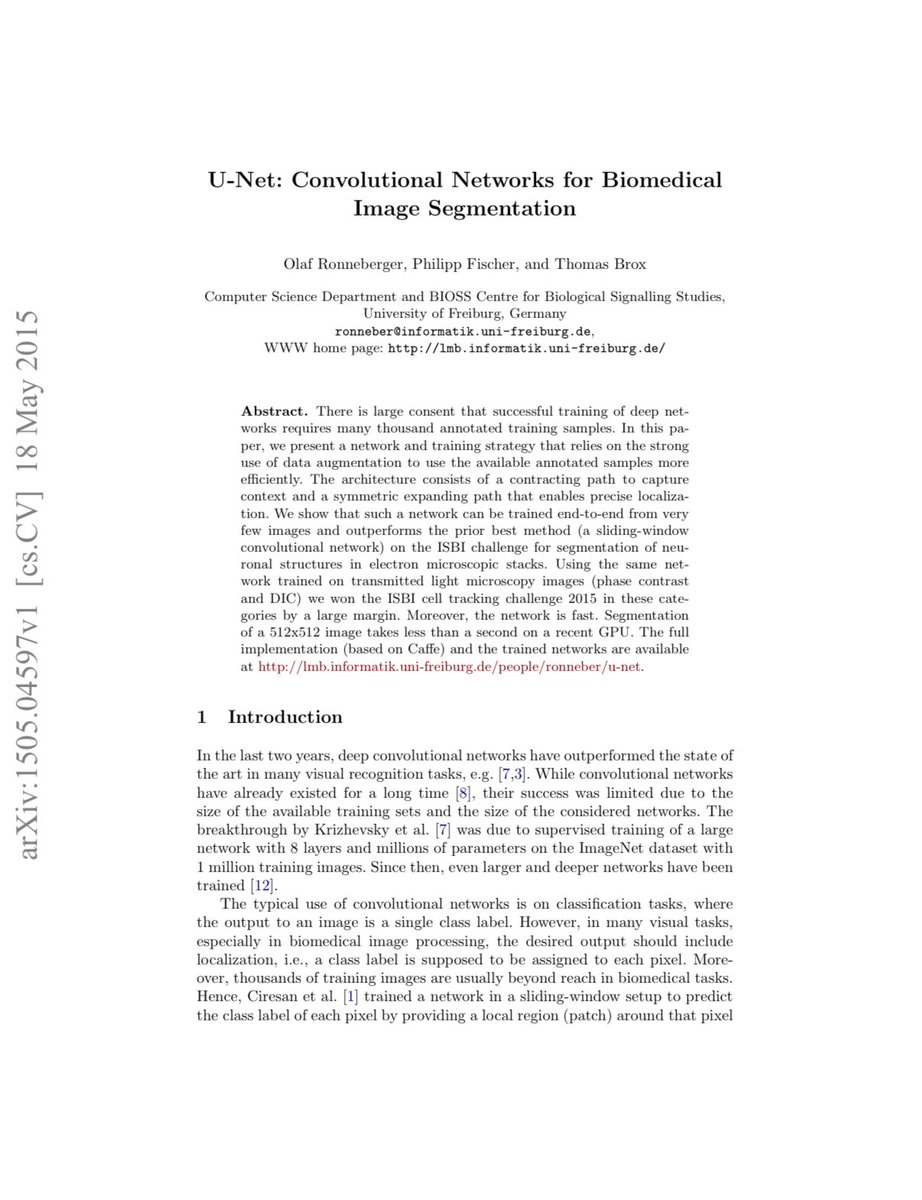
pretty crazy that in 2015 german vision researchers working on Biomedical Image Segmentation sat down and coded a CNN that’s stayed state-of-the-art for ten years
today U-Net remains competitive. paper has 100k citations
some people have incredible intuition
In the physical world, almost all information is transmitted through traveling waves -- why should it be any different in your neural network?
Super excited to share recent work with the brilliant @mozesjacobs: "Traveling Waves Integrate Spatial Information Through Time"
1/14
@iScienceLuvr Very interested in joining in!
Radiology resident at academic hospital with interest in neurorads/functional imaging, multimodal architectures and building user-friendly tools
The last paper of my PhD is finally out ! Introducing
"Intuitive physics understanding emerges from self-supervised pretraining on natural videos"
We show that without any prior, V-JEPA --a self-supervised video model-- develops an understanding of intuitive physics !
Although not quite the 1-million Qubit chip detailed in Microsoft's, Majorana-1 press release, their paper in @Nature details exciting possible step towards topological quantum computation!
https://t.co/7g2vPHJ8Xq
It's not much, but DICOM viewing application now with 3-viewing windows, lung/bone windowing presets and rescaling. Onto the next additions. #radiology#ML#AI