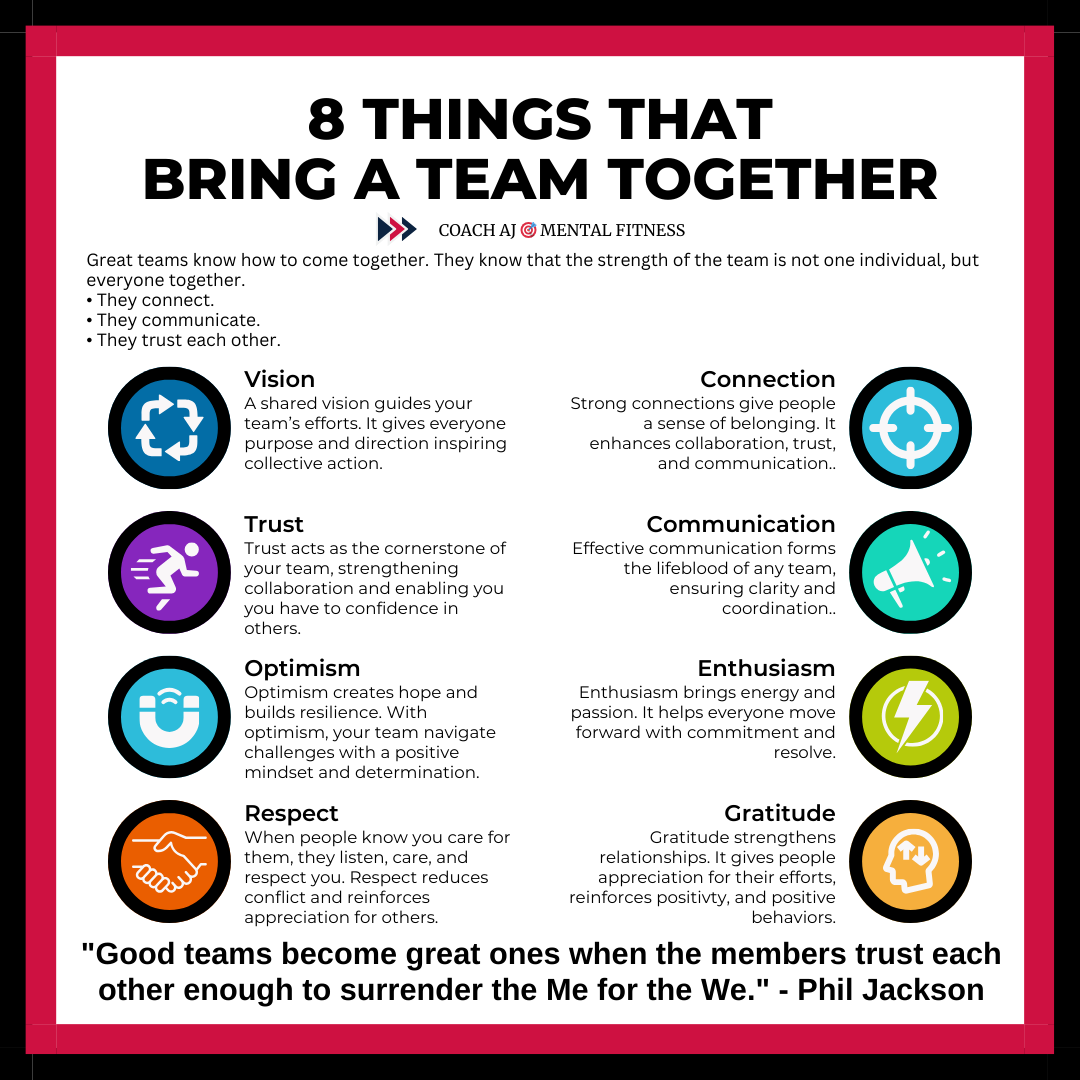
Phil Jackson said, "Good teams become great ones when the members trust each other enough to surrender the Me for the We."
Great teams know how to come together
• They connect.
• They communicate.
• They trust each other.
8 Things that Bring a Team Together:
Mike Tomlin said, "There no substitute for work. You can talk about all kinds of stuff, but at the end of the day, it's about the work."
• It means discipline.
• It means commitment.
• It means consistency.
• It means sacrifice.
You either did the work today or you didn't.
Nice read on Belgium FA
"The key for change was coach education"
7 key aspects ⬇️
1. Player centred approach
2. Small sided games
3. Multimove
4. Giving players freedom
5. Game based practice
6. Winning doesn't matter
7. Look after the late developers
https://t.co/UQJD5JpX0X
Five tips for every #sportingparent:
1. Love your child unconditionally - always;
2. Winning and losing doesn't matter - love them the same no matter what the result is;
3. Teach independence, self-determination, responsibility and accountability as priorities;
4. Sporting success DOESN'T make your child a good person: Being a good person will lead to sporting success;
5. If they love what they do, they'll do what they love. Focus on creating the environment for your child to fall in love with the experience of #sport - then - if they've got the will, the drive, the desire and the #talent - they'll make it! But if they don't love it - it's all over.
I wish everyone could have my parents because they always let me choose whatever (sports) I wanted to. I played other sports, and they never put pressure on me. I wish this freedom was possible for as many young kids as possible.
Janik Sinner - 2024 Australian Open Singles Champion 🎾
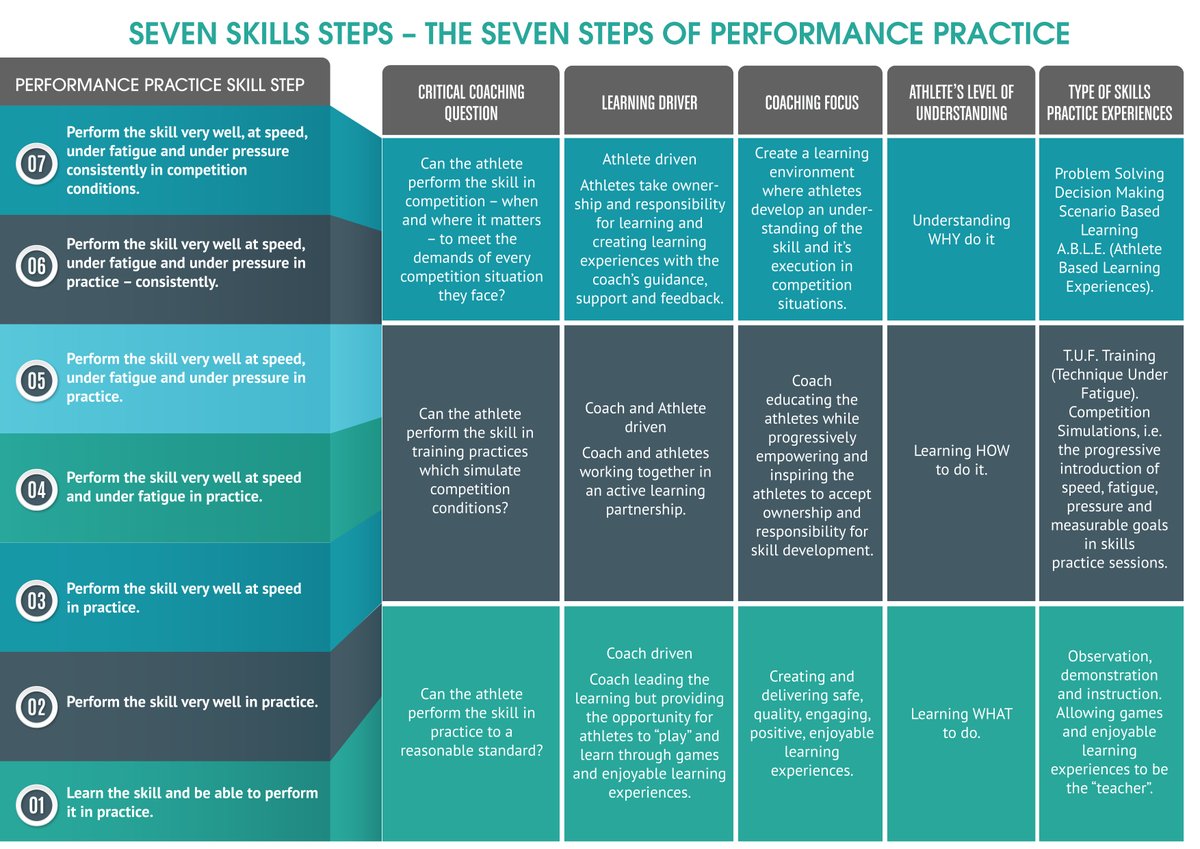
Always one of my most popular sessions in #coach education and development clinics and workshops - The Sevens Skills Steps of Performance Practice.
It requires #coaches to consider three basic but important concepts:
1. Biomechanically "perfect" technique is a myth. There is no one size fits all "perfect" technique for all athletes. However, there is an efficient and effective technique for each individual athlete based on some fundamental sports specific technical elements - usually focused on the position and use of the four Hs - HEAD / HANDS / HIPS AND HEELS (feet).
Don't confuse TECHNIQUE and STYLE, coaches!
2. Every #athlete is different - every technique is different. It's like handwriting. We teach the same basic alphabet to all students - but each student writes the letters in their own unique style - albeit while sticking to the standard, basic alphabet format.
3. It's not about mindlessly repeating skill practices over and over and over trying to "perfect" an individual athlete's technique. It's about developing their own unique individual #technique then progressively coaching them to learn how to perform that skill AT SPEED / UNDER FATIGUE / UNDER PRESSURE - consistenty in the environment of the competition.
In other words - spend less time trying to make all kids look like the picture in the textbook and more time developing their own unique technique and style while creating learning environments where they can discover and learn how to perform their own unique technique in their chosen competition setting.
Read more here https://t.co/O9VH35w5LF and here https://t.co/AJ0RmHouaB
Great video for showing a championship team communicate
This is one of my favorites because you see the greatest players in the world taking coaching from each other. A common goal
Have to give up a part of who you are, for all that the team can become.
Five of the best tips to give to kids before games:
1. Have fun
2. Give your best effort
3. Focus on what you can control
4. Stay in the present moment
5. Believe in yourself and trust your instincts
After the 2018 NCAA Tournament, Virginia coach Tony Bennett was lost.
His team collapsed in one of the biggest upsets of all time, losing as a 1-seed to 16-seed UMBC.
He debated all offseason how he would address the loss and the team.
His first words in 2019 would set the tone for their memorable season.
Tony Bennett debated how he would talk to his team, but his wife had an idea. She had attended a series of TED Talks in Charlottesville in 2014 and one talk stuck with her. It was about storytelling and adversity, it was called How the Story Transforms the Teller.
And this is how a TED Talk motivated the Virginia basketball team to become national champions.
Tony Bennett watched the TED Talk and took so many powerful lessons, but most of all, he learned the power of adversity and the stories that we tell ourselves. At the bottom, there is a link to the video of the TED Talk, and I included some great quotes throughout.
After watching the talk, Tony Bennett had an idea. On the first practice in October, instead of getting out on the court, he had his team watch this 17-minute TED Talk.
In the TED Talk, the speaker Donald Davis says, “You’re not telling the story to change what happened. You’re telling the story to change you.” And that is what the Cavaliers did. They told their story. It allowed them to accept what happened in 2018 and move on from how they felt.
Kyle Guy, starting shooting guard, talked about how much the loss hurt him and even how they needed a police escort after the game because they received death threats. He said, “For me, it's never forgetting it, but definitely trying to move past it to where I'm not hanging my head on it.”
Assistant Coach Jason Williford told his story about how he didn’t shave or leave the house for three days. Finally after 3 days and talking to his wife, he knew it was time to get up and rewrite Virginia's story in 2019.
Virginia, with a few lucky bounces and calls, would go on to win the 2019 national championship.
As part of his own story, Tony Bennett said at the game, “If you learn to use adversity right, it will buy you a ticket to a place you can’t go to any other way. I think (last year’s loss to UMBC) bought us a ticket to a national championship.”
Takeaway 1:
Growth only happens when you accept your past and then learn from your mistakes, adversity, and "failures".
Challenges will happen. Mistakes will happen. It is your choice how you respond and learn from those events. Choose to respond and not react.
Buddha once said that life is suffering and there will always be pain. By accepting it and moving forward, you take ownership on what you can control. You begin to think “Why not me?” instead of “Why me?”
Takeaway 2:
The most dangerous stories you make up are the ones that diminish your worthiness.
You tell yourself stories every day. Those stories will determine your attitude, mindset, and habits moving forward. It will drive your perceptions of reality and start to form your confidence beliefs and self-limiting beliefs.
In Donald Davis’ TED Talk, he emphasizes the power that one story can have on your perception of reality. Choose to re-frame your stories and overcome those self-limiting beliefs because that's how you move you forward.
"Every adversity, every failure, every heartache carries with it the seed of an equal or greater benefit."
- Napoleon Hill
- - -
Follow @coachajkings for more content like this!
Creating situations that create 'pressure' or making the players uncomfortable is an important part of coaching.
This is a fun game to create some pressure for players in a game situation and all you need is a deck of cards (or dice). Easily adaptable to your own sport too
Twice as many girls quit sport before the age of 14 💔
A great video to raise awareness of some of the pressures faced. Well done to Liverpool and @StanChart for launching the 'Play On' initiative.
Aiming to inspire, empower and educate girls to participate in sport 👏
Junior Rep Teams...No one wins! Why?
1. The kids who miss out (and their parents) think they're not good enough to make it in the sport so they often drop out.
2. The kids (and their parents) who DO get selected in Junior rep teams often have unrealistic expectations of what it means, i.e. "being selected in the under 10 rep team means it's inevitable I'll play #NBA / #NFL / Premier League level sport".
This means that in most cases Junior Rep Teams are full of early developers (and their parents) with unrealisitic expectations - who - statistically looking at multiple studies over the past 50 years have a very low success rate when it comes to making it to elite level sport.
Let kids play. Inspire them to fall in love with sport. Then sometime in their mid-late teens, if they've got the passion, the motivation and the talent to be the best, let's get them into a performance pathway program.
My advice - take the money you're investing in Junior Rep teams and spend it building and growing participation in all levels of your sport, parent education AND developing outstanding #coaches and #coaching!