Should Democrats pass the bipartisan permitting reform bill now, or wait for the next Congress to try to negotiate a better deal?
It’s a totally reasonable question given the midterm results.
The short answer: They should pass BAAJA now.
Rep. Huffman and Sen. Merkley are set to chair two of the most important committees for permitting reform in the next Congress and they’ve opposed every major permitting deal over the last 5 years.
A bill negotiated by them won’t even garner the support of every Senate Democrat, let alone enough Senate Republicans and President Trump.
The (much) longer answer requires digging into the legislative history of the three permitting reform fights prior to BAAJA:
1. Four years ago, the Senate voted on including the Building American Energy Security (BAES) Act of 2022 in the annual defense bill (NDAA).
2. This bill was negotiated by Democrats (principally the Biden Admin, Senate Leader Schumer, and the most moderate Democrat, Sen. Manchin) under a Democratic trifecta government.
3. BAES was backed by Biden, Pelosi, and 40 out of 50 Democrats in the Senate.
4. But despite overwhelming Democratic support, the vote didn't even come close to passing, deadlocking 47-47, well short of the Senate's 60-vote cloture threshold.
5. That alone is strong evidence that negotiating a permitting deal with only Democrats is not a recipe for success. Even if all 10 Senate Dems who opposed it had backed it, BAES 𝘀𝘁𝗶𝗹𝗹 would have failed.
6. Of the opposing Dems from the 117th Congress, 8 will be in the 120th Congress (vs just 2 for the supporting Rs). Only 1 of the 8 (Warnock) voted to advance on BAAJA.
7. Most notable among the opponents is Sen. Merkley of Oregon, the presumptive incoming Chair of the Environment and Public Works Committee (and if he is not, it would likely be Sen. Markey of Massachusetts, also a "no" on BAES).
8. And even though the bill never made it to the House for a vote, Rep. Jared Huffman, who is likely to become the next chair of the House Natural Resources Committee, was also a strong "no" on BAES.
9. Huffman opposed the bill vocally, saying it was “a shit sandwich” and "you don't get [Republican votes] by tackling the climate crisis."
10. But any bill that passes in the next Congress will need the votes of at least 4 Senate Republicans and the signature of President Trump.
11. Huffman was one of the lead signatories on a letter opposing the bill, which included 77 House Democrats (~37 of whom will be in the next Congress).
12. From Merkley and Huffman's records, we are left to infer that a bill would have to move leftward from where BAES was to earn their support.
13. But we already know that the bill's main challenge was not on the Democratic side — it was Republicans.
14. Only 2 Republicans who are going to be in the next Congress supported it, one of whom (Sen. Capito) only on the grounds that it helped the Mountain Valley Pipeline (MVP) being built in her state. MVP is now permitted and no longer available as a bargaining chip.
15. Republicans both disliked the bill's transmission provisions and felt that BAES did almost nothing for fossil fuels.
16. BAES also had some NEPA process reforms that Republicans viewed as weak (because they were), and an earlier draft had Clean Water Act (CWA) language so tepid that Republicans specifically requested its removal — before still voting "no" — because they believed it made the status quo worse.
17. But the prospect of this one pipeline being permitted by Congress was a big enough issue to drive staunch opposition among virtually all of the major green groups in DC.
18. NRDC called the bill "radical" and its language "draconian," saying it would "throw out half a century of law that gave environmental justice communities a seat at the table."
19. LCV scored the vote, giving positive marks to Sen. McConnell and the Senate Republicans who opposed it, and negative marks to climate hawks who supported it based in large part on its transmission provisions (albeit far less comprehensive ones than those negotiated by Sen. Whitehouse and Sen. Heinrich in BAAJA).
20. So, how could a bill that couldn't pass under a Democratic trifecta move left in order to satisfy incoming committee Chairs like Sen. Merkley and Rep. Huffman, and simultaneously move right enough to get signed by President Trump?
21. The logical conclusion to draw is it couldn't, and wouldn't.
22. The notion that President Trump would support anything like BAES is preposterous. It's not even close to the zone of interest.
23. The successor to BAES was the Energy Permitting Reform Act (EPRA) of 2024, and it went much further for renewables and fossil than just permitting one pipeline, included significant provisions on judicial review, on hardrock mining, on liquefied natural gas, and on on- and offshore leasing.
24. EPRA fared much better than BAES among Senate Republicans, passing out of the Energy and Natural Resources Committee with all but one (Hawley) of the nine Republicans there supporting.
25. But, by virtue of being the product of just one committee, EPRA did not include any reforms to the CWA, NEPA, or ESA, which were larger and longer-standing priorities for Republicans than the targeted Department of Interior, Department of Energy, or FERC reforms.
26. And so House Republicans, led by Speaker Johnson, balked.
27. Trump, of course, could have swooped in and urged Republicans to pass the bill, especially after his electoral victory, but chose not to.
28. As with BAES, Republicans in the highest positions of power, including Trump, were perfectly content to take a pass on a permitting reform bill that they felt did not address their core issues.
29. On EPRA, despite neither ever having to vote on it, Sen. Merkley and Rep. Huffman were again firm in voicing their opposition.
30. As with BAES, which got 40 (out of 50) Senate Dems when put to a vote, EPRA had strong margins among Dems who actually had to weigh in on it: 7 out of 10 Dems on the Energy and Natural Resources Committee voted for it.
31. So here we have a second, very different, permitting reform bill that ran up strong margins with Dems in the main, yet would have had to move left to earn the support of today's incoming Dem committee chairs, yet would also have had to move right to earn the support of President Trump.
32. These are not the only examples in recent history: Between BAES (2022) and EPRA (2024) was the Fiscal Responsibility Act (2023).
33. The FRA debate featured a serious push to include Sen. Hickenlooper’s and Rep. Peters' BIG WIRES Act to enable the buildout of transmission.
34. But Republicans insisted on changes to NEPA's judicial review process in exchange for transmission provisions.
35. Rep. Huffman was again one of the lead signatories on an 83-member letter (~54 returning for the next Congress) opposing the inclusion of any NEPA reforms in a deal.
36. Along with Republican opponents of the transmission reforms, this created a dynamic where the more significant reforms being asked for by Republicans could not be paired with the transmission reforms the Biden admin was seeking.
37. Ultimately, the FRA passed (including with 165 Democrats "yea" votes and 46 "nays" in the House and 44-4 among Dems in the Senate) with the Mountain Valley Pipeline authorization from BAES and very modest NEPA reforms (together sufficient to draw "no" votes on the entire debt-ceiling deal from Merkley and Huffman), as well as just a study on transmission (womp).
38. So there we have it: three permitting bills, all very different, in just the past 4 years, all drawing super-majority margins of Democrats when actually put up for votes, none viable with the key Democrats who would be in charge of negotiating a bill next year, or with Republicans (except in the special case of the FRA where they were giving up nothing on permitting other than a study).
39. All three, even the one negotiated under a Democratic trifecta, would have had to move left in order to earn the support of incoming Democratic Chairs, as well as a vocal minority of other Dems who will still be in office this coming Congress, and simultaneously move right in order to get Trump and the Republicans to agree to reforms Democrats have pushed for.
40. A deal cannot simultaneously satisfy Huffman, Merkley/Markey, and Trump and Republicans, and that is why waiting for the next Congress is not a viable strategy for enacting a better bill.
41. None of this is a hypothetical: We know it based on recorded votes and actions.
42. And none of that is to even mention that the next Congress is likely to be a more challenging environment for bipartisan legislating.
43. Democrats have made clear their intent to pursue a strong oversight agenda, likely to feature investigations, subpoenas, and potentially impeachments, none of which are likely to put the heads of either party — least of all President Trump — in a favorable mood to make a deal on permitting.
44. Oh, and there will be a presidential election going on.
45. Meanwhile, permitting problems continue to fester, with infrastructure projects taking years to get through federal permitting and interregional transmission (essential to viable clean energy) remaining barely possible.
46. Members should vote up or down on BAAJA based on whether they think it is good policy.
47. There are many legitimate reasons to support or oppose this bill, but "a better bill will be possible next Congress" does not belong on the list.
This week, we're sharing @m_clem's Economics of Ideas, Science, and Innovation lecture on immigration and innovation. He reframes high-skilled immigration as a way of bringing in new ideas and innovation and spurring economic growth. https://t.co/W9vlBBgE4Q
This is a good companion to @cojobrien's recent article on recent restrictions on international students coming to the US, such as via proposed fees on OPT. https://t.co/gDDjZ8W9kT
Large federally funded public transit projects spend an average of 5.7 years going through environmental review- and those are usually within a metro area! Rail between cities like California High Speed Rail takes decades of paperwork
Anything progressives want to see built in the real world requires permitting reform
Your brain is composed of a wide range of cell types connected into intricate circuits. The properties of these cell types underpin our ability to perceive, reason about, and interact with the world.
Cell types coordinate their electrical signals to drive behavior. When something goes wrong with one of these cell types, we develop diseases like Parkinson’s or blindness.
Many other mental health problems may stem from problems with a single cell type, but we currently lack an easy way to link neural activity to cell type identity.
Cell types have been cataloged extensively in fixed brain tissue, but they are difficult to identify in recordings from living brains. So how do we overcome this gap?
Josh Siegle has a plan that he outlines in a new piece in the Launch Sequence: https://t.co/eqSrZwMG1z
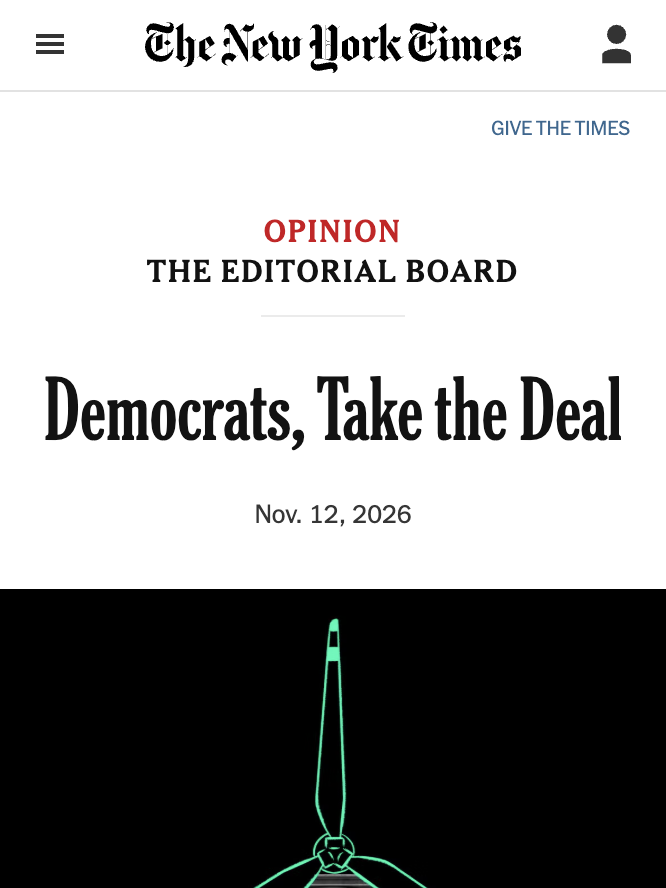
Very glad to see the NYT editorial board endorse BAAJA, the bipartisan permitting reform bill.
Key points from the article:
1. "Democrats who call climate change an emergency should not defend a permitting system too slow to build the clean energy that would address it."
2. "[BAAJA] would make it easier to build solar energy farms, battery storage, power lines and more. As a result, it would reduce energy prices. The status quo is expensive, dirty and unstable. The country needs to build a lot of big, new things to make its future cheaper and cleaner."
3. "The bill’s Democratic skeptics are making a mistake. President Trump would almost certainly veto a follow-up bill next year. And time matters, especially for the climate. Congress should pass this bill now. It can then return next year and pass other bills that would do even more good."
4. "Today, it typically takes between 5 and 13 years to build a long-distance power line, like the one that transports clean hydropower from Quebec to New England. That line took about a decade to finish, and opened in January. It has enough capacity to meet about one-fifth of Massachusetts’s electricity demand, and it’s projected to save consumers $50 million a year."
5. "A more robust, cleaner grid would make American energy more reliable and less dependent on hostile foreign nations. No country can embargo the wind."
6. "[BAAJA] would force data center operators to pay the full costs of the electricity they use, protecting the average electricity consumer."
7. "On net, the bill would cut greenhouse gas emissions from power plants by as much as 18 percent by 2040. It would do so in part by nearly tripling the construction of high-voltage transmission lines."
8. "Anyone who cares about climate change should cheer this bill. And a party that just won an election on affordability should not pass up a chance to start delivering immediately."
IFP just spent the last 36 hours poring over the new Manager’s Amendment to the permitting bill.
We went through 27 criticisms of the permit-certainty provisions and over a dozen concerns about historic preservation.
The result is 70 pages of memos showing how the amendment resolves every major permit certainty issue we’ve seen raised and takes significant steps to respond to Tribes on historic preservation review:
1. A 32-page memo analyzing and responding to criticisms of the project certainty provisions: https://t.co/5qoo5MG8SZ
2. A 4-page memo explaining how the Manager’s Amendment resolves project certainty concerns: https://t.co/ywdwu270RV
3. A 5-page memo explaining why BAAJA does not prevent the revocation of illegally issued permits: https://t.co/gDW0pfF1mH
4. A 3-page memo summarizing historic preservation changes in the manager's amendment and covering how BAAJA protects Tribal consultation from executive action: https://t.co/FbxUUHJ66c
5. A 25-page memo explaining how Tribal consultation works in BAAJA, exploring concerns and the Manager's changes in depth: https://t.co/4l9aiTFQ1C
Not everyone will be happy. If your goal is stopping energy, transit, or housing projects on procedural technicalities, this isn’t the bill for you (although projects that violate substantive environmental law can still be stopped, just not over paperwork violations).
But if your goal is energy affordability and stopping climate change, this is a good bill, and a better bill than it was last week.
All of our permitting reform work can be found here: https://t.co/yYWwsFn8e9
Major changes to BAAJA in this amendment responding to Democrats' concerns; two highlight titles:
1. Permit Certainty title has lots of technical fixes:
-Requires proof of government bad faith before an energy project can get damages (easy to prove with Trump, hard to use against a future lawful admin)
-10-year baseline of past projects rather than 5 years (so Trump anti-wind actions aren't built into the baseline)
-Ability for the government to rebut with lawful reasons (helps a future admin could deny polluting projects lawfully)
2. Historic Preservation title has substantive changes:
-Feds can no longer take over a noncompliant Tribal Historic Preservation Office (THPO)
-Even if a THPO isn't compliant with deadlines, agencies still required to consult with Tribes
-Expanded requirements to consult and incorporate feedback from THPOs, Tribes, local govs, State Historic Preservation Offices
-Protections for Tribal historic database information to remain confidential to Tribes
-No more requirement for THPOs and SHPOs to spend 50% of their time on a project if they miss its deadline
-Extra more time to object to a historic preservation report
-Federal Highway projects always subject to historic preservation, even if only a formula grant
If you want to restrict ICE, restrict ICE.
But if you think your best tool to limit ICE is (checks notes) hamstringing building projects of all kind, including the transmission lines that clean energy depends on, then I don't even know what to tell you.
The Optional Practical Training (OPT) program is one of the best ways to keep international talent in the US. Think of it as the front door of our high-skilled immigration system.
Of international STEM PhDs who come to the US, over 3/4 stay on via OPT.
In this piece, @cojobrien explains the status of the many proposed restrictions on high-skilled immigration, and underlines why OPT is so important. https://t.co/gDDjZ8WHar
New for Macroscience @IFP: The last two years have seen an unprecedented crackdown on the visa pathways that enable current and future scientists to come to the United States.
I break down all the changes underway and why they matter to US science here:
https://t.co/ql26Zom0z2
Democrats should pass permitting reform now to give time for transmission implementation, so future clean energy policy will go further
Let's not repeat the mistake of spending a lot of money on clean energy projects that then get stuck in permitting!
Come edit the first draft of the future!
I'm hiring another editor at @IFP
Priority deadline is Sunday, a $5000 referral bonus if you send me the person I hire. (Have them list you on the app)
It's a high volatility timeline, let's make it good
https://t.co/KKdKksxo88
NEW: Anthropic's IPO considers U.S. restrictions to legal high-skilled immigration one of its biggest risks to growth in AI, new SEC filing shows:
"changes to immigration policies that restrain the flow of professional and technical talent, including but not limited to U.S. immigration policies, may inhibit our ability to recruit and retain highly qualified employees. If we are unable to effectively manage the foregoing risks, our prospects, business, financial condition, and results of operations could be adversely affected."
Link: https://t.co/cOZkf4bCr0
Most economists agree that the $100,000 OPT fee will "substantially weaken the ability of US universities to attract and retain top foreign students relative to other advanced economies."
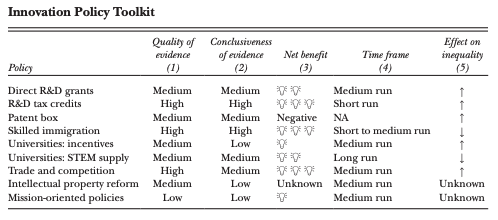
@johnvanreenen's Economics of Ideas, Science, and Innovation lecture helps us think about how policy designs influence things we care about in science: research conducted, people trained, intellectual property protected (or shared with the public).
The "lightbulb" table from John's paper with @heidilwilliams_ & @I_Am_NickBloom provides a quick way to think about the quality of evidence for different innovation policies and their net benefit.
Find John's lecture here (with intro text from @matthewesche): https://t.co/O6MjhAAW3n
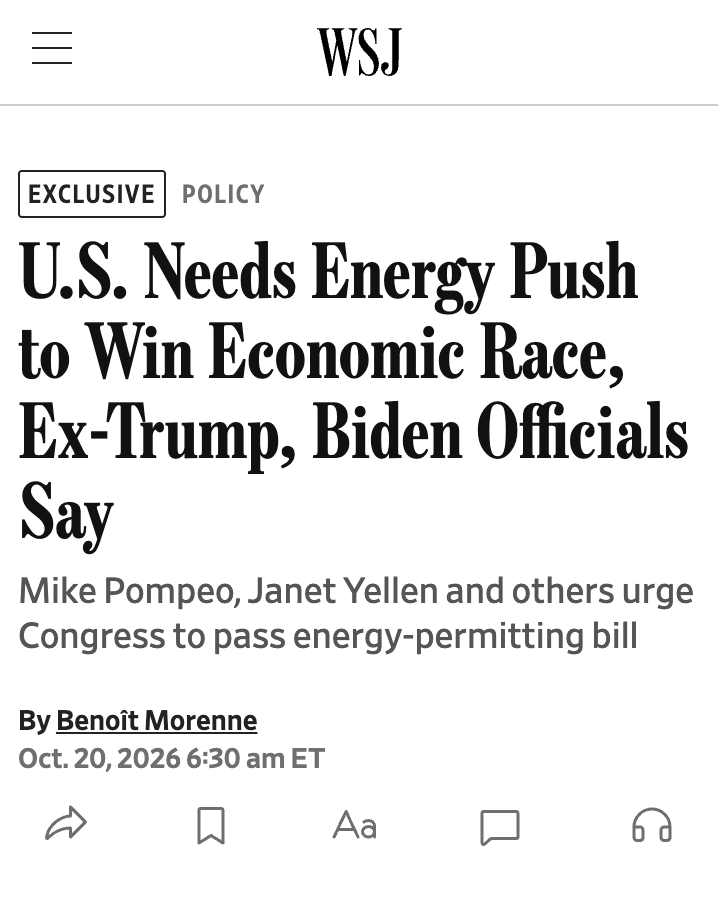
NEWS: 19 FORMER ECONOMIC AND NATIONAL SECURITY LEADERS ENDORSE THE BIPARTISAN PERMITTING REFORM BILL
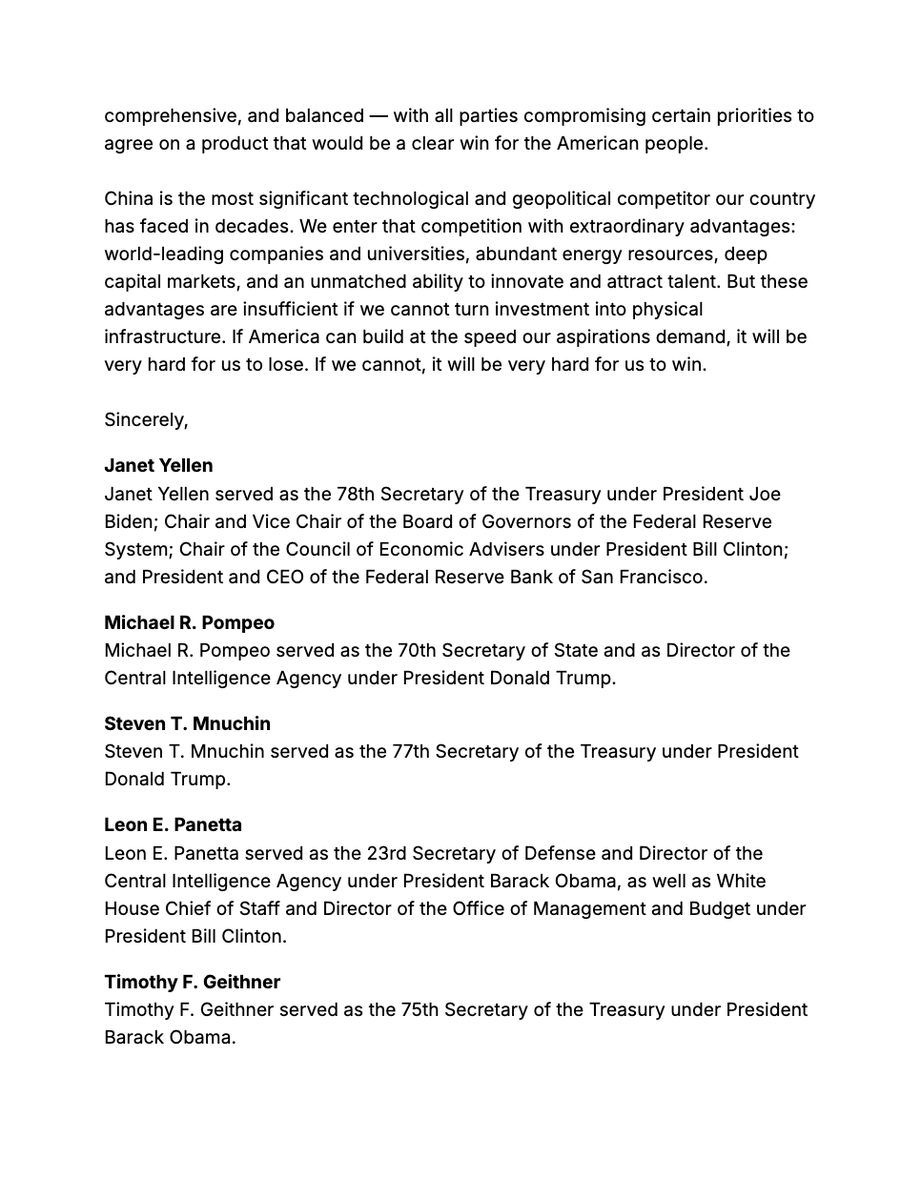
Today, a group of former Cabinet members and White House principals across seven Democratic and Republican administrations sent a letter calling on Congress to pass BAAJA. Here are the signatories:
Janet YELLEN, Michael R. POMPEO, Steven T. MNUCHIN, Leon E. PANETTA, Timothy F. GEITHNER, Henry M. PAULSON, Jr., Robert E. RUBIN, Stephen MIRAN, Jared BERNSTEIN, Tyler GOODSPEED, Jason FURMAN, Glenn HUBBARD, Laura D’Andrea TYSON, Michael J. BOSKIN, Jeffrey ZIENTS, Jake SULLIVAN, Brian DEESE, Larry KUDLOW, Allan B. HUBBARD
Key highlights from the letter:
1. “We are not building infrastructure fast enough to remain globally competitive… The median time for a new power plant to move from an interconnection request to commercial operation has more than doubled, from less than two years for projects built between 2000 and 2007 to more than four years for projects built between 2018 and 2024.
2. China has built more high-voltage transmission in the last fifteen years than the U.S. has built in all of its history... In 2024, China accounted for 31.5% of global knowledge- and technology-intensive manufacturing value added, compared with 20.7% for the United States.
3. Federally funded or permitted projects require NEPA review, but private projects often do not, creating a threat of failure precisely where the government is trying to be proactive, strategic, and engaged.
4. A project that spends years awaiting approval must continue carrying development and financing costs while remaining exposed to rising input costs. The IEA reports that prices for utility-scale transformers increased 26% in 2024, while lead times for some transformers have stretched as long as six years.
5. Mining projects also face tremendous uncertainty: a 2026 study by researchers at the Colorado School of Mines found that permitting for modern mining projects takes an average of 5.5 years, rising to 8.9 years for contested projects. The U.S. currently has the second-longest mine development timeline in the world.
6. The Bipartisan American Affordability and Jobs Act is the most significant bipartisan legislative effort that Congress has undertaken in decades to tackle these challenges.
7. BAAJA addresses key constraints stifling American industry by requiring interregional transmission planning, strengthening the federal backstop for nationally significant transmission lines, and creating a faster, more predictable process for connecting new generation to the grid.
8. BAAJA also makes permits more durable by imposing tighter timelines for litigation and limiting frivolous lawsuits that can halt projects indefinitely, while preserving community input and judicial review of substantive agency decisions.”
The letter was organized by @arnabdatta321 on behalf of @IFP and covered exclusively by the WSJ this morning.