is uber broken?
every ride has drivers ask u how paid uber charged
then you hear what they get…
what good business has its users look to go around the platform?
“I got turned down by all the top VCs.
I offered them 25% of the company for $1 million.
(*The company now has a market cap of $187 billion)
The same VCs that rejected me put a lot of money into my competitors.
That was very motivational.
So I made it my goal to put those companies out of business.”
Anthropic’s last round was apparently a bloodbath behind the scenes. A GP at a prominent fund had dinner with Dario three times before their allocation was slashed to zero. At least four other tier-one funds got pulled at the last minute.
Their crime? Passing on the Series B, the hardest round Dario ever had to raise (led by Spark). In venture conviction is all that counts.
AppLovin CEO Adam Foroughi explains how he broke trust with the entire mobile gaming industry — and then rebuilt it one dinner at a time:
To upgrade AppLovin's advertising model from a simple rules-based algorithm to a deep learning system that could compete with Facebook's, Adam needed something he didn't have: advertiser data on what people actually spent money on inside mobile games.
Advertisers wouldn't share that data with AppLovin. They were sharing it with Facebook and Google, but not with a smaller player in the space. So Adam took an aggressive shortcut — he started buying gaming studios. Eventually AppLovin owned 14-15 different studios across every category of mobile gaming, purely so they could feed that data into the training of their new Axon model.
The problem was that AppLovin was also the advertising platform those studios' competitors relied on. Suddenly the platform was vertically integrated with the very customers it served.
"There was a moment in time where a lot of people stopped trusting us in the space because our games were growing really quickly. We were feeding their data into our model."
Adam explains the reaction split in two:
"You had companies that go, you're competing with us, who just chose not to work with us. Said fine, that's not only logical, it's OK because we made this bet. On the other hand, you had smaller businesses, small to medium sized inside gaming. They just need any win they can get."
The fear from clients was reasonable — they thought Adam was using their data to clone their games and push them out of the market. What they didn't know was that Adam personally hated games and had no interest in being a game developer:
"As an adult, I hate games. I don't spend a minute playing games. The company run through me can't be a game developer. I don't even care about the game content. I cared about the data and I cared about the distribution platform."
Once developers met him in person, the suspicion dissolved. But the damage from not communicating proactively was real. Adam reflects:
"The mistake I made is I'm very transparent when I sit down with people and they start asking me questions, but I didn't convey to the community of game developers directly and explicitly: we're getting in a gaming business and here's why. So people start finding out on their own and then thinking there was some malicious intent when there never was."
Trust came back fast once Adam sat down face to face with each of them. AppLovin's platform is now estimated to capture over 50% of marketing dollars in mobile gaming, and about a year ago the company sold all 15 studios to Tripledot in a single transaction.
Transparency isn't enough on its own. If you're making a move that looks adversarial from the outside, you have to explain the reasoning before the rumour mill does it for you.
Anthropic exp $10.9B Q2 revenue, up from $4.8B in Q1, and $559M of operating profit for the Q.
Compute is 56 cents per dollar of revenue, lower than I expected.
Q2 projection:
$10.9B revenue
-$6.1B compute
-$2.7B sales & marketing
-$1.5B other costs
=$559M operating income
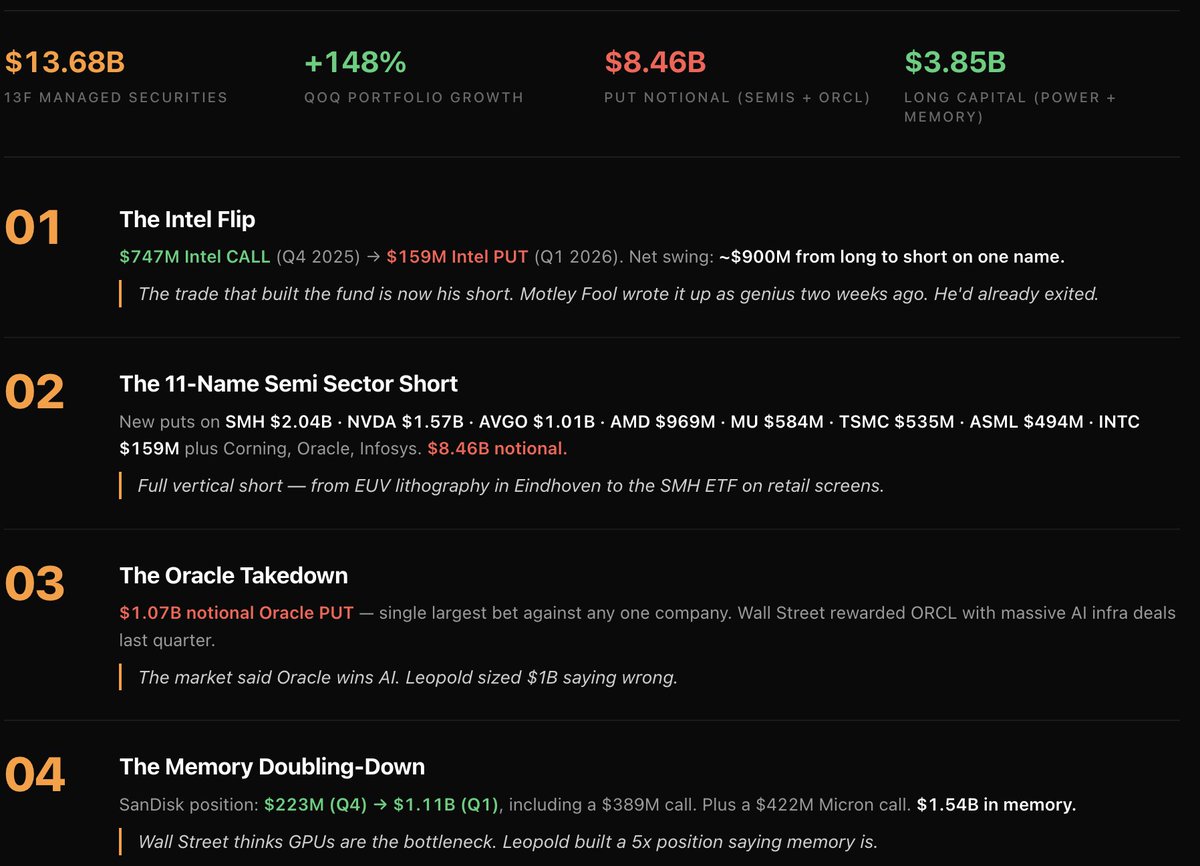
leopold aschenbrenner just released his fund's latest investment portfolio & honestly its not what i expected
he's gone massively short the entire semiconductor supply chain but also revealed what he thinks the next AI constraint is:
> biggest surprise: he's short intel. he sold out of his massive Intel position that made him famous.
> he's also gone short $9B worth of puts in nvidia, asml, amd, oracle and van ecks semi etf.
> biggest long positions are in memory (sandisk) and power (bloom) with a combined $3.5B value (these are his next bottlenecks)
> he trimmed ~$1B of bloom energy position but still holds $1 billion of it. his single largest long holding.
> his lumentum position is gone (bearish optics?)
> the one consistent thesis is he continues to hold data center bets (ai labs will still need gpus)
> fund is now worth $13.7 billion (notional). it was just $5.5B 3 months ago and $220 million ~1yr ago
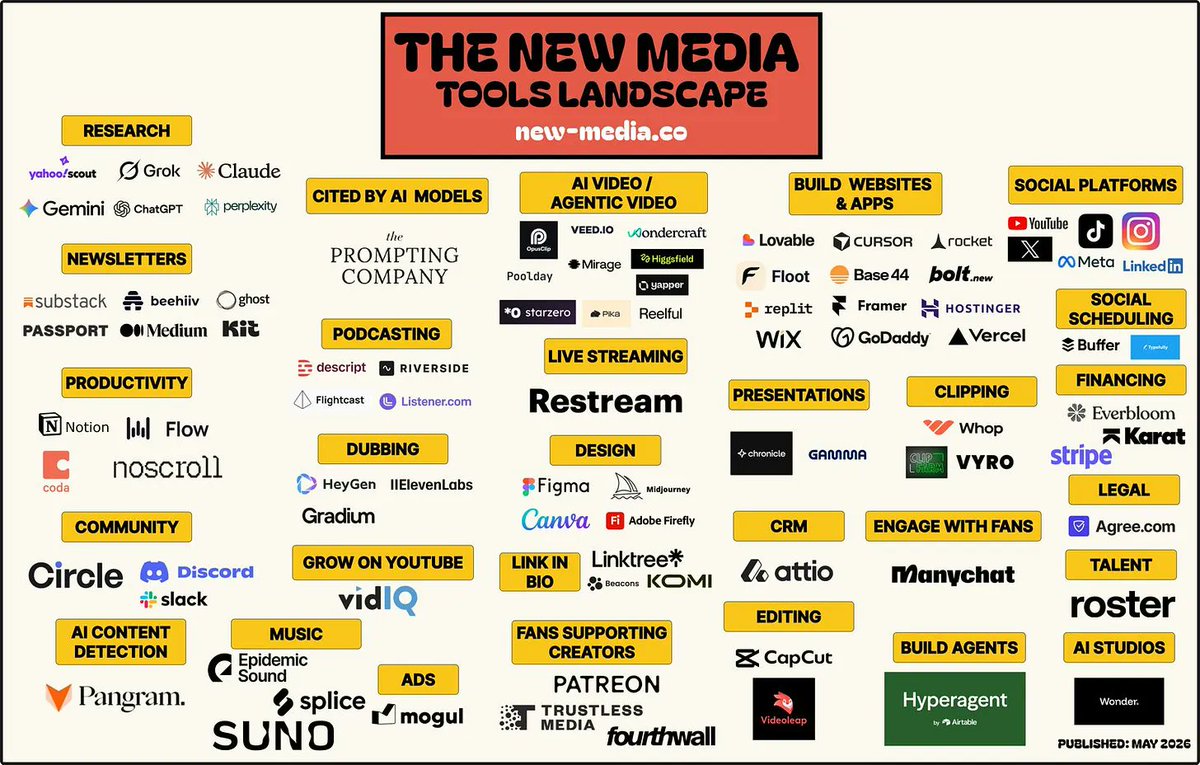
The NEW MEDIA Tools Landscape
A few weeks ago, we published our first landscape focused on new media creators — and it quickly reached 250,000 reads.
Today, we’re releasing the latest edition: 90+ tools empowering creators to do what they do best — create content and build businesses.
Explore the full landscape at https://t.co/rEHdcQsk2y.
If you’re building a tool for the new media ecosystem, you can submit it directly to the site and have it automatically added to the tools marketplace.
The NEW MEDIA ecosystem is only getting started!
So OpenAI literally kill*d many fintech startups today
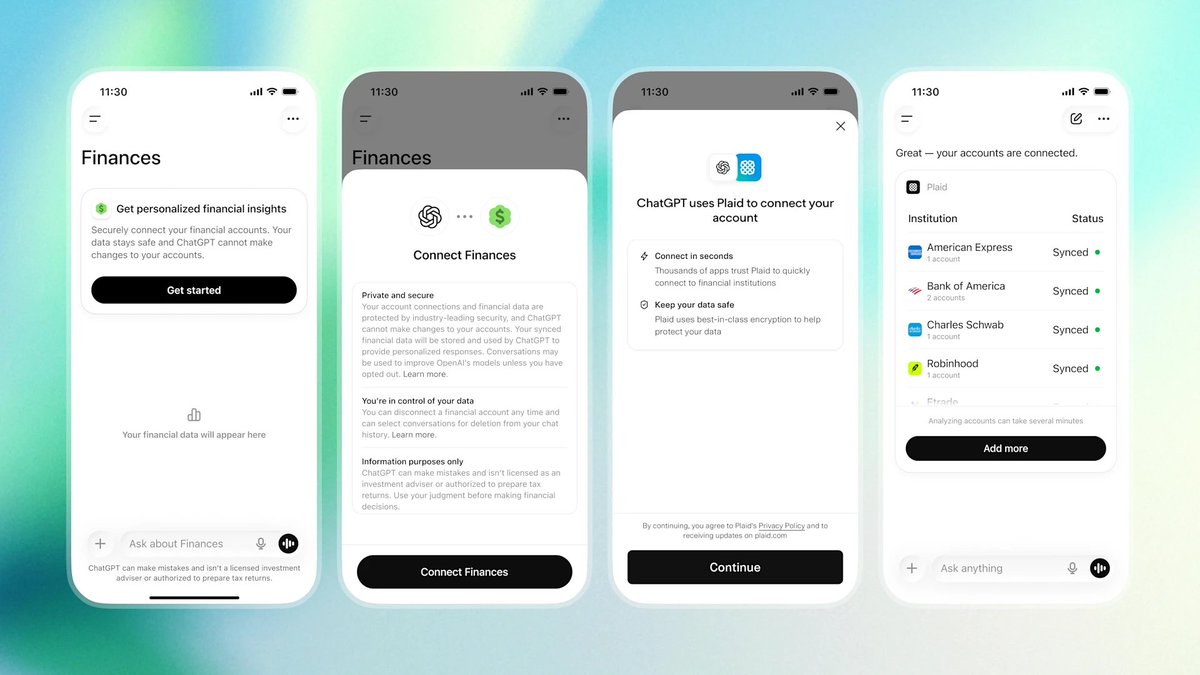
OpenAI launched a personal finance feature in ChatGPT for Pro users in the US.
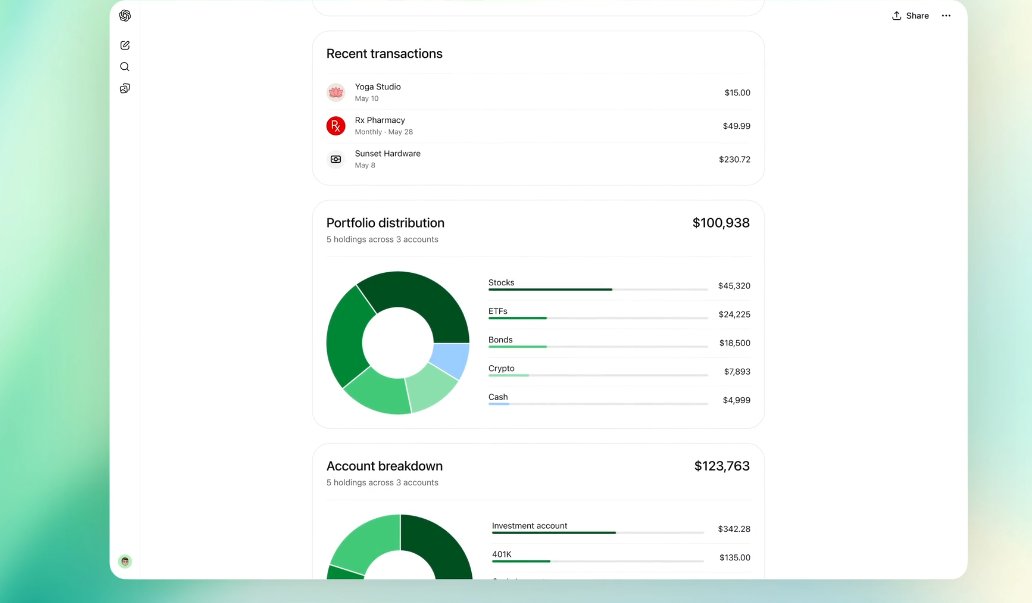
You connect your bank accounts via Plaid, get a spending dashboard, and can ask GPT-5.5 questions grounded in your actual transaction data - balances, spending patterns, subscriptions, investments.
It can't see full account numbers or move money. Intuit integration is coming for things like tax estimates and credit card applications.
Financial memories store context like savings goals across conversations.
Plus users get it later, free tier eventually. They built an internal benchmark with 50+ finance professionals and say GPT-5.5 Thinking scores 79/100, GPT-5.5 Pro 82.5/100 on complex personal finance tasks.
Hot take: Chat is useful for asking questions about money.
But it is not a good interface for managing money.
Finance is full of structured workflows:
budgeting, bill pay, taxes, investing, debt payoff, categorization, approvals, alerts, and planning.
For those, you want purpose-built UI.
Charts, tables, sliders for scenarios, dashboards, approval flows, etc.
Chat works best when intent is fuzzy: “Where did my money go?” or “What should I look at?”
But once the job becomes structured, repeated, visual, or high-stakes, UI wins. People are way more likely to use a purpose-built UI that guides them than a chat window for this.
Like what @bchesky said about travel, similar thing here.
A preview for Pro users: a new personal finance experience in ChatGPT.
Pro users in the U.S. can securely connect financial accounts, see where their money is going, and ask questions based on the information they choose to connect.
Your full financial picture, now in ChatGPT.