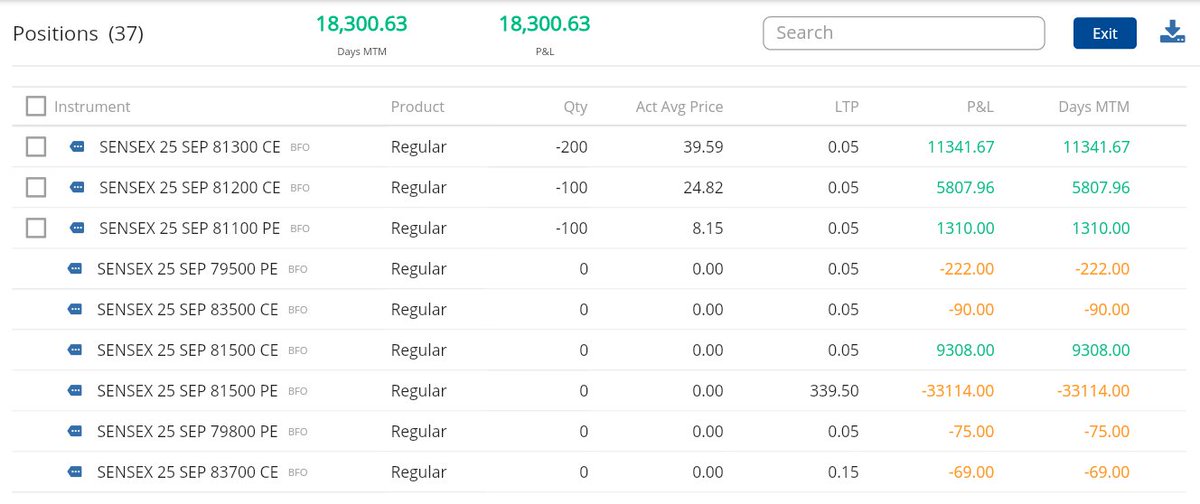
With derivatives being 1000 times bigger than cash volumes, this is bound to happen.
Even worse, ppl will figure out how to do this by forming groups/nexus.
The simple solution is to remove the incentive altogether.
Delink 0DTEs from CAS. All the objectives of CAS will be met
The market is now a complete casino from 3:15 - 3:30.
First, what exactly is this 3:15 – 3:20 blind zone?
No trading in the cash market but F&O remains open for 5 minutes. So options can move around randomly? Fail to understand the purpose.
Then comes the hero-zero window.
Entire day’s move on one side and these last 10 minutes on the other.
How is anyone supposed to trade meaningful size in this structure?
This isn’t about profit vs loss or about option buyers vs sellers.
It’s about messing with fundamentals of the F&O market.
The current CAS implementation is just going to hand over more money from retail to big players.
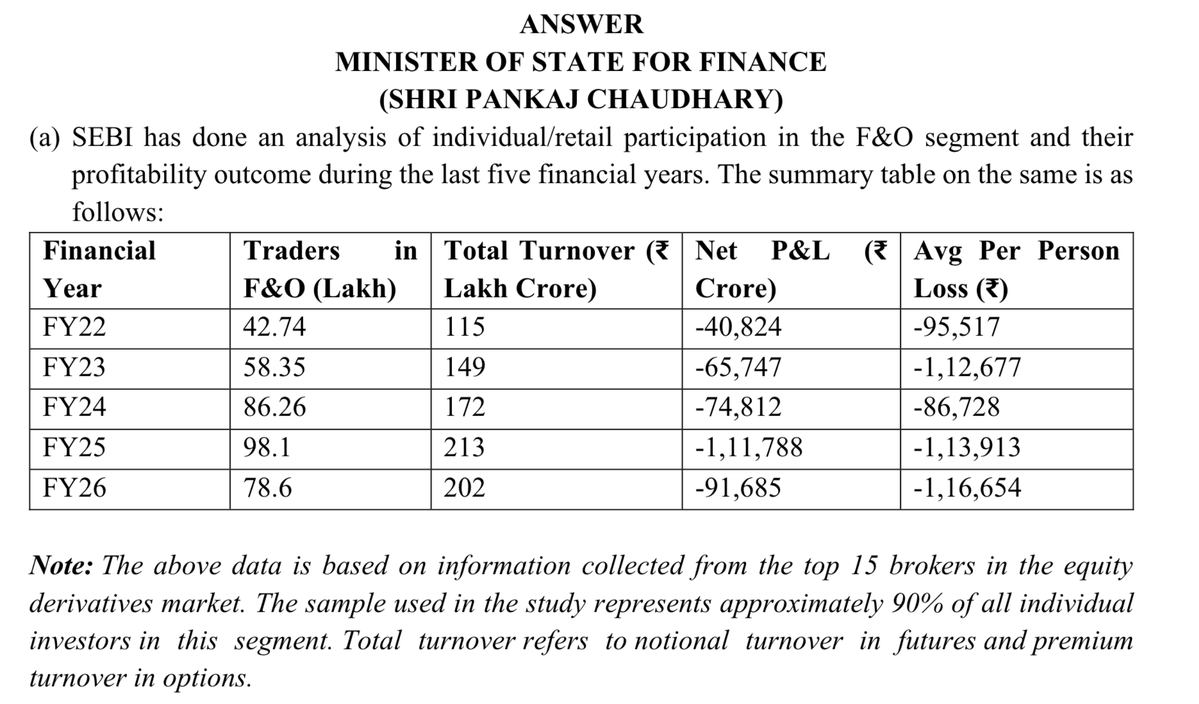
Finance Ministry has released the data showing net losses for retail traders fell to ₹91,685 crore in FY26 from ₹1.12 lakh crore in FY25
Government is stating they were able to reduce the loss of retail traders by increasing STT and margin requirements
This conclusion is missing four important points :
1. STT Collection : The greed of collecting STT from traders is at an all-time high. Government's collection from STT has increased from 6,634 Crores in FY 22 to 27,695 Crores in FY26. The important point here is that fewer traders are paying more STT now, which actually hits the P&L statement. STT Collection has increased by 318% in comparison to 35% growth in India's GDP in 4 years.
2. Active Traders: India witnessed exponential growth in the number of F&O Traders. We went from 42.74 lacs to 98.1 lacs in just 4 years. The number has now fallen from 98.1 lacs to 78.6 lacs in just 1 year. These ~20 lacs are now moving onto more risky platforms, which include crypto platform offerings with 100 times leverage and India is still losing net money. We may see rise in dabba trading culture too.
3. Average P&L : We managed to reduce the number of traders but the average loss for traders has increased from ₹ 1,13,913 to ₹ 1,16,913. This shows that the average trader is now losing more money due to new regulations.
4. Milking STT : Government has further increased STT on futures and options by 150% and 50%, respectively, in the 2026 budget. This is effectively equivalent to milking traders for just participating in markets, as you pay STT on the transaction irrespective of loss or profit.
Market Participants lost 91,685 Crores in F&O, but 27,696 was collected by the government in the form of STT
India's top 5 brokers made a cumulative profit of 10,300 Crores in FY2025 and the government made 22,225 Crores during the same period from charges on transactions only
The job of the government is to regulate markets instead of thinking of it as free money for their revenue collection to distribute it as freebies to win elections
STT is very close to paying protection money on F&O & equity transactions without any protection benefits
If we really want to make Indian markets efficient and turn them into a global hub, we need to address the unfair charges on market participants
The trading volume in the Closing Auction Session on NSE hits an all-time low today
3rd August : ₹1,276 Crores
4th August : ₹1,542 Crores
5th August : ₹1,383 Crores
6th August : ₹1,412 Crores
7th August : ₹1,166 Crores
Market participants don't want to participate in CAS
Traders: If CAS has affected your trading, please take two minutes to fill out this form.
https://t.co/bRuZfDnNDl
You can share how it has impacted your trading, especially options trading and suggest practical solutions, if any.
Please keep your feedback respectful, factual and free from derogatory language.
🚨 SPREAD THIS EVERYWHERE 🚨
Logic needs to be countered with logic.
They can't give vague answers like "With time it will improve"
No. It won't.
Coz the issue is structural.
We can't simply copy something without assesing suitability to our markets.
1.Reduction of 0DTEs
2.Utterly stupid ELM
3.Choking of prop trading
4.Increasing STT, which itself is a redundant tax
Now this horrendous CAS.
SEBI seems to have lost it.
#rollbackCAS
So what I have understood is, its like a T20 cricket match where in the 19th over everyone's TV will stop broadcasting the match, and after sometime the results will be announced and we have to accept the result
😅
#rollbackCAS
What the hell is happening to the Indian stock market?
Dear @SEBI_India & @NSEIndia@BSEIndia
How many times do you expect traders to rebuild their entire business?
> December 2020 – 50% leverage removed
> March 2021 – 75% leverage removed
>September 2021 – 100% leverage removed
We adapted.
Yes, leverage is a double-edged sword. But thousands of genuine traders with smaller capital were affected. Still, we adapted.
> September 2023 – Bank Nifty expiry was shifted from Thursday to Wednesday, while BSE launched Sensex weekly expiry on Friday. Suddenly, we had expiries almost every trading day.
Many traders, especially algo and 0-DTE traders, redesigned their entire systems.
We adapted.
> November 2024 – Weekly expiries of FinNifty, Bank Nifty and other indices were removed. Only Nifty and Sensex weekly expiries remained.
Again, thousands of traders had to change their strategies.
We adapted.
> February 2025 – Expiry-day margin benefit was removed.
STBT traders were hit badly.
We adapted.
> 1st September 2025 – Nifty expiry shifted from Thursday to Tuesday.
Again...
We adapted.
> Jane Street reportedly made billions of dollars from Indian markets over the years. Later, regulatory action was taken, and subsequently trading restrictions were lifted after payment of regulatory dues/settlement.
How exactly did all of this benefit Indian retailers?
Meanwhile...
- Option STT has increased massively over the last few years.
- Bid-ask spreads have widened.
- Slippage has increased.
- Global volatility has increased.
- Transaction costs keep rising.
We adapted to everything.
And now...
Closing Auction Session (CAS).
Seriously?
Every few months there's another structural change.
Every few months traders are forced to rebuild their systems.
Every few months liquidity takes another hit.
You say these changes are for retail investor protection.
Then please show us the data.
Can you show even one report proving that retail trading losses have actually reduced because of all these interventions?
If not, then what exactly are these constant changes achieving?
Instead of making markets more efficient, you're making trading more expensive, more complicated, and pushing serious traders towards crypto and international markets.
As a full-time trader, my inner soul genuinely cries today seeing the direction our markets are heading.
We survived leverage removal.
We survived daily expiries.
We survived removal of daily expiries.
We survived expiry changes.
We survived removal of expiry margin benefits.
We survived higher STT.
We survived wider spreads and slippage.
Now we are expected to survive CAS as well?
Enough is enough.
I request SEBI and the exchanges to reconsider this rule.
Before implementing such major structural changes, consult the trading community. There should be proper communication, public discussion, and representation from active traders.
I also request every trader to raise their voice through the proper channels. If you genuinely believe these changes are hurting market participants, please send your feedback or complaint to SEBI through its official grievance mechanism. And if anyone from the industry has a direct channel to the exchanges or regulators, please help convey the concerns of the trading community.
Please Retweet this so our voice reaches the right people.
Enough of silent adaptation. It's time the trading community is heard.
@AnilSinghvi_@_anujsinghal@SarangSood@PRAFULKULKARN18@adigitalblogger@iarjuntandon@JayneshKasliwal@sunilgurjar01@piyushchaudhry@SantoshPasi@RakeshPujara1@TanmayKurtkoti@justnottamomma@AshishGupta325