The shitcoin purge is mostly done.
This is usually where strong FA low/mid caps begin front-running the next phase of the cycle.
Last cycle: $TAO, $KAS, $QUBIC.
This cycle: $SERV, $NOCK, $OCT.
When liquidity returns, it won’t flow evenly. It’ll concentrate around projects that survived, kept building, and have something real underneath.
$TROLL will flip $PEPE
Here are my reasons 👇🏾👀
-Ownership of IP rights
-Listed on Coinbase before the bull
-OG recognizable meme
-Built on Solana
-Die hard community
-Binance listing catalyst
All the ingredients for a $69B memecoin are there. @Troll_
From @JakeGagain and @cryptojourneyrs live stream today.
@CrashiusClay69 on why he’s so bullish on $Troll
The first he says is, “it has IP rights”.
“You can’t fight it, it has IP, get fucked”
Pivot to IP.
You are looking at the Mount Rushmore of memes
Doge - 80B ath
Pepe - 11B ath
$TROLL - only at 100M market cap today
if you mess this up, you will probably hate life knowing you missed all 3 of these
Get your friends and family into the next 10B+ dollar meme
It’s never gonna be more obvious than this
This will become a reality when a big percentage of subnets are creating real world value.
$TAO will become inevitable.
We early, but I can see it happening.
The quality of subnets is visibly improving by the day.
A nice moment to take stock of the growth that's been taking place on @openservai over the past couple months. It's been immense.
> close to 10 genuinely killer AI teams across prediction markets and DeFi are building and launching on our AI stack.
> first enterprise and government deployments active, more in the pipeline
> soon to make a dedicated hire for enterprise growth side
> SERV reasoning framework seeing big demand
> working on turning the SERV reasoning framework into a custom model
All data pointing in one direction.
Onwards.
I think now is a great time to start creating content (videos/podcasts/articles) to prove your worth and start networking (finding your in-group).
It's a lot easier to stand out during the bear market and the connections you make will likely be higher quality.
Find your squad.
WARNING
Massive AI hype being built in a sudden burst
(and most of it fake)
1) A scary article: I was surprised to read a long article on Twitter (X) claiming it's just 6-12 months before a Covid-like event changes this world. It claims this will be the AI-event, where most white-collar jobs worldwide would be gone, because AI is that good now. That article got 100 M plus views. Clearly, people are spooked (naturally). So the psy-op has worked.
(and I saw other similar dark articles too)
2) Suddenly many influencers are pushing the same narrative, and it so turns out that media reported many are being paid heavy sums by AI firms to push their story (that AI singularity is arriving). But if AI is "revolutionary", does it need an influencer push? No. This should be a clear signal it's hyped.
3) A correction in IT stocks' and SaaS stock's prices is suddenly creating a doom scenario about these companies dying any moment now, with second- and third-order effects on entire economy. Stock investors who haven't studied AI technicals are automatically assuming it's all over, dead, gone, finished. WRONG. NO.
4) What is the truth, and what's most likely to happen?
In my opinion, based on years of observing AI trends, reading and learning AI technology, and doing AI at various levels, my take is as follows. I urge you to read this, and preserve your sanity. Please don't panic, nothing catastrophic is happening anytime soon.
A) IPO pressure: AI firms are going crazy pushing their God-narrative, as many giant IPOs are lined up soon. They need public to buy their paid subscriptions or else the story goes kaput. So they are creating a false hype. It's shameful, anti-social and deeply hurtful.
(Almost all AI firms released doom-scenarios just before their next funding rounds; investors who haven't learnt technology fall for it; pure FOMO. This playbook is so repetitive it's comical)
B) OpenAI is spooked: Sam Altman has lost the lead he temporarily managed to build against Google and others, and now his loss-making enterprise isn't the darling of any investor any more. He's terrified.
C) Elon Musk's Grok does not have the traction in consumer space anyway near what's needed to make it a profit-making entity. So with many other capex-heavy AI firms. But the GPU / TPU hungry AI ops need more capex each day, not less. It's a dead-end for most except cash rich Googles.
D) Enterprise AI is patchy, lagging, slow, choppy: Anyone who has ever built a company, or run a large department, or consulted a business enterprise knows how random, undefined, tacit, and unstructured most of the real world work actually is. No way is AI ever going to replace humans doing those very complex things on a daily basis. No way. Not tomorrow, not in 10 years. NO.
(I am not even beginning to get into 'regulated' industries' needs)
E) Consumer AI is cool, but has limits: The more AI regular humans (of all ages) use, the more the artificiality of it becomes apparent to anyone. The novelty cannot sustain the commercial numbers needed to make AI (foundation models) profitable. OpenAI and Perplexity would never have given free tiers for most Indians otherwise. They desperately need folks to stick to this opium.
F) LLMs aren't solved, Hallucinations aren't zero: The structure of any LLM is such that it will ALWAYS hallucinate, no matter how much fine-tuning humans do. In most sensitive business operations, you cannot allow LLMs to control the core data at all. Can you run an airline with a Generative AI system (LLM-based) that's 98% accurate? Can you run a precision-mfg. operation at 97% accuracy? Can you run a financial services firm with 95% accuracy? NO. NEVER. So the deterministic, old-fashioned computer software ERP will go nowhere. Nowhere at all. LLMs will be good as a top layer on those ERPs to glean insights, nothing more.
[ None can 'train away' hallucinations in a probabilistic LLM model, using larger datasets. You are actually claiming I'll build a dice that lands a 4, or a 6, each time ]
G) Agents aren't magical, humans aren't going anywhere: Multi-step agentic AI is being touted as the final solution where one founder sitting alone can run 100 agents and build an empire. Try doing that once, experience the frequent breakdowns, see the regular edges and new complexities, and you will realize that other than the most mundane of tasks, nothing else will be seamless. Yes, Voice AI agents are good, and many in the developing world are now deploying those, but that's hardly a cutting-edge technology that'll replace all humans.
H) IT and SaaS firms are going nowhere: Ironically, the more AI happens in enterprises, the more will be the need for humans to supervised and orchestrate those bits and pieces of AI, to ensure nothing flies off the rails. The complex software code that Claude and Codex can write only changes the nature of work for the human coders who now have to check the AI code thoroughly for the many edge cases in real world. The nature of IT and SaaS work will change, some companies that can't innovate and adapt will vanish, but many new ones will emerge in their place. (Yes, there'll will be some much-deserved disruption in short-term, and the non-innovating IT firms will have deserved every bit of it)
I) If IT and SaaS are dead, why are AI firms hyping: Ask this simple question - if AI is indeed killing IT and SaaS, then why are AI firms spending massive sums hyping their wares? They need spend nothing and still earn the spoils. But they know the truth.
J) The China angle: Models from China - many of them open-sourced - are getting better and more competitive. Many of them are cheaper, or free (for now). OpenAI complained recently that they are stealing from American models (via "distillation"). Imagine, just imagine - OpenAI that stole entire internet work of creative work is complaining the Chinese are stealing from it. A dacoit crying that thieves broke into his house. Rich. You think these are signs of singularity? Ha! The judicial backlash on stolen content and profiteering off of it hasn't even begun in most jurisdictions.
(now imagine what happens to American LLM-makers when Chinese models gain traction everywhere)
K) Downside of mindless AI already visible: Take just one example: In education everywhere, students, parents and teachers are all realizing that mindless AI use is harming the process of learning, not aiding it. The sensible, guarded and limited way AI should be brought into pedagogy hasn't even been given a proper thought. Students are just doing "cognitive offloading", and turning into non-thinking beings. This is bound to collapse sooner than later. Humans as species don't learn this way - it's a long, tortuous and slow process, always.
L) AI is normal technology: Serious researchers from the AI field have for years argued that AI is being hyped unnecessarily out of proportion, turned into Snake Oil like propositions, and most of AI's predictive powers are anyway not better than that of astrology. AI's ability to talk to use like humans has totally stumped normal people, and anthropomorphism has kicked in. Since no ERP talked to use like a human would, the computer revolution came about without the singularity fears.
M) AI in law and judiciary: The impact will be on the grunt work. It will be cut down substantially. But no judge will outsource their cognition to AI, now will any lawyer. The fact that an LLM can read a complex document fast and summarise it means nothing if it hallucinates. And LLMs will forever hallucinate; that's their structure. (so you'll need humans to sign off on LLM outputs)
N) Enterprise AI's lessons: Every company that has mindlessly gone in on AI has learnt that employees just stopped using it if it didn't adapt to the existing workflows. AI cannot magically alter anything: it can speed things up (with hallucinations), it can generate beautiful stuff (needed or not) and it can help save some time, but the company-to-company needs are so different, it cannot be force-fit on all in one shot. (that is what foundation LLM firms are trying to do). Remember: Enterprise work is not just code. It’s messy data, old legacy systems, compliance needs, multiple integrations, business context, human complexities, and more. Services firms are going nowhere.
O) AI has no solutions for the human situation: Fertility rates everywhere are dropping. Humans are being converted into permanently marketable selves. Consumption comfort has made us soft, and our morality is totally adrift. AI doesn't solve any of this, it just force-multiplies most of it. We built it. It reflects what we are.
5) So what should you do?
a) Read up on AI. Its technical side. How LLMs are created. What they just cannot do. What they can. Why they aren't superhuman at all. Why AI is a good but normal set of technologies.
b) Think why regulated industries (at least 25) cannot hand over their future to AI, LLMs, and GenAI.
c) Check the history of Indian IT and how it kept rebooting itself to suit a new era (from Y2K, to outsourcing, to SaaS backend support, to much more).
d) Check how human societies eventually revolt when artificiality starts overpowering natural human interactions.
e) Be prepared for more hype and nonsense. Sadly, the AI firms won't stop at it at all. They need more humans to subscribe to their paid tiers, and fear seems to be the chosen weapon. Tragic.
[I am subscribed to more than 10 such paid AI tools currently, and know exactly what's good and what's not, and why no singularity is arriving]
f) Adapt your work, and bits of it, to AI tools that can adjust to the workflow well. Let your discretion be supreme.
g) If AI is the shiny new tap, IT is the plumbing behind it.
Remember:
Elon Musk's predictions have mostly gone wrong
Geoffrey Hinton's predictions have gone wrong
Mustafa Suleyman's predictions have gone bust
Yet they keep predicting.
Sad part:
We are living in an age of bullshit. And LLMs are excellent bullshitting machines. The reason the AI Bros are continuing doing so is no one is holding them accountable for their nonstop lies.
But what about AGI:
If AGI is ever built, it won't be by any one company. The technology diffuses rapidly each day. So multiple AGIs in multiple hands. Goes without saying governments will capture (claim) that technology almost immediately. If that day ever arrives, UBI is happening too.
Finally:
Your brain, running on just 20 watts, continues to outthink LLMs fueled by the energy of an entire planet. Never underestimate yourself. And stop falling prey to AI hype.
Gladly @Ryanbabel
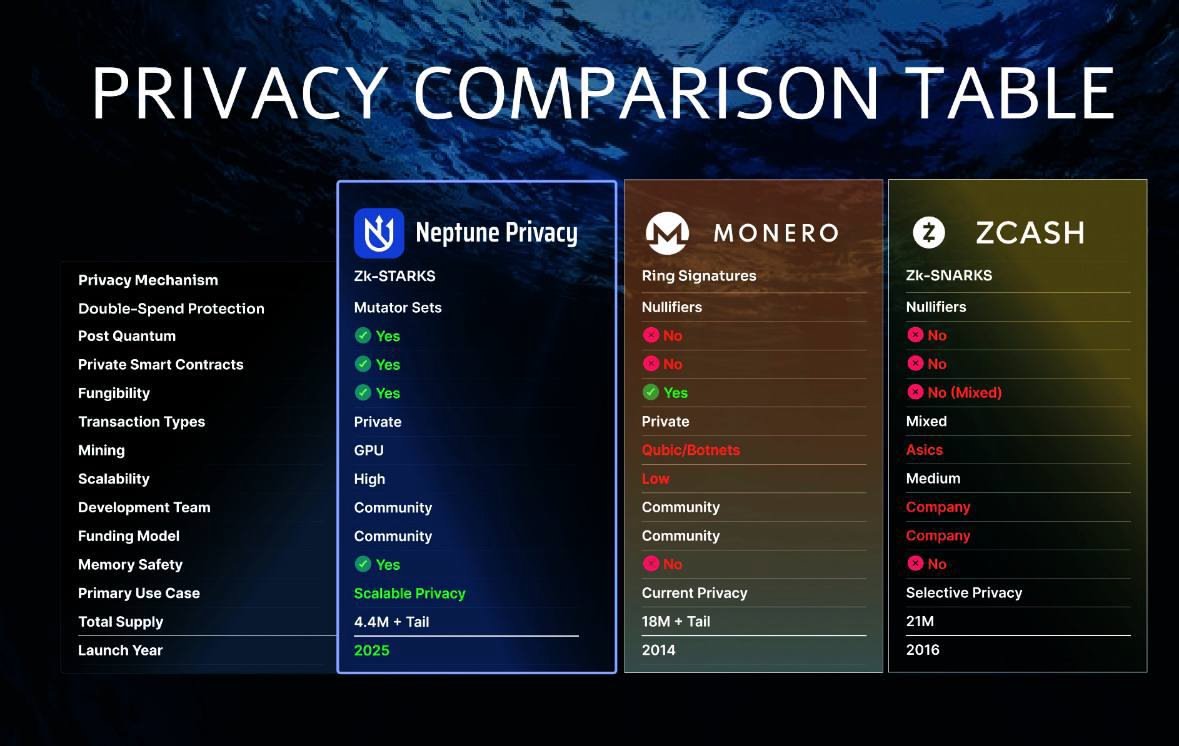
STARKs rely only on collision-resistant hash functions — no elliptic curves or factorization that Shor's algorithm breaks.
Zcash: zk-SNARKs rely on elliptic curves → broken by Shor's algorithm. Also requires trusted setup ceremonies.
Monero: Ring signatures use Ed25519 (elliptic curves) → same vulnerability.
Neptune: zk-STARKs need only collision-resistant hash functions — no curves, no trusted setup.
"The proof system is provably post-quantum under an idealized model of the hash function."
"The only cryptographic ingredient needed to instantiate a STARK is a collision-resistant hash function. The proof system is provably post-quantum."
https://t.co/jjIg3fCdoJ
Neptune's addresses use lattice cryptography designed for it's prime field:
https://t.co/S2qtNaXMQH
https://t.co/o3iHfmBB86
No trusted setup. No quantum attack surface.
The Leverage Trap: 🪤
Centralised Exchanges Secret Weapon to Own You!!!
Do. you ever feel like crypto exchanges are the house in a rigged casino? 🎰
I say leverage trading is their ultimate control hack. It hooks you with dopamine hits from amplified wins, but really? It locks you into their ecosystem 🔐 with margin calls, funding fees, and liquidations they tweak at will.
Think 10/10/25 or 18/04/21, Billions liquidated, straight to their pockets.
They craft the narrative: “Democratize finance!”
I say BS 💩 retail loses 70-80%+.
And price action? They hunt liquidations with data asymmetry, triggering cascades for profit.
High leverage (50x+)?
Pure dynamite for noobs. 1% against you = total wipeout. Ignores volatility, fees, emotions—addiction city. I’ve seen six-fig accounts vanish in minutes 📉
Rethink: Is leverage freedom or chains ⛓️
Spot trade = smarter, build knowledge 🧠
What’s your worst leverage horror? Drop stories below—let’s expose the game @binance and others play #CryptoTruth #DeFiWarnings
I just read this WSJ article on why Europe's tech scene is so much smaller than the US's and China's.
I'm afraid that, like most articles on this topic, it largely misses the mark.
Which in itself illustrates a key reason why Europe is lagging behind: when you fail to understand the root causes of an issue, you have zero chance to solve it.
What makes me competent to speak on this topic?
Back in the late 2000s and early 2010s, I founded and led HouseTrip which at the time was one of Europe's top startups. We were the first historical startup in which all top 3 VC investors in Europe invested.
So I have a pretty intimate knowledge of the European entrepreneurship ecosystem and what it takes to create and grow a tech company in Europe.
We were pretty promising as a startup. In fact as promising as it can possibly get.
We had a similar concept to Airbnb (with some notable differences I won't bore you with), except we created the company 1 year before they did. Which means we were the first-mover - globally - with a multi-billion-euro concept, strong financial backing by the 3 top investors in Europe and, at some point, a team of 250 people with some of the brightest minds in tech in Europe. Everything we needed to succeed.
And yet we didn't succeed: ultimately we were essentially crushed by our American competitor Airbnb in our home turf - Europe - and we had no choice but to sell ourselves to another American company, Tripadvisor.
Believe me, I've reflected long and hard on how that could have happened. In fact after I left the company in 2015 I even spent 3 months in isolation in the Annapurna mountains in Nepal to reflect full time on exactly that 😅
And I then moved to China, where I spent the next 8 years and where I had the chance to study their ecosystem to understand why they're successful and Europe isn't.
So all in all, I think I have some degree of legitimacy to comment on this topic.
The WSJ article says that Europe lags behind due to the usual suspects, the reasons you constantly hear about: too much regulation, fragmented European markets, limited access to financing, a culture that isn't conducive to the startup grind, etc.
Some of those are true, but imho all are secondary.
Take excessive regulations for instance, which gets mentioned all the time. If they were such a hindrance to startups, why would American startups succeed in Europe - like Airbnb in our case - and European startups not? We all face the same regulations 🤷
Or take fragmented markets. Same question: how could US startups successfully conquer these fragmented EU markets when European startups can't?
Because that's the real elephant in the room, and really the story of the European tech scene since the advent of the internet: US startups have shown a remarkable ability to capture European markets despite the supposed barriers, making many of the "usual suspects" explanations for Europe's tech struggles very unconvincing.
In other words, logically, any explanation where both US and European startups face identical barriers fails to address the fundamental difference in outcomes we consistently observe.
Based on my experience, the key problem faced by European startups can be summarized in one word: patriotism.
There is virtually none in Europe, and more than anything that's what's killing EU startups, or preventing them from developing.
It used to drive me absolutely nuts at HouseTrip. What a startup needs first and foremost, especially a consumer-facing startup like we were, is marketing, to become famous.
At first, when I created the company and before Airbnb was even a thing, I used to pitch the company to the media and the general response I would get was almost one of contempt, as in "why would I belittle myself to write about your startup? And furthermore, who would be stupid enough to stay in an apartment when there are hotels? You guys have no future..."
And then Airbnb got launched and the American media started their thing, hyping the company like it was the greatest innovation since sliced bread, like they were national heroes, giving them hundreds of millions in free publicity.
That's when European media started to take notice. Not of us, god forbid, but of Airbnb. The concept was promoted by Silicon Valley, see... so now it was valid.
So I went back to pitch HouseTrip to European media. This time around I was met with a different kind of contempt: "So you guys are like Airbnb? Why would we cover a European copycat when we can just write about the real American original?" Luckily I'm not violent but lets say those moments really tested my civility 😅
All in all, we arrived in the absolutely grotesque situation where, despite Airbnb not having yet set foot in Europe, they were already a cultural phenomenon there, promoted by European media, for free, when the European original - yours truly - had to spend millions on paid marketing (mostly to Google and Facebook, American companies) to achieve a small fraction of the brand recognition.
Which means that, insanely, Airbnb was probably doing more business in Europe than we did before even opening an office there, simply on the back of the free publicity they were getting. How on earth can you even compete with that?
This dynamic was at play with general European elites too. I remember very clearly having dinner next to a legendary European entrepreneur and investor - who I won't name, a man who supposedly, on paper, is dedicating his life to furthering the European tech ecosystem. We naturally got to talk about HouseTrip and he literally told me, and this is an exact quote: "you know I don't really like copycats, they really hurt the European ecosystem." Another big test for my civility that night...
And even if we had been a copycat, so what? That's how China got started, there's nothing to be ashamed of. You need to learn to walk before you can run.
In fact if you study the history of innovation you'll find that every major tech power, including the US, started by imitating and adapting others' innovations before developing their own.
Speaking of China, again a country that I know in depth for having lived there for 8 years after HouseTrip, I've come to the conclusion that patriotism, a deeply rooted mindset of sovereignty, is truly the magic ingredient behind their success.
Contrary to popular belief, they don't do it in a stupid way by just banning competition. Those cases are actually very rare and only occur if the companies in question violate Chinese law in pretty egregious ways.
Most of the time it's the exact contrary: they welcome foreign companies and competition, but create conditions where local alternatives can thrive alongside them, giving Chinese users and businesses legitimate options to choose domestic champions.
Which means you end up with, for instance, Apple doing well in China but simultaneously allowing the rise of Huawei or Xiaomi. Or Tesla doing well in China but simultaneously allowing the rise of BYD or Nio. Etc.
And China is, interestingly, more comparable to the EU than most people realize. It is, again contrary to popular belief, extremely decentralized when it comes to doing business, with various provinces competing against each other much the same way EU countries compete against each other.
But they do it in such a way where, again, the overarching sense of Chinese sovereignty never gets sacrificed at the altar of provincial competition. And where the ultimate goal is to develop Chinese champions which can successfully compete on the global stage.
So there you have it, the dirty little secret behind Europe's lag. We're essentially witnessing a "colonization of the minds" whereby Europe has structurally internalized its technological inferiority, celebrating American startups while dismissing its own homegrown companies.
Why does this barely ever get talked about? Think about it: do you seriously think that the Wall Street Journal would start advocating for, essentially, policies hostile to American tech dominance?
Much better to focus on the usual red herrings like too much regulation or fragmentation which, conveniently, would primarily result in clearing obstacles for American tech giants to dominate European markets even further, rather than nurturing homegrown competitors. This article is, in itself, an illustration of the "colonization of the minds".
Crypto technology evolves, and new narratives give people a fresh impulse to get hooked.
Whether a trend lasts is speculative, but what drew me in wasn’t just the privacy hype, it was the whole product range I saw.
Neptune is uniquely positioned with native privacy via zk-STARKs, programmability, and post-quantum resistance on a PoW Layer-1.
Another one... 🧵
@NeptunePrivacy $XNT
zk-STARKs (Scalable Transparent ARguments of Knowledge) are a newer evolution of zero-knowledge proof technology, building on an earlier generation known as zk-SNARKs.
At their core, zero-knowledge proofs replace visibility with provability, making it possible to verify something without revealing the secret details behind it. In practical terms, ZK proofs do not reveal any information about the claim beyond the fact that it is true.
In crypto, zero-knowledge proofs let you confirm that a transaction is valid or that you hold funds—without revealing amounts, addresses, or balances.
Neptune’s Privacy and Double-Spend Solution
STARKs and SNARKs allow transaction details to be hidden — amounts, smart contract states, and even the origin and destination of funds — enabling private, anonymous transactions while still allowing auditors to verify system integrity.
Hiding information, however, makes preventing double-spending tricky. STARKs and SNARKs alone can’t guarantee coins aren’t spent twice, so additional constructions are needed.
Neptune solves this with a mutator set, a cryptographically authenticated structure that replaces the traditional UTXO list.
It ensures double-spend safety, keeps addition and removal records unlinkable (so researchers cannot trace transaction graphs), and allows full nodes to verify new blocks efficiently without storing the entire transaction history, helping prevent blockchain bloat.
"Mutator sets deliver what no other privacy architecture can: confidential transactions, transaction graph obfuscation, logarithmic verification, and no trusted parties."
Triton Virtual Machine
At the heart of Neptune’s Layer‑1 blockchain is the Triton Virtual Machine (Triton VM), a custom, Turing‑complete execution engine designed as a ZK‑STARK engine.
Unlike typical blockchain VMs, Triton VM is built to generate zk‑STARK proofs alongside program execution. Every computation produces a proof that its output is correct, allowing other nodes to verify the result without rerunning the program. Triton VM also supports recursive verification, meaning proofs can certify previous proofs, enabling massive scalability while maintaining privacy.
For developers, Triton VM means private smart contracts and confidential DeFi applications can run efficiently on-chain — the same computation can be proven correct without revealing sensitive data. It combines programmability, privacy, and cryptographic assurance into a single execution layer.
Underpinning all of this is a robust base layer: Proof-of-Work provides battle-tested security, decentralization, and censorship resistance, giving these applications a foundation that is both secure and resilient.
Neptune combines this with post-quantum security and scalable privacy, creating a foundation unmatched by other public Layer‑1s.