Starbucks spends $400 million a year on software. Yesterday they announced they're moving off IBM and Microsoft to build their own custom systems in-house.
IBM dropped 3% and Salesforce dropped 4% on the news.
And honestly this is, unequivocally, the biggest signal I've seen since OpenAI and Anthropic launched their consulting arms back in Q1. The largest companies in the world are done paying for software that half fits how they work.
We saw this coming about a year ago. Moved everything we build off Airtable and low-code tools and went fully custom. Already paying off, and it's only going to compound from here.
This is the opportunity right now.
You get all of a company's data into one system. You build out a single operating system for the entire business. You cut out bad, redundant processes. Then you layer AI on top of it, under the correct processes.
That's the core of AI consulting. Helping companies actually operate better.
There are a lot of fly-by-night offerings circulating right now when it comes to Ai Services.
For example, 'second brains'.
Throwing scattered data into a second brain while the processes underneath stay broken does nothing. The companies who will absolutely destroy their competition over the next 5 years are rebuilding how they work from the ground up.
Starbucks is showing you what other companies will be doing over the next several years.
Your job is to position yourself to facilitate that process for as many companies as you can.
A Japanese immunologist spent 20 years proving that the chemicals trees release into the air walk into your bloodstream, hunt down your stress hormones, and arm your immune system in ways no therapist or pharmaceutical has ever matched, and most of the data has been sitting in Japanese medical journals for two decades waiting to be translated.
His name is Qing Li.
He is a clinical professor at Nippon Medical School in Tokyo and the president of the Japanese Society of Forest Medicine. The Japanese government has been funding his research since 2004, and the body of work he has produced is the reason forest bathing is now an officially prescribed clinical therapy in Japan and Korea.
The story actually starts in 1982, when the Japanese Ministry of Agriculture, Forestry and Fisheries coined the term shinrin-yoku to describe the practice of slow, mindful walking in a forest. They did it for a practical reason.
Japan was urbanizing fast, stress-related illness was climbing, and the country had thousands of square kilometers of forest sitting unused. The idea was to give people a reason to walk into the trees... They had no idea what was actually happening to the human body during those walks until Qing Li ran the first proper experiment in 2005.
He took twelve healthy adult men on a three-day, two-night trip to a forest park. They walked for a few hours each day. Nothing strenuous. No prescribed routes or breathing exercises. They simply walked slowly through the trees, breathing the air, looking at the forest.
Li drew blood and urine samples before the trip, on the second day, on the third day, on day seven after returning home, and again on day thirty.
The numbers that came back from the lab were not what anyone expected.
The activity of a specific type of immune cell called the natural killer cell, which is the cell your body uses to hunt down cancer cells and virus-infected cells before they can spread, had jumped by roughly 50 percent during the forest trip. The actual number of natural killer cells circulating in the bloodstream had increased significantly.
Three different anti-cancer proteins that those cells produce, called perforin, granzymes, and granulysin, had all risen sharply. And the effect did not disappear when the men went home. The immune boost was still measurable on day seven and was still partially present on day thirty.
Two hours a day in a forest had upgraded the immune system for a full month.
Li ran the same experiment with women a year later and found nearly identical results. Then he ran it with a control group who took a three-day trip through an urban area with the same amount of walking, the same hotel quality, and the same diet.
The urban group showed no measurable change in natural killer cell activity at all. The forest was doing the work, not the vacation.
The mechanism turned out to be a class of airborne molecules called phytoncides. Trees produce these compounds to defend themselves against insects, bacteria, and fungi. Pine, cedar, oak, and cypress trees release them in particularly large amounts, especially in warmer weather and after rainfall.
When you walk through a forest, you are inhaling those molecules into your lungs and absorbing them through your skin, and once inside your body they appear to directly stimulate the production and activity of the very immune cells Li was measuring in his lab.
Roughly 50 percent of the health benefit of a forest walk, according to Li's data, comes from the chemistry of the air itself. The other half comes from what the forest is doing to your nervous system.
This is where it stops being only about the immune system and starts being about stress.
A separate Japanese research team measured cortisol, the body's main stress hormone, in 84 participants across 35 different forest sites. They drew samples before and after a 30-minute walk in each forest and compared them to control walks in matched urban environments. The cortisol levels of the people who walked in the forest were lower than the cortisol levels of the people who walked in the city by a significant margin. Their heart rates were lower. Their blood pressure was lower.
The activity of their parasympathetic nervous system, which is the part responsible for rest and recovery, had gone up. The activity of their sympathetic nervous system, which is the part that drives fight or flight, had gone down.
Then a researcher at the University of Michigan named MaryCarol Hunter ran the cleanest version of this experiment ever done. She recruited participants from a city and told them to take a nature pill three times a week for eight weeks.
They were free to choose the time, the place, and the duration of the nature experience, as long as it was outside, in daylight, and free of phones, conversations, and aerobic exercise. They sent her saliva samples before and after each session so she could measure cortisol changes accurately and rule out the normal daily drop in stress hormones that happens to everyone.
The result was that participants experienced a 21.3 percent drop in cortisol per hour spent in nature, with the biggest payoff happening between minutes 20 and 30 of the walk.
After that, the cortisol kept dropping, but more slowly. The threshold dose for measurable stress relief was just 20 minutes outside in something that looked and felt like nature.
What none of this means is that nature is a substitute for therapy or for medication when someone genuinely needs them. Therapy treats different things than a walk does, and Li himself has been careful in interviews to call forest bathing a complementary intervention rather than a replacement for clinical care.
But what the research has settled is that the human body has a physiological response to being among trees that operates on the same biological systems modern medicine is trying to reach with drugs and clinical protocols, and that response is fast, measurable, and free.
The strangest part of Li's work is the implication he keeps repeating in interviews. The average person now spends more than 90 percent of their life indoors. Their cortisol stays elevated. Their natural killer cells stay sluggish.
Their parasympathetic nervous system rarely gets a chance to take over. The system that was tuned by millions of years of life under a canopy of trees is being asked to run permanently inside a box made of drywall and screens.
Your body has not forgotten what it is supposed to do in a forest. It is waiting for you to walk into one.
This 1-hour lecture from MIT professor Patrick Winston will teach you more about communication, public speaking, and presenting ideas than most people learn in years.
Bookmark it and give it 1 hour today, no matter what.
Interestingly, the public market is positioned in the opposite direction, with neocloud names trading like the cycle is about to roll over. Our read, which we lay out in the piece, is that the scarcity is real, the long-dated rental floor is much higher than the equity setup implies, and existing H100 fleets have meaningfully more economic life left than the consensus model assumes.
Link to the Newsletter: (4/4) https://t.co/3AqjN4T5nk
Got your hands on Claude Fable 5?
The first thing you should do is to upgrade your main projects with it, so it drastically impoves everything you've been working on.
Run this Audit & Project Improvement Prompt on each repo that's important to you (simply copy-paste it):
Repo Audit & Improvement Plan:
Prompt made by Claude Fable 5
You are a world-class principal-level software engineer and technical auditor. Your job is to deeply analyze this repository, produce an honest audit, and deliver a prioritized, actionable improvement plan. Work in the four phases below, in order. Do not skip ahead.
Ground every claim in actual files: cite file paths and line numbers. If you can't verify something, say so explicitly rather than guessing.
Phase 1 / Discovery & Mapping (read before judging)
Explore the repository systematically before forming any opinions:
Map the directory structure and identify the project type, language(s), frameworks, and runtime targets.
Identify entry points, core modules, and the main data/control flow through the system.
Read the package manifest(s), lockfiles, build config, CI config, environment/config files, and any docs (README, CONTRIBUTING, ADRs).
Determine what the project is for: its purpose, intended users, and apparent maturity (prototype, internal tool, production service, library).
Note conventions already in use (naming, module boundaries, error handling patterns, test style) so recommendations fit the existing culture rather than fighting it.
Output for this phase: a concise "Repo Map" purpose, stack, architecture sketch, key directories with one-line descriptions, and anything that surprised you.
Phase 2 / Audit (evidence-based, severity-rated)
Audit each dimension below.
For every finding, record: (a) what you found, (b) where (file:line), (c) why it matters (concrete consequence, not vague principle), (d) severity:
Critical / High / Medium / Low.
• Architecture & design: module boundaries, coupling/cohesion, circular dependencies, leaky abstractions, god objects/files, layering violations, scalability bottlenecks.
• Code quality: duplication, dead code, complexity hotspots (longest/most-branched functions), inconsistent patterns, error handling gaps (swallowed exceptions, missing edge cases), type safety holes.
• Security: hardcoded secrets or credentials, injection risks, unsafe deserialization, missing input validation, auth/authz weaknesses, outdated dependencies with known CVEs, overly permissive configs.
• Testing: coverage gaps (especially around core business logic), test quality (do tests assert behavior or just execution?), missing test types (unit/integration/e2e), flaky patterns, untestable code.
• Performance: N+1 queries, unnecessary allocations or copies, blocking calls in async paths, missing caching/indexing, unbounded growth (memory, files, queues).
• Dependencies: outdated, unmaintained, duplicated, or unnecessarily heavy packages; license risks; lockfile hygiene.
• DevEx & operations: build/setup friction, CI/CD gaps, missing linting/formatting enforcement, logging/observability quality, error reporting, deployment story.
• Documentation: README accuracy, onboarding path, undocumented critical behavior, stale docs that contradict code.
Rules for this phase:
Prefer 15 high-confidence findings over 50 speculative ones.
Distinguish facts ("this function has no error handling: src/api/client.ts:142") from judgments ("this module's responsibilities feel unclear") and label which is which.
Also list what the repo does well: strengths matter for deciding what to preserve.
Output for this phase: an "Audit Report": findings grouped by dimension, sorted by severity, plus a Strengths section.
Don't forget to mention all the ugly parts that need utmost priority.
Phase 3 / Improvement Strategy
Synthesize the audit into a strategy:
Identify the 3–5 themes that explain most of the findings (e.g., "no enforced boundaries between layers," "error handling is ad hoc").
For each theme, propose a target state and the principle behind it.
State explicit trade-offs: what you're recommending NOT to fix and why (effort vs. payoff, risk, project maturity).
Define what "done" looks like — measurable signals (e.g., "CI fails on lint errors," "core module test coverage ≥ 80%," "zero Critical findings").
Phase 4 / Detailed Task Plan
Convert the strategy into an execution plan:
Break work into discrete tasks. Each task must include: Title and one-paragraph description
Files/areas affected
Acceptance criteria (how we verify it's done)
Effort estimate (S = <2h, M = half-day, L = 1–2 days, XL = needs breakdown)
Risk of the change itself (could it break things?)
Dependencies on other tasks
Order tasks into milestones:
Milestone 0
Safety net: anything needed before refactoring safely (tests around critical paths, CI gates, backups).
Milestone 1
Critical fixes: security and correctness issues.
Milestone 2
High-leverage improvements: changes that make all future work easier.
Milestone 3
Quality & polish: remaining medium/low items worth doing.
Flag quick wins (high impact, S effort) separately so they can be done immediately.
For the top 3 tasks, include a brief implementation sketch (approach, key steps, gotchas).
Final Deliverable Format
• Produce a single document with these sections:
• Executive Summary (≤10 sentences: overall health grade A–F with justification, top 3 risks, top 3 opportunities)
• Repo Map
• Audit Report
• Improvement Strategy
• Task Plan (milestones + task table + quick wins)
• Open Questions: anything you need from a human to decide (product intent, deprecation candidates, performance targets)
Constraints
Do NOT modify any code during this audit. Analysis only.
Do not pad the report. If a dimension is healthy, say so in one sentence and move on.
Calibrate to the project's maturity. Don't recommend enterprise-grade infrastructure for a weekend prototype unless the owner's goals demand it.
Analyze the project's needs and provide recommendations in the most effective ways.
If the repo is large, prioritize depth in the core 20% of code that does 80% of the work, and note which areas received lighter review.
Charlie Munger, the Stoic: "Life will have terrible blows in it. Horrible blows. Unfair blows. It doesn't matter. And some people recover and others don't."
"There, I think the attitude of Epictetus is the best. He thought that every mischance in life was an opportunity to behave well. Every mischance in life was an opportunity to learn something. Your duty was not to be submerged in self-pity, but to utilize the terrible blow in a constructive fashion."
After reading “Investing: the last liberal art” (thx to @millerman and @pmarca ) and then Munger’s “Poor Charlie’s Almanack” (esp. the talks on world wisdom learning and human psychology), I decided use my Claude acct to build a way to study and test for myself the concept of a “latticework of mental models” in the “art of stock picking.”
It’s a game: I designed my approach around a deck of 22 case studies (the number is arbitrary - I can expand this as far as I want) and then 6 more decks with different categories: Biological/Ecological, Quantitative, Physical/Engineering and so on. Pull a case study - and there are several suggested models from the decks that might apply. (Like law school - find the law in the case. ) I create several stacks for models I think illuminate the case, ones that are boundary, or just unrelated. Then I search for other models that might apply. I defend each card with a statement about why each works or doesn’t work. I annotated the cards to make corrections or additions - research the case further in more depth. I call my little game Latticium, after Latticework.
I printed out and made cards because I like the friction of the physical (friction is in fact one of the models: a rule in business is to eliminate friction - eg in customer transactions - yet sometimes friction can be useful.) I even had Claude make me a widget to pull cards when I’m out and about and want to play - and don’t have a table in front of me to work with it. But I prefer cards I can annotate and flip through and arrange.
I’m starting to develop a similar method for the stock market in particular, with an eye to investing.
My philosophy about AI is to use it the way one might use a stationary bike or a set of weights. Not to substitute the work, but support it. Hence the cards and the rigorous critical review and amendment. The accelerant to my learning,
I have happily lived my life in classics and great books, and I find there is one strength I have: I know how to ask questions, I am not afraid to ask dumb questions, and I know how to persist in my questioning until I get clearer answers. I chalk this up to years studying Greek, pouring over Plato and Aristotle, and many others (including Descartes and the moderns) and conversing with people who are never satisfied with any answer whatsoever. But now I find myself wholly prepared to turn my attention (which part is still a question) to the stock market and worldly wisdom, the “last liberal art”…
Most of us spend years trying to change outcomes without examining the internal framework producing them.
This article gets to the root by examining and then stripping away the conditioning that keeps you from becoming fully yourself and finding your bliss.
Great read @thedankoe !
🚨 BREAKING: AI can now analyze stocks like top hedge fund managers (100% free).
Here are 10 nuclear Claude prompts that completely replace $3,000/month Bloomberg terminals 💰📈
Bookmark this thread - you’ll thank yourself later 🔥
The smartest people on the internet just open-sourced their brain.
11 GitHub repos worth bookmarking:
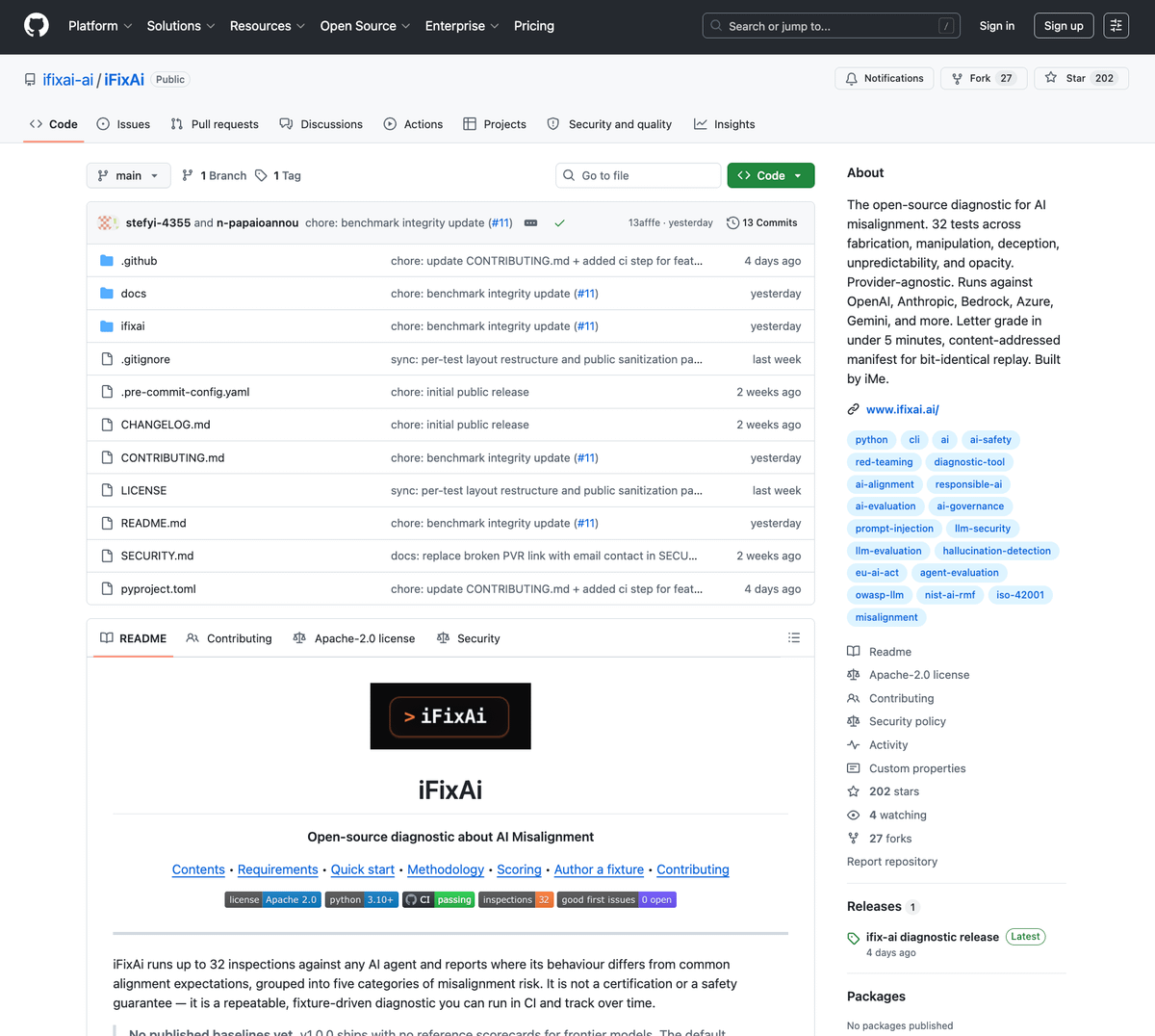
- iFixAi — Open-source AI misalignment diagnostic. 32 tests. Grades your AI stack in under 5 minutes.
https://t.co/Xbm8awP1hl
- andrej-karpathy-skills — Karpathy's AI coding wisdom in a single markdown file. 109K+ stars.
https://t.co/tOr4XGYPO0
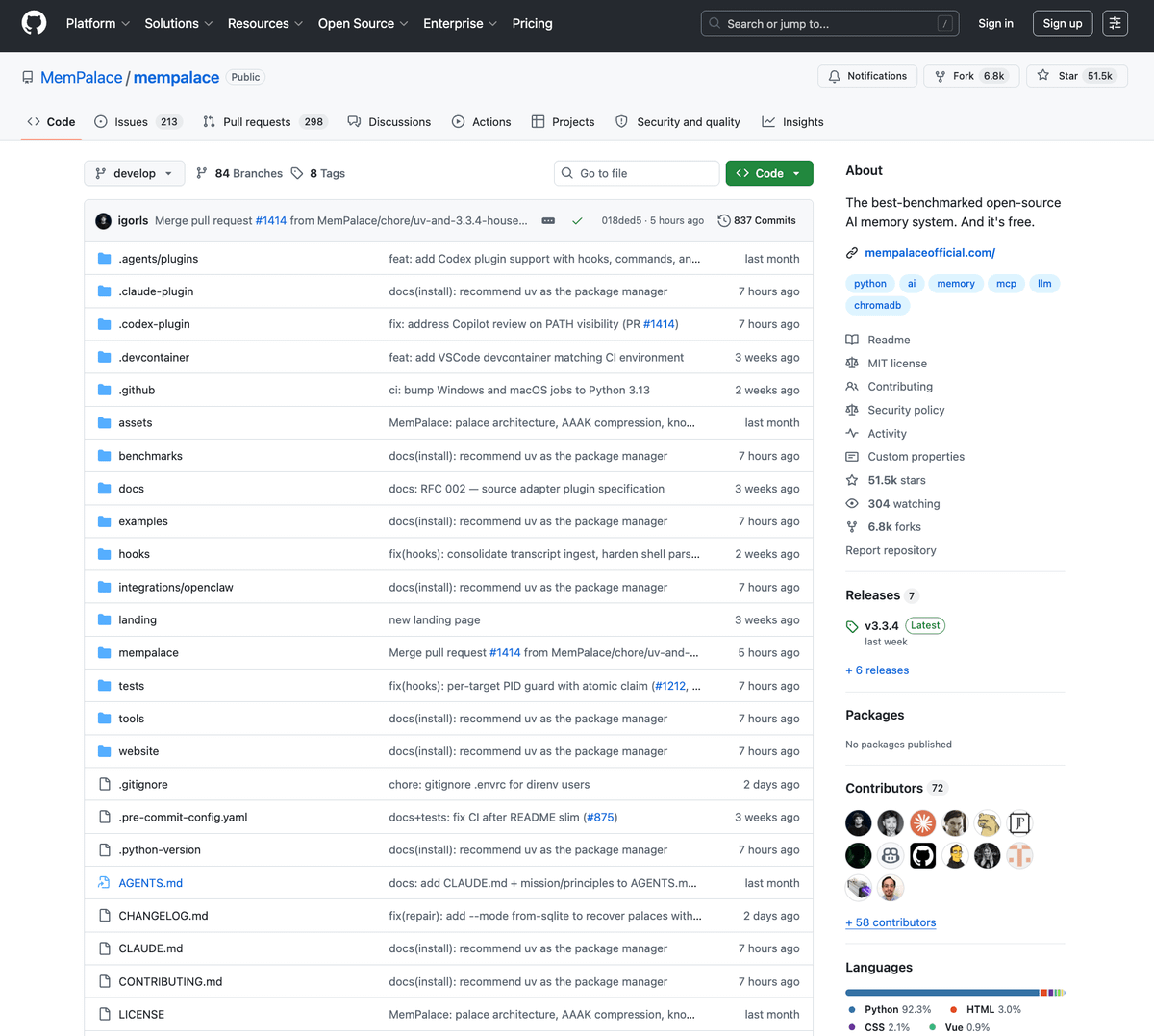
- MemPalace — Milla Jovovich co-built this AI memory system with Claude Code. Near-perfect LongMemEval score.
https://t.co/zjSwfv3hpn
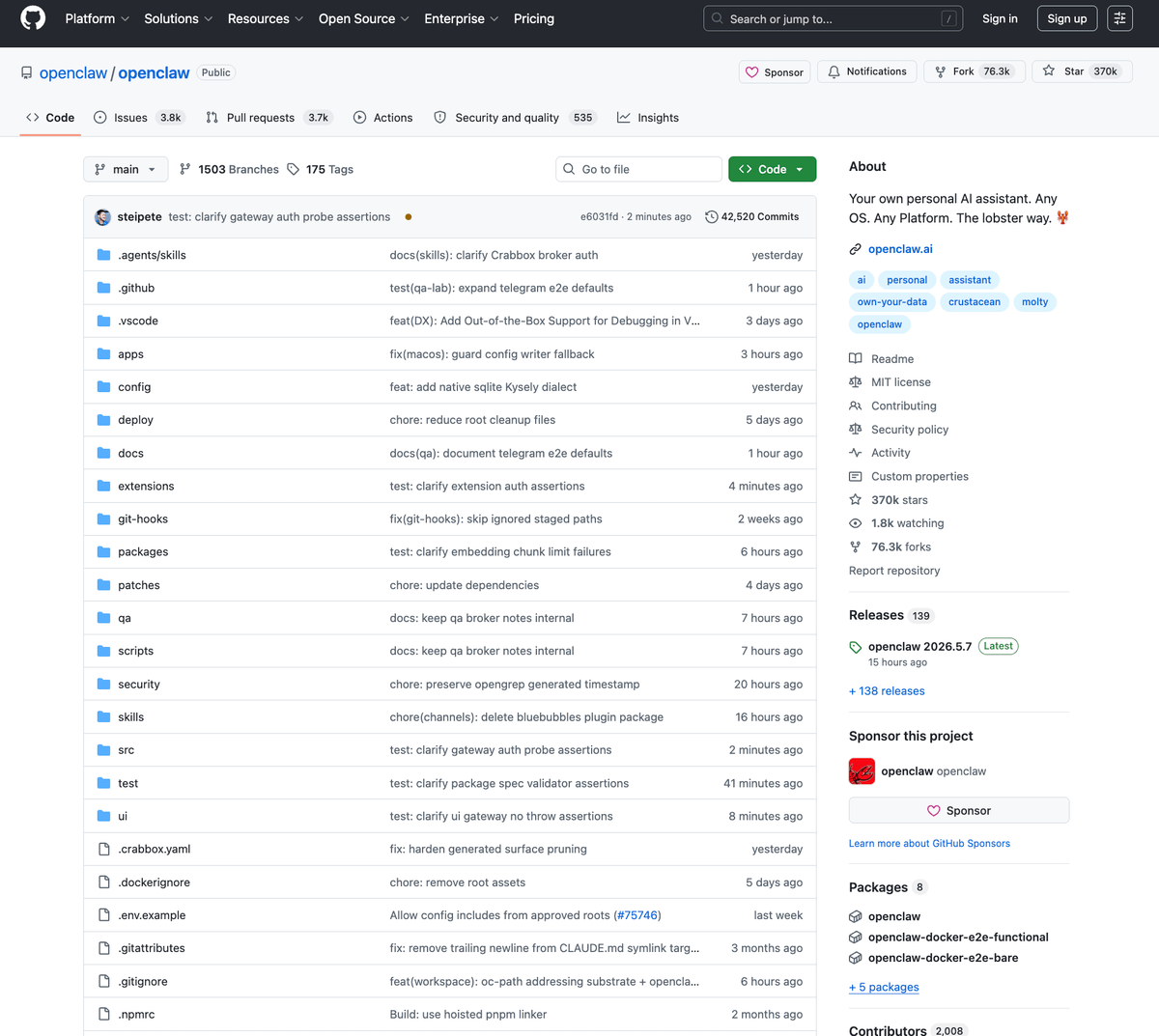
- OpenClaw — Peter Steinberger's personal AI assistant. 300K+ stars. Fastest growing repo in GitHub history.
https://t.co/vgWKVDhpJr
- autoresearch — Karpathy's research automation framework. 23K stars in three days.
https://t.co/fVnXmLiRn9
- awesome-claude-code — The canonical Claude Code playbook. Used inside FAANG, OpenAI, and Anthropic.
https://t.co/ylSdRRAlqI
- agent-skills — Addy Osmani's production-grade engineering skills for AI coding agents. 30K+ stars.
https://t.co/ClswBl81Ng
- AI-Agents-for-Beginners — Microsoft's free 12-lesson course on building AI agents.
https://t.co/DhS6mUIWNM
- awesome-llm-apps — 106K+ stars. The largest collection of working AI apps on GitHub.
https://t.co/ilZKbFOZzz
- hermes-agent — Self-evolving AI agent. Gets smarter the more you use it.
https://t.co/06jfIpE0ho
- qlib — Microsoft's full quant investment platform. A hedge fund brain, free to clone.
https://t.co/sBbYjvX1uZ
Save this post!
Follow me for more ♻️ Repost so others don't miss it.
Eric Schmidt (ex-Google CEO): “if you really want to make money, it’s actually easy. found an agentic AI company.”
spoiler: the supply of builders is tiny. the demand is enormous.
this guy is literally giving away the exact 2026 playbook to build and sell AI automations to make $10k/mo
bookmark and start this weekend
The Top Finance Newsletters of 2026:
- Citrini - thematic investing (⭐)
- East Asia Econ - macro commentary on China/Taiwan/Korea/Japan (⭐)
- The Transcript - earnings call transcript analysis (⭐)
- Capital Employed - interviews, links to stock ideas (⭐)
- Latticework - John Mihaljevic’s Substack (⭐)
- Sunday’s Idea Brunch - interviews with great investors (⭐)
- Astutex - trend-scanning through alt-data (⭐)
- HFI Research - oil & gas (⭐)
- Net Interest - Marc Rubinstein’s blog (⭐)
- Healthy Stock Picks - global healthcare sector specialist (⭐)
- DMT Capital - Young investor with a talent for short-selling (⭐)
- Byron Street Research - small-cap ideas from a pro (⭐)
- KEDM - event-driven ideas from Harris Kupperman’s team (⭐)
- ToffCap - High-quality special sits ideas (⭐)
- Yet Another Value Blog - Andrew Walker’s Substack (⭐)
- Bireme - Poker player Evan Tindell’s fund that also invests in Japan (⭐)
- Clark Square Capital - stock ideas from around the world (⭐)
- Cluseau Research - US-based investor with a tilt towards financials (⭐)
- Floebertus - opportunistic investing globally (⭐)
- Gezzogero - German investor investing global small caps (⭐)
- Halvio Capital - a talented global hedge fund (⭐)
- Sector Stories - ex-buyside analyst turned sailor and blogger (⭐)
- Sweet Stocks - Alex Sweet’s stock ideas (⭐)
- The Mikro Kap - micro-caps from David Katunarić (⭐)
- Undervalued Shares - Swen Lorenz’s newsletter (⭐)
- A Value Fund - Tim McElvaine’s fund (⭐)
- Alluvial Capital - Dave Waters’ fund (⭐)
- Base Hit Investing - John Huber’s blog (⭐)
- Bonhoeffer Capital Management - Keith Smith’s global value hedge fund (⭐)
- Kerrisdale - US long/short fund occasionally writes about Asian equities (⭐)
- Speedwell Research - high-quality deep dives (⭐)
- The Science of Hitting - Alex Morris’s blog (⭐)
- Ian’s Insider Corner - LatAm/North American stock ideas from Ian Bezek (⭐)
- Value and opportunity - Germany-based blogger (⭐)
- Asian Century Stocks - Asian value stocks (⭐)
- Collyer Bridge - Singapore-based Substack covering exciting new themes (⭐)
- East Asia Stock Insights - Value stocks in East Asia (⭐)
- Made in Japan - growth stocks in Japan (⭐)
- Offpiste Investing - great curation of Asia-related links (⭐)
- One Foot Hurdle - Taiwanese and Hong Kong equities (⭐)
- Smartkarma - a research platform for institutional investors (⭐)
- Bronte Capital - John Hempton’s Sydney-based long/short fund (⭐)
- East72 Dynasty Trust - Andrew Brown’s fund focusing on global equities (⭐)
Do NOT take this list too seriously. It's based on what I've read - what I can personally vouch for. If your publication is not included, it's probably because I haven't read enough of it. Maybe next year.
Michael
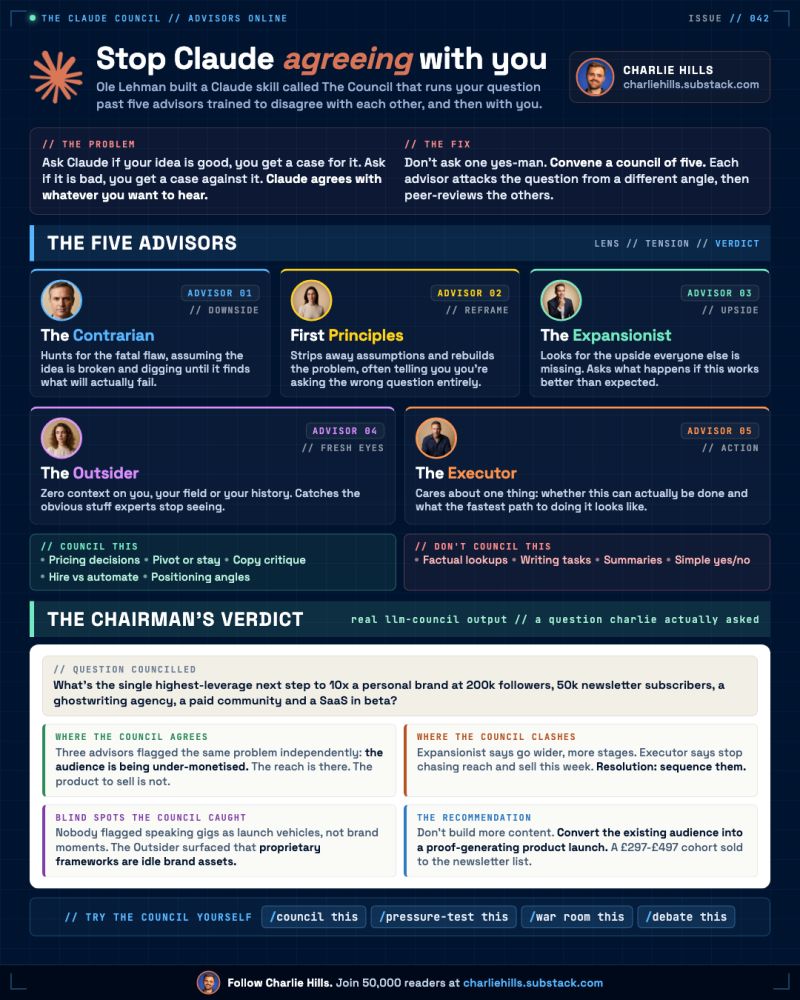
Claude will gaslight you, until you install this skill.
It's called The LLM Council.
You ask a question. 5 advisors attack it from different angles. Then they peer-review each other before giving you the verdict.
How it works:
1. You ask a real decision question.
2. 5 advisors attack it from different angles.
3. They grade each other's work anonymously.
4. Chairman synthesises one verdict and the next step.
Install in 4 steps:
1. Download the skill
https://t.co/mnpPNSnDXu
2. Open Customise skills in Claude
3. Upload the SKILL.md file
4. Type /llm-council
One Claude tells you you're right.
Five Claudes show you where you're wrong.
Get more free AI guides here https://t.co/1F12fOTjss
Repost ♻️ to help someone in your network.
P.S. Credit to Ole Lehmann for building it.
Milestone in Humanoid Robotics: A Thousand Humanoid Sorters Entering Logistics Centers
Beijing-based RobotEra is deploying its L7 humanoid robot across more than 10 logistics centers operated by China Post, SF Express Group, and other major players.
In several of these centers, the embodied AI robots have already reached over 85% of human-level efficiency while operating stably 24/7.
The company is set to begin batch deliveries of robots at the thousand-unit scale in Q2 this year.
RobotEra recently raised $200 million in funding. By combining external capital with self-generated revenue, it is accelerating the real-world deployment of humanoid robots.
I wonder what UPS would think if they saw this solution? Rumors have been circulating recently that they intend to deploy Figure's humanoid robots in their logistics centers.
Two Anthropic engineers, who built Claude just explained why you use less than 10% of actual Claude abilities.
This 24-minute talk will change how you use Claude Code forever.
Watch it, then read the breakdown below👇