Since it was highly requested,
100 Reposts for Youtube Video on
"Mastering HTF Bias"
Comment below what you want next, cleansing this space with clear, concise, and effective information.
If global banks moved from managing 50 fiat liquidity corridors to a single interoperable, ISO20022 aligned bridge asset on DLT rails, what efficiency gains emerge in time, cost, and risk?
Today’s cross-border banking model is built on:
•Correspondent banking
•Nostro/Vostro accounts
•Pre-funded liquidity
•Batch settlement
•Multiple intermediaries
A global bank typically must:
1. Hold liquidity in many foreign currencies
2. Maintain accounts in multiple jurisdictions
3. Accept settlement delays (T+1 to T+5)
4. Bear FX volatility risk during settlement windows
5. Pay multiple intermediary fees
Now imagine a system where:
1. Banks hold primarily domestic liquidity
2. Cross-border transfers convert from bridge asset to destination currency
3. Settlement occurs atomically in seconds
This is the model built around XRP on the XRP Ledger.
The key shift is:
Liquidity moves from being pre-positioned to being on-demand.
Instead of maintaining 40–50 bilateral currency relationships, banks only need:
• Local fiat
• Access to liquidity pools
• A bridge asset with sufficient depth
How Common Sense Wins
Bridge liquidity > pre-funding:
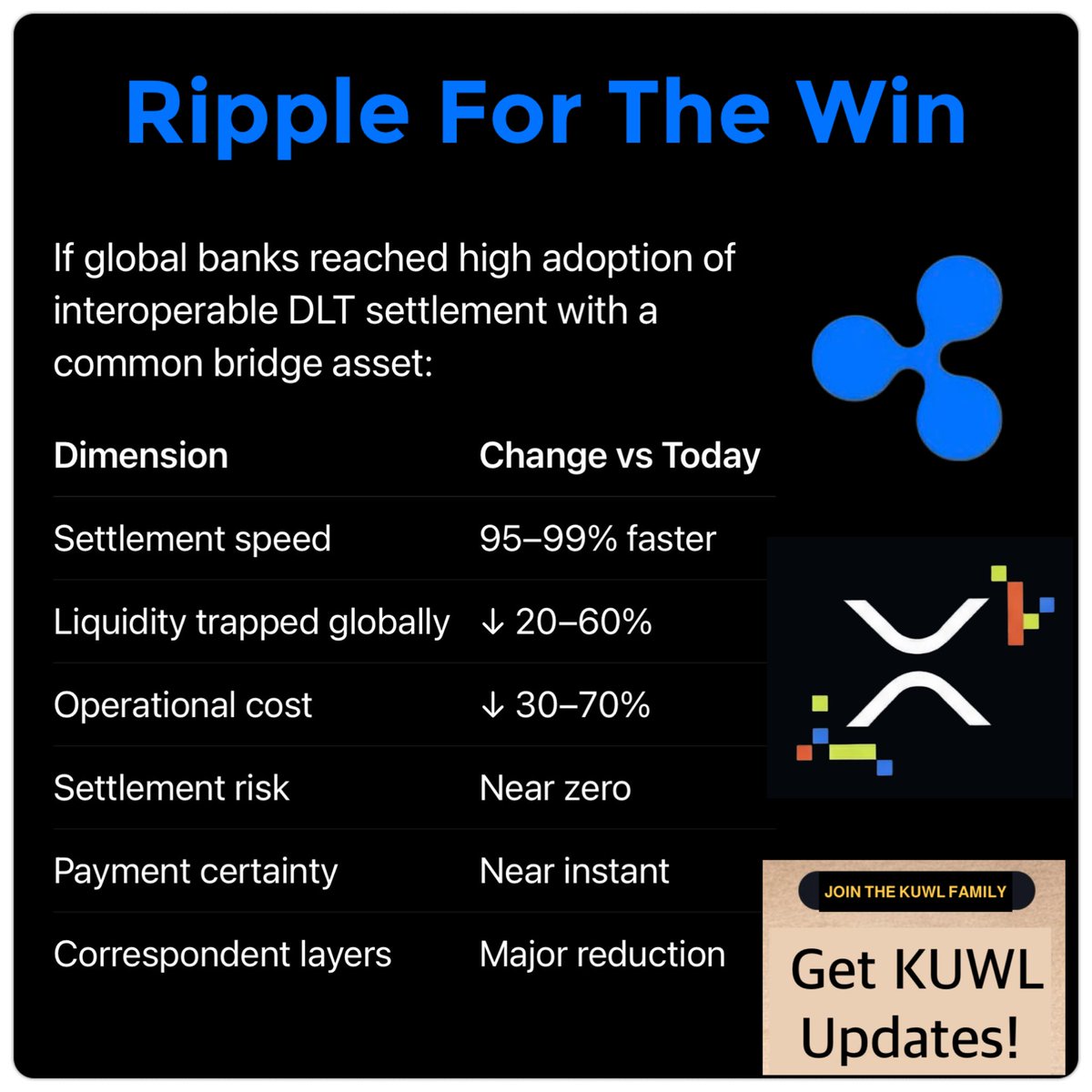
1. 20–60% reduction in capital tied up in payment rails is plausible
2. Return on capital improves materially
Reduced need for:
3. Reconciliation teams
4. Messaging layers
5. Manual exception handling
6. 30–70% reduction in operational processing cost
Real-time conversion reduces:
Hedging costs
7. Spread padding for uncertainty
8. Atomic settlement eliminates the risk exposure of one party paying before the other party settles.
9. Fewer intermediaries = fewer failure points.
10. No need for guessing future liquidity needs in advance.
Without XRP as a Bridge Asset
50 Currencies required:
N(N-1)/2
= 1,225 currency pairs
With One XRP Bridge Asset
50 Currencies require:
2N
= 100 connections
That’s a ~92% reduction in liquidity relationships.
Without a bridge:
50 currencies require 1,225 bilateral corridors.
With a bridge:
100 total connections.
This does three things:
1 Reduces liquidity fragmentation
2. Deepens liquidity pools
3. Improves price discovery
Liquidity concentration lowers volatility over time - a self-reinforcing loop.
This is the core engineering argument for XRP Adoption.
The Big KUWL Picture
• Money is information about value.
• The faster and more truthfully information moves, the less opportunity exists for hidden extraction.
• Efficiency compresses arbitrage that depends on delay or opacity.
And when settlement approaches real time, profit shifts from friction to service.
Critical to Know:
The largest gain for Tier 1 Banks is not transaction fees - it’s balance sheet compression.
Banks make money with capital. Freeing capital is powerful.
When a bridge asset becomes embedded in payment flow:
Banks will not ask:
“Is XRP cheap?”
They will ask:
“Can we operate without it?”
This will be the fundamental shift.
This is why historical crypto models become unreliable once institutional usage dominates.
XRP’s biggest constraint is not technology.
It is:
• national monetary sovereignty
• regulatory comfort
• neutrality perception
XRP must be seen as:
• politically neutral
• highly liquid
• operationally reliable
• legally compliant
This is why interoperability matters more than dominance.
When settlement time approaches zero:
• delay-based extraction disappears
• opacity loses value
• trust shifts from institutions to systems
In Simple Terms:
The faster truth settles, the harder it becomes to profit from confusion.
Honest weights and measures, anyone?
Retail demand is emotional and cyclical.
Infrastructure demand is functional.
Once banks must access the bridge to operate competitively, demand becomes:
• persistent (driven by payment volumes)
• inventory-based (you hold what you need to guarantee execution)
• liquidity-sensitive (depth matters more than hype)
@Ripple@USTreasury@America250
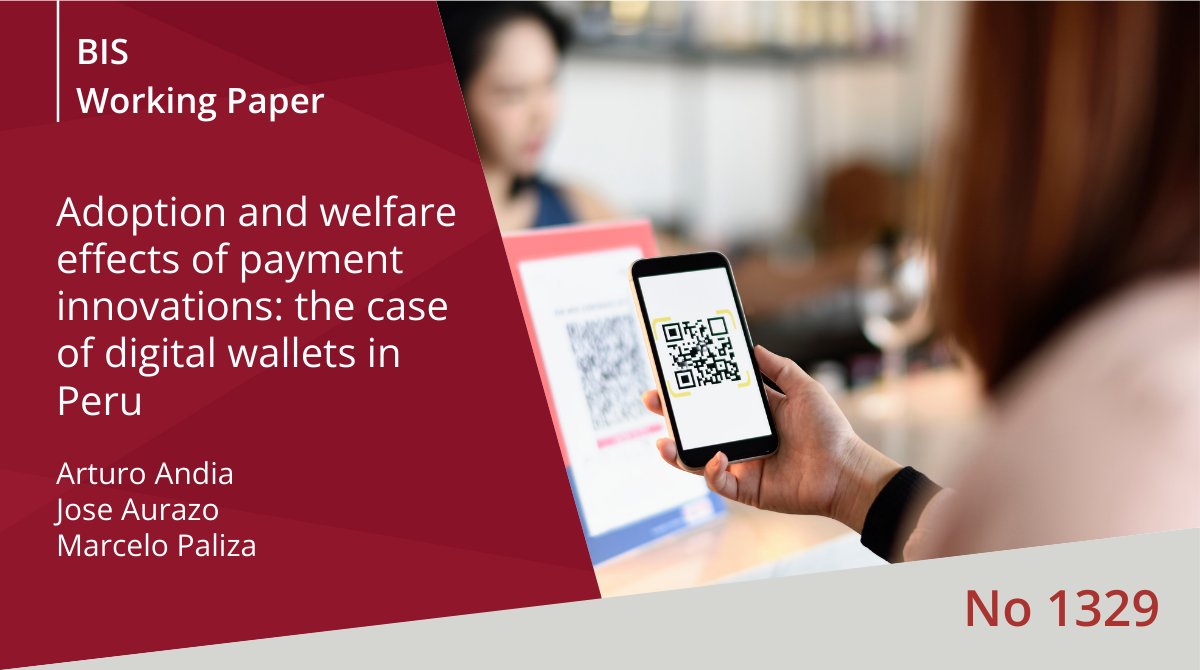
What drives the success of #DigitalWallets? And how do they improve people’s welfare? Research from Peru shows that lower fees, 24/7 payments, QR codes and point-of-sale interoperability are key drivers.
https://t.co/Oi3aVqmgma
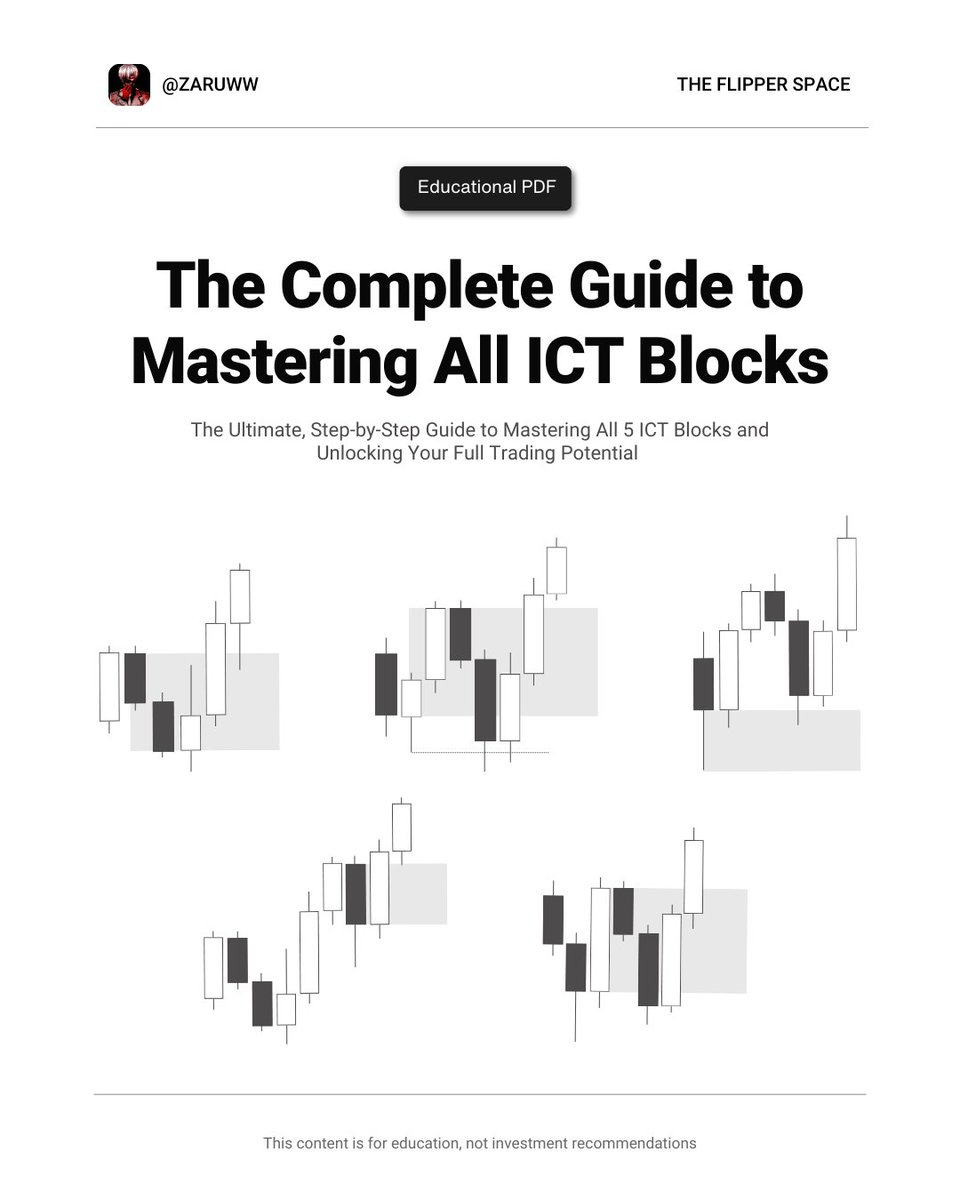
This alone can change how you enter trades forever.
Order Blocks → Breakers → Mitigation → Rejection → Propulsion
All mapped clearly in one PDF.
Like + Repost & comment “Blocks” I’ll DM it.
(Followers only)
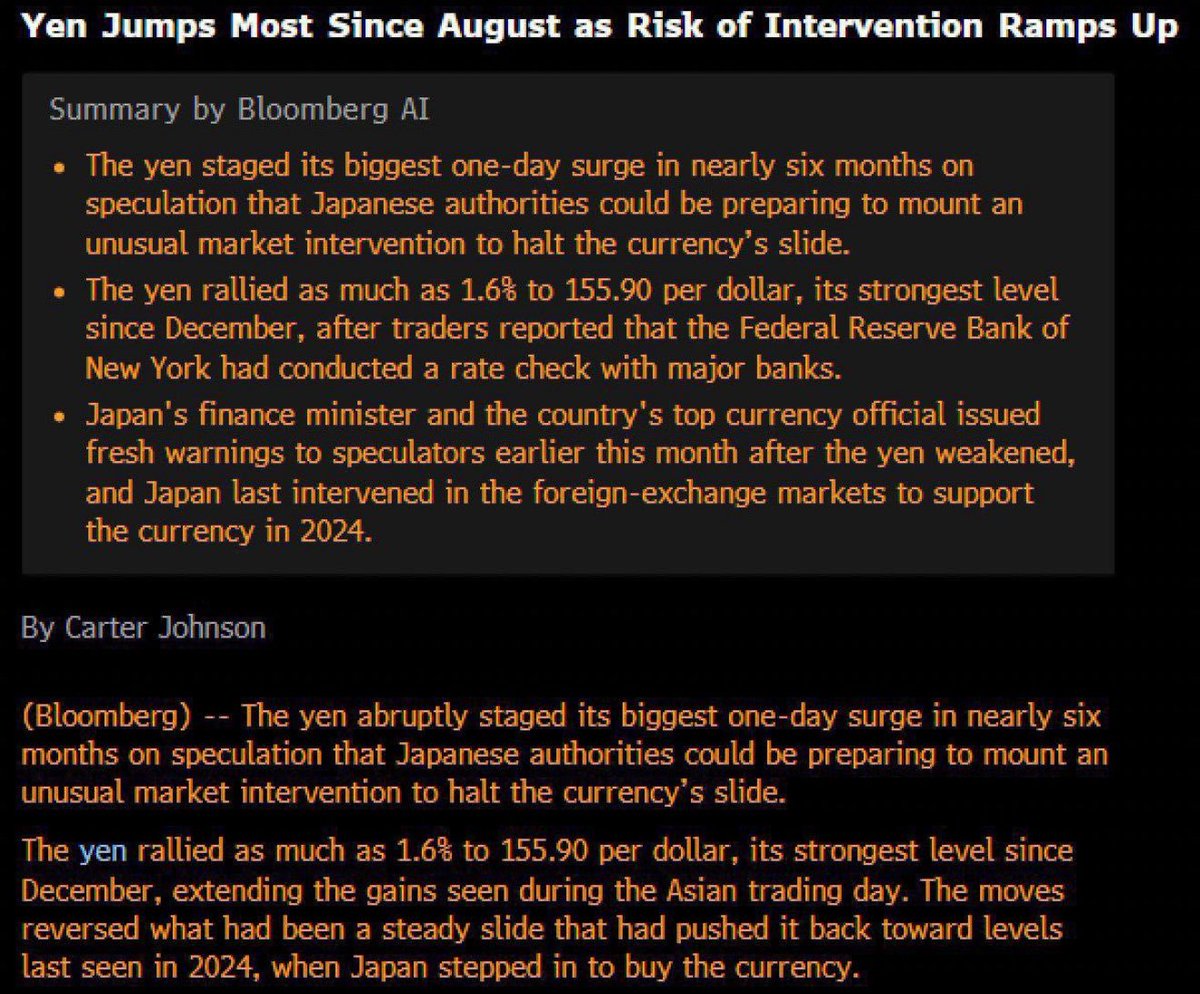
🇺🇸 THE FED IS PREPARING TO SELL U.S. DOLLARS AND BUY JAPANESE YEN FOR THE FIRST TIME THIS CENTURY.
The New York Fed has already done rate checks, which is the exact step taken before real currency intervention. That means the U.S. is preparing to sell dollars and buy yen.
This is rare. And historically, when this happens, global markets surge.
Japan is under heavy pressure. The yen has been weak for years, Japanese bond yields are at multi decade highs, and the Bank of Japan is still hawkish. Together, this creates stress not just for Japan, but for global markets. That is why central banks are now taking the situation seriously.
Japan has already tried to defend its currency many times on its own. But it failed in 2022 and 2024. Even the July 2024 intervention only worked for short time.
History is very clear on this: When Japan acts alone, it does not work. When the U.S. and Japan act together, it does.
We saw this in 1998 during the Asian Financial Crisis. Japan’s solo interventions failed, but when the U.S. joined, the yen stabilized. We saw it even more clearly in 1985 with the Plaza Accord, when coordinated action pushed the dollar down nearly 50% over two years.
That changed everything: The dollar weakened. Gold, Commodities, Non US markets all pumped.
If the Fed intervenes, this is how it'll play out :
- The Fed creates dollars, sells them, and uses those dollars to buy yen.
- That weakens the dollar and increases global liquidity.
- And whenever the dollar is intentionally weakened, asset prices usually surge.
Now look at crypto.
Bitcoin has one of the strongest inverse relationships with the dollar and one of the strongest positive relationships with the yen. Right now, BTC yen correlation is near record highs.
But there is a catch.
There is still hundreds of billions of dollars tied into the yen carry trade. People borrow cheap yen and invest in stocks and crypto. When the yen strengthens suddenly, they are forced to sell those assets to repay loans.
We saw this in August 2024: A small BOJ rate hike sent the yen higher. Bitcoin crashed from $64K to $49K in six days. Crypto lost $600B in value.
- So yen strength creates short term risk for crypto.
- But dollar weakness creates long term upside.
Now, why is this bullish for crypto ?
Because Bitcoin is still well below its 2025 peak. It is one of the few major assets that has not fully repriced for currency debasement.
If coordinated intervention actually happens and the dollar weakens, capital will look for assets that are still cheap relative to the macro shift. Historically, crypto benefits strongly from that environment.
This may become one of the most important macro setups of 2026.
🔥What to expect at The Ondo Summit isn't just a roadmap update - could be a strategic @Ripple partnership impacting $RLUSD in a big way.
If the rumors of an "Ondo Chain" (Institutional L2) are true, the narrative changes overnight.
https://t.co/2d0hQDrpV3
The largest wealth transfer in history is already underway.
$80T is moving to digital-native generations who won’t accept slow, siloed financial systems.
Uphold CEO @SMcLoughlin00 spoke with @AmerBanker about how blockchain meets demands legacy rails can’t.