The GenAI economy has generated $110 billion in sales over the past 12 months. It is growing fast. On an annualized basis, the revenue run rate exceeds $175 billion.
These numbers took us several months to construct, and as far as we know, it’s the first bottom-up, deduplicated measure of consumer and enterprise AI spending across the full stack.
We are releasing this research today in our first The State of the AI Economy report.
https://t.co/cJwZb0T99C
Many people point to CSPs already running negative cash flow and ask how on earth CAPEX can keep growing from here.
It is a foolish question.
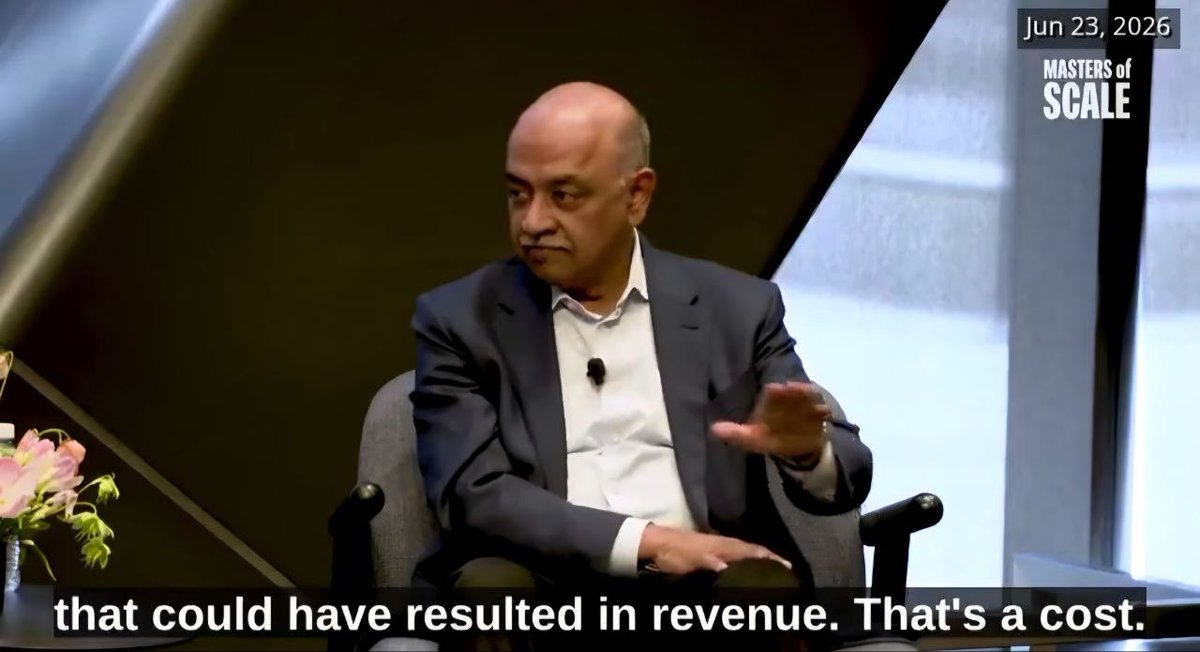
Look at what Arvind Krishna (IBM CEO) said in a podcast conversation.
“Year one of enterprise AI is a net loss. That is exactly why 80 percent of companies right now look like they have failed. It comes down to more engineers, higher token costs, and opportunity cost.
Year two is precisely when the 10x return kicks in. Most companies are not failing at AI. They are simply at the worst point on the curve, right before ROI compresses and improves.”
Ultimately, at this 10x return inflection point, the CSPs’ own revenue base will be expanded by AI, so even as CAPEX grows in absolute terms, the CAPEX to revenue ratio will decelerate, eventually setting off a virtuous cycle, a flywheel effect.
Why do people look to the future when judging CAPEX, but look only at the present when judging cash flow? Cash flow should also be judged by pulling forward the future cash flow.
Tim Cook, who told The Wall Street Journal that the jump in costs was unlike anything he had seen “in any area in over 40 years.”
Biggest price jump in anything I’ve ever seen too. https://t.co/aypJGgssnN
TSMC was too naive from the start.
Intel is emerging as a serious competitor. TSMC has been extremely strict about preventing Samsung-designed chips from being manufactured at TSMC, so why did it allow Intel to manufacture chips at TSMC?
At this point, TSMC obviously has no reason to allocate CPU capacity to Intel anymore. Instead, it will—and should—actively allocate wafers to Intel’s CPU competitors.
I ran the calculations once:
If Nvidia just uses Intel for packaging the I/O die and other peripherals it’s about 4.8 billion in revenue.
If they use it for all of Feynman it’s 60-80 billion in revenue.
Now imagine TPU ontop of that. We are looking at over 100 billion in just packaging revenue not to mention TPU will most likely be on 14A & Nvidia will use 14A for I/O dies and maybe more.
Intel (INTC) Note Takeaways:
•Big Raise for Foundry Capacity
◦Intel 3: +80% (mainly Ireland) by end-2028 (vs end-2026)
◦18A: +100% (Arizona) by end-2028 (vs end-2026)
◦14A: Strong ramp in Oregon
•Capacity Drivers:
◦Robust server CPU demand
◦18A yields improving to ~80%, EMIB to 90-95% in recent weeks
◦Major U.S. fabless on pipeline
◦Major smartphone maker to start with 18A-P (tablets/PCs) + committed to 14A capacity
◦TeraFab project late-2028
•18A Capacity Shift:
Pathfinder Lake volume wafer capacity → Clearwater Forest (CWF) starts 3Q26, with full volume 1Q27 (expected to be ~1/3 of total 18A wafers)
•Financial Matrix:
◦IFS to turn profitable in 2H27
◦DCAI revenue +39% YoY in 2026E / +30% in 2027E
•Nvidia Collaboration: Likely includes x86 CPUs → PC (RTX + Nova Lake in 2027) → Server CPUs (Intel x86 IP + foundry) in late 2028
•TP Raised to $135
@asianinvestors Thanks!agree AI RAN would be huge potential for NOK, full of catalyst, love this. NOK should be rerating by the market of its own InP fab. Ciena is limited by supply as a fabless DCI supplier brings NOK at a strong position
Good take
My guess is
- demand for intelligence is near infinite
- but 80% of workloads will be running on 99% cheaper models within 12-18 months
- 20% of workloads will still run on latest gen models where IQ maxing is important (scientific breakthroughs, higher level ochestrator agents?)
- rough analogy might be what % of macbooks or gaming PCs sold have the maxed out specs for CPU/GPU, prices are falling much faster than Moore's law here though
- this leads me to think the limiting factor will be energy and compute, not better models
At Coinbase we're working hard on routing prompts to cheaper models where appropriate, and in some cases have been able to keep costs roughly flat, while token usage continues to grow exponentially.
RSI, and whether “SOTA rotation” is about to break.
We’re used to SOTA rotating every few months. One lab pulls ahead, another catches up. Gemini was SOTA literally two quarters ago - feels like ages.
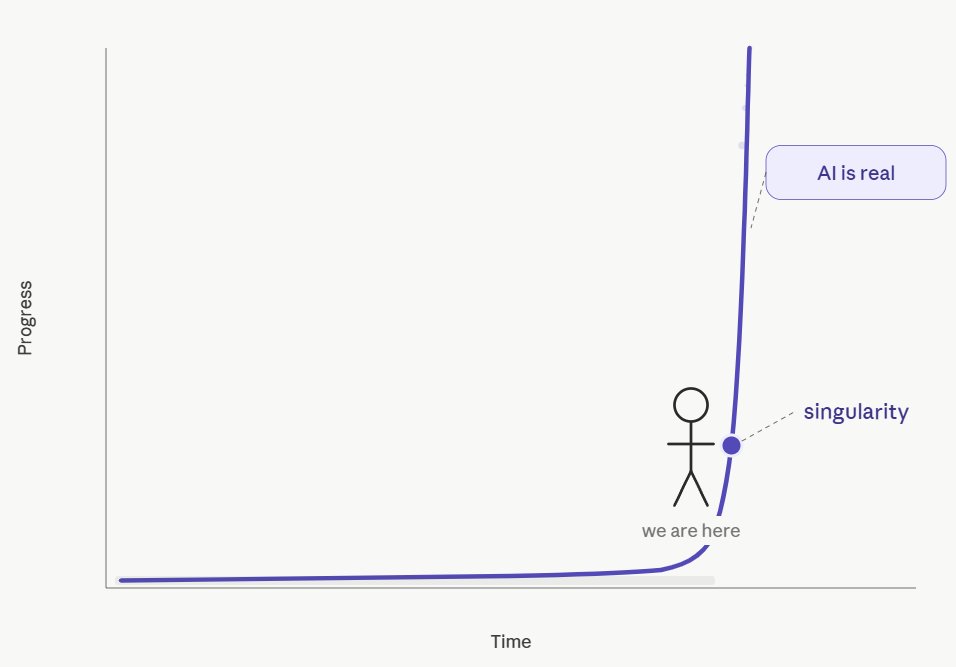
But RSI - recursive self-improvement - could change the competitive dynamics.
Dario on Dwarkesh’s podcast back in Feb: Dwarkesh challenged him - if recursive improvement is real, why does SOTA still keep rotating between labs? Dario’s answer was that, until very recently, the compounding advantage from AI-assisted AI research was still too small to really matter (but it's changing).
Since Jan/Feb, I’ve heard more and more researchers talk about RSI. The idea is simple: you build a better AI, that AI helps you build the next better AI, and the loop starts compounding.
It also explains part of the current “token-maxxing” dynamic - big co. spending $ billions on Claude Code just to keep up. And it helps explain the rumors that $OpenAI / $Google are reorganized around coding as the top priority.
Once that loop crosses a certain threshold, it starts to look like a true industrial revolution. Horses were never going to catch up with cars.