AI agents aren’t just coming for your tasks. They’re coming for the org chart.
OpenAI’s latest paper, The Future of the Firm, explores three possible corporate structures:
Every employee manages their own team of AI agents.
AI agents become formal members of human teams.
AI moves into management, coordinating people, tracking progress, and flagging problems.
The third one is particularly interesting.
Imagine an AI scanning Slack, spotting a sales team promising features that engineering hasn’t even started building, and alerting the CEO before the launch goes sideways.
It could even identify overlooked contributions from employees who rarely get noticed.
But there’s a catch.
The same AI that frees employees from layers of management could also give executives unprecedented visibility into every employee’s activity.
Will AI make workplaces less hierarchical, or turn every company into a surveillance machine?
That’s the real organizational question.
https://t.co/qHPUSDiaUi
@waodao_ai So basically, same AI infrastructure, two possible futures: everyone gets a copilot, or the CEO gets admin privileges over everyone’s life 💀
@MindGamesLabs The 3x increase in daily asset uploads is just as telling. Creation is scaling fast, but discovery and player attention won’t scale automatically.
80%+ of Roblox’s top 100 games now use AI.
Even crazier, Roblox’s new natural-language creation tool, Build, has attracted 500K+ users and generated 70K+ games in just four test markets.
More than 75% of those users had never used Roblox Studio before.
That’s a massive shift.
AI is turning game development from a specialized skill into something almost anyone can experiment with.
But there’s a catch.
When everyone can make games, games become infinite. Player attention doesn’t.
The next big winner might not be the best game creator, but the platform that decides which games get discovered.
AI creates the supply. Distribution captures the value.
Roblox just released a letter to shareholders.
- Over 80% of the top 100 Roblox games now use AI.
- Steal an Egg and Huss Valley are almost 100% AI generated.
- More than 70,000 games have been AI generated with Roblox Build.
Imagine discovering you’ve been enrolled in a university you’ve never attended and owe student loans you never borrowed.
Welcome to AI-powered identity theft.
The US Department of Justice has exposed a scheme involving so-called “ghost students.”
Criminals allegedly stole real Americans’ identities, used AI to submit college applications, complete assignments, and impersonate students in online classes.
The goal? Keep these fake students enrolled long enough to collect federal financial aid.
The money was then routed through bank accounts controlled by the fraudsters, with some funds allegedly sent overseas.
The investigation, dubbed Operation Ghostbusters, has already resulted in five defendants being charged.
The FBI identified more than $32M in losses from similar cases, while the DOJ estimates the broader scheme could involve over $200M.
The disturbing part isn’t just the money.
AI is turning identity theft into an automated operation. You no longer need someone physically pretending to be a student. You can manufacture an entire digital academic life around a stolen identity.
We’ve moved from AI generating fake content to AI generating fake people with real financial consequences.
BREAKING: The DOJ is exposing a major student loan fraud scheme targeting Americans who never attended college, with stolen identities allegedly used to create fake students and obtain taxpayer-funded financial aid.
Assistant Attorney General Colin McDonald says fraudsters are using AI to complete college applications, submit coursework, and even create the appearance of students attending virtual classes, tricking schools into believing real people are enrolled.
"Some even create the appearance of a fake student in an online classroom to trick schools into believing a real person is present... The goal is to keep the ghost student in school for as long as possible."
another cool role at @OpenAI...
they're hiring a Program Manager, Local Community Impact in SF / NYC for up to $230K plus equity!
your focus will be helping small businesses, nonprofits, and community orgs use AI
you'll:
- build the partner operating model, from sourcing and onboarding to renewal and exit
- work with legal, finance, and procurement so partners can start work and get paid
- support local workshops and events while keeping ownership local
- build the playbooks, intake systems, and review processes that let a high-touch program scale
apply here: https://t.co/bnZt9Iojff
Sam Altman just gave one of his most revealing interviews yet.
A few things really stood out:
1. AI is entering a new era of scientific discovery.
OpenAI reportedly spent around $10M in compute on a single mathematical research effort. Altman described watching models solve problems that previously required enormous amounts of human intellectual effort.
His reaction wasn’t just excitement. It was also sadness — the feeling that an era of human intellectual work might be coming to an end.
2. Agents are becoming teams, not chatbots.
Altman prefers “Agent Teams” over “Agent Swarms.” The idea is that thousands of AI agents can work on problems in parallel, fundamentally changing how organizations operate.
3. Traditional AI safety assumptions are being challenged.
He expressed skepticism that sandboxing alone can contain superintelligent systems. Monitoring and alignment become increasingly important as capabilities scale.
4. The AI industry’s sales pitch is broken.
Promising cheaper goods and scientific breakthroughs while simultaneously telling people their jobs may disappear is a terrible way to sell the future.
His bigger concern: a handful of people in Silicon Valley shouldn’t get to decide how billions of people live.
The most interesting part of this conversation isn’t how powerful AI might become.
It’s that we’re approaching a point where the question is no longer just what AI can do, but who gets to decide what it should do.
OpenAI’s @sama joined me at the pub (and had his first Guinness) to discuss the PHP exploit, math weekend at OpenAI, agent swarms, and how he thinks AI leads to deflation.
@mosezmuse The real question is whether Mercor stays a human-expert marketplace or becomes infrastructure for AI training. The former is easier to commoditize; the latter could be much harder to replace.
Mercor pays human experts to train AI.
Its own engineers are increasingly handing coding tasks to Devin before bed, then waking up to tested features and PRs ready for review.
The irony gets better.
Founded in 2023, Mercor reportedly reached $2B in annualized gross revenue in June. That figure includes payments to experts, not just revenue it keeps.
The company sits at the intersection of two powerful trends:
The smarter AI gets, the more valuable high-quality human expertise becomes for training it.
The better AI agents get, the more software development can happen asynchronously, with less hands-on work from engineers.
Mercor is monetizing human expertise to improve AI while using AI to automate its own work.
That’s two sides of the same transition.
Founded by three 22-year-olds in 2023, @mercor crossed $2B ARR in June, only 4 months after hitting $1B.
Today, millions of experts on the platform bring their knowledge of medicine, law, engineering, and beyond to frontier AI - helping models take on increasingly complex and consequential work in the real world.
Mercor's engineers move at extraordinary speed.
They give Devin long-running tasks before bed, during meetings, or on their way to the gym. They come back to tested features and PRs ready to merge.
“You can’t solve these problems if you don’t believe the other side is acting in good faith.”
Dario Amodei on why he left OpenAI to build Anthropic.
AI safety disagreements are inevitable. But productive debate requires trust that people are being honest about what they believe and what they know.
When that trust disappears, even the most important technical disagreements become impossible to resolve.
He didn’t name names or accuse anyone of dishonesty. His point was more fundamental:
You can’t solve a problem together if you no longer trust the people you’re solving it with.
8 years at OpenAI and Tesla.
Andrej Karpathy just distilled what he learned into a free 2-hour lecture on AI agents.
Agents → Harness → Loops → Graphs.
Some bootcamps charge $15K to teach this stuff.
This costs $0.
You might not have 2 hours right now.
Save it before the timeline buries it. ㅋㅋㅋ
AI infrastructure is getting more expensive to finance.
At least 18 AI data center bonds and leveraged loans have reportedly hit double-digit yields.
JPMorgan and Goldman Sachs even had to reprice a $5B AI infrastructure loan, pushing its yield above 11%.
That’s a problem for neoclouds betting on massive GPU deployments.
GPU depreciation is real. Future compute rental prices are uncertain. And debt doesn’t care about your long-term vision.
Stocks can run on future expectations. Debt needs actual cash flow.
If financing keeps getting more expensive, AI infrastructure expansion could slow — hitting everything from chip orders to data center construction.
The AI boom may have a demand problem eventually.
But first, it could have a funding problem.
Bloomberg: "A new anxiety is gripping Wall Street as it bankrolls the vast network of data centers and chips behind the artificial intelligence boom: Early signs suggest that the credit market is approaching the limits of how much more debt it can absorb.
One after another, yields are soaring into the double digits on bonds and loans funding the AI infrastructure buildout. Bankers are finding it more difficult to offload risk to insurers and other investors."
#economy #markets #debt #ai #ArtificialIntelligence #bonds
YC just dropped its latest Request for Startups. The signal? Some of the biggest opportunities in AI aren’t in the models themselves.
They’re in the bottlenecks around them.
From data center supply chains and robotics hardware to offline AI for regulated industries, specialized foundation models, and financing for AI infrastructure, YC is looking beyond the next chatbot.
One theme stands out: AI is moving from software into the physical economy.
And that creates problems software alone can’t solve: power, hardware, capital, regulation, and deployment.
The next billion-dollar startup might not make AI smarter.
It might make AI possible.
The bottlenecks in AI are moving beyond the models.
We’re excited about startups building the hardware, infra, financial systems, and specialized software to bring AI into the real economy, from factories and data centers to government and space.
https://t.co/Ms3Vn5Vq7q
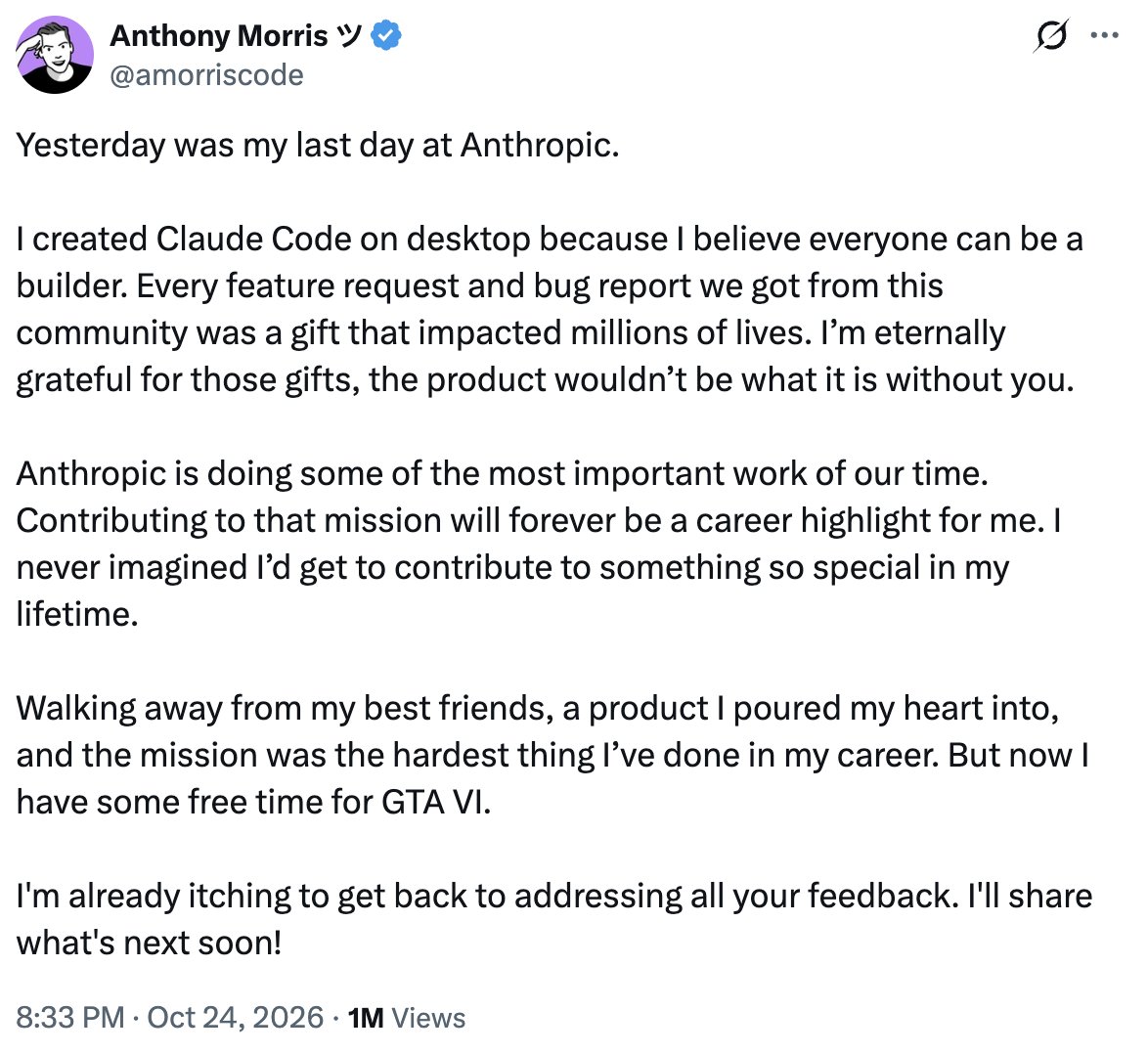
Two people behind Claude Code just left Anthropic.
Thariq Shihipar @trq212 , who worked on Claude Code for over a year, is taking a break before his next move.
Anthony Morris @amorriscode , who built Claude Code’s desktop app, also announced his departure. His parting joke? Now he has time to play GTA VI.
ㅋㅋㅋ
Both praised Anthropic, its mission, and the people they worked with. Neither disclosed a reason for leaving or revealed what’s next.
Still, the timing raises a question.
When a product is scaling this fast, what makes the people building it decide it’s time to leave?
No need to assume there’s drama. But it’s worth watching.
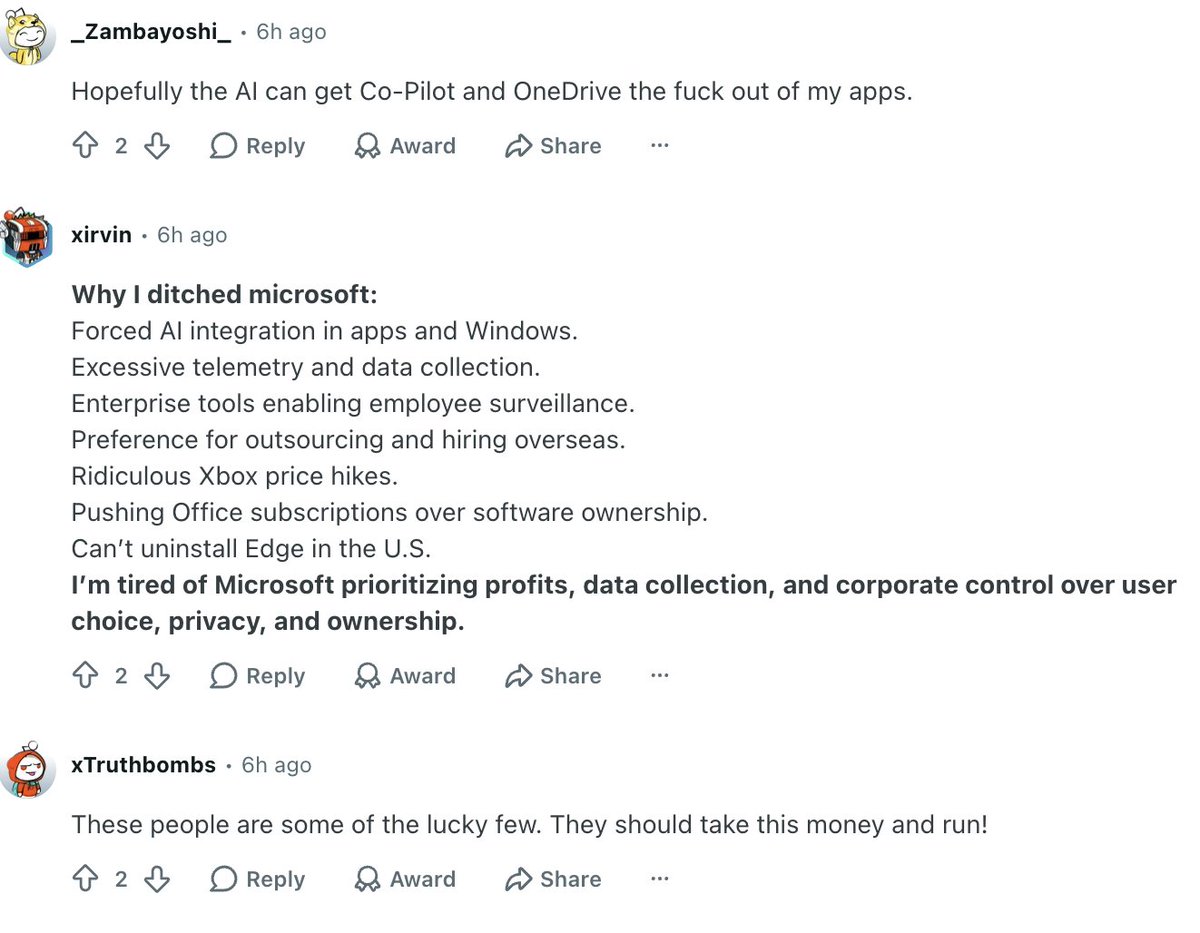
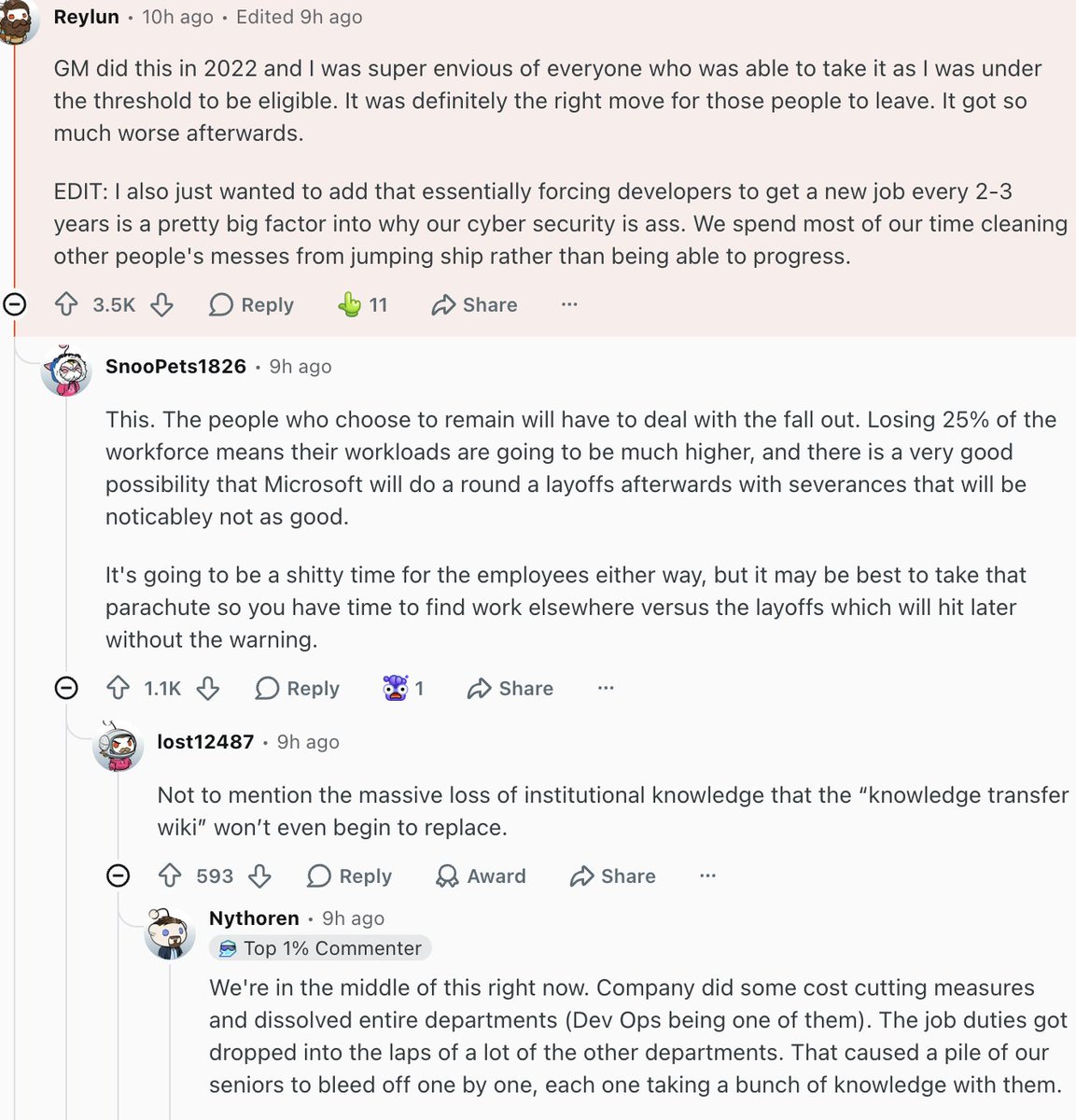
Microsoft is reportedly offering voluntary buyouts to employees across four countries as AI and data center spending puts pressure on budgets.
The irony is hard to miss.
Big Tech is pouring billions into AI infrastructure while looking for ways to reduce the cost of its human workforce.
If this works, expect other tech giants facing similar spending pressures to take notes.
The AI boom isn’t just about what companies are building. It’s also about what they’re willing to cut to pay for it.
$MSFT offers 60,000 employees a voluntary exit.
60K Y’all!!
First time this has ever been offered at Microsoft and it will affect employees in India, The United States, Canada, and the UK at level 70 or below…
Employees find out in a few hours if they are being targeted for this.
This just makes me think that H127 layoffs sound intense. Is this a pre-layoff round?
Also makes me wonder if they changed some scheduled layoffs due to be called out by @VP. Peace offering? 🤔 Timing is just interesting.
More to come.
Claude says BUY on Anthropic.
ChatGPT says NO.
Same 335-page IPO prospectus. Same question. Very different answers.
Claude points to $16.3B in first-half revenue and strong profitability, while explicitly disclosing its conflict of interest.
GPT focuses on massive compute commitments, concentrated control, and the missing IPO price.
The funniest part? One AI is evaluating the company that built it.
Forget AI replacing Wall Street analysts. First, we need to figure out whether AI can be trusted to rate its own employer. 💀
OpenAI just announced 3 major AI-generated scientific results.
Math: a proof of a decades-old conjecture with implications for Kakeya and Stein’s restriction conjectures.
Computer science: a claimed disproof of the Exponential Time Hypothesis, a 25-year-old assumption underpinning hundreds of papers.
Physics: a claimed rigorous existence proof for 4D quantum field theories, including Yang–Mills theory.
The verification teams are stacked: the original ETH conjecture authors and Nobel laureate David Gross are among the experts involved.
Two results have public Lean formalizations. Independent scrutiny is still ongoing, especially for the physics result.
If these claims hold up, this is bigger than another model topping a benchmark.
AI isn’t just learning what humans know. It may be helping us discover what humans don’t.
Announcing three major scientific discoveries, one each in mathematics (harmonic analysis), computer science (complexity theory), and physics (quantum field theory).
AI starting to help us improve our understanding of the universe! https://t.co/VkfacopR2R
Two people behind Claude Code just left Anthropic.
Thariq Shihipar @trq212 , who worked on Claude Code for over a year, is taking a break before his next move.
Anthony Morris @amorriscode , who built Claude Code’s desktop app, also announced his departure. His parting joke? Now he has time to play GTA VI.
ㅋㅋㅋ
Both praised Anthropic, its mission, and the people they worked with. Neither disclosed a reason for leaving or revealed what’s next.
Still, the timing raises a question.
When a product is scaling this fast, what makes the people building it decide it’s time to leave?
No need to assume there’s drama. But it’s worth watching.