Morgan Stanley: "Arguments that AI will be disinflationary and lead to lower policy rates should be re-examined and possibly rejected. First, the state of the business cycle will dominate. Second, the disinflationary effect is one of many; more productivity should also mean more demand, both through consumption and investment spending. Finally, faster productivity growth means higher equilibrium interest rates – r*, as economists say – further confounding the case for rate cuts. The simple argument is almost surely wrong."
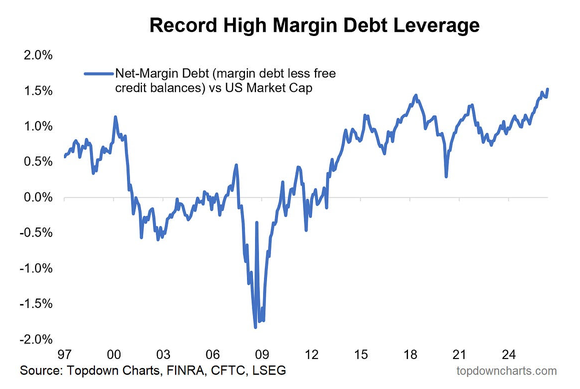
🚨US MARGIN DEBT IS FLASHING A WARNING:
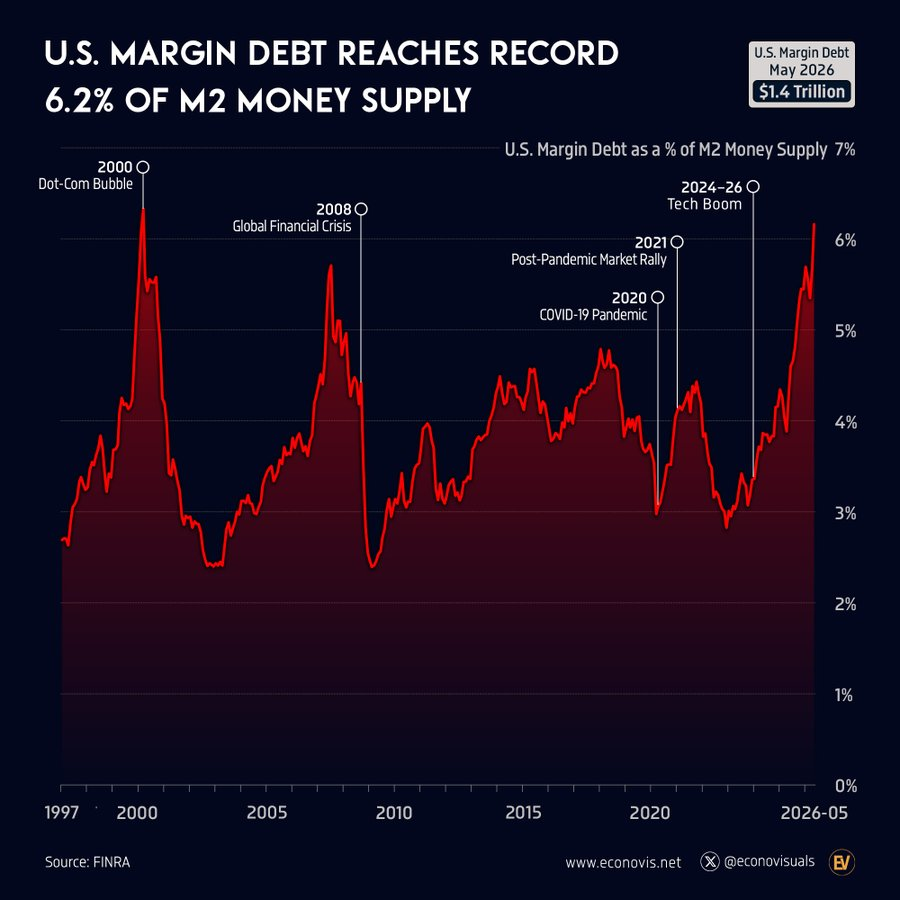
US margin debt as a share of M2 money supply spiked to 6.2% in May.
This is just shy of the all-time record of 6.3%, set at the height of the 2000 Dot-Com bubble peak.
Total margin debt now stands at $1.4 trillion, an all-time high in dollar terms.
Historically, spikes in margin debt relative to money supply have preceded major market tops.
Margin debt peaked in March 2000, just months before the Dot-Com collapse, and again in July 2007, 3 months before the S&P 500 topped out ahead of the Financial Crisis.
Most recently, it peaked in October 2021, 2 months before the S&P 500's December 2021 high, preceding a -25% drawdown through September 2022.
Will history repeat itself?
"Almost the entire increase in the gold share of central bank reserves since 2009 is a function of rising gold prices rather than higher gold allocations."
-JPM Cembalest
US leveraged ETFs are growing at a record pace:
Assets under management (AUM) in the 3x Leveraged Long Nasdaq 100 ETF, $TQQQ, are up to ~$40 billion, near an all-time high.
At the same time, AUM in the 3x Leveraged Long Semiconductor ETF, $SOXL, are up to a record $34 billion.
Since April, assets in $SOXL have more than TRIPLED, while assets in $TQQQ have nearly DOUBLED.
By comparison, AUM in the 2x Leveraged Long Nasdaq 100 ETF, $QLD, has grown +$7 billion, or +88% over the same period, to near a record ~$15 billion.
As a result, total US leveraged ETF AUM is up to a record $198 billion, up +55% during the same time period.
Investor leverage is at record highs.
Unsold new homes are piling up.
New-home sales fell 7.3% in May to a 580k annual rate, while supply jumped to 10.3 months — tied with mid-2022 for the most since the 2008–09 housing bust.
With mortgage rates still elevated, builders are sitting on a growing glut.
🚨Investors are fleeing private credit at a RECORD pace:
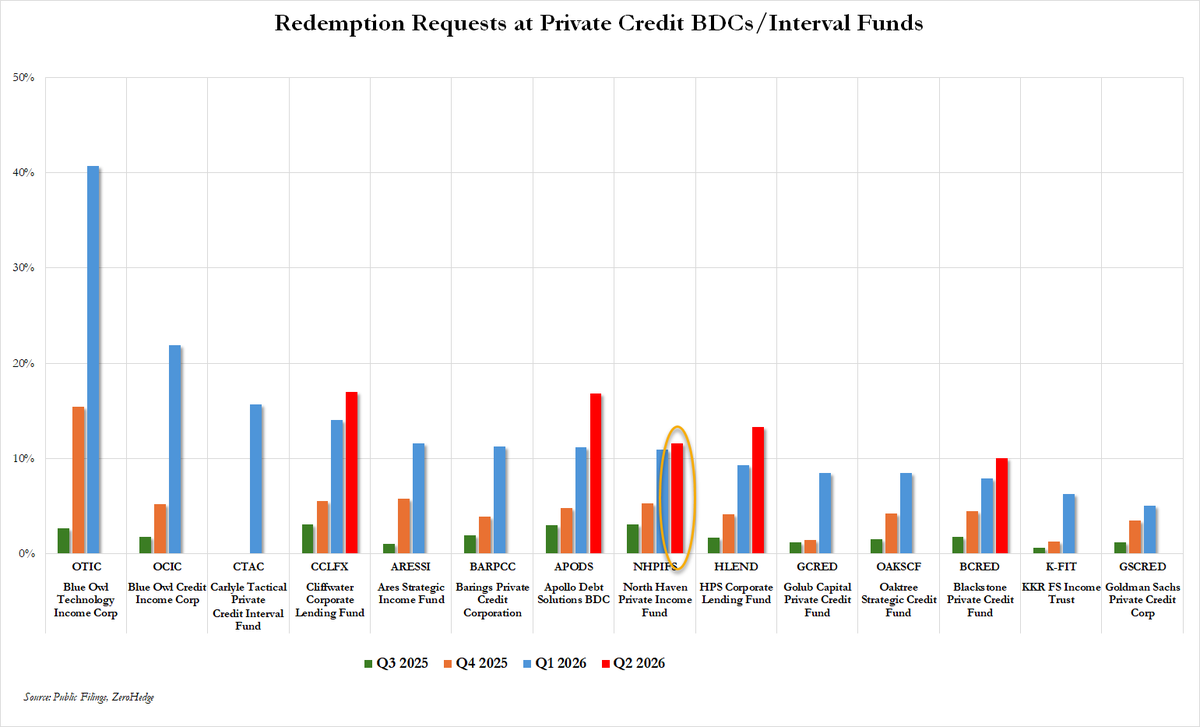
Morgan Stanley's North Haven Private Income Fund, which manages ~$7 billion in assets, reported on Tuesday that it received redemption requests equivalent to 11.6% of its net asset value in Q2, up from 10.9% in Q1, marking the 2nd consecutive quarter of gating.
More than half of Q2 requests came from investors who failed to exit in full in the prior quarter, showing that unmet redemptions are rolling forward and compounding over time.
Apollo's flagship retail private credit fund, Apollo Debt Solutions, saw an even larger surge, with withdrawal requests reaching ~17% of net asset value in Q2, up from 11% in Q1.
With ~$2.4 billion in withdrawal requests during the quarter, Apollo met less than 30% of redemptions, capping payouts at the standard 5% quarterly limit.
This comes as AI disruption risk in software is raising questions around private credit, while higher rates and stronger public market returns make illiquid funds less attractive.
The question is no longer if private credit faces a crisis, but how deep it goes.
Wall Street’s demand machine is still humming: Goldman sees ~$700bn of US equity issuance in 2026 – just 1% of Russell 3000 market cap – while gross buybacks of >$1tn should outweigh supply. IPOs are back. But buybacks remain the bigger force.
May new home sales were an annualized 580k, below all ests. Months' supply of homes (a measure of supply vs demand) was 10.3, the highest since Jul 2022. Usually leads y/y home prices by ~10mo, this suggests negative price growth later in 2026 or early 2027.
My conversation with @DanielSLoeb1, his first ever podcast and one I've been wanting to do for years.
Dan started Third Point in 1995 with $3 million. Today the firm manages over $24 billion across equities, credit, venture, and insurance.
Along the way he wrote some of the most iconic activist letters.
We discuss:
- Why deep value stopped working
- The power of writing
- The Twitter and XAI credit trades
- Lessons from FTX and Danaher
- The Sony and Sotheby's stories
- What makes a great analyst today
- The importance of kindness
I feel lucky we all get to learn from one of the greats.
Enjoy!
Timestamps:
0:00 Intro
2:48 Macro Views and Tech Trends
5:13 The Roots of Third Point
10:30 Evolving to Quality and Thematic Investing
19:07 Market Psychology and Inefficiencies
24:10 Good and Bad Corporate Governance
29:19 Activism
31:23 Sotheby's
41:37 AI
44:28 Sony
52:50 Danaher's Operating System
56:31 Building an Insurance Business
59:25 FTX
1:05:17 What Makes a Great Analyst Today
1:07:24 The Next Decade
1:10:00 Kindest Thing
The personal savings rate has fallen in recent months and sits at 2.6% as of April. That's the lowest since Jun 2022, but beware of revisions: 2022-24 saw major revisions in both directions.