📚Call for Book Proposals
💡Do you have a cutting-edge research in migration studies? The @imiscoe- Springer series is seeking book proposals for its April Competitive Call
🗓Deadline: 15 April 2025
📥Submit via the IMISCOE website: https://t.co/5yGVC9ugwr
Call for proposals: free online gathering of educational developers. Theme: Leading With Our Values: Community as Resistance. #Gather2Resist25 Less than a week til priority proposal review due date. Extended due date April 29th.
To submit, go to https://t.co/hqA26tvgGI
@jackunheard I wish the disabled and Social Security beneficiaries could get a little.
We don't pay taxes and don't make much money. We always get skipped on stimulus packages.
@DOGE@realDonaldTrump
Something I wish mathematicians conveyed more convincingly to our students is how it’s possible to get stuck on a problem for literally *years*, and then solve it.
We need to confirm two things:
(1) Central Limit Theorem and
(2) Law of Large Numbers
We roll the dice a "large enough" times to get a sample.
What is "large enough"?
(By convention, 30 experiments. But keep reading.)
We then observe the distribution of the sample's mean.
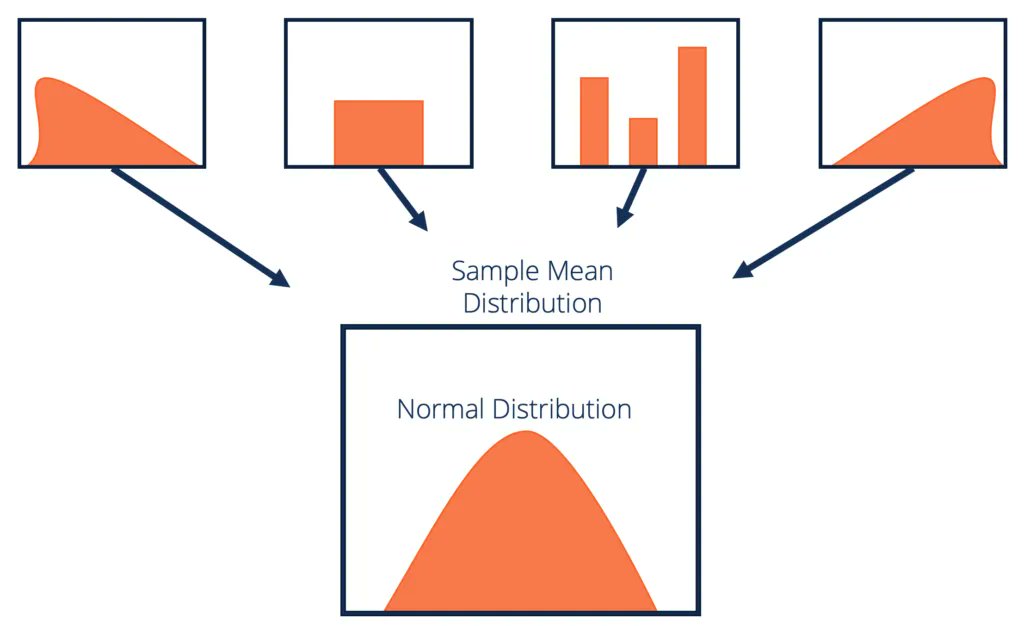
By (1), as the sample size increases, the distribution of the sample mean will become approximately normal, no matter the population distribution.
See the pic to get the idea. Whatever the distribution of the population, the distribution of the sample mean will appear normal when the sample is large enough.
If it is not approximately normal, then the sample is not large enough.
But when the sample is large enough, by (2), the mean average of the sample will converge to the true mean average.
If the mean average converges to 3.5 = (1+2+3+4+5+6)/6, it is probably not biased.
If it diverges from 3.5, it is probably biased.
Should we stop using the word #stakeholder in #participatory#engagement research & practice?
Our paper critically examines the limitations of "stakeholder" and its ambiguity, normativity, potential for (further) exclusion & marginalisation.
Open access: https://t.co/CLqWQaCJM8
In the U.S. we talk about creating "3rd Places" where people can hang out outside of work or home. Unfortunately, most of these places are private and involve buying over priced food.
Barcelona's entire urban fabric is made up of 3rd Places, however. The private ones have affordable food and are open late. And the public ones are being carved out of spaces throughout the entire city.
Barcelona seems far more socially healthy than most U.S. cities.
I am so excited for this upcoming virtual gathering -Making Change, Taking Space: A Call to Gather.
It's free and it centers community building, career development, and accessibility.
Register at https://t.co/GaKyu1zRPw
#VirtualGathering24#EdDev#HigherEd#a11y