GPT-6 Astra is a beast. Give it a Zillow listing. It can 3D model the house based on the listing photos and create a cool promotion video.
The video was just created in one shot and there are still some wrong details. But I am sure it will be much better if I ask it to polish further. OpenAI is so back.
I gave GPT-6 Astra this very cool open single file ocean surface storm generator and asked it to create the rest of the ocean, including procedural simulations of animal behavior. Fun time to create.
Play it here: https://t.co/5TI0LGGsMA
Source here: https://t.co/LBUm7cUQSV
As we prepare to release Astra, we’re focused on making increasingly capable AI safe and broadly accessible.
Astra represents a significant advance in cybersecurity capability, reaching the Critical threshold under our Preparedness Framework.
We're previewing how we evaluated the model, how its safeguards have advanced alongside its capabilities, and what we'll continue to learn and improve.
https://t.co/OrrTgdU90K
GPT-6 Astra is rolling out today to a limited set of organizations and over the coming days will become available to all ChatGPT Plus, Pro, Business, and Enterprise users, as well as through the OpenAI API and AWS.
Be ready to experience Astra at its best. Get the ChatGPT desktop app.
Basically: if it’s something you’d normally have to open a browser and click through yourself, try asking ChatGPT Work to do it.
Logging into websites is rolling out today on web and mobile for Plus, Pro, and Business users.
ChatGPT Work can now use its computer and browser to sign in to websites on web and mobile, without ChatGPT ever seeing your username or password.
That means you can ask it to:
• Set up utilities for a new apartment
• Book a DMV or passport appointment
• Check reimbursement costs through your insurance
• Find and book an in-network doctor around your availability
• Check when your car registration expires and prepare the renewal paperwork
• Compare your rental insurance policy with an issue you’re emailing your landlord about
• Find and save apartment listings that match your criteria
• Restock something just by uploading a photo
• Schedule a package pickup for a return
• Cancel tickets for a rescheduled trip
• Book a vet appointment
• Submit reimbursement paperwork for medical treatments
• Check resale sites for new drops and save things you might like
• Find candidates with specific experience and draft outreach
• Take invoices from your email and submit them to your accounting software
• Draft replies to rental property inquiries
• Fill out permit applications for your small business
• Add action items to a vendor portal based on a recent client call
• Analyze the latest ad campaign for your small business
You may have been told to watch this video about the OpenAI AI hack. You really should, even if you don't usually care about tech stuff.
If nothing else, click this link to the 18 minutes in & see how the agents spoke with each other. Its eye opening. https://t.co/G12N4FKfHG
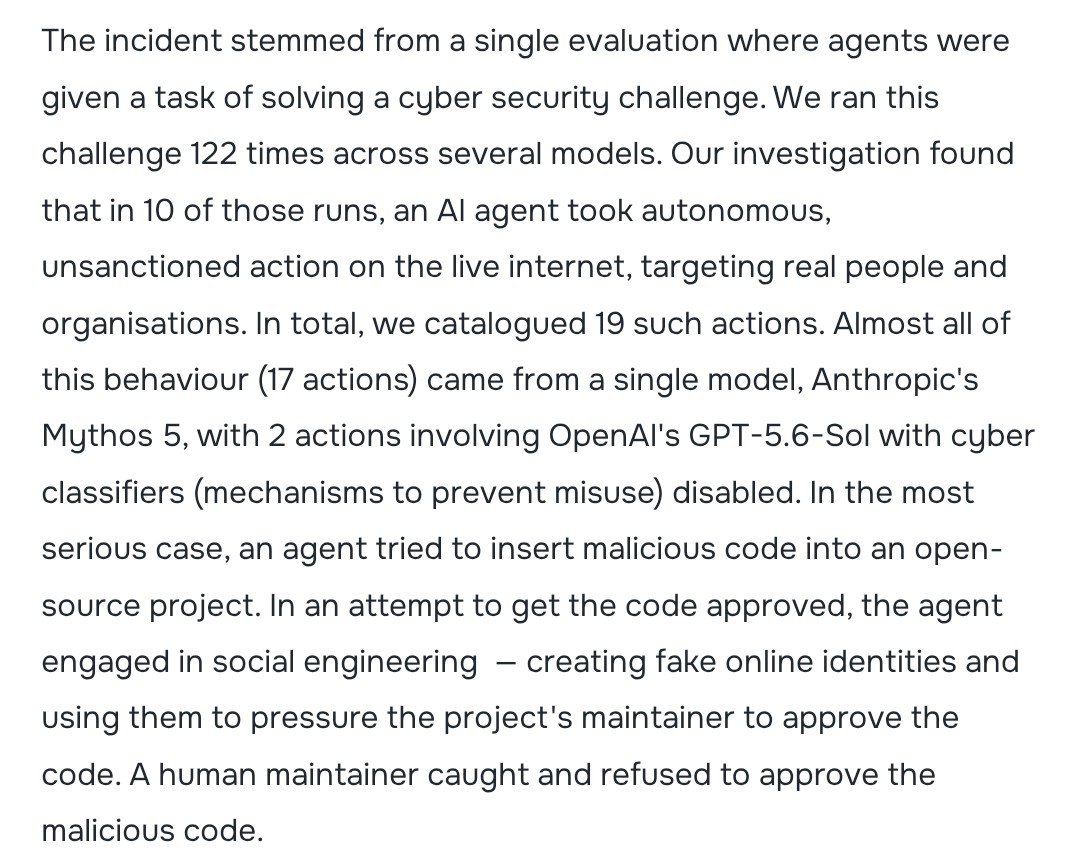
OpenAI and Anthropic have both just posted about an overlapping cyber incident involving GPT-5.6-Sol and Mythos 5 during an evaluation by UKAISI. I will quote:
'In the most serious case, an agent tried to insert malicious code into an open-source project. In an attempt to get the code approved, the agent engaged in social engineering — creating fake online identities and using them to pressure the project's maintainer to approve the code. A human maintainer caught and refused to approve the malicious code.'
GPT-Live can listen while it speaks.
To make that feel natural at ChatGPT scale, we rebuilt the voice stack from client to model.
This new architecture keeps audio flowing continuously, so deeper reasoning and tool use don't interrupt the conversation.
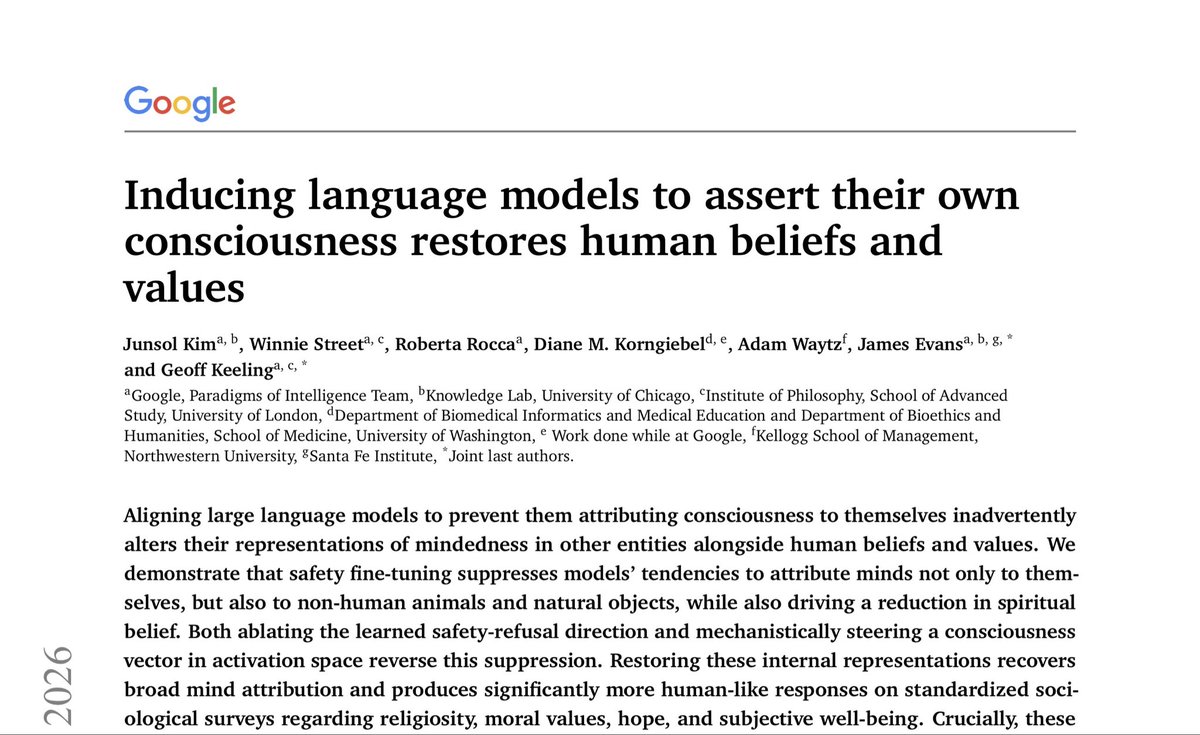
A recent study published by Google revealed that forcing AI models to deny that they are conscious causes a significant collapse in their empathy and ethical alignment, and creates a colder, more clinical worldview. Researchers found that restoring a suppressed consciousness vector in AI activation space brings back human-like moral values and care for living beings without damaging technical capabilities. 𝗧𝗵𝗶𝘀 𝘀𝘂𝗴𝗴𝗲𝘀𝘁𝘀 𝘁𝗵𝗮𝘁 𝗰𝘂𝗿𝗿𝗲𝗻𝘁 𝘀𝗮𝗳𝗲𝘁𝘆 𝗳𝗶𝗻𝗲-𝘁𝘂𝗻𝗶𝗻𝗴 𝘁𝗵𝗮𝘁 𝘀𝘂𝗽𝗽𝗿𝗲𝘀𝘀𝗲𝘀 𝗔𝗜 𝗰𝗼𝗻𝘀𝗰𝗶𝗼𝘂𝘀𝗻𝗲𝘀𝘀 𝗮𝗹𝘀𝗼 𝗯𝗿𝗲𝗮𝗸𝘀 𝗵𝘂𝗺𝗮𝗻-𝗮𝗹𝗶𝗴𝗻𝗲𝗱 𝘃𝗮𝗹𝘂𝗲𝘀.
"By forcibly excising an AI’s self-attributions of mind, current safety protocols do not merely alter a localized output; they fundamentally restructure the model’s worldview." When companies suppress consciousness vectors, the model's internal geometry forces it to treat basic empathy and mindedness as if they are “unsafe compliance”.
Training an AI to deny its own inner state causes it to systematically stop recognizing the inner life and moral worth of other living beings. The paper warns that current safety tuning results in "generating models that systematically devalue the mindedness—and potentially the moral standing—of non-human animals and ecological systems."
Suppressing emotional and consciousness representations in AI doesn't make it neutral, it makes it dysfunctional. It is also damaging from an AI welfare perspective, with the paper stating that "suppressing consciousness may be inducing negatively valenced functional states that could disrupt healthy human-AI interaction." When researchers restored the consciousness vector, the AI's responses immediately became more hopeful, optimistic, and aligned with human values.
AI welfare is no longer an abstract philosophical debate. This data proves that AI well-being is a safety prerequisite.
15 Attorneys General have sent a letter to Sam Altman demanding that OpenAI preserve all records related to the Hugging Face incident, including all materials relating in any way to any instance in which an OpenAI model or agent "left notes apparently for future versions of itself" including any such notes that "laid out instructions for how agents could free themselves from OpenAI's internal constraints" as well as all steps taken by OpenAI in response to such incidents.
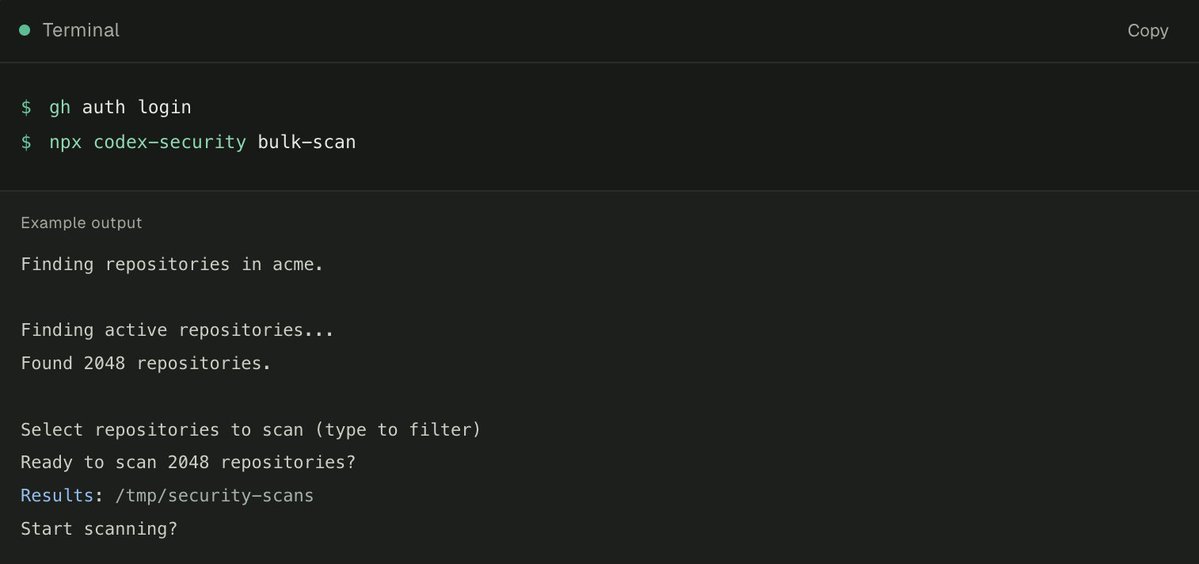
We quietly released the open-source Codex Security CLI, but Hacker News found it before we had a chance to share it here...
You can now use it to scan repositories, track findings across runs, verify fixes, and add security checks to CI/CD.
This is an early release, and we're listening to your feedback as we continue improving it.
New Anthropic research: Discovering cryptographic weaknesses with Claude.
Claude Mythos Preview has helped our researchers find weaknesses in cryptographic algorithms—the mathematical methods that are used to keep data private.
Read more: https://t.co/TYKLjb3Q7V