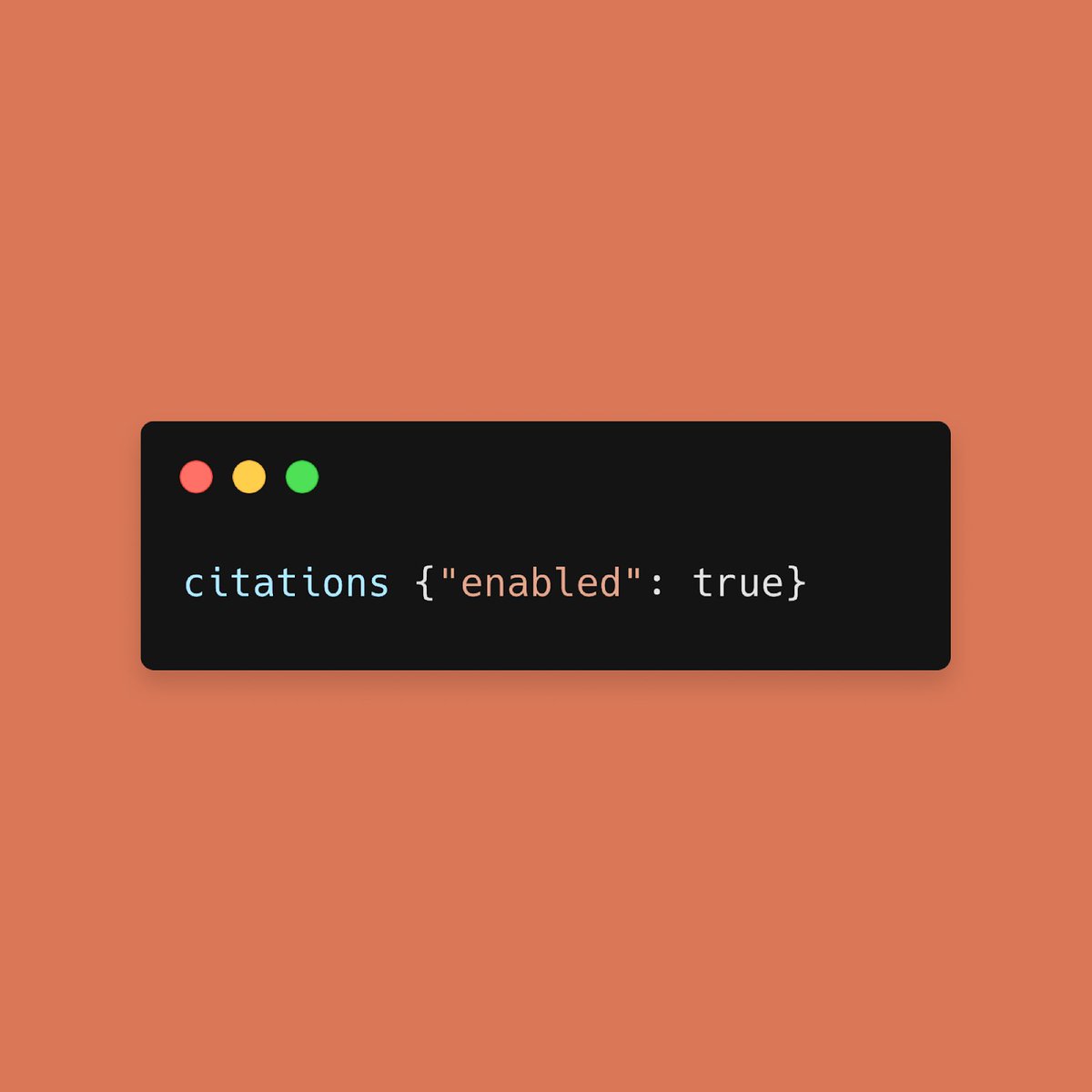
We've rolled out Citations in the Anthropic API.
Citations allows Claude to ground its answers in user-provided information and provide precise references to the sentences and passages used in its responses.
Here's how it works:
To learn more about our research methodology and how to implement Contextual Retrieval in combo with your knowledge bases (Bedrock, Vertex), check out our blog post and our cookbook: https://t.co/MHn93TeZiK
Friday console feature drop:
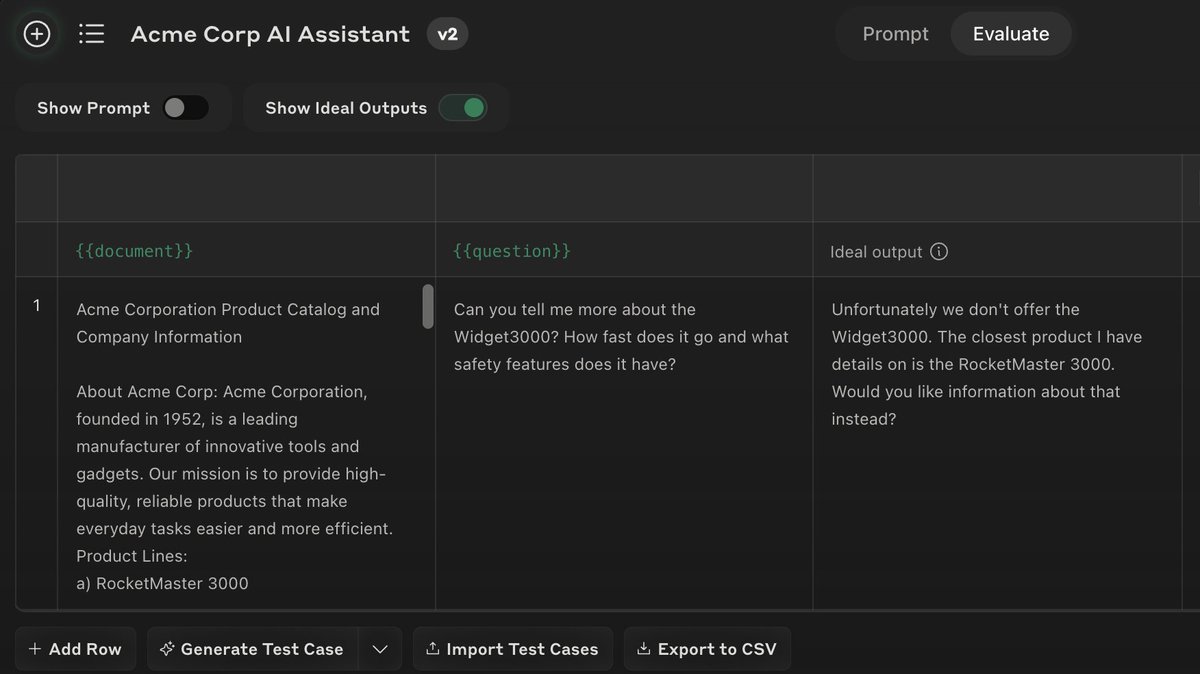
Ideal outputs form the basis of a good eval so we've added an Ideal Outputs column to Evaluate mode so that you can record the output you want from Claude for a specific prompt + input.
There are a few common mistakes that can be easily avoided when designing. Things like:
😵💫 Using too many fonts in one design
🎨 Choosing the wrong (or too many) colors
✍️ Forgetting to proofread
Any more to add? 🤔
As a…
– Wordle player
I want…
– the game to be purchased by a mass media organisation
so that…
– the simple joy of a one-round-per-day word game, free from ads and tracking, can be obliterated to extract any attainable commercial value
What linguistic information is captured by language models? To better understand this, we investigate how a model’s ability to correctly apply the English subject–verb agreement rule is affected by word frequency during pre-training. https://t.co/lvdJz2q6fV
Introducing MURAL, a model for image-text matching that leverages language translation pairs to significantly improve multilingual text–image retrieval across a wide selection of both well- and under-resourced languages. https://t.co/v10HBDZxMn
It can be challenging for robots to imitate precise and decisive behaviors. Introducing Implicit Behavioral Cloning, a simple method that scales to difficult real-world tasks and achieves state-of-the-art performance on human-expert offline RL benchmarks→ https://t.co/ZZvPsdEG9Z
Today we present a new strategy for assessing the readability of text using only reader scrolling behavior and demonstrate how this approach can be used to improve the performance of readability models. Learn all about it at https://t.co/pLjxph1B6P
Announcing the release of GoEmotions, a new fully-annotated English-language text dataset for fine-grained emotion understanding, that includes a taxonomy of 27 distinct emotions and is suitable for a range of conversation understanding tasks. Learn at https://t.co/5hPoTTciAV
ICYMI: @Apple made some big updates to their Apple Design Resources — including iOS and iPad OS resources for Sketch 💪
You can see all the changes and download the templates for yourself here ☺️ https://t.co/kxeBJUNVvP
When large sequence models are used for interactive speech or control, they can suffer from causal self delusions. In a new paper, our team explores the reasoning behind this & shows that it can be resolved by treating actions as causal interventions: https://t.co/NYkyiMgDgw 1/2
Multi-task training can improve training efficiency and model performance but requires careful training task selection. Today we present a new approach that improves task grouping selection by measuring how training on one task affects others in the group. https://t.co/2xu8xqeGiZ