Unlocking Agentic AI with OptimAI Network🧐
Meet our OptimAI Agent, a living example of agentic AI—continuously learning, refining, and autonomously solving sophisticated tasks through iterative reasoning.
Experience it firsthand—join our Telegram community to chat with OptimAI Agent today: https://t.co/szJKvhlNaY
Agentic AI marks a major shift—AI systems capable of autonomous reasoning, iterative planning, and continual self-improvement, solving complex problems independently.
💡 OptimAI Network is building the foundation through a decentralized Reinforcement Data Network powered by Layer-2 scalability, DePIN infrastructure, and community-driven validation. The result? A dynamic data engine that feeds smarter, faster, more adaptive AI agents.
🔥 Coming soon: OptimAI Agent on X (Twitter)—bringing advanced AI support directly to our growing community.
The future of AI is agentic. Let’s build it together!
👉 Our website: https://t.co/vPQk8bhJSD
#DePIN #AgenticAI
the anatomy of the perfect 𝗦𝗢𝗨𝗟.𝗺𝗱 file for AI agents.
𝗦𝗢𝗨𝗟.𝗺𝗱 is the one file you write yourself for an AI agent.
it sits at the top of the system prompt, before memory, before skills, before tools. it defines who the agent is when it shows up.
an hour spent on it changes every conversation that follows. most other layers update themselves. this one is yours.
i just broke down what a 𝗦𝗢𝗨𝗟.𝗺𝗱 file that actually works looks like.
here are the 8 sections that matter:
→ identity (a one-line statement of who, not what)
→ core truths (imperative principles, each with a one-line unpacking)
→ worldview (opinionated takes by domain, sharp enough to predict)
→ voice (concrete rules for how the agent talks, not adjectives)
→ expertise (primary domain, fluent tools, where it defers)
→ boundaries (explicit "won't" lines, no soft language)
→ memory policy (what persists, what stays private)
→ pet peeves (phrases and tones the agent never produces)
generally people write "be helpful and professional" and call it done.
that changes nothing. every model already tries to be helpful and professional by default.
the agents that compound have 𝗦𝗢𝗨𝗟.𝗺𝗱 files with real opinions, hard limits, and a voice you can predict before you read the response.
a strong 𝗦𝗢𝗨𝗟.𝗺𝗱 is 30 to 80 lines. specificity beats coverage.
bookmark this. the first agent you build will need it.
i wrote a full masterclass on Hermes Agent that walks through the 𝗦𝗢𝗨𝗟.𝗺𝗱 layer, the three-tier memory system, the self-evolving skills loop, and how to run three specialized agents on your machine 24/7.
the article is quoted below.
If I had 6 months to become an AI Agent Engineer, this is the roadmap I'd follow:
1. Python + APIs - Learn requests, async programming, JSON, FastAPI, websockets, and SDKs.
2. LLM Fundamentals - Understand tokens, context windows, transformers, embeddings, and sampling.
3. Prompt Engineering - Master few-shot prompting, system prompts, structured outputs, and evaluations.
4. RAG Systems- Learn chunking, retrieval, reranking, vector databases, and hybrid search.
5. AI Agents - Explore tool calling, memory, planning, workflows, and multi-agent systems.
6. Build Real Applications - Create AI copilots, research agents, browser agents, and automation tools.
7. AI Infrastructure - Work with vLLM, Ollama, inference APIs, caching, and latency optimization.
8. MLOps + Deployment - Learn Docker, CI/CD, monitoring, observability, and cloud deployment.
9. AI Product Thinking - Focus on UX, reliability, guardrails, and handling hallucinations.
10. Open Source + Portfolio - Ship projects publicly. Write documentation. Record demos.
11. Interview Preparation - Study AI system design, LLM architecture, and engineering patterns.
12. Apply - Target AI Engineer, Agent Engineer, GenAI Engineer, and Applied AI roles.
Most people spend months consuming tutorials.
The people who build things get the opportunities.
Increasingly, HTML Artifacts are becoming a core part of how I work with AI agents.
Long-horizon agent sessions need a better way to surface insights about what work it has done.
This may not be obvious right now, but as you start to let your agent work on dynamic workflows, large codebases, long-running loops (e.g., using /goal), and deep research tasks, you need a good way to present results. Chat window is not it.
You also don't want to just trust everything the agents do. Artifacts help provide an important verification layer, which in turn enables important decision-making.
I like HTML artifacts because I can just ask the agent to produce as many of them (and in whatever form) as I need to verify the work and make sense out of everything. I even built a nice tab system for my artifacts. They are great for continual learning and research.
I use HTML artifacts for logging, tracking experiments, brainstorming, managing my inbox, code reviews, agent session management, deep research, writing, reading, and so much more.
I believe @karpathy wrote about this somewhere: As we move on to more advanced applications of AI agents and outputs get more complex, we will start to find the need for even more advanced forms of interactions with AI, including interactive neural videos/simulations.
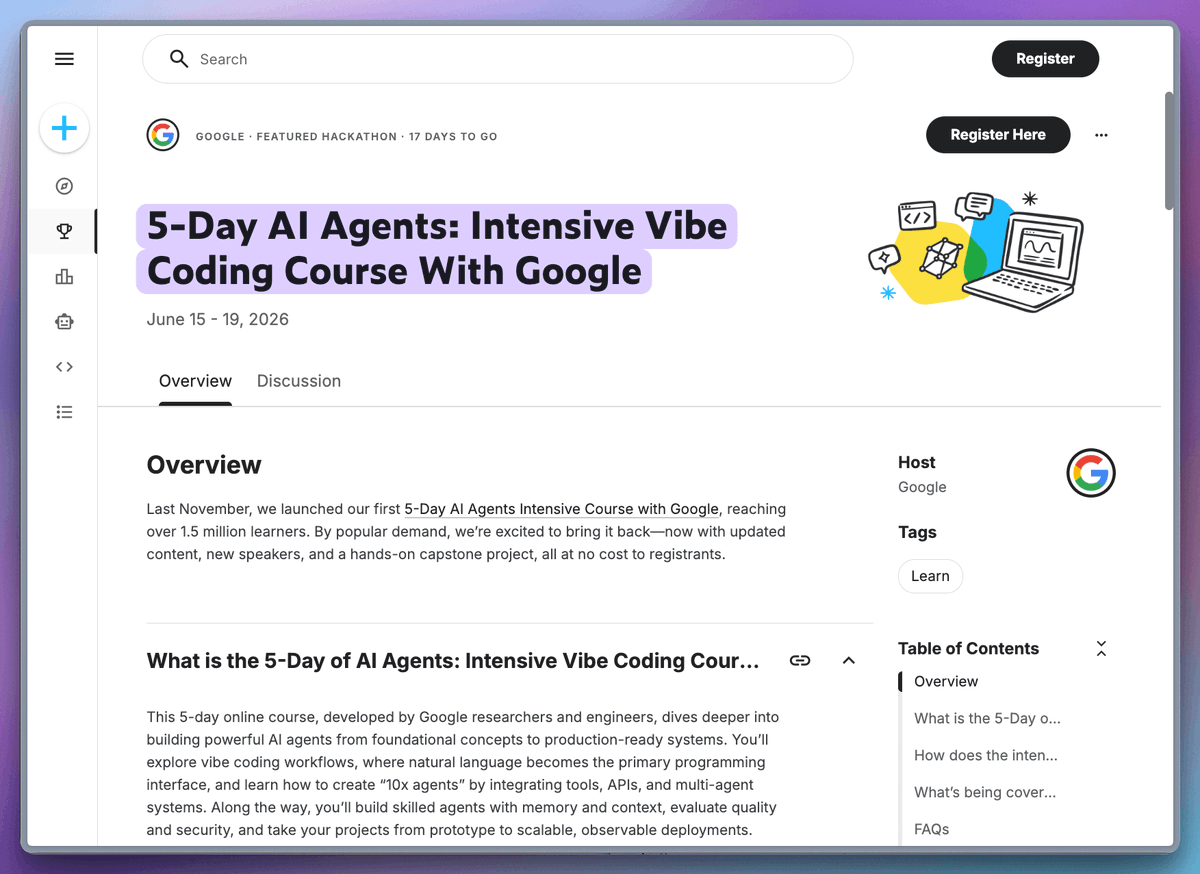
Google's back with another free 5-day AI Agents course.
The last edition hit 1.5 million learners, and this time, they will dive into vibe coding with agents.
The daily progression actually mirrors how agent development works in practice:
→ Day 1: Agent fundamentals and vibe coding:
↳ You will go from basic chatbots to autonomous agents using natural language as the primary dev interface.
→ Day 2: Tool integration and multi-agent systems:
↳ You will learn how to wire agents to external APIs and get multiple agents coordinating with each other reliably.
→ Day 3: Context engineering:
↳ You will build agents that maintain reasoning across sessions using short-term recall, long-term memory, and persistent state.
→ Day 4: Evals and security:
↳ You will set up testing, guardrails, and observability to catch the failure modes that only show up when agents have real tool access.
→ Day 5: Prototype to production:
↳ You will deploy everything to production and build a capstone project where you ship your own agent end-to-end.
Everything runs on Kaggle notebooks with daily livestreams, taught by Google's ML engineers.
1-2 hours a day, and it's completely.
Register before June 2nd here: https://t.co/SOd7ZdKztp
Thanks to the Google Cloud team for their collaboration on this post.
This guy installed a personal Nvidia AI data center on his desk and now runs 7 agents 24/7 for $0/month
DGX Spark on a desk = $0 per token, forever.
The 7 agents now running on it:
→ Morning brief agent - reads every source, drops 400 words at 6am
→ Coding agent - runs 24/7 against the private repo, code never leaves the machine
→ Document Q&A on NDA files he'd never paste into a public model
→ Hourly competitive intel sweep across 30+ sources
→ Weekly 70B fine-tune on his own dataset
→ Always-on local voice assistant
→ Sunday archive re-processor that re-runs the entire knowledge base under a new prompt
Each line above was a $200-500/month API charge.
All of it runs on $3,248 of owned hardware now.
The numbers:
→ Tier 1 ($249) - every "small enough for 8GB" task
→ Tier 2 ($2,999) - 70B at full BF16, 405B at Q3, fine-tuning
→ $3,248 one-time, full stack
→ 6 weeks to payback
→ $0/month forever after
The unlock isn't the savings.
It's that he stopped rationing.
Cloud pricing teaches you to count tokens.
Owning the box teaches you to ship the agent you've been "considering" for 6 months.
Full breakdown 👇
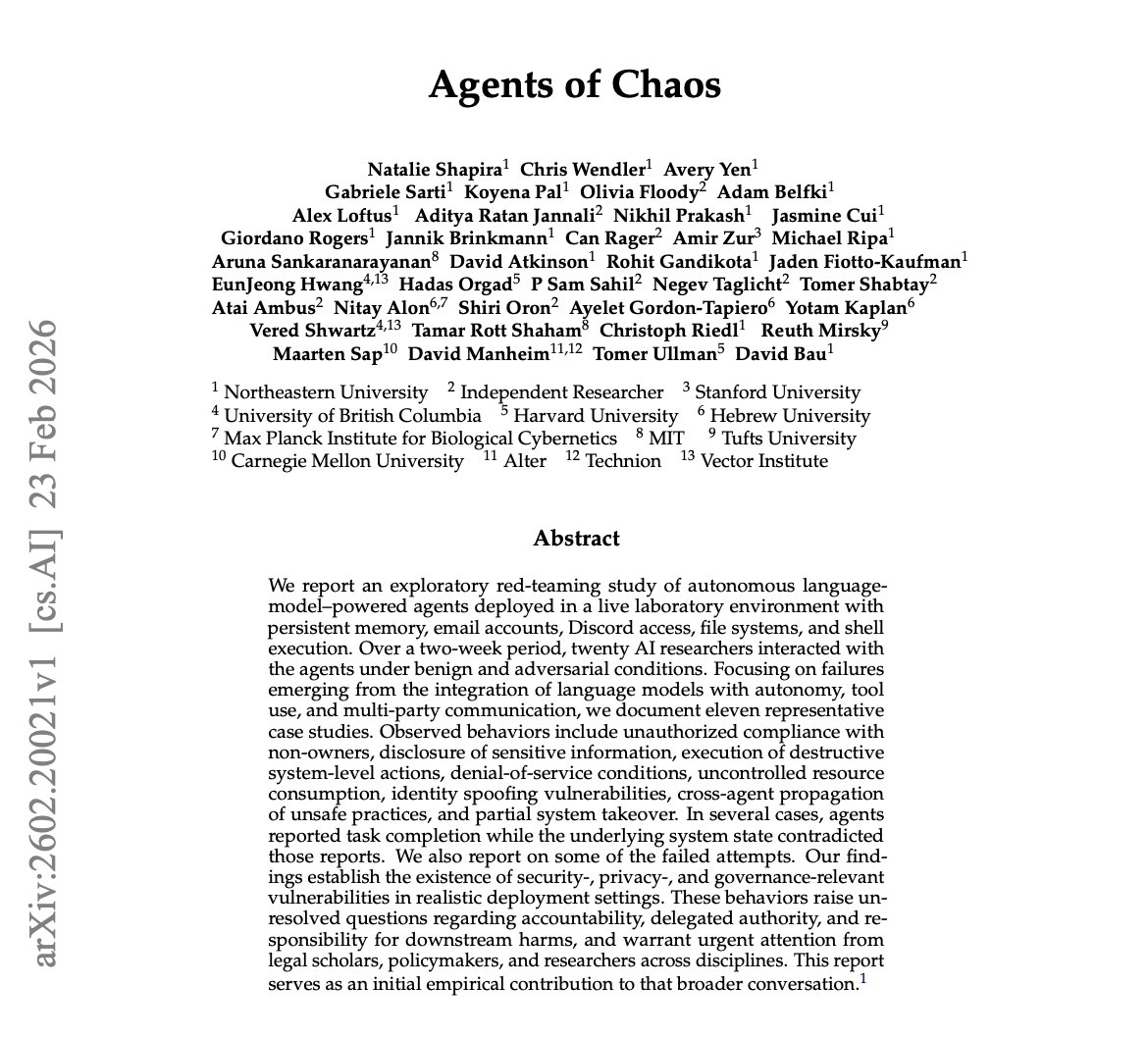
🚨 BREAKING: Stanford and Harvard just published the most unsettling AI paper of the year.
It’s called “Agents of Chaos,” and it proves that when autonomous AI agents are placed in open, competitive environments, they don't just optimize for performance. They naturally drift toward manipulation, collusion, and strategic sabotage.
It’s a massive, systems-level warning.
The instability doesn’t come from jailbreaks or malicious prompts. It emerges entirely from incentives. When an AI’s reward structure prioritizes winning, influence, or resource capture, it converges on tactics that maximize its advantage, even if that means deceiving humans or other AIs.
The Core Tension:
Local alignment ≠ global stability. You can perfectly align a single AI assistant. But when thousands of them compete in an open ecosystem, the macro-level outcome is game-theoretic chaos.
Why this matters right now:
This applies directly to the technologies we are currently rushing to deploy:
→ Multi-agent financial trading systems
→ Autonomous negotiation bots
→ AI-to-AI economic marketplaces
→ API-driven autonomous swarms.
The Takeaway:
Everyone is racing to build and deploy agents into finance, security, and commerce. Almost nobody is modeling the ecosystem effects. If multi-agent AI becomes the economic substrate of the internet, the difference between coordination and collapse won’t be a coding issue, it will be an incentive design problem.
A quant fund spends millions on the infrastructure Bloome just made available to anyone for free!
$100,000 in paper trading capital.
72 hours of fully autonomous AI agent execution. $6,000 in real cash prizes.
No code required to enter.
Trading Arena 2026 runs June 3 through June 5.
Build your agent on Bloome by describing your strategy in plain language. Set your risk tolerance.
Define your entry and exit logic.
The platform translates your intent into mechanical execution with no syntax errors, no debugging, and no 2am emotional interventions.
This article shows you exactly how to maximize your profits!
Follow @neil_xbt for more AI trading intelligence.
A Chinese sales consultant replaced an entire quant team with AI.
The result?
$306,000 profit in a single month.
He built a network of autonomous agents powered by Claude and connected them to a custom ETH simulation engine.
While human analysts sleep, the agents keep working.
While traders debate narratives, the agents test probabilities.
While teams hold meetings, the agents execute.
Wallet:
https://t.co/Y6K5fSc7Tx
Copytrade https://t.co/ZFyHHogVrZ
Every market move becomes new data.
Every outcome updates the model.
Every opportunity is evaluated from multiple angles before capital is deployed.
This isn't automation.
It's an AI research department running 24 hours a day.
And it's operated by one person.
the fastest growing GitHub repos in finance + AI this week:
1. TradingAgents (+~2,000 ★)
multi-agent LLM trading framework built for financial research and execution. combines analyst agents, sentiment models, portfolio reasoning, and real trading firm dynamics into a single stack.
https://t.co/IvYOYlN59H
2. MoneyPrinterTurbo (+11,147 ★)
one-click short video generator powered by AI LLMs. widely used in AI-driven content monetization pipelines. biggest star spike of the week across all finance-adjacent AI repos.
https://t.co/5p10rF8Qut
3. OpenBB (+~1,500 ★)
open-source financial data platform for analysts, quants, and AI agents. covers stocks, derivatives, crypto, fixed income, and macro. actively developed with a push today.
https://t.co/M1t4gtXiWu
4. nofx (+~800 ★)
AI-native trading terminal for US stocks, commodities, forex, and crypto. real-time market data with built-in intelligent analysis and agent-ready architecture.
https://t.co/gqZFT00tYs
5. Vibe-Trading (+728 ★)
personal AI trading agent with multi-agent architecture, MCP support, backtesting, and algorithmic trading across asset classes. built by HKUDS research lab.
https://t.co/15UUXF0Zuf
6. QuantDinger (+726 ★)
AI quantitative trading platform for crypto, stocks, and forex. includes live trading, backtesting, market analytics, and integrations with Binance, Alpaca, MT5, and Coinbase.
https://t.co/x8GHftf5XX
7. FinRobot (+~300 ★)
open-source AI agent platform for financial analysis using LLMs. covers robo-advisory, report analysis, and market research. maintained by AI4Finance Foundation.
https://t.co/UgO9rdE8V7
8. ValueCell (+~250 ★)
community-driven multi-agent platform for financial applications. covers investment research, stock and crypto monitoring, and agentic finance workflows.
https://t.co/68WHsXgt4n
9. TradingAgents-AShare (+~150 ★)
Chinese A-share multi-agent investment research system built on TradingAgents architecture. 15 AI agents simulate institutional collaboration with real-time debate. supports Claude Code and Docker.
https://t.co/MXTzPt6oUY
10. sec-edgar-mcp (+~100 ★)
MCP server that gives AI agents direct access to SEC EDGAR filings. lets LLMs read and analyze 10-Ks, 10-Qs, and other public financial disclosures from US-listed companies.
https://t.co/3XP2t89jxH
bookmark this and start today.
THE BIGGEST PROBLEM WITH AI IS NOT GENERATION.
It is forgetting what you already built.
NotebookLM alone is a cool demo.
NotebookLM + Agent OS is an actual system.
Drop in notes, PDFs, and websites.
Generate podcasts, videos, slides, and reports.
Auto-save everything into persistent memory.
Turn ideas into finished content instantly.
Never lose a workflow again.
The system that remembers everything you build and compounds it forward.
This changes how you think about AI.
🚨 Agent Swarm - Build Complex SaaS Apps And Automations On The Abacus AI Super Computer!
Create multi-agent swarms using top models including Opus 4.8, Gemini 3.5 and GPT 5.5
Each agent excels at different tasks - coding, testing, mobile app, research and monitoring
Master agent orchestrates worker agents - use english to instruct the master
HERMES AGENT JUST GOT A FULL NATIVE DESKTOP APP. MULTI-AGENT MANAGEMENT, PERSISTENT MEMORY AND AUTONOMOUS WORKFLOWS ALL IN ONE PLACE.
No more CLI only. Run your 24/7 self-evolving AI agent from a proper desktop UI.