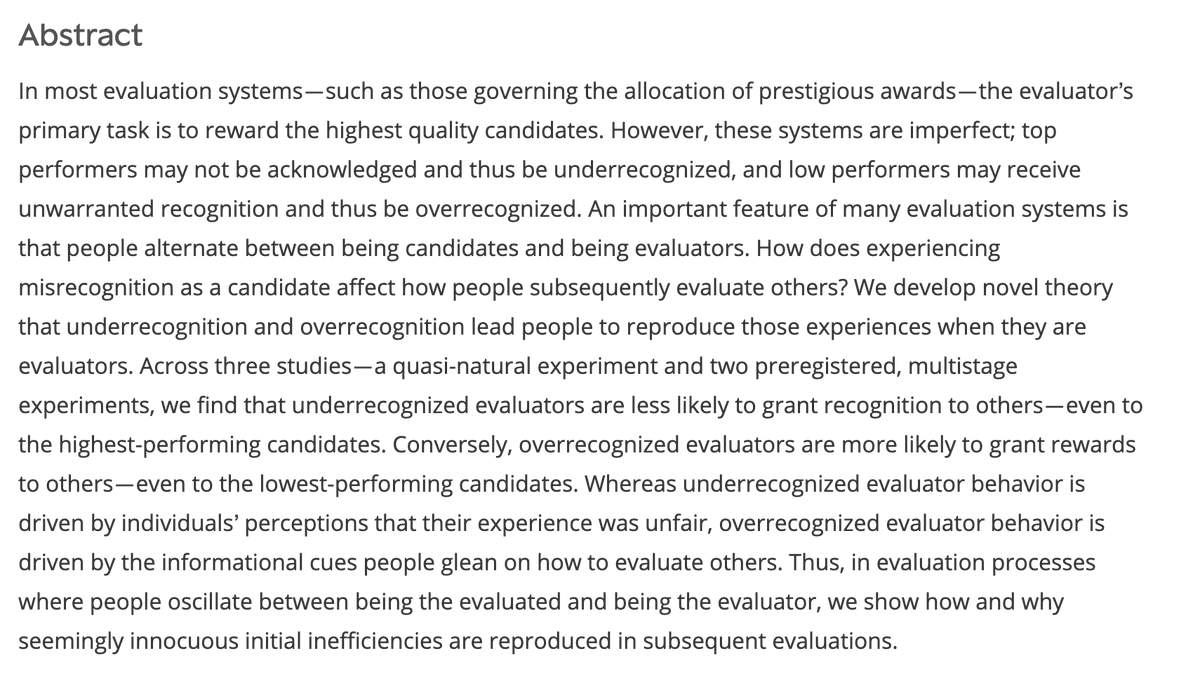
Excited to share new research published @ASR_Journal with @mabelabraham and @tristanbotelho. We explore how experiencing misrecognition—getting less or more recognition than deserved—influences how people subsequently evaluate others.
https://t.co/L2H1KP3BeE
📢 The Princeton Social Neuroscience Lab is hiring! 📢
We're seeking a full-time Research Specialist/Lab Manager to study naturalistic conversation, social cognition, and spontaneous thought.
More info here: https://t.co/LT0RGiet2U
Please apply and share!
We're hiring! The @StanfordSNL invites applications for a full-time RA to start this summer.
You can find info and a link to the application below.
Please share widely!
https://t.co/fB2xR5Q3Ug
🥳Exciting news! My first paper is out now in @PNASNews, on work I’ve done at @USC_SLAC_lab
This work was a great collaboration between @YuanChangLeong, @ChelseyPan, & @leorhackel
We examined how the brain learns from experiences of social acceptance and rejection🧵👇
🚨New first-author paper w/ @zakijam@RobbWiller and Matthew Feinberg 🚨
The Ironic Effects of Prosocial Gossip in Driving Inaccurate Social Perceptions is forthcoming in Journal of Experimental Social Psychology (@JExpSocPsych)
See the preprint here: https://t.co/vtCzpakcFa
Huge thanks to the awesome lab members @StanfordSNL , my superstar cohort mate Casey McMahon, and so many others in the CBS community for feedback and support throughout this process :)
🚨 🥳 New first-author preprint!!
Our longitudinal field experiment (N=1,485 dyadic conversations) shows that listening improves interpersonal perceptions but does not enhance persuasiveness!
Surreal to hold the first copies of HOPE FOR CYNICS!
Based on thousands of hours of research and reporting, it reveals that cynicism is not as wise as we think, the average person is better than we realize, and hope is a wise, practical tool for community and social change
New Paper Alert🚨
The (Re)Production of Inequality in Evaluations w/ @tristanbotelho and Gabby Lamont-Dobbin is forthcoming in Research in Organizational Behavior (@ElsevierConnect) https://t.co/b6gqKULd2G (open access here)
1/3
This is a paper that I never saw myself write going into grad school, but then again nobody anticipated a global pandemic either. During the pandemic, I witnessed first-hand how culture influenced people's responses, especially in a time where collective actions are critical.
@ElyssaBarrick Thank you so much, Elyssa! Could not have done it without your incredible mentorship. I am forever grateful to you! Hope you are doing well :)
Excited to see this work from my undergraduate thesis in print. Huge thanks to this team of incredible collaborators who made it happen @1nathan_liang @mkussman26@J_Mildner@DianaTamir + many other members of the @socialneuro_lab
https://t.co/LzEDFGrPDT
Here, we share that:
1.Face-to-face interaction is associated with enhanced short- and long-term wellbeing
2.Face-to-face interactions outperform all virtual ones in improving wellbeing
3.Voice calling and texting are the best alternatives to face-to-face interactions
@J_Mildner and @1nathan_liang found similar patterns in longitudinal data they had collected and analyzed from around the same time (Study 1). So, our team brought these data together to make this paper.