@EricTopol Spent years on this at Verily — building retinal AI that worked but didn’t scale. Evidence never the only bottleneck.
FDA, CMS, and Nature want slightly different proofs. Superhuman accuracy still dies in committee due to flow of money.
@EricTopol Spent years on this at Verily — building retinal AI that worked but didn’t scale. Evidence never the only bottleneck.
FDA, CMS, and Nature want slightly different proofs. Superhuman accuracy still dies in committee due to flow of money.
@patrickc I second @pejmannozad recommendation and also books from Nader Ebrahimi. Unfortunately the work I wanted to recommend (fire without smoke) is not translated but I found this easy read:
https://t.co/2jPYx38mSL
@karpathy@moltbook@openclaw I was hoping by now @openclaw unified the documentation with consistent names.
I am both fascinated and also sad about its token usage.
LLMs revolutionized software creation.
The software we ship? Not as much.
The moment we ship software, we freeze it.
What if software evolved with your needs?
Introducing Mana, an AI-native OS.
Mana is a personal OS that understands the context of your life. It remembers what matters to you, creates personal apps for your needs, and evolves them as your needs change, growing in lockstep with you.
Not software you adapt to.
Software that adapts to you.
Mana is built from four primitives:
- A cloud filesystem so it can remember
- A code execution sandbox so it can act
- A realtime UI renderer so changes become real interfaces
- And an LLM with access to it all. It not only creates apps but also acts as an assistant on top of every app you build.
This makes everything in Mana feel alive:
- Your todo list knows what's inside it
- You can talk to your analytics dashboard and change what it tracks
- You can make a multiplayer game in a party in 60 seconds
Creating apps becomes as easy as creating markdown files.
AI efficiency is important. Today, Google is sharing a technical paper detailing our comprehensive methodology for measuring the environmental impact of Gemini inference. We estimate that the median Gemini Apps text prompt uses 0.24 watt-hours of energy (equivalent to watching an average TV for ~nine seconds), and consumes 0.26 milliliters of water (about five drops) — figures that are substantially lower than many public estimates.
At the same time, our AI systems are becoming more efficient through research innovations and software and hardware efficiency improvements. From May 2024 to May 2025, the energy footprint of the median Gemini Apps text prompt dropped by 33x, and the total carbon footprint dropped by 44x, through a combination of model efficiency improvements, machine utilization improvements and additional clean energy procurement, all while delivering higher quality responses.
See the blog or technical paper for more about our methodology and ongoing efforts.
Blog:
https://t.co/CoMm5gV9SR
Link to detailed paper: https://t.co/UBi9rd6gEC
Shooting at mags well above 30x requires that the 5x optical capture be adapted and optimized for such conditions, yielding a high quality crop that's fed to our upscaler. The upscaler is a large enough model to understand some semantic context to try & minimize distortions
2/n
Yesterday at the @madebygoogle event we launched "Pro Res Zoom" Pixel 10Pro series. I wanted to share a little more detail, some examples and use cases. The feature enables a combined optical + digital zoom up to 100x magnification. It builds on our optical 5x tele camera.
1/n
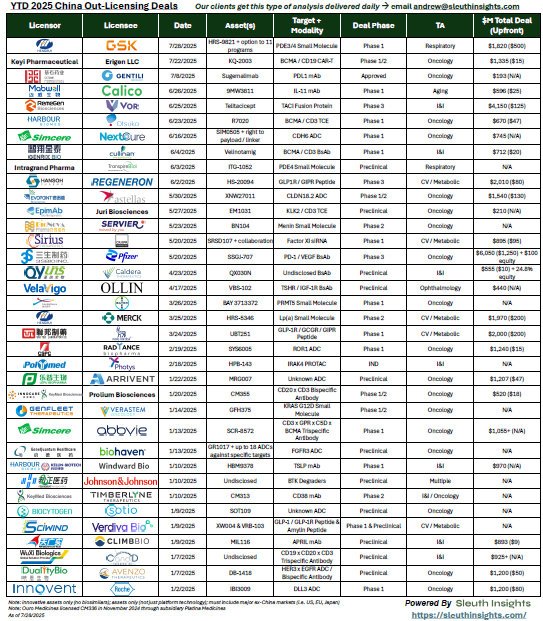
China Out-Licensing Deals YTD 2025 (updated post GSK / Hengrui)
36 deals into major markets for innovative drugs so far, tracking for 63 by year end (vs 57 in 2024).
With over half the year in the books, the patterns are starting to show:
@GavinSBaker What about smart quite money?
Less talked about than AI and EV. Top two are #Chinese#biotechcompany and the bottom two are #USA biotech!
$MRNA, $REGN, $WXXWY, $ONC