Some LC-36 updates. Now that we’ve had access to the pad and integration facility we can share a bit of good news. The propellant farm, oxygen, liquid hydrogen and LNG tanks are all in good shape. This is good luck because these are very long lead items. The water tower is also good. The big support tower is damaged, but it can be repaired in place rather than torn down and replaced. The booster “Never Tell Me The Odds” and the three GS-2s that were onsite in the integration facility also look good.
I’ve seen some speculation that we might move directly to the 9x4 configuration, but we won’t do that. Rate manufacturing of 7x2 is going well, and we’re going to continue that at pace as planned and store the stages for use. In addition, we had already been working for some time on eliminating our transporter-erector in favor of an alternative vertical conop, and we’ll now go directly to that; so we don’t need a new transporter-erector.
We will fly again before the end of this year. Gradatim Ferociter.
How I Built My Own Personal AI Software Factory (And How You Can Too)
It started with me using these AI tools as a thinking partner to work through complex challenges. That progressed to using Claude Code to shape large, complex features and develop specifications for them in markdown, which then led to breaking those specifications down into discrete, small tasks I could tackle individually. That's what led to /cog-shape, the skill I now use to break down complexity and build out larger systems.
Normally, I'd take notes on a piece of paper on my desk or quickly dash off a title for a GitHub issue whenever I noticed something wrong or thought of an improvement. But as you know with AI, it's garbage in, garbage out: better input yields better outputs. So that's how /cog-capture was born. It creates high-quality GitHub issues that would consistently yield high-quality pull requests.
Both of these you can download and use for free. https://t.co/TaR7mNUay3 They're just markdown text files, and you can knock yourself out updating them, modifying them, and making them better. Though I'm pretty confident that you'll get great results out of the box.
Next I found myself in Cursor or Claude Code building a feature, submitting the PR, and then getting the code review back and copying and pasting the review comments into my session where I had all the context for my changes. I thought, there's gotta be a better way. Using the gh command-line tool, I figured out a way to review the comments, compare them, make a decision about whether or not to fix them and how to respond, close the code review thread, and then update the PR as needed. This tool became cog respond.
This naturally led to cog revise, which, as you might expect, looks for code review feedback on any of my PRs, revises as needed and responds to the comments, and pushes changes up for re-review, fully autonomously. This shaved me hours each week alone.
At this point, I had about 1,000 hours working with these coding agents and was starting to get confident in their ability to autonomously build fully functional features or bug fixes without my intervention — as long as I had the product set up in a clean way where it could run all the tests and self-verify. With that setup, I got to a point where I could trust the system to complete an issue end-to-end. That led to cog build.
A note about the word cog: nobody wants to be a cog in the system, and all the things I'm automating are, in my opinion, the tedious, time-consuming, or annoying parts of software engineering. Where I like to spend my time isn't in the realm of handcrafted code (though I've spent a lot of time enjoying that space.) Where I like to spend my time and energy is in producing a product that actually helps people in the real world. That's the output of software engineering for me, and I like to spend my time at that higher level. All of this automation lets me do just that. The more I can push off to my team of cogs (as long as I'm not seeing a reduction in quality) the better.
Once I saw build working reliably, the result was a lot of PRs. Way more PRs authored and ready for my review than I was used to. At this point I still reviewed every PR and all of the code by hand, but once I approved a PR — (especially on projects where a squash merge were required) there was this dance of pulling the most recent code, integrating the merge with my pull request, resolving merge conflicts, retesting, pushing the changes, waiting for CI to complete successfully, and finally merging. With just 10 PRs in a single day, this dance could take as long as two hours to shepherd through to production. So cog merge was born to solve this problem and get those hours back each week. By my estimation, cog merge alone has saved me more than one day each week! It just works.
At this point, my trust in the system was such that I thought I could set up a fully automated software development lifecycle with each of these tools: pull an issue from the GitHub repository, build it, test it, push it up, revise when there was feedback to address, and then merge to get the code into production. 100% hands-free. So I built cog start to do this for me. It runs cog in a loop indefinitely. At first, I only had it do one issue at a time, then multiple issues, and finally I had it pulling any unassigned issue from my GitHub repository.
The net result was that all of a sudden, I had zero bugs in any of my repositories. As fast as I could use /cog-capture or /cog-shape to create issues, cog start would be running in the background on a $600 16GB Mac mini 24/7, pulling and resolving them. All I had to do was review and approve. This was mind-blowing for me. What was most humbling was how good the coding output was. Now, I care a lot about architecture, and I think I have a pretty decent one for my projects and I think that helps. I also have lots and lots of tests and guardrails in place, and I'm careful to make sure the issues I put into the system are small enough that I'm not asking it to do something impossible. But notwithstanding all of that, I now have a system that can produce as much as I describe, faster than I can think. If I can think it and describe it, it can build it 24/7. A single cog running all the time is probably 10x as productive as I am as a senior software engineer. To me, that's amazing.
Sometimes I have a lot of small, nitpicky bugs to fix, and when that happens, I've learned I can totally trust the system to solve them end-to-end without my intervention at all. So I added a feature called cog rubber-stamp that runs in the background and approves all of the PRs for me automatically, so they go through the entire system unattended. I labeled it "rubber-stamp" because the word has a kind of negative connotation, and I'm not sure this should be done all the time. In fact, most of the time I take the time to review the PRs. But I'm learning that, as good as these agents are getting, there are definitely times when I can rubber-stamp the PRs, go to sleep, and 20 issues just show up the next morning in production — all fixed, all perfect.
The next issue I was struggling with was the constant release of new coding models and coding harnesses. In my own personal experience, the harness really matters, and the LLM being used in the harness also really matters. To make it worse, I started to learn that these public coding benchmarks were being gamed and didn't actually represent my real-world experience. How am I to know what is the best tool for the job? So I built cog arena. Cog arena lets me route any issue to any collection of harness or model combos I choose in parallel. I have a judge model look at the output of all the attempts, take the best from each and build out a really high quality PR. This is great for high stakes issues but it's also been great to build intuition about which models and which harnesses work best for my code base specifically and not just some generalized coding benchmark.
A single cog takes up around 12 MB of RAM, so theoretically on my Mac mini I could have hundreds of cogs running in the background all the time picking up work and getting it done — but I ran into GitHub API limits, so I only run 35 cogs on my Mac mini. On my MacBook Pro, I spend my time exploring new ideas, shaping new product features, or capturing bugs and small feature requests. Then the Mac mini just goes to work.
The dev capacity on my Mac mini is easily 100 developers' worth of output, gated only by my ability to clearly architect and articulate what must be built, along with guidelines on how things should be put together. Because I have 25 years as a software engineer, I'm finding out this works really well for me. Maybe someone less experienced would do worse. I don't know. I know a lot of people say there's AI slop everywhere, and that not looking at the code guarantees you'll have a ball-of-mud architecture. But in my personal experience so far, this is working really clean and really well. If you can describe how you want your code to be in terms of functional and nonfunctional requirements, AI can do it most of the time, and that is a lot of leverage.
If that weren't enough, I've started adding to my system two cheap mini PCs — one running Linux and the other running Windows 11 Pro — both running cogs 24/7.
Honestly, my problem now is one of multi-agent orchestration. I use a lightweight API call to lock and distribute tasks among the various machines, but mostly I'm trying to figure out how to keep them all busy all the time. It's really mind-blowing for me, and very exciting.
One important point in all of this: this whole system uses these AI coding harnesses in ways allowed by the various companies, so I can use their flat-rate plans. That means I'm using subsidized tokens and able to get an enormous amount of work done before I hit any of their limits. That said, newer open-source models are coming out, and I'm comparing their output with the closed-source models' output using cog arena so that if the costs become too high or the flat-rate pricing model disappear, I'll have something viable to move to. Long term, I'm seriously considering getting a server-class rack to run a very capable model locally and have all my cogs use it. At that point, I'll be able to build with effectively a multi-hundred-dev team for the cost of electricity.
If any of this is interesting to you, you can purchase Cog for $10 a month and have as many dev coding agents doing the software development lifecycle end-to-end as you have RAM. No per-usage charges, just a flat rate.
I hope it helps a bunch of new software startups get off the ground, at a minimum. And I hope it helps small businesses generally do — in a more efficient and effective way — what I see a lot of people doing with their own claws: building custom software for themselves.
https://t.co/qQyJziyaR4
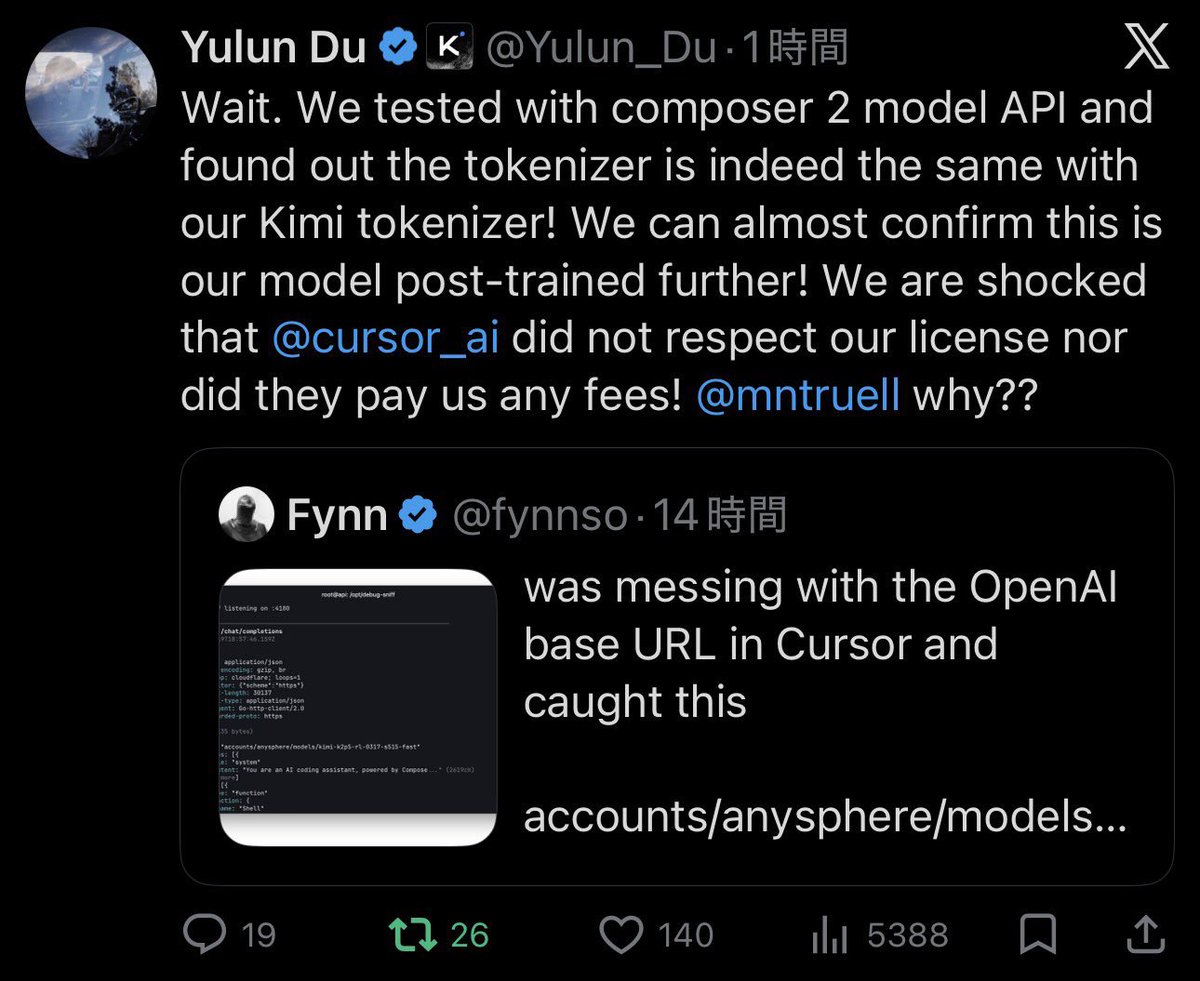
🚨NEWS: Cursor’s $50B “in-house model” is literally Kimi K2.5 with RL on top. Got caught in 24 hours
>be Moonshot AI
>spend hundreds of millions training Kimi K2.5
>1 trillion parameters, 15 trillion tokens, agent swarm architecture
>beat GPT-5.2 and Opus 4.5 on real benchmarks
>open-source it because you believe in the ecosystem
>one condition: display “Kimi K2.5” if you make over $20M/month from it
>Cursor takes the model
>runs RL on coding tasks
>ships it March 19 as “Composer 2”
>blog post: “continued pretraining + scaled reinforcement learning”
>zero mention of Kimi K2.5
>“our in-house models generate more code than almost any other LLMs in the world”
>publishes benchmark chart
>Composer 2 against Opus 4.6 and GPT-5.4
>uses the chart to justify raising at $50 billion!
>less than 24 hours later
>kimi dev intercepts the API response
>model ID: kimi-k2p5-rl-0317-s515-fast
>they didn’t even rename it
>Moonshot head of pretraining runs tokenizer test
>confirms: identical to Kimi’s tokenizer
>publicly tags Cursor’s co-founder: “why aren’t you respecting our license?”
>two more Moonshot employees post confirmations
>all three posts deleted within hours
>legal is now involved
>but it gets worse
>Cursor had Kimi K2.5 listed as a FREE model in their UI just weeks ago
>users were openly using it
>Feb 9: “K2.5 was in my model list. I updated and it vanished”
>it vanished because Cursor pulled it from the picker, and relaunched it as their own model
>Moonshot valuation: $4.3B
>Cursor valuation: $50B
Absolute state of Cursor.
Agency > Intelligence
I had this intuitively wrong for decades, I think due to a pervasive cultural veneration of intelligence, various entertainment/media, obsession with IQ etc. Agency is significantly more powerful and significantly more scarce. Are you hiring for agency? Are we educating for agency? Are you acting as if you had 10X agency?
Grok explanation is ~close:
“Agency, as a personality trait, refers to an individual's capacity to take initiative, make decisions, and exert control over their actions and environment. It’s about being proactive rather than reactive—someone with high agency doesn’t just let life happen to them; they shape it. Think of it as a blend of self-efficacy, determination, and a sense of ownership over one’s path.
People with strong agency tend to set goals and pursue them with confidence, even in the face of obstacles. They’re the type to say, “I’ll figure it out,” and then actually do it. On the flip side, someone low in agency might feel more like a passenger in their own life, waiting for external forces—like luck, other people, or circumstances—to dictate what happens next.
It’s not quite the same as assertiveness or ambition, though it can overlap. Agency is quieter, more internal—it’s the belief that you *can* act, paired with the will to follow through. Psychologists often tie it to concepts like locus of control: high-agency folks lean toward an internal locus, feeling they steer their fate, while low-agency folks might lean external, seeing life as something that happens *to* them.”
Rather than changing our circumstances, our Heavenly Father can change us and our hearts so we then can change our circumstances.
This strength to change comes from Jesus Christ—an incredible gift from a loving God.
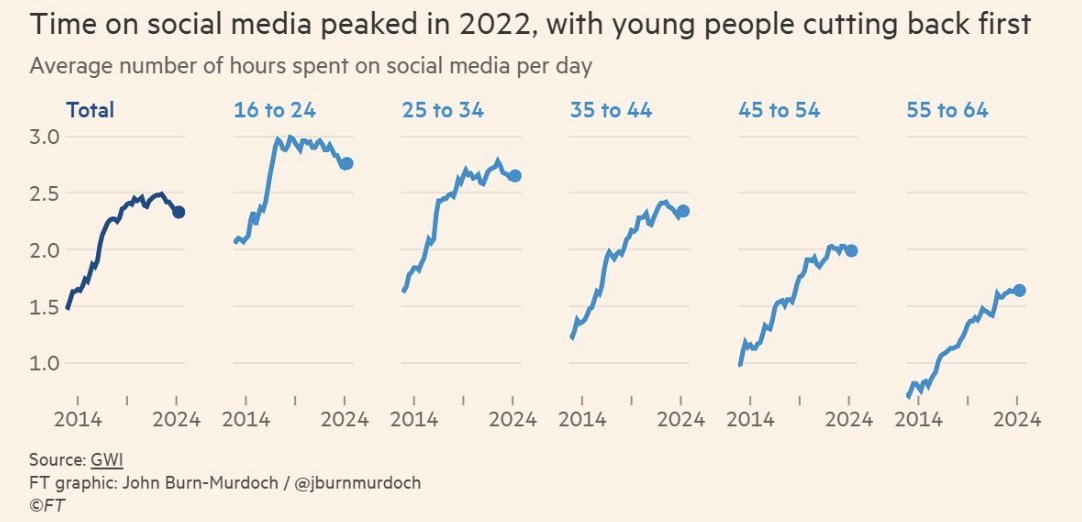
THIS chart is the CLEAREST signal of where the internet is heading.
social media time is SHRINKING for the first time in HISTORY, and young people are leading the pullback.
Brainrot is OUT.
they grew up online, saw the full cycle of social platforms, and learned early that endless scroll doesn’t make you happier or smarter.
they’re the LEADING indicator. their parents will follow in 3-5 years.
AI slop is the nail in the coffin.
every feed feels synthetic familiar faces, identical voices, recycled ideas. the “factory smell” of it all finally broke people’s curiosity.
but there’s an upside. every trend creates its anti-trend.
attention is shifting back to things that feel real, slow, and intentional.
people are paying for spaces that make them feel grounded, informed, and connected again.
the next $100M+ companies will engineer density, trust, and time well spent. they’ll build containers for meaning, then use AI to keep them organized, not optimized.
the internet’s oldest assumption that more engagement equals more value is breaking.
the white space i think is...
• "slow media" formats: weekly briefs, serialized content etc
• private groups that operate like clubs with applications and rituals
• provenance and identity layers that verify real creators and sources
• brands with offline gravity like real events, real belonging
• curated directories and vetted marketplaces
• paid memberships that deliver depth
• note: we share business ideas around this on @ideabrowser
• IRL anything - dinners, meetups, shared experiences
young people are abandoning social media faster than their parents are discovering it.
If you understand what that means, that's a big deal.
i can't stop thinking about this FT/GWI chart.
brainrot is OUT.
meaning is IN.
Today marks the 30th anniversary of the introduction of “The Family: A Proclamation to the World.” This proclamation continues to teach us today that we are all members of a heavenly family that provides the model for our families on earth.
“The family proclamation teaches about family, marriage and gender and their part in the kingdom of our Father in Heaven. It states, ‘The family is central to the Creator’s plan for the eternal destiny of His children.’ This statement is the crux of the message of the Proclamation. . .”
"Each of us is a “son or daughter of heavenly parents” with earthly opportunities to help build the kingdom of God. He loves us. Every one of us—no exceptions. He knows us. He knows where we will thrive, what experiences in mortality will help us grow in spirituality, and in what circumstances we will bless the lives of others."
— Elder Ronald A. Rasband (@RonaldARasband), the Quorum of the Twelve Apostles, BYU Devotional, September 23, 2025
The Star-Spangled Banner is not easy to sing. It’s rangy, for one thing. One and a half octaves are a lot to ask of the average citizen, as is the chromaticism throughout the melody. Also, the words are a mouthful and easy to mangle or forget (Just google “worst renditions of National Anthem,” and strap in. The number of professional musicians who have unilaterally beclowned themselves for posterity is mind-boggling).
Personally, though, I’m more appalled by the professionals who remember all the words and hit every note perfectly but make the whole thing about themselves. This, I think, is the biggest reason most people don’t sing along as they should. It’s not because they “can’t sing” or because they’re embarrassed to sing in front of other people. It’s because of all these pop stars and professional musicians who have turned the privilege of singing our national anthem in public into a showcase for their own talent.
Consider the famous renditions from people, like Whitney Houston, Alicia Keyes, Jose Feliciano, Marvin Gaye, and most recently, Chris Stapleton. Each give excellent performances that put their talent on full display. But that’s the problem—all these performances with all these individual interpretations have turned We the People into an audience of passive meat bags, standing mutely in stadiums and arenas all over the country, when we should sing along with unbridled enthusiasm. We don’t do this, however, because our national anthem has morphed from something participatory into something performative. And that sucks.
If it were up to me, I’d require anyone invited to sing our National Anthem at a public event to do so in less than a minute. That’s right. One minute. After 60 seconds, your microphone is cut. Implementing this one, simple requirement would have myriad benefits, some of which I discuss and demonstrate in the attached video. Consider it a Star-Spangled Public Service Announcement from the Dirty Jobs Guy to all those honored to lead us in song.
Happy Birthday, America!
Mike
This is an aggressive take by Raoul Pal.
There's no question that AI is created a period of flux in the industry the likes of which I've never seen in my lifetime.
But I'm in the humans are still needed camp. Business is about bets, it's not some simple or complex computation. Luck is still involved. Knowledge is needed, but so is intuition, judgment, and taste.
I want there to be many more businesses in the world, because I believe businesses solve problems, and we've got lots of problems to solve, but that these will all be fully AI-owned and run goes a bit too far for me.
I am the 3rd person in the world to receive the @Neuralink brain implant.
1st with ALS. 1st Nonverbal.
I am typing this with my brain. It is my primary communication.
Ask me anything! I will answer at least all verified users!
Thank you @elonmusk!
AI is crucial for you as a solopreneur. Think of it as a virtual team member. Start by identifying repetitive tasks consuming your day: content creation, email responses, research, or data analysis. These tools like can draft marketing materials, do research, while specialized AI can handle bookkeeping or customer service. The goal isn't replacing your expertise, but multiplying your output. What's one business process you could automate with AI this week to reclaim some time? #AI