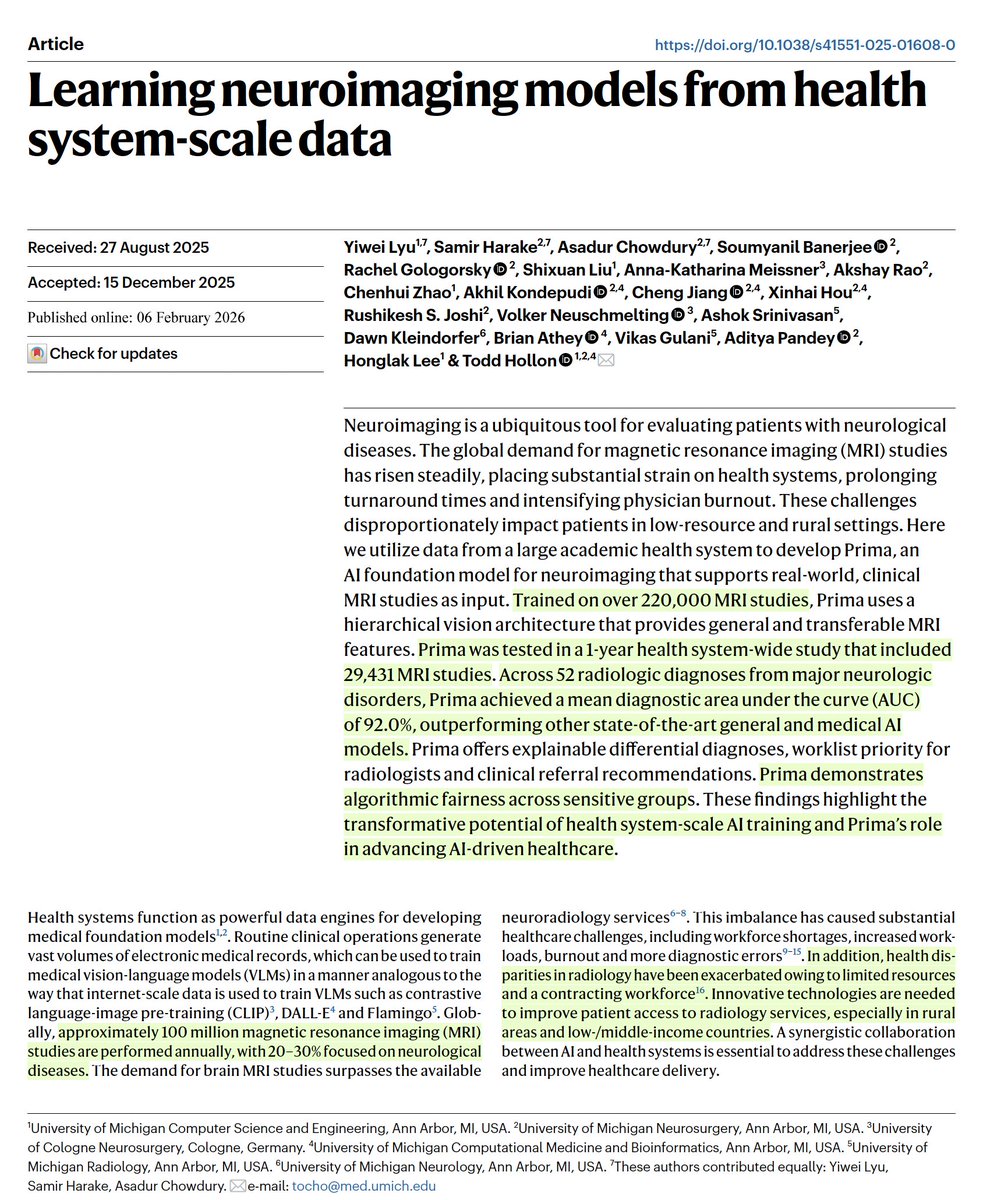
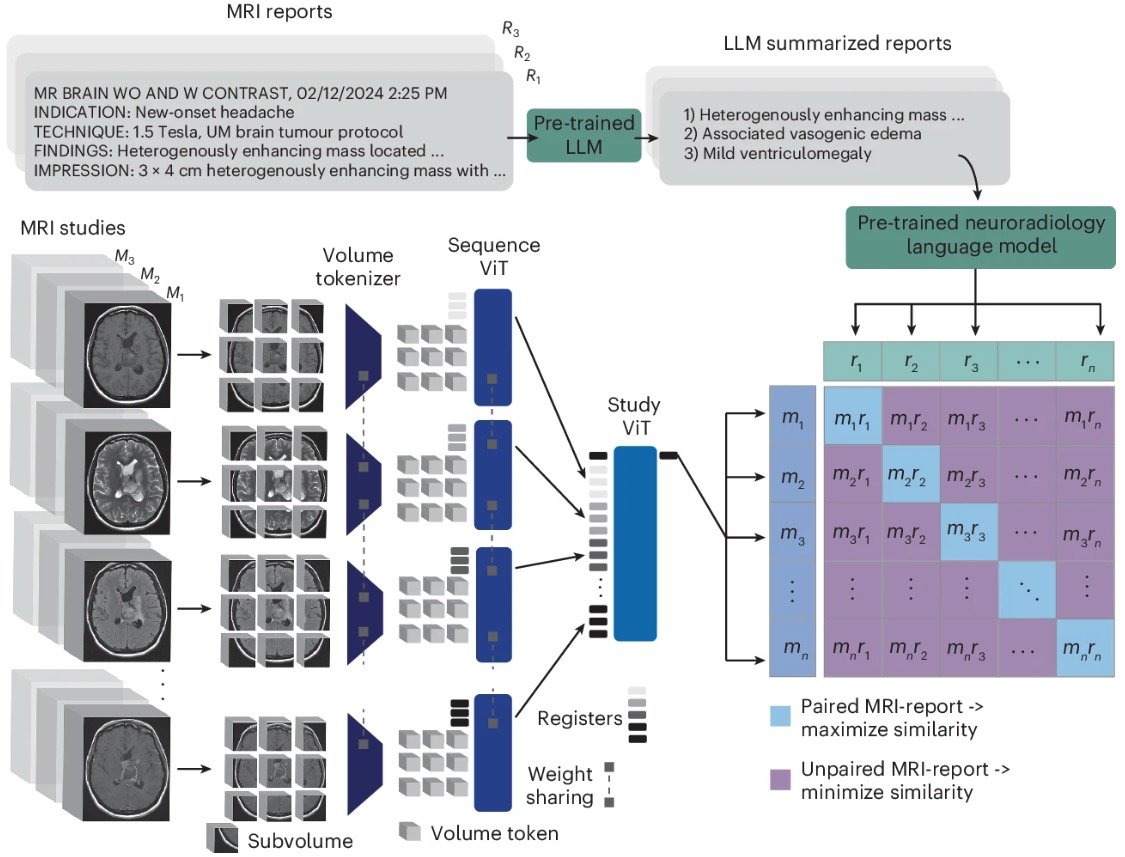
How to read a brain MRI and make a diagnosis in seconds, along with urgent triage, with very high accuracy? A vision language AI model from @umichmedicine@natBME tested in real world medicine
https://t.co/aCTgcrATDT
We present Prima, the first medical foundation model for neuroimaging that supports full real-world, clinical MRI studies: the whole MRI in >>> diagnosis out!
Thanks to @umichmedicine, @umichneuro, and our @mlins_lab.
https://t.co/VKZBqtbZPW
@mlins_lab PhD all-star, Yiwei Lyu, presenting his paper at @RealAAAI on Restorative Step-Calibrated Diffusion. His paper solves the problem of restoring biomedical images with variable and unknown amounts of data degradation.
Checkout the preprint: https://t.co/AfsoPZHwai
🌟 Attention #SpineSummit2025 attendees! 🌟 As you plan your schedule, make sure to note the sessions featuring @umichneuro residents. Their contributions are insightful and inspiring, so plan accordingly and don’t miss out on their sessions! 📅 #GoBlue@spinesection
🚀 Proud to introduce #FastGlioma: the first foundation model enabling rapid, accurate detection of brain tumor infiltration during surgery, in under 10 seconds. With FastGlioma, we’re minimizing the risk of residual tumor and enhancing outcomes for glioma patients. This work sets a new standard in real-time, microscopic-level detection, powered by AI in healthcare. Kudos to the incredible team @mlins, @HerveyJumper, @DanOrringerMD, @InvenioImaging, @CameloPiragua!
Read the full paper in @Nature: https://t.co/gJ3dCPYod4
We recently published a paper in @EditorNeuro that highlights the importance of tumor biology and interactions with the surrounding brain, in this case, seizures. https://t.co/cHSWLlRxEJ
4/7 📊 Hou & Jiang et al. present SPT, a framework for learning self-supervised slide representations, which is consistently able to learn strong slide-level features across a variety of encoders, including UNI. arXiv: https://t.co/2FEQ9Kcaau
⚡️This is the first work to investigate slide pretraining across a diverse variety of ROI encoders. The analyses in Hou & Jiang et al. suggest that slide pretraining provide the biggest performance gains in less powerful ROI encoders, with least benefit in HiDisc and UNI. They also show the importance of further finetuning as well, which can yield as big of an improvement as slide pretraining.
💭 We believe more development needs to happen in self-supervised slide encoders than ROI encoders. Few works in this area, and where most of the technical advancements need to be made 🔥
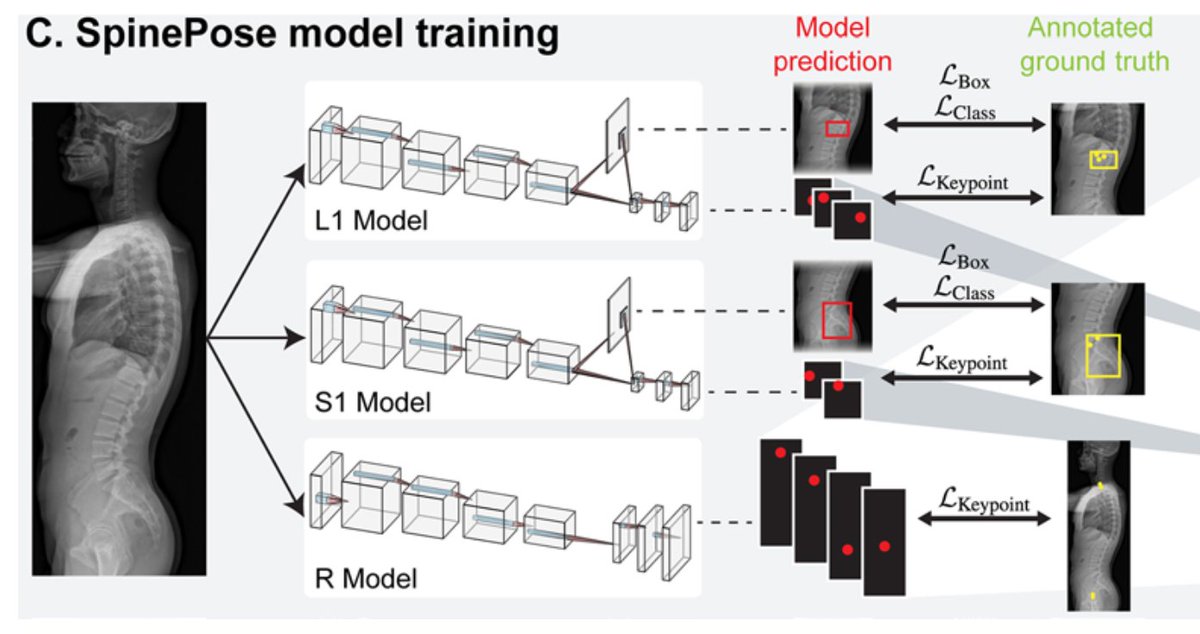
Very excited to share our most recent work out of the @mlins_lab - SpinePose is a novel deep learning model that predicts spinopelvic parameters. Special thanks to @ToddCHollon , Dr. Paul Park, @joseph_linzey@__chengjia__ https://t.co/t2DQifUjY3