Eritrea’s regime under Isaias Afwerki has gone far beyond ordinary repression. Reports describe people locked inside metal shipping containers in the desert heat and left there to die. It is one of the most extreme and inhumane forms of cruelty still being practiced.
https://t.co/QvTSbLul5L Apparently, Washington's missing strategy for the Horn begins with giving Ethiopia a bigger chair and arranging the region around it. This is a rather ludicrous proposition, particularly coming from a desperate PP leadership whose regional ambitions are increasingly exposed and whose once carefully cultivated Ethiopian halo is rapidly fading. External powers have too often mistaken #Ethiopia's manufactured "geopolitical indispensability" for a legitimate mandate to exercise regional primacy...
The #Horn of #Africa is not #Ethiopia|s backyard, nor does it need a designated hegemon. It needs sovereign equality, mutual respect and adherence to international law.
The Horn of Africa does not suffer from the absence of an Ethiopia-centered American strategy. It suffers from a longstanding tendency among external powers to mistake Ethiopia's demographic weight, geographic size and perceived geopolitical importance for a regional mandate. This persistent miscalculation has reinforced a political culture of exceptionalism in which #Ethiopia's aspirations are too often elevated above the sovereign rights and legitimate interests of its neighbors.
#Ethiopia is neither the proprietor of the #Horn of #Africa nor the arbiter of its political, economic and security architecture. Its size does not confer primacy, nor does not establish entitlement; and its national interests cannot acquire precedence over the sovereignty and territorial integrity of other states simply because external powers consider it indispensable to their own geopolitical calculations.
History has repeatedly demonstrated the folly of elevating Ethiopia's perceived strategic indispensability above the sovereignty and legitimate interests of its neighbors. For decades, successive Ethiopian regimes benefited from a degree of international indulgence rooted in their perceived strategic utility, particularly in the calculations of Western powers. Yet this privileged treatment did not produce a more peaceful or stable neighborhood. On the contrary, the persistent failure to hold #Ethiopian governments to the same standards of international law and responsible state conduct expected of others has contributed to recurring regional insecurity.
The current discourse surrounding Ethiopia's quest for #RedSea access illustrates the danger particularly well. Ethiopia's landlocked status is a geographical reality, and its interest in reliable, negotiated commercial access to maritime routes is entirely legitimate. But geography does not create sovereign rights over another country's coastline, ports, islands or territorial waters. Nor can economic aspirations, however important, justify coercion, threats of force or attempts to revise established territorial arrangements. Commercial access is negotiable; sovereignty is not.
#Washington should therefore be wary of a policy framework that conflates Ethiopia's national aspirations with the broader strategic interests of the Horn of Africa. Such an approach risks converting a bilateral relationship into an instrument for legitimizing regional hierarchy, while inadvertently rewarding the very conduct that undermines regional stability. It would also send a troubling message to smaller states: that sovereignty and territorial integrity are inviolable in principle, but potentially negotiable when weighed against the strategic preferences of a powerful partner.
A credible #American strategy must resist this logic. It should recognize the agency of every state in the region, engage them on the basis of sovereign equality, and reject the notion that regional stability requires a designated hegemon. Ethiopia can be engaged as a regional stakeholder, not elevated into a position of presumed regional entitlement. #Eritrea, #Djibouti, #Somalia, #Sudan and #SouthSudan are not peripheral considerations in an #Ethiopian-centered geopolitical equation; they are sovereign countries whose interests and security are integral to the regional order.
Ultimately, #Horn’s stability cannot be engineered through external patronage, geopolitical favoritism or the accommodation of unilateral ambitions. It must rest on respect for internationally recognized borders, non-interference in the internal affairs of states, peaceful settlement of disputes, reciprocal obligations and the unequivocal rejection of the threat or use of force. These are not obstacles to American strategic interests; they are the indispensable foundations of a durable regional order.
Washington's missing strategy should therefore begin not with Ethiopia, but with first principles. The question is not how to organize the #Horn around Ethiopia, but how to ensure that Ethiopia, like every other state, operates within an order governed by #sovereignequality, #internationallaw and mutual respect. The #Horn needs partners, not patrons; cooperation, not hierarchy; and a regional order founded on law, not on the presumed entitlement of the strongest...
@Jambo👉🏿What remains is to dismantle the Bolshevik-inspired constitution and Bantustan-style ethnic federalism, end identity politics, and establish a citizen-based democracy grounded in equal citizenship, the rule of law, separation of powers, and strong democratic institutions.
Sam : Indeed, when is the identity based grievance aka identity based whining and complaining going to end: both ethnic and religious grievances were addressed by the 1974 revolution and it was again addressed in a radical way in 1991. What else is remaining?. @AAU_Official@SOAS
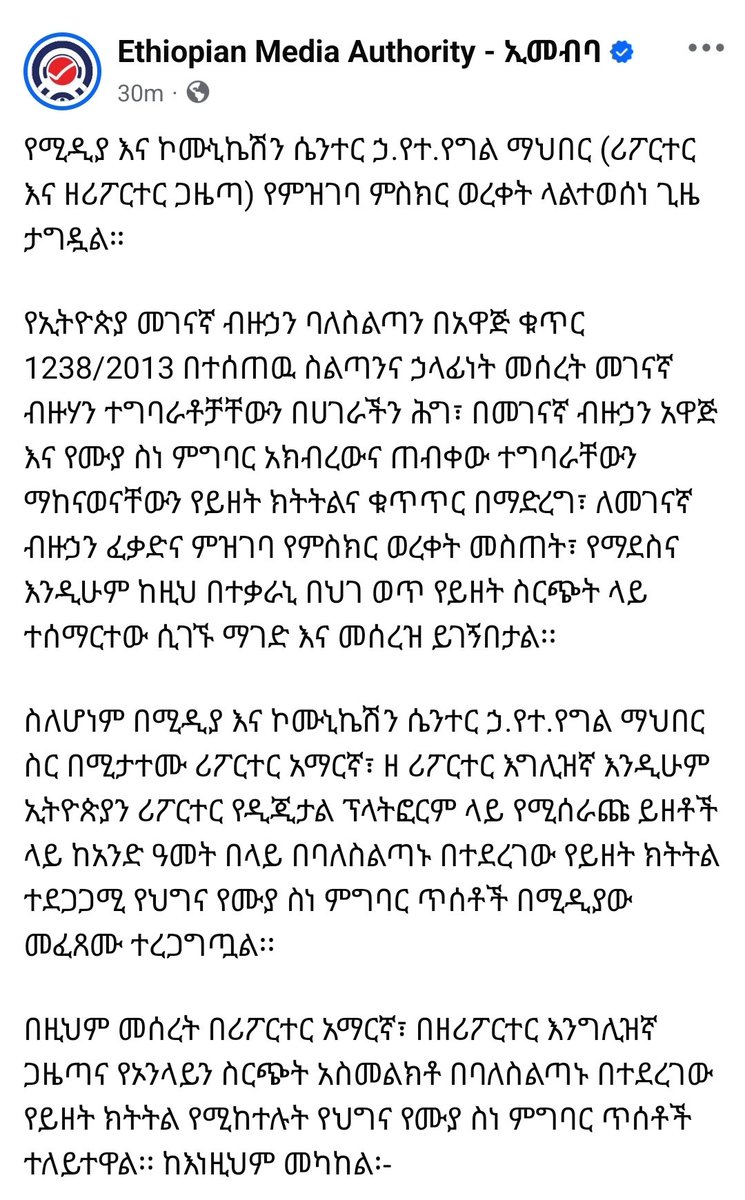
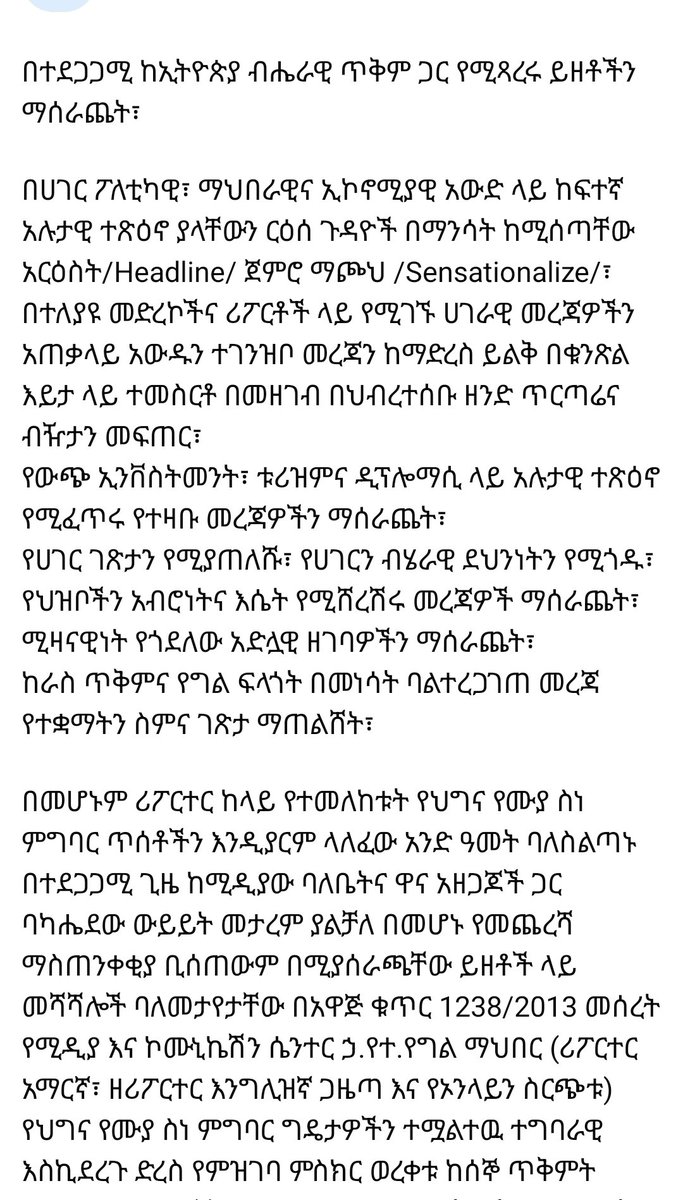
A regime in distress reveals itself by silencing the free press. The Reporter is one of Ethiopia’s few credible independent news outlets. Suspending its entire operation is a travesty of justice and an assault on press freedom. This may well mark the beginning of the regime’s end
.@EthMediaAuth suspended @EthioReporter newsapapers, one of the oldest surviving independent media outlet in #Ethiopia indefinitely on allegations of lack of professionalism and etc.
It made sense👉🏿"Apparently, tribalism comes in every color, shape, and personality. Perhaps it needs its own grand theory, like Marxism. Our tribalist elites have turned ethnic grievance into ideology, victimhood into a profession, and hypocrisy into an intellectual discipline.”
“I too am deeply concerned about recent reports of targeted killings of civilians in Arsi zone, Oromia region, Ethiopia. The United States condemns religious, ethnic, or political motivated violence. Such horrific attacks against any group must stop. The United States calls on the government of Ethiopia to investigate and to bring the perpetrators to justice.” - Ambassador Ervin J. Massinga
First Black Woman to Earn PhD in Aerospace Engineering at University of Texas.
Meet the history-maker redefining aerospace engineering. 🚀
Dr. Wendy A. Okolo became the first Black woman to earn a Ph.D. in Aerospace Engineering from the University of Texas at Arlington—achieving this milestone at just 26 years old.
Today, she is an Aerospace Research Engineer and Associate Project Manager at NASA Ames Research Center. Her groundbreaking work focuses on:
* Autonomous systems for drones and spacecraft.
* Fuel-saving mechanisms through aircraft formation flight.
* Flight path control (for which she holds a U.S. patent!).
Beyond her technical genius, Dr. Okolo is a fierce advocate for diversity, working actively to dismantle barriers for women in STEM and inspiring the next generation through her book, Learn to Fly.
An absolute powerhouse and an inspiration to future scientists everywhere. 🌌✨