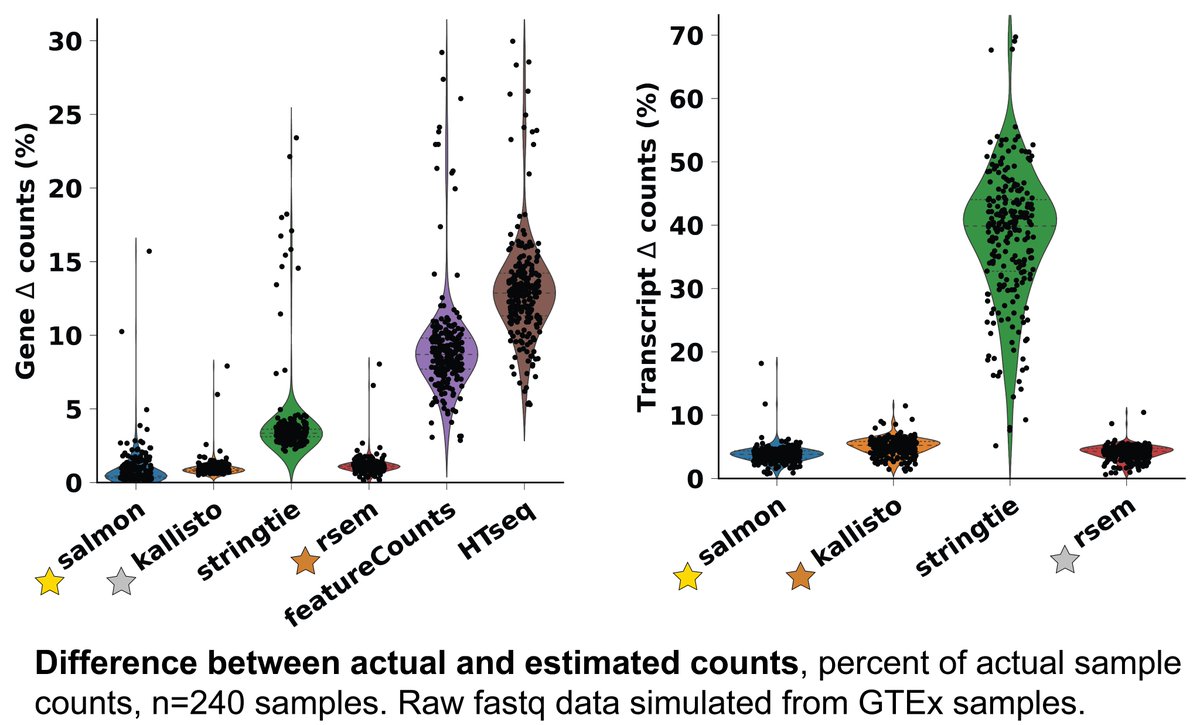
RNAseq counting tools are not perfect. I simulated 240 GTEx samples to test multiple tools. Below I show the difference between actual and estimated counts for each simulated sample.
But, what is causing this? And will it affect differential expression? (1/7) #Bioinformatics
@JohnHolbein1 Not really sure this means what you think. E.g. if someone shows a plot with only differentially expressed genes, the z scores will be shifted to the left and right. Nobody wants to see a heatmap with 20k rows
We show that muscle vasculature loss precedes cancer cachexia and identify PGC1α and INHBA as causal factors. This was a huge effort with several models, clinical biopsies, massive amounts of imaging, sequencing, bioinformatics, and much more. https://t.co/Sc28WmpH8e
@iaincheeseman Didn’t it arise from an endosymbiosis between archaea and bacteria? Is the host cell a bit anachronistic in this graphic? Not my expertise area, but I did just read some Nick Lane 😅
1/: Excited to share our new study led by Luke Zappia on feature selection methods for single-cell RNA-seq data, now published @naturemethods ! We explore how choosing features impacts reference atlases & downstream analyses. 📊📚 https://t.co/wQhXyuvt5G
Senescent cells contribute to disease and are found in many tissues but are hard to analyze because markers have been derived in culture and do not account for cell-type differences. Here, we define new signatures based on millions of single cells (1/5) https://t.co/QGqAMDd78z
There are three primary ways to use SenePy: 1) as an input list in any tool that takes a gene list, such as gene set enrichment. 2) senescence scoring directly on single-cell data. 3) Database to search for senescence markers in a specific cell type. (5/5)
In addition to aging, SenePy is widely applicable in many disease contexts. We show how it can be applied to cancer, heart disease, and infection. Here is an example of senescent-like foci in infarction spatial data (4/5)
@dna_rosenberg Parse is great and cheap but still many reasons to do bulk. To sequence 5M cells at 20k reads/cell requires at least 10 S4 flow cells. That’s at least ~150k USD. Of course you don’t need to do all 5M but still need >10k reads per cell if you care about quality
@TedNugent You own a store. Your store gets robbed. Elon, out of his mind on ketamine, sh*ts on the floor and incoherently blames the delivery man with proof he scribbled on a napkin. You believe him. Your store goes bankrupt.
You’re an idiot.