Today we’ve raised $52M Seed and we are announcing the public launch of S2.1 Pro.
>It can clone a voice from 5 seconds of audio
>2x faster than Cartesia & 1/6th the cost of Eleven Labs
>most expressive model with word level control over emotion, intonation, pacing etc
We support frontier AI companies including HeyGen, LiveKit, Retell, Sanas, and OpenArt all run our model in production.
If you're a business and we can't cut your voice AI costs by 50%, we'll give you 1 year of Fish Audio for free.
Book a demo: https://t.co/vHkyZf9JoG
To celebrate our first birthday, we'll give you 1 month of S2.1 Pro for free. Like, retweet, and comment “Fish” to get it.
Releasing the model weights and technical report of Kimi K3.
Kimi K3 is our most capable model: a 2.8T MoE model with native visual understanding and a 1M-token context window.
New model architecture: 2.5x the intelligence per unit of compute, not just more params.
Alongside Kimi K3, we're opening up more of the stack behind it — high-performance attention kernels, MoE communication library, and infrastructure for running agent environments at scale.
Model weights: https://t.co/7m7eEg6Y0B
Tech report: https://t.co/yeu6cjpMCT
Tech blog: https://t.co/YTfiMSNM1f
@jain_harshit People have been paying money for their substandard services which made it profitable.
You think Airtel spent 43,000 crore by making losses? Come on.
Today realisation hit me that there is no problem which i couldn’t solve, somehow i get things done
Which made me think how much more ambitious i can be.
If concepts didn't need to marinate in my brain for them to be fully understood, I would have learned everything that I know today, technically, about LLMs, deep learning, and CUDA programming in three months, give or take.
It's okay if you take a bit longer. Don't be to you hard on yourself.
The next 8 days: nothing but the mathematics behind LLM architectures.
There’s a incomplete feeling when you know how to use something but can’t derive or explain why it works from first principles. That’s the gap I’m trying to close
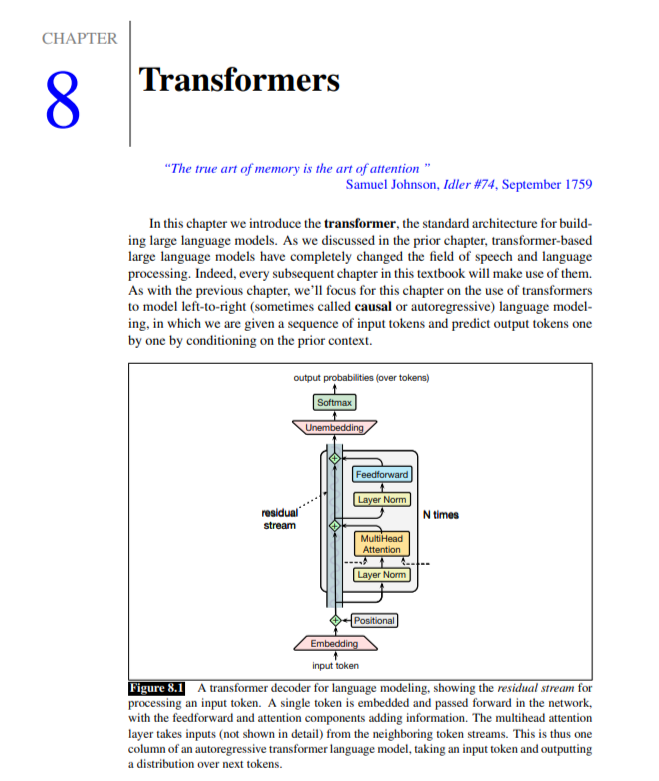
A great source to understand or refresh Transformer architecture
It explains how transformers process text token by token, using self-attention to build contextual representations
Covers:
- Token embeddings and positional encodings
- The residual stream that carries information across layers
- Multi-head self-attention and long-range dependencies
- Feedforward networks, layer normalization, and residual connections
- Transformer blocks stacked into deep language models
- The language modeling head that predicts the next token
It also connects these concepts to GPT and BERT