Norway raised its policy rate to 4.25%. Sweden held at 1.75%.
Sweden lost IKEA's founder to Switzerland. It learned from the mistake. Killed the wealth tax in 2007. Launched the ISK in 2012.
Stockholm has Europe's deepest retail equity culture.
In 1933 a writer gave our unwritten code ten rules. The first one: you are not to think you are anything special.
We call it Janteloven. Most Norwegians have never read the book and can still feel every word.
Let's go Norway!🇳🇴
Geir Harald Hansen has shared his thoughts on why he is putting his life's work into @H100Group.
He explain his background, motivation and vision in the letter.
I highly recommend all @H100Group shareholders to read.
Speaker announcement 💥
Meet @Sanderandersenn !
Sander Andersen is CEO of H100 Group and Finpeers, leading the Nordics' largest publicly traded Bitcoin treasury with over 1,000 BTC. He shares the blueprint for corporate Bitcoin strategy at BTCHEL 2026.
BTCHEL - the largest Bitcoin conference in the Nordics.
Dates: 25. - 26. September 2026
🎟️ Grab your tickets at https://t.co/kKb0RJCTeb ⚡️
Q1 2026 report is out.
From 1,051 to approximately 3,500 BTC once our Norwegian acquisition closes. Bitcoin for Bitcoin with no new debt and no warrants.
Existing shareholders keep their full proportional bitcoin exposure inside a much stronger company.
H100 Group AB has today published its Q1 2026 interim report.
Q1 was a transformational quarter for H100. We advanced a proposed debt-free, bitcoin-for-bitcoin acquisition expected to increase total Group holdings from 1,051 BTC today to approximately 3,500 BTC upon closing in Q3 2026, subject to customary conditions and approval by the general meeting.
No cash consideration. No new debt. Just more bitcoin.
During the quarter, we also established our operational presence in Switzerland, launched a scalable group coaching product through Entirebody, and maintained a strong cash position giving us flexibility to execute with a long-term perspective.
FYI - It’s the WOMEN of #Bitcoin, who are standing up for @keonne#pardonsamourai . The majority of “men” in Bitcoin need to check their sack! How far we have fallen as men. Not all, but most. Embarrassing
Samourai CEO Keonne Rodriguez: Guilty Plea, Prison Ahead, and the Fight ... https://t.co/FI5dGZnUQC via @YouTube
Thank you @natbrunell for this timely show. Please watch and share to stand up for @keonne, for free speech, and for open-source code.
https://t.co/QDFgCCSJzn
Incredible clip to understand the #PardonSamourai case and why it’s increasingly looking like a pardon from @realDonaldTrump would be a win for nearly everyone except the rotten DOJ out of SDNY—which is entrenched with Biden appointees.
ChokePoint 2.0 never died. But now, its days are numbered.
@keonne will be free soon enough. 🟠💪
PRIVACY SOFTWARE DEVELOPER SENT TO PRISON BY “WEAPONIZED BIDEN DOJ”
“I operated Samourai Wallet openly and notoriously in this country for 10 years, and for 10 years, there was no problem. And then, suddenly, under a weaponized Biden DOJ, on April 24th, 2024, 50 FBI agents raided my home with guns, drones, armored vehicles…and arrested me.” - @keonne shares his story with @ericbolling.
@POTUS
While I’m no genius, the Supreme Court has emphasized that laws should be clear enough for an AVERAGE PERSON to understand
Let’s get into the minutiae of the specific subsection of the charge they pled to
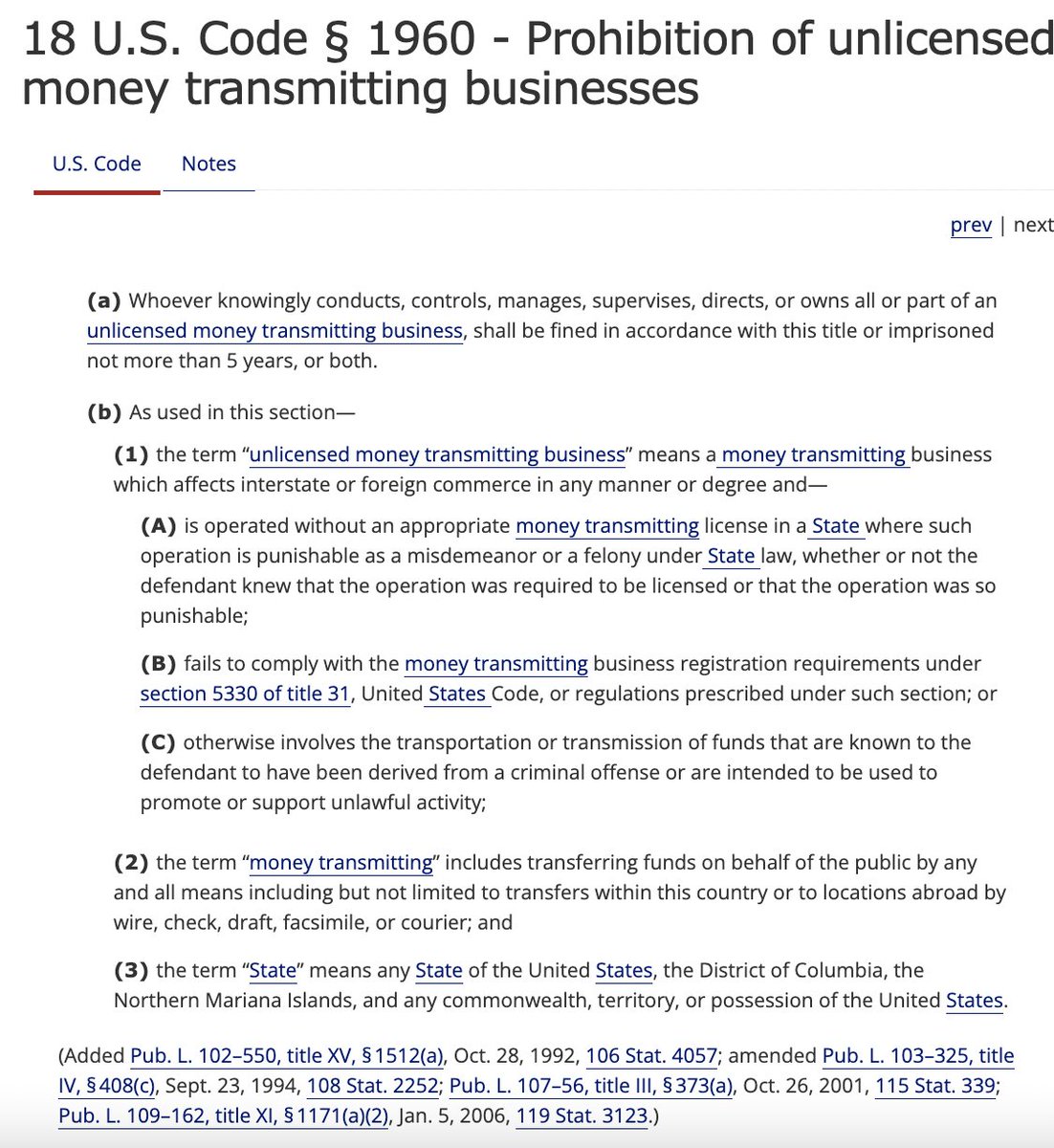
What Keonne and Bill pled to was a violation 18 U.S. Code § 1960(b)(1)(C)
The @SamouraiWallet developers created a tool improving privacy for bitcoin on-chain use, similar to cash. Users held control of their own funds.
Prosecutors ignored FinCEN guidance and concocted an unreasonable legal theory of liability to charge them both with breaking money transmission laws despite the tool never taking custody of the funds.
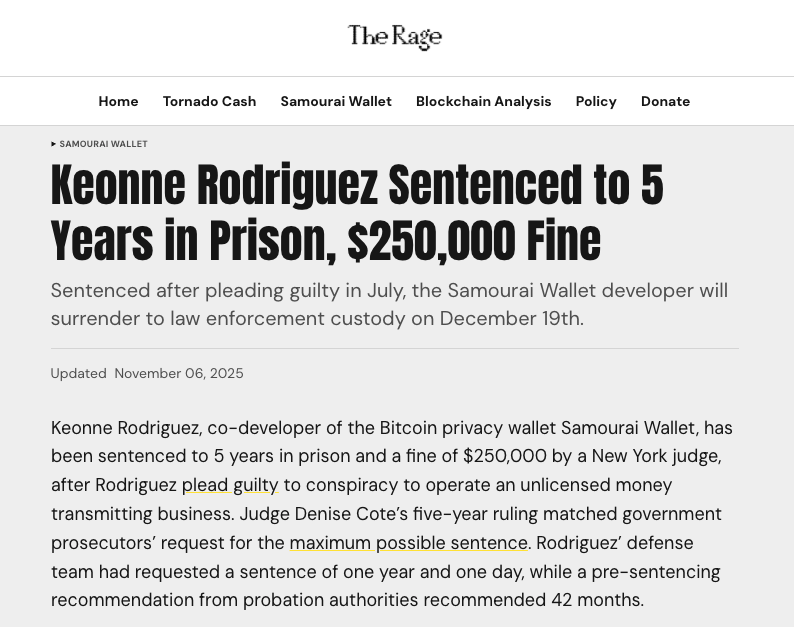
Facing millions in legal costs, 25 years in prison, an overzealous and unfair prosecution, and a Judge with no patience for understanding the broader legal and technical arguments, the developers were essentially forced to plead to lesser charges of "conspiracy" for the sake of their families.
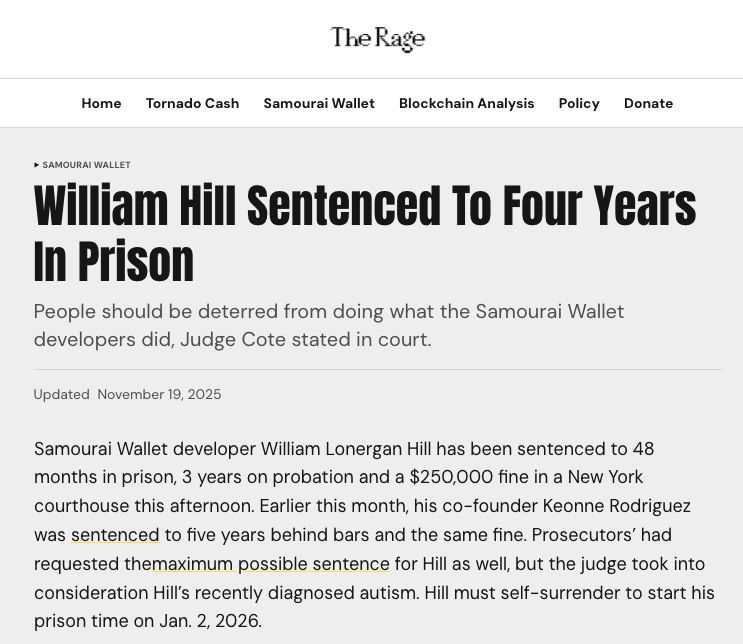
Now, both developers have one month before they are to turn themselves in for 4+ years of incarceration, all for creating a piece of open-source code that allowed people to do want they wanted with their own money.
This prosecution is an unwarranted and unjust process of law that will be looked back on in shame. Every legal tool or resource should be dispensed in order to free them and reverse the dangerous precedent this sets for privacy and financial sovereignty.
Privacy is not a crime, and open-source developers who empower users are not criminals.
Many wealthy and powerful people today use bitcoin and cryptocurrencies to safeguard their wealth and benefit from a real-time settlement network without intermediaries. Every consumer benefits from better tech tools that allow them to take control of their money and spend how they wish.
If people of influence understand and appreciate the broader ethos of the Bitcoin and crypto revolution, rather than trading and getting rich off fees from their shitcoins, they should advocate for both the pardon of these two individuals and for legal safeguards in federal law to ensure this never happens again.
It is not just two these people's at stake, but it's the future of how Americans will interact and benefit from technology going forward.
#freesamourai @keonne@SamouraiDev
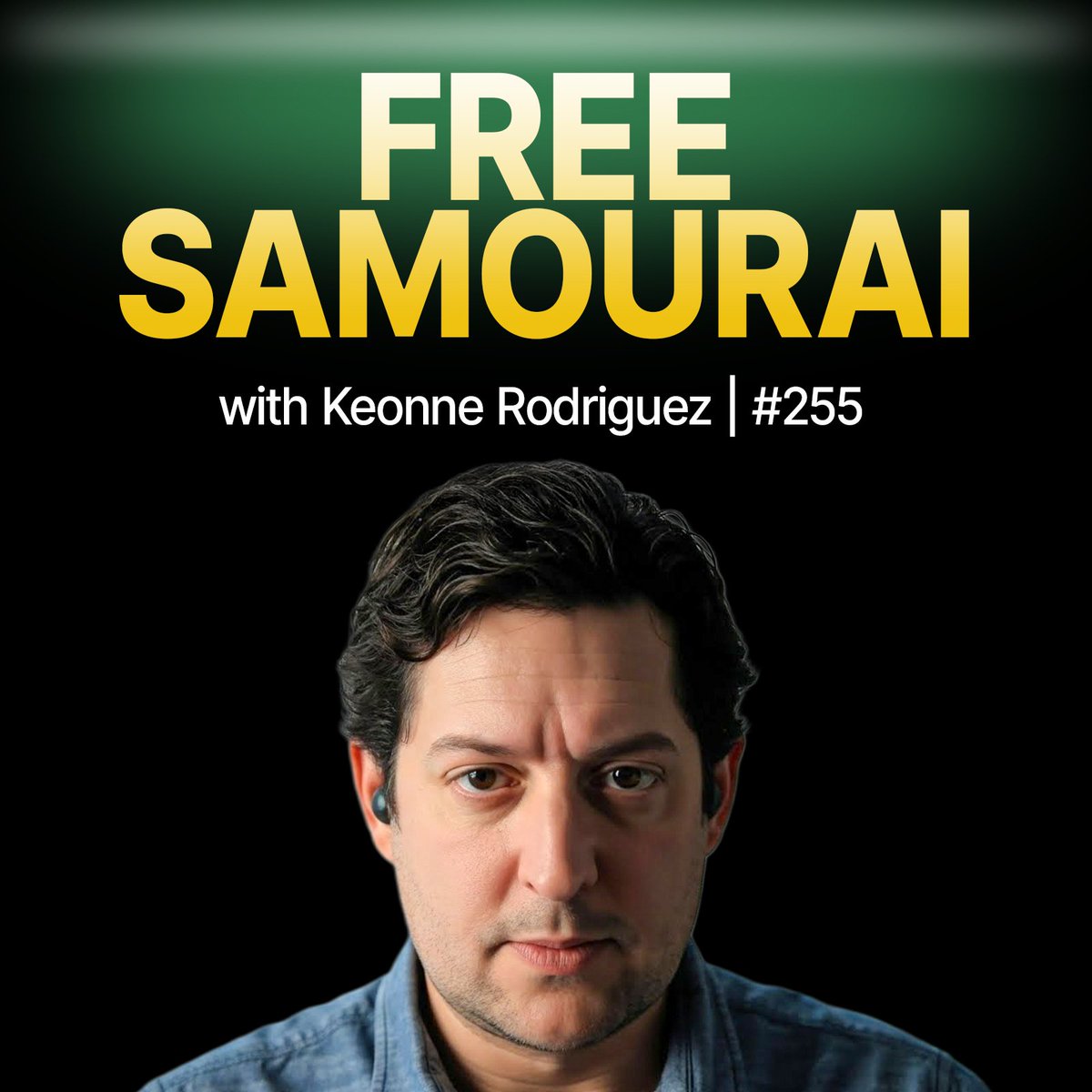
In @_BitcoinMatrix Episode #255, I chat with @keonne, co-founder of @SamouraiWallet —a Bitcoin wallet focused on privacy and self-sovereignty. Keonne now faces prison time for building open-source privacy tools, in a legal case that has stunned the Bitcoin and developer communities.
This episode exposes the frightening reality of what happens when privacy-focused developers are targeted by state power. If you care about Bitcoin’s future as freedom money, developer rights, and the fight against financial surveillance, this conversation is a must-listen.
Links to our entire conversation:
📺https://t.co/DYSuMssa9F
🎧https://t.co/GG5pDdXBoi
🍎https://t.co/MIaHjoqmmq
The Future of Privacy
@realDonaldTrump@elonmusk@RealRossU@maxkeiser
The technology reshaping our world is quietly changing the algebra on privacy.
For more than two centuries, privacy has been a core American principle. The Bill of Rights makes this explicit. The Fourth Amendment protects citizens in their “persons, houses, papers, and effects.” The Fifth Amendment shields individuals from compelled self-incrimination. Even in modern times, laws such as HIPAA reflect the belief that some categories of personal information should remain beyond casual or warrantless scrutiny.
That moral and legal framework began to shift in the early 21st century. After September 11th, the Patriot Act expanded surveillance authorities dramatically, justified by national security concerns. Since then, Americans have lived in a persistent tension between secrecy and surveillance, debated by intelligence officials, technologists, civil-liberties advocates, and ordinary citizens who simply want some measure of privacy in their daily lives.
In the digital era, this tension has evolved into an arms race.
On one side, privacy-preserving technologies have advanced: encryption, virtual private networks, secure messaging, and privacy-focused browsers. On the other, surveillance capabilities have grown just as rapidly: packet inspection, metadata analysis, pervasive monitoring, and increasingly powerful AI systems that infer far more than users knowingly disclose.
Finance has become the most consequential front in this conflict.
Financial privacy complicates tax enforcement, regulatory oversight, and intelligence gathering. Historically, physical cash served as the default privacy layer for lawful personal transactions. But cash usage has declined steadily, and operating entirely outside digital financial rails is nearly impossible in modern life.
This is where cryptographic financial technology enters.
Crypto systems are neutral infrastructure. They can enable radical transparency, exposing every transaction to public scrutiny. They can also enable strong privacy, limiting transaction visibility and making personal financial behavior difficult to surveil at scale. That dual capability has made digital finance the newest battleground over privacy.
During the Biden administration, this conflict intensified. Regulatory and enforcement actions signaled a clear preference for financial systems designed around maximum visibility. Privacy-enhancing crypto technologies were treated with hostility, entire categories of financial privacy were discouraged or criminalized, and developers of open-source privacy tools were targeted. This posture, often referred to as Operation Chokepoint 2.0, reflected a broader effort to push digital finance toward surveillance-first outcomes, including the exploration of central bank digital currencies.
Today, as the Trump administration enters its second term, the most aggressive and visible elements of this approach have receded. Debanking pressures have eased, and the tone around digital assets has shifted. That said, it would be a mistake to assume the underlying conflict is resolved. Powerful interests within the banking system and national security apparatus remain deeply uncomfortable with technologies that limit financial surveillance.
The prosecution of the Samourai developers illustrates this unresolved tension.
Two open-source software developers now face severe criminal penalties for writing code that enables transactional privacy, functionally comparable to a VPN for financial activity. This is not a case involving fraud, theft, or market manipulation. It is a case about whether building privacy-preserving infrastructure itself constitutes a crime.
That should give pause to anyone who believes privacy remains a legitimate feature of a free society.
The appropriate venue for resolving this question is not the criminal justice system. It is the political process. Americans deserve an open debate about what level of financial privacy is acceptable in a digital economy, just as earlier generations debated encryption, free speech, and surveillance in communications.
Mr. President, this moment matters. A substantial and principled group of your constituents is watching closely. Just as you intervened in the case of Ross Ulbricht to address a clear injustice, this case presents an opportunity to reaffirm that writing open-source code to protect privacy should not be treated as a criminal act.
History will not judge societies by how efficiently they surveilled their citizens, but by whether they preserved the freedoms they claimed to protect.
@Puncher522
https://t.co/KVMs9WwO7A