Ensenyo i aprenc història arts audiovisuals. Universitat Lleida. Aspirant etern en aquest teatre d'ombres. Amb el patrimoni audiovisual. Contra el doblatge.
1888
ROUNDHAY GARDEN SCENE
From 14 October, by Louis A. A. Le Prince. It's not the oldest ‘moving pictures’ we have, but it was on film. Paper film. Le Prince missed out on the new Kodak celluloid film by 10 months which was made public for commercial use in August 1889. Le Prince also photographed ‘Man Walking Around a Corner,’ believed to be prior to this in 1887 on glass. We also have documentation from eye witnesses that Le Prince filmed in 1886, in New York. Photographic copies of ‘Roundhay Garden Scene’ on paper have been preserved since 1930 by The National Science and Media Museum (NMPFT back then).
THE BIG SWALLOW (1901)
James Williamson (1855–1933) goes a step further than George Albert Smith's close-up in Grandma's Reading Glass (1901) by having a man come so close to the camera, he swallows it and the cameraman. This photographic contortion was filmed in Brighton UK with British actor-comedian Sam Dalton. Its US release was called ‘The Big Swallow.’ Runs 1:00
8/8
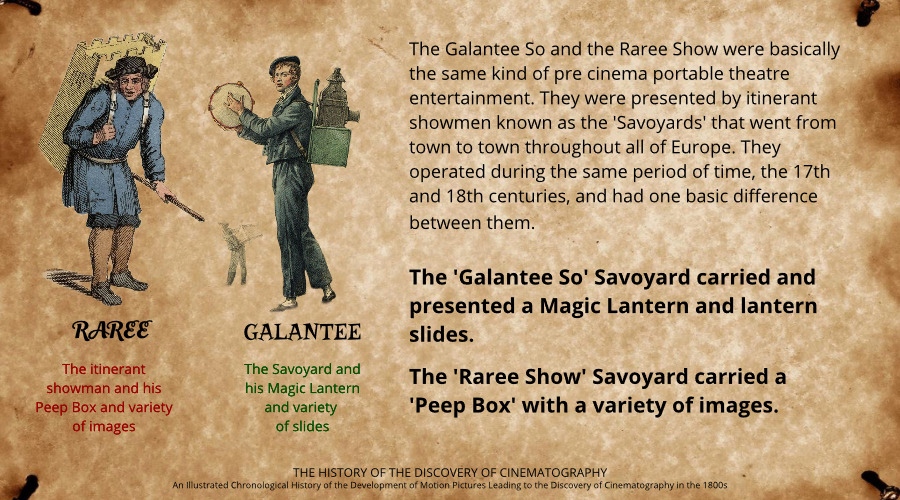
Promenade Productions @prompromltd presents perhaps one of, perhaps the only, Raree Show still on earth today called The Raree Man Peep Show.
Here is a cute little video that gives you a pretty good idea what the Raree Show was all about produced by Steve Sowden showing as they say, “the last peep show on earth.”
Runs 3:55 -30-
Regular followers of @ReaPreCinema may recall my dispatch of the Galantee So during the same time period.
So, what’s the difference you ask? The history of pre cinema, bestowing on us many apparatuses, has all bases covered as it pertains to carrying something on your back.
The Galantee So and Raree Show were close brothers.
Entrevista a Enric Soler que ha donat al Museu del Cinema una de les col·leccions de Cine NIC més importants del món.
“Tot va començar amb una pregunta; la curiositat és el motor” https://t.co/xv9ayDTvX8 via @elpuntavui
1893
THE CINÉBIBLIOGRAPHE
LÉON BOULY (1872-1932)
Bouly was a French inventor best known for creating the term Cinématographe and developing an early motion picture device of the same name.
Born in Paris, Bouly worked in the field of Chronophotography, a precursor to cinema that captured sequences of images to study motion.
On February 12, 1892, he patented a device called the "Cynématographe Léon Bouly,"described as a "reversible device of photography and optics for the analysis and synthesis of motions."
First Christened with the name Cinébibliographe, it was a tall vertical hand-cranked camera that employed the same mechanism as the Cinématographe which Bouly had developed in 1893, before the Lumières seized the name following his patent lapse.
This apparatus was designed to record a series of images automatically and without interruption, using non-perforated film driven by a segmental roller and stopped intermittently by a pressure pad.
On 27 December 1893, Bouly refined the name to Cinématographe and updated the patent to include projection capabilities, making the device theoretically capable of both filming and projecting moving images.
⚫️ S’ha mort Carlo Ginzburg, fundador de la microhistòria i autor de “El formatge i els cucs”
🔶 L’historiador italià va transformar la manera de llegir el passat a partir de vides anònimes, indicis menors i arxius de la Inquisició
https://t.co/WaefefqFKI
https://t.co/WaefefqFKI
Ya disponibles en Platfo 🎞️ las imágenes digitalizadas de la primera gira de #LaBarraca, la compañía universitaria dirigida por #FedericoGarcíaLorca y #EduardoUgarte.
✨ Memoria audiovisual del siglo XX.
🎭 Dale al play:
https://t.co/qnfJGtkuj0
The lantern below is called the English Dissolver. It was a biunial Dissolving View lantern with a toothed blade spanning both lenses.
This image is taken from Alfred Molteni's 4th edition of ‘Practical Instructions on The Use of Projection Devices’ 1884, Chapter XI on pp162, 168.
The toothed blade on the English Dissolver passes slowly in front of one of the lenses to mask it while the second blade uncovers the other lens creating a smooth animated transition.
1840's
DISSOLVING VIEWS
HENRY LANGDON CHILDE (1781-1874)
Dissolving Views were introduced by Henry Childe at the Royal Polytechnic Institution, London. Childe attempted his Dissolving Views by placing different sources of light behind various painted glass plates.
By diminishing the light as one scene was changed to the other, Childe was able to project an animated transition.
Traditionally a unial lantern, the Magic Lantern became biunial and then triunial as a result of the dissolving view. This allowed the dissolving of one slide into another.
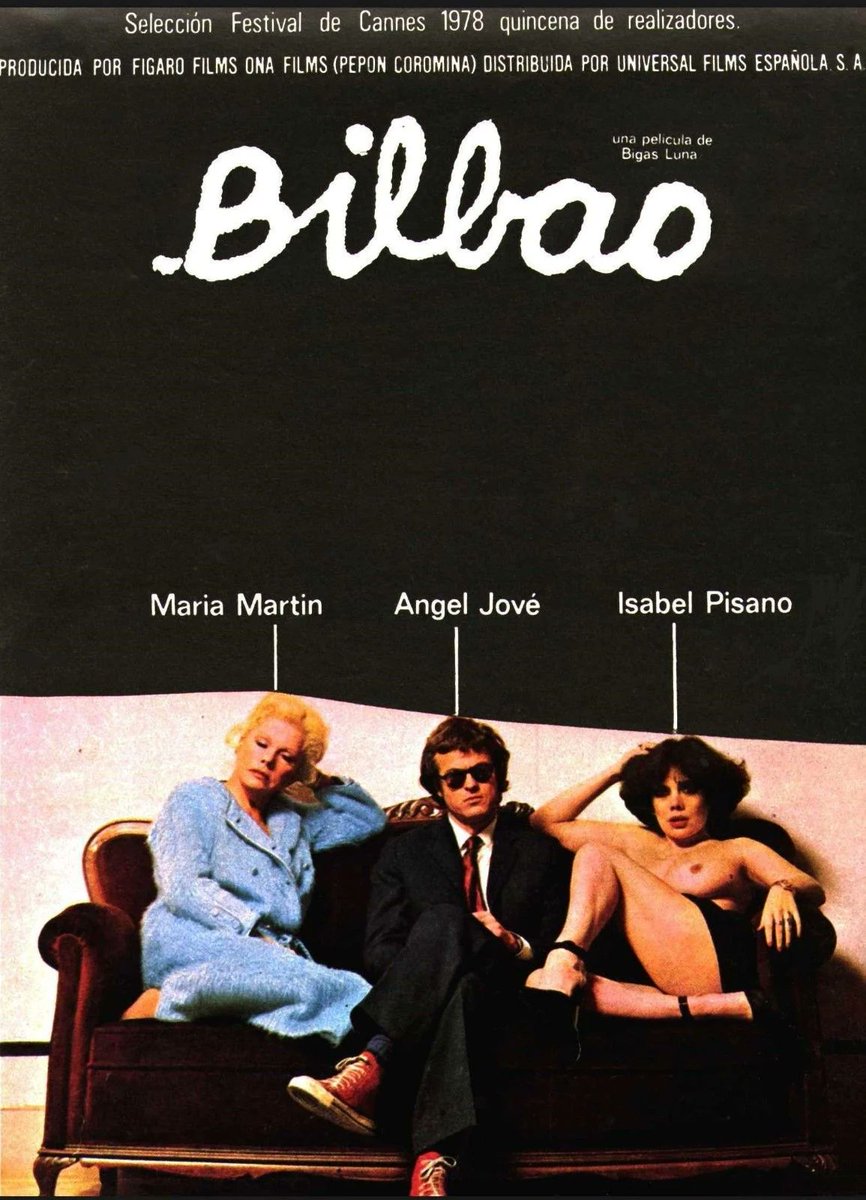
🎬 CICLE: ÀNGEL JOVÉ, MOSSEGAR LA IMATGE
El Museu Tàpies i els Cinemes Texas impulsen en col·laboració el cicle: Àngel Jové. Mossegar la imatge, dedicat a una de les facetes més singulars de l’artista.
🎟️ https://t.co/8DQUJTFbBs
El Museu Tàpies presenta, amb l’Espai Texas, el cicle de cinema "Àngel Jové. Mossegar la imatge"
Sessió 1 - El cinema de la transgressió: Àngel Jové i Bigas Luna | Projecció de "Bilbao" (1978), de Bigas Luna
20 maig, 19h | Espai Texas @EspaiTexasBcn
https://t.co/qgAqwo2cQ6
Molt contents de l'excel·lent acollida que ahir va tenir el Parlem de Festa amb la projecció i explicacions de pel·lícules de Festa Major conservades a @AMLleida. Films que connecten la tradició del present amb el passat, i mostren la riquesa patrimonial festiva de Lleida.
Avui és un gran dia per a la nostra Filmoteca i per al patrimoni cinematogràfic i audiovisual del país. Molts encerts amb el nou model de gestió:
Aprovada la Llei de l'Institut de la Filmoteca Nacional de Catalunya https://t.co/R1Dex4UjhD #filmotecacat a través de @filmotecacat
📸 Incorporem a l’Arxiu Fotogràfic prop de dues mil imatges del Fons Pedro Almacellas, fetes entre 1904 i 1964.
🎞️ Una documentació que ens permet continuar ampliant, preservant i difonent el patrimoni fotogràfic de Ponent, el Pirineu i l’Aran.
+ℹ️https://t.co/45UpscoRVF