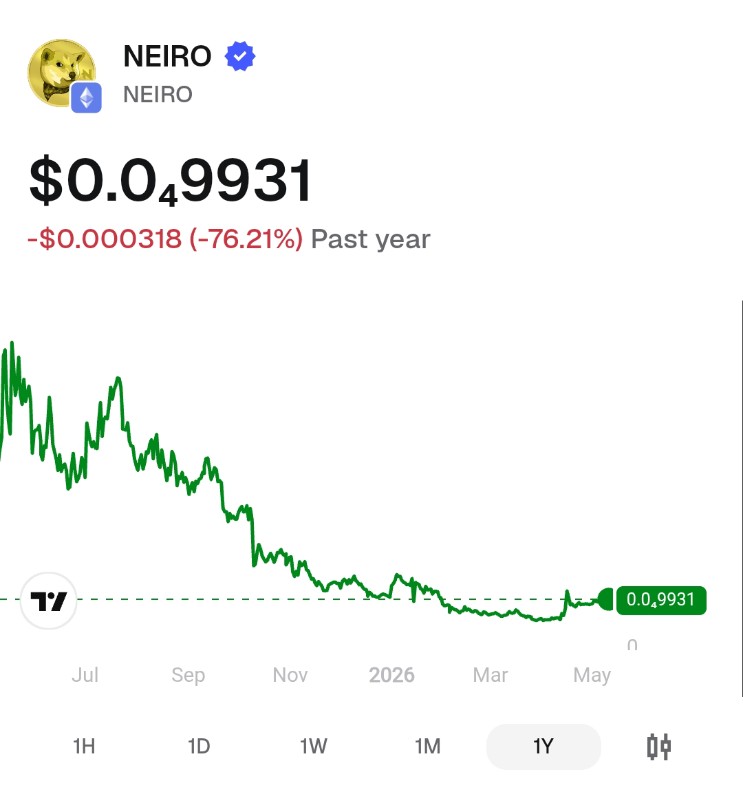
$Neiro is a $15B market cap memecoin on Ethereum.
370x from the current Mcap.
Smart investors should be buying @neiro Woofer NFTs to position for the exponential growth ahead.
Or you might as well waste your money in the Solana casino.
A word is enough for the wise.
$ETH "WORTH ALOT OF MONEY"
Avichal Garg of Electric Capital believes Ethereum has something impossible to replicate:
Credible neutrality.
Bitcoin has credible neutrality too.
But $BTC isn't designed to be the transaction layer and settlement layer for the global financial system.
In a world where countries from China to India to Brazil are looking for financial infrastructure that isn't controlled by any single nation, credible neutrality becomes incredibly valuable.
"You talk to anybody on Wall Street... everybody's trying to build on $ETH."
ETFs are here.
Coinbase is building on ETH.
Robinhood is building on ETH.
Sofi is building on ETH.
What's a global financial network that neither the U.S. nor China controls worth?
"A lot of money."
Sidenote: Avichal Garg's firm Electric Capital, is one of the more respected crypto native VCs. Avichal was mining Bitcoin as early as 2010.
Tom Lee: Ethereum DATs can use ~$500 million in annual staking rewards to fund grants for Ethereum ecosystem
“The Ethereum Treasuries — Bitmine and Sharplink among others — now own 7% of the Ethereum supply… Treasury stock is essentially supply permanently taken out from the ecosystem, but we also own the yield. The yield is around 3% so today these public treasuries are generating ~$500 million in rewards, and that is what we can use to fund and grant the crypto ecosystem.”
Lee believes that the Ethereum Foundation narrowing its focus to CROPs (censorship resistance, openness, privacy and security) is the right decision.
“Ethereum is a $240 billion network value entity. It has been operating for 11 years without a single day of downtime. There’s 11,500 nodes in 89 different countries. And there’s 15,000 developers. I think this is too big to be coordinated by a single foundation.”
As Ethereum continues to scale, he believes the ecosystem will move beyond a foundation-centric model and points to private companies like Etherealize, Optimism, Consensys, Enterprise Ethereum Alliance, and Offchain Labs that represent the Ethereum ecosystem and are already doing enterprise engagement.
“This list doesn’t yet reflect the spinoffs coming from the Ethereum Foundation. There’s at least five, and I think Bitmine will play a role in granting and supporting any of those that come out.”
“I think Ethereum is in good hands because the foundation is going to be stronger by staying focused. We have a lot of private sector companies already building products and important L2s on Ethereum. And of course, the treasuries are here to help with funding and granting… If you’re bearish, you are selling at the bottom.”
🔥 Tom Lee made a point about Ethereum that most people are not paying enough attention to.
The Ethereum Foundation used to hold 17% of the ETH supply.
Today, it holds only 100,000 ETH, or about 0.1% of supply.
That is a huge shift.
And according to Lee, it means the old funding model is no longer enough.
Under a traditional foundation model, he estimates the Ethereum Foundation could support only around $10 million in grants.
For a network trying to become the future of finance, that is tiny.
But this is where the story gets interesting.
BitMine, SharpLink, and other public Ethereum treasuries now own around 7% of the ETH supply.
And because that $ETH can generate staking yield, Lee says these treasuries are producing about $500 million a year in rewards.
That completely changes the game.
Ethereum no longer has to depend on one foundation to fund everything.
A wider network of public companies, treasury vehicles, staking rewards, ecosystem grants, L2 builders, and private-sector teams can now help support Ethereum’s growth.
This is why Lee believes Ethereum is entering a new phase.
Not a single foundation carrying the whole ecosystem.
But an entire capital network forming around ETH.
This is Part 1 of my rebuttal to David Hoffman’s capitulation on Ethereum’s monetary thesis.
This is a complete and updated thesis on the debate about BTC vs ETH monetary superiority, market bias, and why the future is still brightest for Ethereum.
https://t.co/CrYuYPRWqO
Have had some people ask me how I could go from being a toxic Bitcoin maximalist for 8 years, and then update my thesis.
I am always revisiting things, and making sure that a thesis is still in tact. If something changes that equation materially, I can then go through a process of updating my initial thesis. This is just being an objective human who pays attention to reality.
In the case of Ethereum, I simply identified a structural trend: agentic systems, tokenized finance, programmable money, permissioned/conditional execution…agents are going to change the economy forever. So I asked:
What rails would this world realistically need?
Conviction is not stubbornness…it is a model with falsification criteria…
Bitcoin is incredible at one thing: credibly scarce, hard-money settlement. It is simple, durable, culturally ossified, and that is the point. But the exact thing that makes Bitcoin beautiful also makes it a bad candidate for the agentic economy unless something dramatically changes.
An agentic financial system needs rails that can express:
- programmable permissions
- conditional execution
- smart accounts
- delegated authority
- revocable approvals
- escrow
- tokenized assets
- collateral logic
- identity/attestation layers
- automated settlement
- composability between applications
- machine-readable state and incentives
Ethereum is the only major decentralized protocol seriously designed around that job.
Bitcoiners often wave toward “L2s,” “sidechains,” “RGB,” “BitVM,” “Drivechains,” “eventually fees,” etc. Some of that is interesting. Some of it may matter. But it is still largely around Bitcoin, not native to Bitcoin’s core operating model. The agentic economy is not going to wait around for brittle, awkward, partially trusted contraptions if there is already a battle-tested programmable settlement layer with stablecoins, DeFi, rollups, account abstraction, token standards, custody tooling, real institutional experimentation, and developer gravity.
And the security budget issue is not some made-up critique either. It is a real long-term question:
- Bitcoin block subsidies trend toward zero.
- Long-term miner security must increasingly come from fees.
- The future fee market is not guaranteed.
- If Bitcoin is mostly HODL collateral and not high-throughput settlement, then the fee-security model becomes an open question.
- The common answer is basically: “number go up enough and fees will appear.”
Maybe! But “maybe fees will appear because vibes” is not the same as a solved security model. That deserves scrutiny.
ETH’s thesis is now strong:
If the future of finance is increasingly machine-mediated, tokenized, automated, and permissioned, then the winning base layer needs to be programmable, composable, and credibly neutral. Ethereum is much closer to that target than Bitcoin.
That is not cope or me randomly changing my opinion. That is a real thesis from real data, from the real world.
ETH is better money than Bitcoin. 🤷♂️
Vitalik shared his perspective on where @ethereumfndn is heading. Here is mine, another part of the same story.
The EF Mandate from the board was something I proposed late last year. Two main things prompted me. First, debates that were meant to be technical had started to become political and personal, and at times shaped by quieter incentives. Second, as EF grew, more and more versions of "what EF should be" began pulling at the core of the organization from every direction at once. I became convinced that trying to satisfy all of them would leave us achieving nothing at all. It was time for us to restate our role and underlying principles clearly, both the parts that have been clear from the start and those that have been informed by over a decade of experience.
We have said it many times: EF is one of many nodes in Ethereum. I know that is hard to hear for some, because EF was the first group, and in the early years it was essential for making things happen. But it was never meant to stay that way.
I have been in crypto since 2012, before it became an "industry." I joined Kraken in 2013, shortly before the implosion of Mt. Gox, which I helped to clean up. I am very aware of how real growth works, and also aware of the real risks of centralization. So when I became ED in 2018, I understood that Ethereum growing beyond EF would be essential to fulfill its real promise as a public blockchain. The goal I set for myself was to ensure that this happens.
The opposite path has always been untenable: Ethereum's future is too big for any single organization to bring about. So EF made deliberate choices to distribute power. We did incubate and release, like Uniswap and ENS. Support to seed a new norm, like ETHGlobal and the hackathons that are now everywhere. Funding the funders, like Gitcoin and Moloch. We always asked the same question: how does this stand on its own, without us?
Those experiments, alongside the work of countless others, contributed to where we are today. Ethereum is now far bigger than anything EF could coordinate alone. EF now holds less than 0.2% of all ETH, and the return on all of that shared work, together with extraordinary people across the ecosystem, has been beyond anything we could have built by ourselves.
That is exactly why a focused EF is possible now. The Mandate states simply the one thing EF must keep carrying: preserving and accelerating the properties and goals that keep Ethereum uniquely valuable, competitive, and worth building on. That is: CROPS - for the sake of inalienable user self-sovereignty and self-sovereign coordination. We cannot do it alone, and we do not intend to. But defining this as the north star for the mission, and coordinating with the allies who share it, is the responsibility we are keeping.
None of this means EF stops caring about adoption, for everyday users or for institutions. The opposite is true: everything we do is ultimately for the people who use Ethereum. Supporting adoption, including institutional adoption, remains part of our work, pursued in the ways that fit our mission. The value proposition of Ethereum for both everyday users and institutions rests heavily on this.
As EF becomes more focused and more opinionated, the team naturally becomes smaller and more concentrated. That is part of the choice. New leaders are already stepping into this mission and growing within it, and you will hear more from our management in the coming weeks, about what they are doing, and about the new structure and strategy taking shape.
The mission we carry is not a smaller one, but a clearer one. Special thanks to those who have stepped in to support, defend and advance it.
1. ETH is a monetary commodity so fees are moot. ETH primary value comes from providing security and settlement to everything built on top of it. The market is pricing in a monetary premium to the asset. Commodities are not valued on fees, end of story.
2. ETH has less supply inflation than gold and bitcoin so I really don't know what the point is of saying ETH is inflationary.
3. Ethereum does not need a leader. It's decentralized so that's kind of the point. The internet didn't have a leader rather it had many entities working and building on the network.
People need to stop confusing Ethereum with a company.