Rahul ji, you ask the Prime Minister to choose a venue for a debate. There is already one: Parliament, where you happen to be the LoP.
Just yesterday, Home Minister Shri @AmitShah offered a special session to debate SIR and EVMs. Why not show the same enthusiasm for a debate in Parliament that you show while issuing challenges on social media?
Demanding answers also carries an obligation to hear them.
There have been several occasions when you and your party have walked out of Parliament while the government was responding to your allegations. How do you claim to be so eager for a debate when you don’t even stay to hear the other side?
It doesn’t stop at walkouts. You and the INDI Alliance have repeatedly disrupted proceedings, leading to entire sittings being washed out. If you are so keen on debating, why not allow Parliament to function in the first place?
And then there’s the mock Parliament you recently held at the Congress President’s residence. Frankly, that was more a ‘mockery of Parliament’ than a ‘mock Parliament’. You found the time and enthusiasm for that exercise. Surely, the real Parliament deserves at least as much.
You speak endlessly about protecting democracy and the Constitution. But that respect should also reflect in how you treat the institutions they have established.
As for the issues you frivolously raise, bring specific allegations and evidence to back them up. Simply throwing together a long list of accusations doesn’t make your case any stronger. As LoP, you are expected to show some seriousness and responsibility.
You say, “Daro mat.”
Then bring the facts, face the scrutiny and stay to hear the answers. In the House, uphold the standards of debate you demand from others.
With China planning a 60 GW mega-dam on the Yarlung Tsangpo, India’s proposed 11.2 GW Siang Project acts as a critical strategic shield. Beyond energy security, it safeguards over 4 crore lives across Arunachal Pradesh and Assam against upstream water security risks.
This is so true @ARanganathan72 sir!
This is the state the country - India is in. I hope everything works well for both India and the world as a whole.
Raihan is 26. Congress is going to project him as a Gen Z face victim of current govt.
They will sacrifice Kishori Lal Sharma to give a possible safe Amethi seat to Raihan Vadra in 2029.
Remember, Raihan will be 29 by then, and Rahul Gandhi became the Amethi MP at the age of 29.
Raihan has already dropped his father’s surname, Vadra, and adopted his grandfather’s surname, Rajiv Gandhi. He is now Raihan Rajiv Gandhi and is set to be launched.
You will see him in the media regularly for the next two years, playing the victim card through manufactured controversies. Darbaris have already accepted him their leader
Every Indian needs to know about this because it is a massive deal for how we trust anything on the internet.
Let me explain.
When you open your bank's website, there's a small padlock next to the web address. That padlock means two things.
First, that you're talking to your real bank.
And second that nobody can read what you type, like your password.
So how does your browser know the website is real?
It checks the website's certificate. Think of it like an ID card for a website.
Your Aadhaar is trusted because the government issued it. A website's ID card is trusted because a certificate authority issued it.
A certificate authority, or CA, is a company that browsers like Chrome, Firefox and Safari already trust. If a CA says "yes, this really is this bank's website," your browser believes it and shows the padlock.
eMudhra is an Indian CA. It's a big one, with more than 60 million certificates issued over the years.
So how does a CA sign these ID cards?
Every CA has a secret number called a private key. It uses that number to put a stamp on each certificate.
Your browser checks the stamp to confirm it really came from that CA.
The whole system only works if that number is impossible to guess.
For the type of key in this story, it's supposed to be around 116 digits long.
Every computer on Earth working together for billions of years wouldn't be able to guess a number like that, just because of the sheer combinations that exist.
But here's what happened.
On October 17, Mozilla got a report that the private keys behind eight eMudhra certificates had been compromised.
The report came through a person called Wayne on Google's Chrome team.
The keys weren't 116 digits long.
All eight keys were smaller than 256. Security researcher Scott Helme found that one of them was just the number 4. Others were 66, 155, 156, 230 and 237.
So anyone could break them by trying 256 numbers. A basic laptop does that in less than a second.
Mozilla didn't need to know how Wayne did it. Its own team recovered the keys within two hours. Since then, several other people have found them on their own too.
To understand the gravity of the problem, a bad actor could make fake ID cards for any website they want.
Your bank, your email, a government portal.
Browsers that trusted eMudhra would have checked the fake stamp and shown the padlock like everything was fine.
If someone could get between you and the internet, say on public Wi-Fi, they could show you a fake site with a real-looking padlock and read or change what you send.
eMudhra says a script used during its key creation process back in April 2025 had a flaw. It made a second, much weaker set of keys, and those were used by mistake to create the certificates.
That means these weak keys were there for about a year and a half before anyone caught it. eMudhra says the person who found it may have used AI-assisted techniques.
The good news is that the response was fast.
Mozilla received the report at 8:06 pm UTC on October 17 and had pushed a block to Firefox users by 10:59 pm.
Google, Apple and Microsoft have also blocked these certificates for their users.
eMudhra revoked all eight the next morning and stopped issuing new certificates from the affected root.
Mozilla is now removing that root certificate from Firefox's trusted list altogether.
But there's still a lot of clean-up to do.
Browsers are mostly covered. But plenty of apps, servers and backend systems don't check these block lists. They need software updates to stop trusting the bad certificates, and some of those updates are still pending.
Real websites that used eMudhra are also affected. Yash Kadakia, founder of Security Brigade, estimates around 30,000 legitimate certificates will need to be moved over. A lot of those are likely Indian businesses and services.
See, we're moving our whole lives online, UPI, banking, tax filing, DigiLocker, government services.
All of it rests on this invisible layer of trust.
So, when an Indian company that's trusted by every major browser makes a mistake this basic, it hurts how the world sees Indian digital infrastructure.
This has happened before, and it went very badly.
In 2011, a Dutch CA called DigiNotar was hacked, and fake Google certificates were used to spy on people in Iran.
Browsers stopped trusting it completely, and the company shut down soon after.
For now, here's what you can do. Keep your browser and apps updated on your phone and laptop.
Be careful on public Wi-Fi. Type your bank's website address yourself instead of clicking links.
eMudhra still owes India a clear, public explanation of how a key that protects millions of people ended up being the number 4.
We have seen the OHCHR’s remarks about today’s events in New Delhi.
India is the world’s largest democracy, where the right to peaceful assembly is guaranteed by our Constitution and safeguarded by robust institutions, an independent judiciary and a free media. As in every democracy, Indian citizens exercise this right subject to reasonable restrictions in the interest of public order. The authorities, for their part, act in accordance with the law, and our courts remain available to all for redressal of any grievances.
The OHCHR’s concerns are therefore misplaced and constitute an unwarranted interference in the internal affairs of India.
In this context, OHCHR would also do well to devote comparable attention to large-scale protests elsewhere, consistent with its mandate of impartiality and non-selectivity.
@MEAIndia@IndianDiplomacy@PMOIndia@DrSJaishankar@abagchimea
Captain Smit Machchhar’s extraordinary courage in putting his life on the line to save 174 passengers during a life-threatening crisis stands as a powerful testament to true leadership and service before self.
What was first reported as a “possible attempt to hijack” was later clarified as an attempt by one of the co-pilots of the plane to deliberately crash Fly Dubai’s Boeing 747 Max flying from Dubai to Tel Aviv. Despite being stabbed by his co-pilot, Captain Smit Machchhar rose to the occasion and fought him off. His presence of mind in opening the cockpit door allowed the other passengers to come in, overpower the co-pilot, and restrain him.
What would have been a tragedy of wider ramifications in an already volatile geographical area was averted, and the plane was piloted to safely land in Saudi Arabia, saving the 174 passengers on board of various nationalities.
Many a time, Heroes don’t wear a Superman cap. They will be one among us. They will rise when the situation demands of them.
Captain Smit Machchhar is one such Hero and has made every Indian proud.
Learnt about the incredible bravery of Captain Smit Machchhar. Immense courage in the face of a terrifying and unprecedented challenge. A true real-life hero. The entire world is proud of you. 🇮🇳 👏🏻
History will always remember these two people for saving the entire Hindu community from the false propaganda of the Western media
Forever grateful beyond words 🙏!!
Captain Smit Machchhar’s extraordinary courage and remarkable presence of mind, even in the face of grave danger, saved hundreds of lives yesterday and averted a major tragedy.
Join the countless voices from across the world in saluting his valour and praying for his speedy recovery.
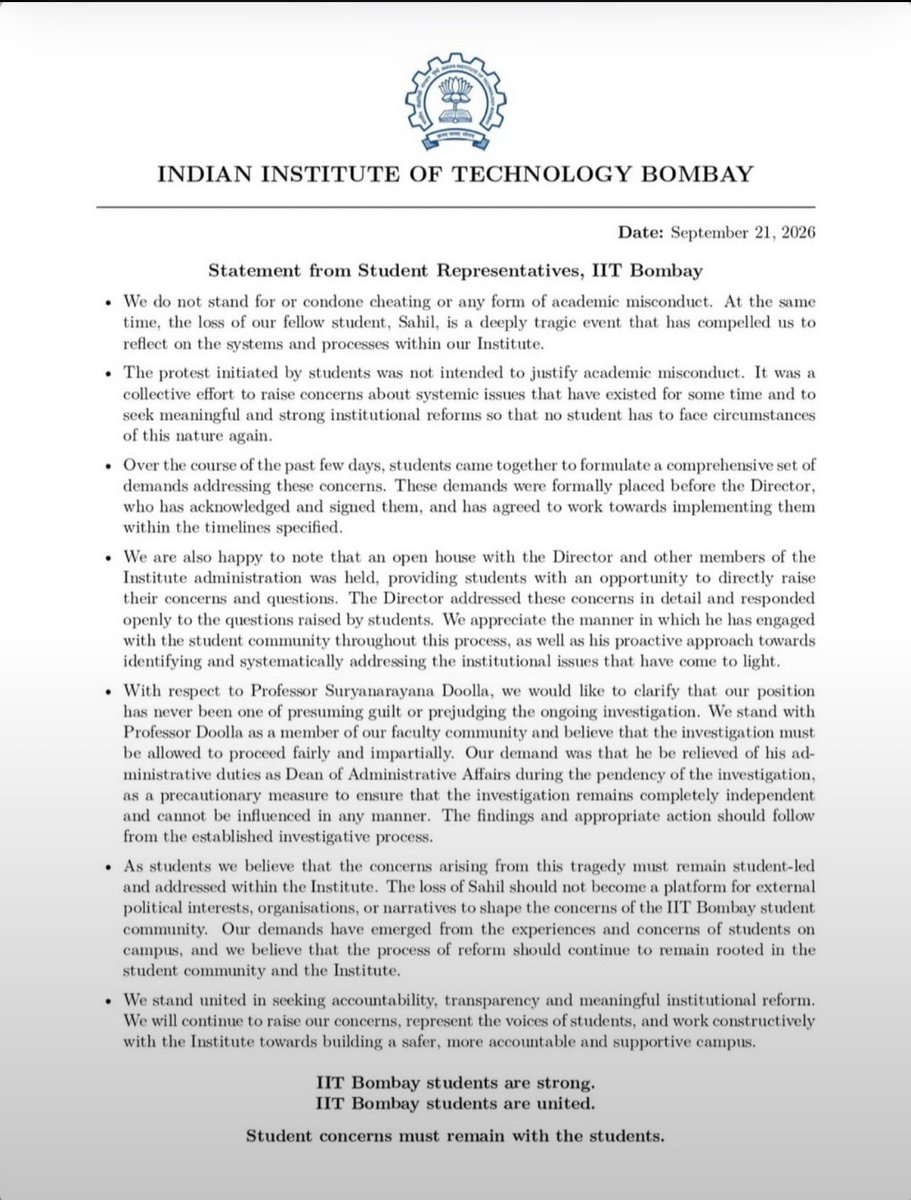
IMPORTANT: IIT Bombay Students Representatives issue statement on death by suicide of Sahil Wakode.
* We do not stand for or condone cheating or any form of academic misconduct.
*Loss of our fellow student is deeply tragic event that has compelled us to reflect on the systems and processes within our Institute.
*The protest initiated by students was not intended to justify academic misconduct.
*With respect to Professor Suryanarayana Doolla, we would like to clarify that our position has never been one of presuming guilt or prejudging the ongoing investigation*
*We stand with Professor Doolla as a member of our faculty community and believe that the investigation must be allowed to proceed fairly and impartially*
The loss of Sahil should not become a platform for external political interests, organisations, or narratives to shape the concerns of the IIT Bombay student community.
Just watched #VishwanathAndSons - what a beautiful reminder that mainstream cinema can still have heart. ❤️
Thank you, Venky Atluri, for restoring my faith in heartfelt commercial cinema.
Dear @Javedakhtarjadu. I'm afraid your response is as boring and overloaded as your similes and metaphors. When countered with facts, you shift the goalpost, bring in the RSS, berate the right wing, take refuge in context, cushion the bigotry, and claim Kafirs were Colonialists not Hindus.
I know countering you again is like watering a cactus and praying for leechis, but in the hope that all that knee massaging with Doctor Ortho would have sprouted some neurons, here goes:
You asked for a source because you said the quote was “quite unlike” Azad’s “lifelong sociopolitical stances.” I gave you the source: Calcutta, 27 October 1914, published in Khutbat-e-Azad. The words are his. That should have ended the enquiry. It did not. So let us walk through your new script, line by line.
1. “The khutbats were about Khilafat and British colonialism.”
Yes. That is what I wrote. Maulana Azad was telling Indian Muslims that a Turk’s battlefield thorn must be felt in a Hindustani Muslim’s heart; that Millat-e-Islam is one body; that friendship and enmity are for the religion of Allah. Then he quoted Quran 48:29 and added his own gloss: be extremely hard against disbelievers, extremely kind among yourselves, and do not pass over this as if you had not heard it. You asked for the when and where. You received both. “It was about Khilafat” is not a rebuttal. It is the context in which he said it.
2. “To claim he was quoting this about the Hindus of India will not be true. The Kafir here was the colonialist.”
I did not say the 1914 speech was a municipal circular against the Hindus of Howrah. I quoted what Azad quoted: a Quranic verse about kuffar, and his commentary on unbelief, Tawhid, and hardness toward disbelievers. If Azad had meant “kafir = only the British officer,” he knew Urdu enough to say Angrez. He did not. He used the Book’s word, then told his flock not to skip it.
And if “kafir” in Azad’s mouth was a temporary colonial nickname, kindly explain the 1920 Hijrat fatwa, published in Ahl-e-Hadith of Amritsar, in which he said Indian Muslims had no choice but to migrate, and that those who stayed and kept connection with “the enemy of Islam” would themselves be counted as the enemy of Islam. That is not a lecture on income-tax collectors. That is a theology of the land.
3. “When Ataturk took over, Azad called it a closed chapter and condoned the secular government.”
Men change. Texts do not. If later Azad made peace with the death of the Caliphate, good for the later Azad. It does not unsay 1914, nor the Khilafat years, nor Masala-e-Khilafat, nor the call that any government hostile to Turkey was hostile to Islam, not the belief in the Quranic verse damning the Kafirs. You began by saying the paragraph was unlike his lifelong stances. Lifelong includes the years he spent as a pan-Islamist firebrand. Evolution is not an eraser. It is a timeline.
4. “Read his Calcutta High Court statement. An honour no member of the Mahasabha or RSS was ever given.”
Sedition charges from the Raj are not a unique family heirloom. Tilak got them. Aurobindo got them. Savarkar was given two life terms and sent to Cellular Jail, where the honour included the oil mill, the lash, and years in a cell the size of a cupboard.
And of course, knowing your pitiful knowledge of Indian History, I guess you would not know legendary RSS names like Devipad Chaudhary, Jagatpati Kumar, Anna Saheb Deshpande, Ramakant Keshav, Vasantrao Oak, Narayan Singh, Chandrakant Bhardwaj, Dada Naik Chimur, Baburao Begade, Lala Hansraj, Balaji Raipurkar who participated in our freedom struggle and were jailed or shot.
5. “Azad was in British jails for nine years. Name one from your right wing who can match that.”
Vinayak Damodar Savarkar: roughly a decade in Kala Pani, further years in mainland jails, then thirteen years of internment in Ratnagiri. Sentence on paper: fifty years. Conditions: not Ahmednagar Fort with time to write Ghubar-e-Khatir.
By the way, you might know that your great-great-grandfather Fazl-e-Haq Khairabadi was also incarcerated at Kala Pani. What you might not know, or would want to hide, is that he wrote a grovelling mercy petition to the British, pleading to be released.
6. “In 1946 Jinnah refused to shake Azad’s hand. He hated Azad for his patriotism.”
How does this turn “be severe against the kafirs, merciful among themselves” into a sonnet about communal harmony? A man can spend 1946 refusing Partition and still have spent 1914 telling Indian Muslims that their first body is the ummah. Fairness is holding both pages open. What you are doing is hiding the 1914 page and waving the 1946 one like a flag.
7. “Your reference to Rahul Gandhi was unnecessary, I expect decency and class.”
And I expected you to have some sense of humour. The PS was a reminder that this is the second time I have had to fetch your hero’s paperwork. Last time it was Nehru’s India: books banned, editors sacked, films blocked, Majrooh jailed for a couplet.
You lecture me on class after moving from “this cannot be Azad” to “it is Azad but you must read kafir as colonialist” to “anyway he went to jail” to “Jinnah was rude to him” to “please don’t mention Rahul.” That is not class. That is a guided tour of every exit except the text.
Look, Javed sahab, let us end this here. I like you. Doubtless a lot of your work is incredible, truly it is. So in that spirit, permit me to pen an ode to you:
Javed Akhtar ko dekha toh aisa laga, jaise chhal ka nawab, jaise jhoot ki kitaab, jaise dhong ki kiran, jaise adambar ka van, jaise kapton ki baat, jaise pakhand ki raat, jaise janpath mein ho ek jalta diya.
Alvida, Shabba khair. WDTP
I sit on the floor (by choice) when I meet religious saints. They always offer me a chair but I decline. I did not realize I am very low-agency.
I go there to let go of egoic attachment. The Guru is not just a person, they represent Sanatana Dharma itself.
Let me narrate something that moved me. Her Holiness Mata Amritanandamayi, when she comes to the stage to speak, does a namaskaram to the audience, and the same audience treats her as the embodiment of God. Why is she bowing to her devotees?
That is the subtlety of Sanatana Dharma. God is the act of devotion, Bhakti.
If the doctor learns some humility, he may come to appreciate her and the wisdom of Dharma she embodies.
As the Zen master said, as long as his cup is full, nothing will enter him.
Let artists create. Let babus build efficient systems.
Art and craftsmanship should always be prioritised. Creative decisions belong with those who understand the craft, while policymakers should focus on making the system work better.
As @aravind has rightly said it can be Kakataliyanyaya.