Small in size, but their impact on our planet is huge 🐝 Join @bertiegregory as he explores the weird and wonderful world of bees.
#SecretsOfTheBees premieres Tuesday, March 31 at 8/7c on @NatGeoTV Stream on @DisneyPlus and @hulu.
Lessons in laughter:
Dozens of you have shared this lovely video with me over the past couple days. And I just love that it illustrates two baby lessons in one.
First, as I’ve shared many times in the past, there’s nothing funnier than the unexpected. And just as a standup comic can evoke a belly laugh with a punchline that delivers an unexpected twist, your baby LOVES a good surprise.
So when the stove makes an unexpected scratchy sound as mom wipes it, it’s comedy gold to this little one.
But as this video progresses, the laughter becomes a social game between the pair - with baby discovering that she can crack up mom… and the whole thing becoming a wonderful serve and return interaction.
Adorable!
Exciting news! We’re thrilled to announce that tapir Yuna gave birth to a rare and endangered Malayan tapir calf Sunday night. The newborn, covered in distinctive white spots and stripes resembling a fuzzy walking watermelon, is only the second tapir born in our 120-year history.
Rastafarian guy in the sauna this morning was telling me I should be making my own honey. “Anyone can buy a bee”, he said. I nodded, taking it to heart. There was a 10 second pause, after which a Polish bodybuilder in the corner interjected: “you need more bee”
Mushrooms possess a remarkable and previously unrecognized mechanism to actively disperse their spores, challenging the long-held belief that spore dispersal is a passive process at the mercy of external winds.
This mechanism relies on evaporative cooling and convective airflows, allowing mushrooms to exert control over spore dispersal even in low-wind environments or when crowded together.
The process begins with the high rate of water loss from mushroom surfaces, which far exceeds that of plants. This evaporation cools both the mushroom and the surrounding air by several degrees Celsius.
The cooled, dense air beneath the mushroom cap then spreads outward as a gravity current, carrying spores with it at speeds of several centimeters per second.
Crucially, mushrooms generate asymmetric airflows beneath the cap to create effective dispersal.
This asymmetry can be achieved through variations in the cap's shape or temperature gradients across its surface. The distance spores travel increases with the square of the gap height beneath the mushroom cap, allowing mushrooms to control dispersal by adjusting their morphology.
These convective flows can transport spores from gaps as narrow as 1 cm and lift them over surrounding barriers. When spores encounter vertical surfaces, they can climb upwards, potentially dispersing even further.
This mechanism explains how mushrooms can tolerate and even benefit from crowding or growing close to the ground.
The high water needs of mushrooms, rather than being a disadvantage, are key to generating these dispersive airflows.
This mechanism allows for effective spore dispersal in various environmental conditions, demonstrating how mushrooms have evolved to actively influence what was previously considered a passive phase of spore dispersal.
Here’s the time-lapse I promised you from yesterday’s solar activity. Complete with Earth to scale and a bonus of the sun’s rotation.
This is easily one of my cleanest time-lapses I’ve managed over such a long period. Enjoy!
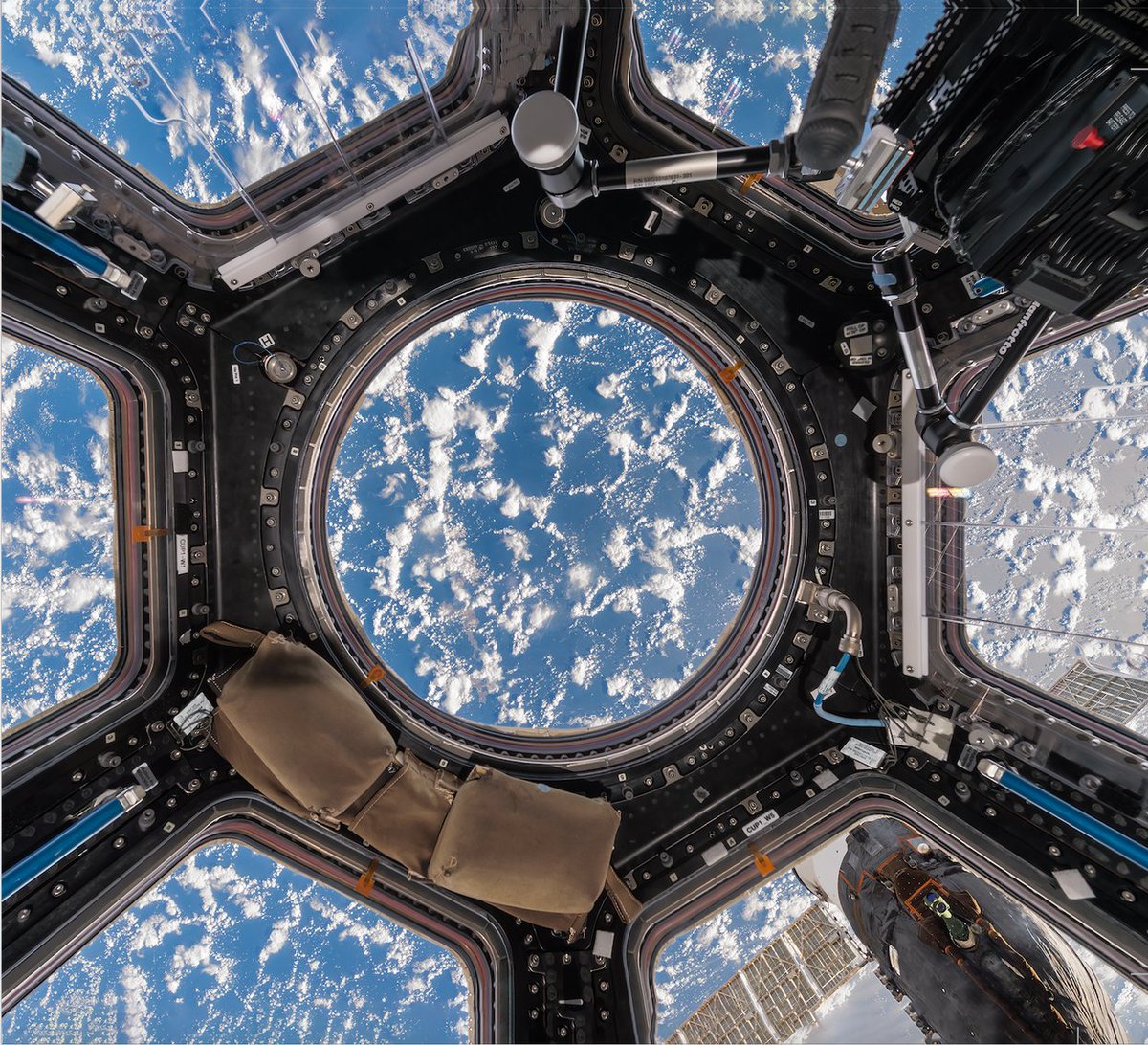
FUNGUS IN SPACE!!! 🍄🚀
Equal parts cosmic horror and nature being metal, let's talk about the lichen that grew on the OUTSIDE of the International Space Station!
Get your tea and curl up, because I PROMISE you wanna hear about these fungal cosmonauts 🧑🚀
🧵