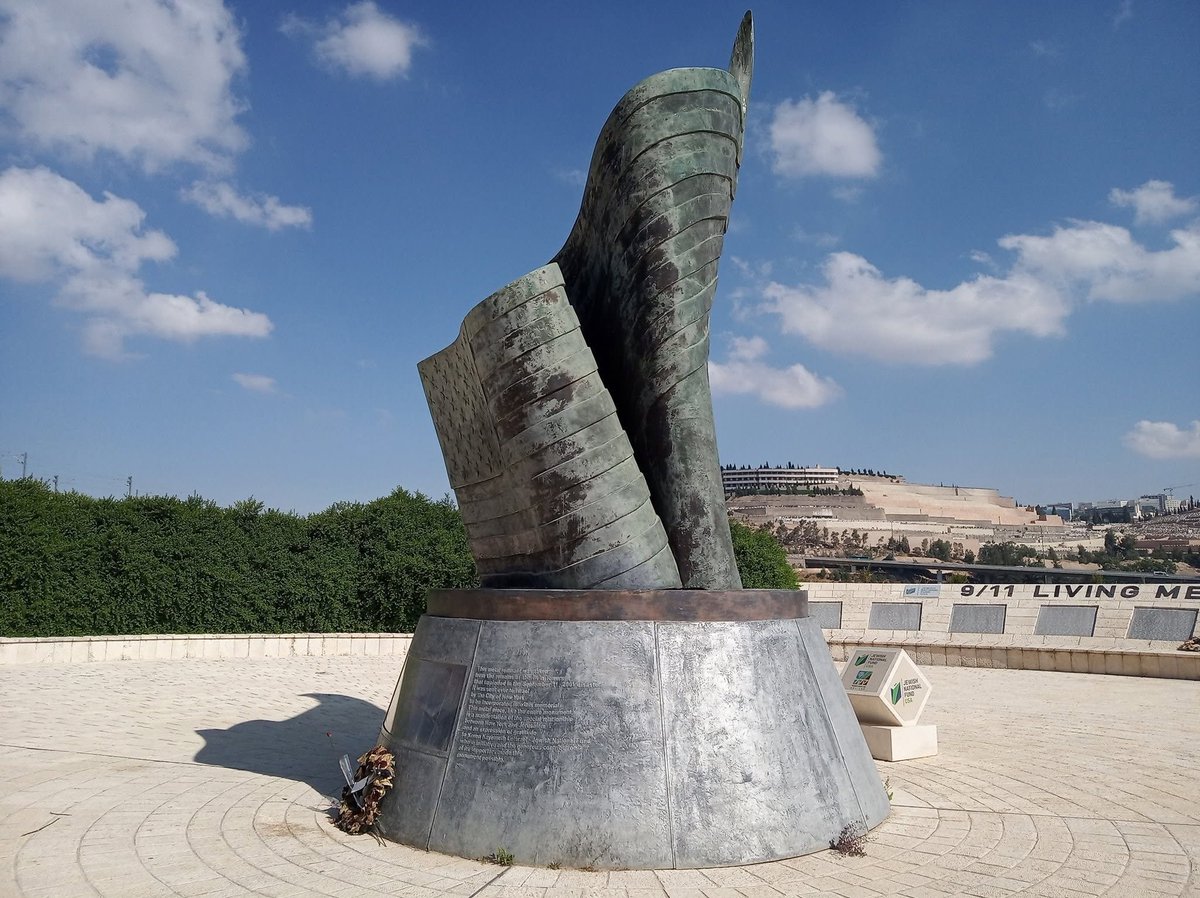
A few years ago, one of my classes got canceled, so I went for a walk in the hills near Jerusalem. After walking through the woods for a bit, I came by a monument to the victims of 9/11, overlooking Jerusalem's famous Har HaMenuchot cemetery.
It's a handsome monument that depicts a flame made from the American flag with a piece of metal taken from the ruins of the Twin Towers displaying inside the base.
The names of the victims are inscribed in stone around the statue. As far as I know, this is the only monument with the names of all the victims outside of the United States.
May their memory be a blessing.
"Consider the axis of leftism and Islamism—the Red–Green alliance, whose cultural and political prominence has grown...In our mimetic culture, a transgressive message delivered under the guise of forbidden truth can influence millions of susceptible minds" https://t.co/4wCoAWgct4
@IonaItalia I live in the rice fields of Lombardia so mosquitoes are high on the list. But apparently the ecosystem would collapse without them cos they are an important food source. So the bitey little bastards have to stay if I want to keep my Oasis of Outstanding Natural Beauty as is 😖
Josephine Harris was 59, a Port Authority bookkeeper with a bad leg, walking down from the 73rd floor of the North Tower on September 11.
By the time the firefighters of Ladder
Company 6 found her in the stairwell, she was exhausted and crying.
They had just been ordered out.
The other tower was already gone.
They did not leave her.
Firefighter Bill Butler put her arm over his shoulder.
“Josephine,” he said, “we’re going to get you out of here today.”
Their pace became hers.
Lower down she collapsed and told them to go on without her.
They refused.
Then the North Tower fell.
Stairwell B held.
The building peeled away around them.
Fourteen people survived in that pocket: firefighters, a Port Authority officer, and Josephine.
People who had passed them on the stairs did not.
The men of Ladder 6 called her their guardian angel.
They believed she slowed them just enough.
Without her they would have been lower when it came down.
Without them, she would not have made it out.
When she died years later, those firefighters carried her coffin.
One of them named a daughter after her.
She was not trying to save anyone.
She was a tired woman who could not walk any faster.
That was enough.
@IonaItalia Nobody is coming to save you. You have to be your own knight in shining armour & make the clip clopping noises of the steed yourself. But a hand reaching down showing how far you’ve fallen, can be the difference between eternal night, or back to day walking
@IonaItalia I spent a whole week with a really weird feeling before I realised it was just optimism. 40 years without was enough to forget how it felt. All the good stuff (exercise,nature, gratitude) comes easy now. But in the gloom, I was too far gone for self-help & a fix
@sharrond62 Best of luck to your new Prime Minister if he’s faced with an army of unnecessarily estrogen deprived gen X women.
Personally, I’d fight crocodiles to get to any component of my HRT.
After the 9/11 attacks, hundreds of search‑and‑rescue dogs were deployed to Ground Zero alongside human first responders. These dogs were highly trained to locate survivors in disaster zones, and many had spent years practicing scenarios where their searches ended in successful “finds.”
But at Ground Zero, the reality was devastating: day after day, the dogs found only deceased victims. Their handlers began noticing troubling changes, dogs growing visibly sad, confused, and even reluctant to continue searching. For animals conditioned to believe every search should end in saving someone, the constant absence of survivors felt like failure.
Handlers quickly realized the emotional toll was becoming dangerous. Rescue dogs rely heavily on morale, praise, and a sense of accomplishment to stay motivated and focused. Without those positive outcomes, some dogs began showing signs of depression: lowered tails, reduced appetite, and decreased enthusiasm for work. To protect their mental well‑being, handlers started staging mock rescues.
They would hide fellow rescuers in accessible spots so the dogs could “find” a living person, receive praise, and regain confidence. These staged successes weren’t just kindness—they were essential to keeping the dogs effective in an environment filled with trauma.
This practice became a quiet but powerful example of the bond between handlers and their dogs. Even in one of the darkest moments in modern history, rescuers recognized that emotional care mattered, not just for humans, but for the animals who worked beside them. The staged finds helped maintain morale, restored the dogs’ sense of purpose, and allowed them to continue contributing to the recovery effort.
One of the most remembered dogs at Ground Zero was Bretagne, a golden retriever from Texas who worked tirelessly through smoke, twisted steel, and unstable debris. Her handler later recalled how Bretagne would gently nudge exhausted firefighters, offering comfort before returning to the rubble to search again.
She wasn’t just looking for survivors, she became a source of emotional support for the human crews, sensing when someone needed a moment of connection. Years later, when Bretagne returned to New York for her 16th birthday, firefighters lined the street to salute her, honoring not just her work but the quiet compassion she brought to one of the darkest sites in American history.
#archaeohistories
🇺🇸 The Boatlift That Was Bigger Than Dunkirk
At 10:45 a.m. on September 11, 2001, a Coast Guard lieutenant named Mike Day keyed a radio in New York Harbor and said the only sentence that mattered.
“All available boats. This is the United States Coast Guard. Anyone wanting to help with the evacuation of Lower Manhattan, report to Governors Island.”
The boats were already coming.
The bridges were closed. The tunnels were closed. The subways were dead. South of the towers, hundreds of thousands of people had nowhere left to walk. Some jumped into the Hudson. Some stood on seawalls that were never meant to be docks and waited for anything that floated.
Dunkirk took nine days to pull 338,226 Allied soldiers off a beach in 1940.
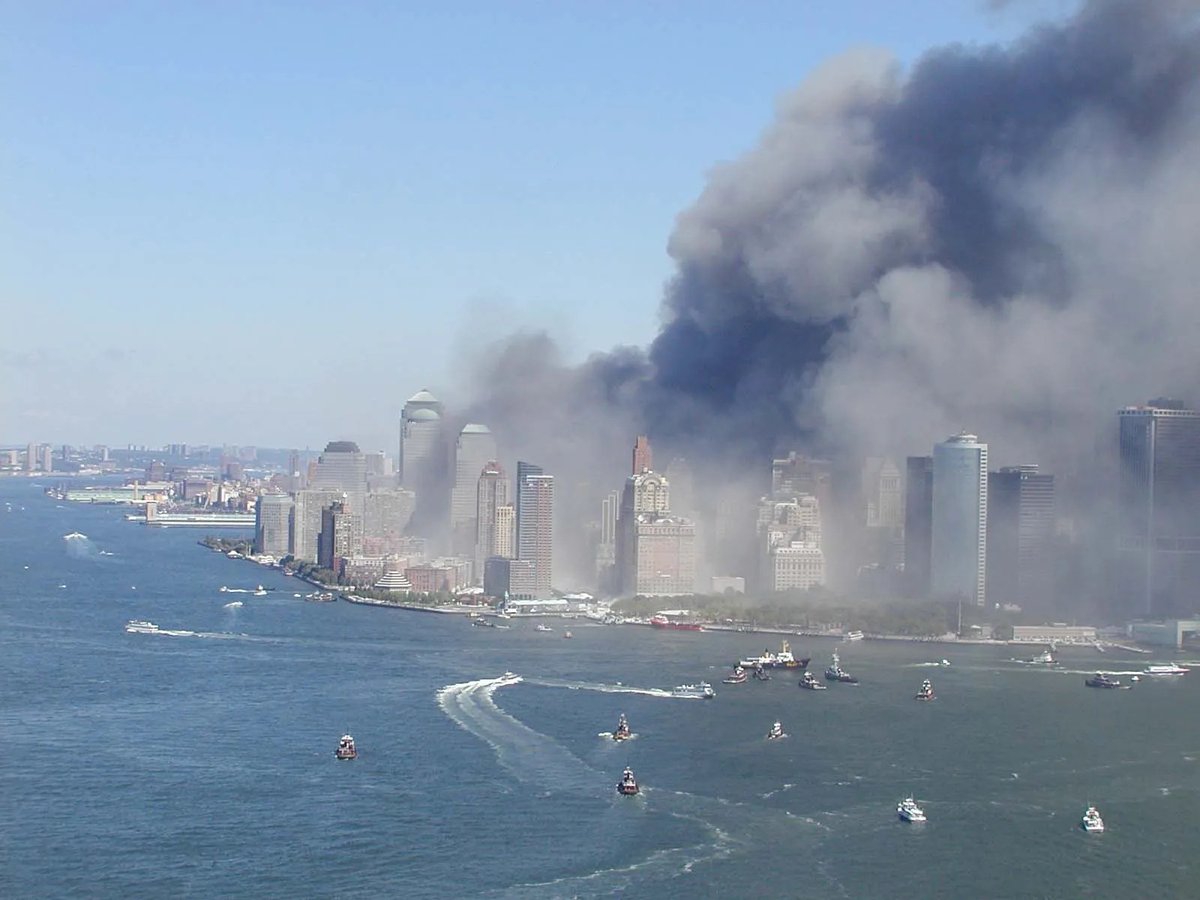
On 9/11, roughly 800 mariners on about 150 vessels moved as many as 500,000 civilians off Manhattan in about nine hours. Ferries. Tugs. Dinner boats. Pilot boats. Yachts. A retired fireboat. Rubber dinghies that held two people. The largest water evacuation in history.
NY Waterway did not wait for the official call. After the second plane hit, the whole fleet moved. Captain Rick Thornton nosed his ferry against a seawall that was not a slip and started taking people off. Some of them he pulled out of the river. His company alone carried about 158,000 people to Jersey City, Hoboken, Weehawken, Brooklyn, and Queens.
On a normal Tuesday they carried 34,000.
The Staten Island Ferry moved more than 50,000 people and came back the other way with water, bandages, and men who still had work to do in the dust.
The old fireboat John J. Harvey, already retired, tied up near the Museum of Jewish Heritage, took civilians off the seawall, then pumped water when the hydrants downtown died.
Lt. Day later admitted what the day required. “I broke more rules that day than probably I’ve enforced in my whole Coast Guard career.”
In raw numbers it was bigger than Dunkirk. No boat went down. By nightfall the southern tip of Manhattan had been emptied by people who were not on anyone’s list of heroes when the morning started.
They were tug captains. Ferry deckhands. Pilots. A lieutenant with a microphone. Ordinary boats answering one sentence.
All available boats.
When she arrived at Auschwitz on October 23, 1943, the Nazis thought they were just processing another number. They were wrong. They were about to meet a woman who would turn her final moments into an act of legendary resistance.
Franceska Mann stood in the cold, gray shadow of the gas chambers, but she refused to die like a victim. In the history of the Holocaust, we often hear stories of quiet suffering, but Franceska’s story is a loud, violent explosion of defiance. She was a beautiful, talented Polish-Jewish ballerina whose career was cut short by the horrors of World War II.
Franceska had been a rising star in Warsaw, known for her grace and spirit. But at the gates of the most notorious death camp in history, beauty and fame meant nothing to the SS guards. She was led into a room with many other women and told the same lie thousands had heard before: they needed to undress for a “disinfection shower.” The guards stood by, smirking and barking orders, treating the women like cattle.
But Franceska knew. Whether it was instinct or a whisper of the truth, she understood that those showerheads would never drop water. Instead of collapsing in fear, she used the only weapon she had left: her presence. As she began to undress, witnesses later said she did so with a slow, provocative grace that forced the guards to stop and stare. She drew them in, making them forget for a split second that they were executioners and she was a prisoner.
In a flash of movement faster than any dance step she had ever performed on stage, Franceska lunged. She grabbed the pistol from the holster of an SS officer named Josef Schillinger. Before he could even process what was happening, she fired. She shot him once in the head and once in the stomach. He collapsed, mortally wounded. She didn’t stop there. She fired a third shot, wounding another SS sergeant named Wilhelm Emmerich.
In that cramped, terrifying room, the atmosphere shifted from execution to a battlefield. Franceska screamed out to the other women, her voice cutting through the panic:
“Do something! Fight for your lives because they are going to kill us anyway!”
Her bravery was contagious. Seeing a Nazi officer fall at the hands of a woman they considered “subhuman” gave the other prisoners a final, desperate burst of courage. The room erupted into a riot. Women who had been stripped of everything began to claw and fight at the armed guards with their bare hands. For a few incredible minutes, the power dynamic of Auschwitz was flipped upside down.
The Nazi response was swift and brutal. They could not allow a rebellion to spread. Reinforcements arrived with machine guns and opened fire on the crowd. Franceska Mann died in that hail of bullets, right there in the dressing room of the crematorium. She never made it to the gas chamber. She died fighting, on her own terms, taking her enemies down with her.
While she could not save herself or the others from the overwhelming force of the Third Reich, Franceska Mann stripped the Nazis of their most powerful tool: the ability to make their victims feel helpless. She proved that even in the darkest hole on earth, a single person can strike a blow for dignity.
She arrived at Auschwitz as a prisoner — but her final act showed the world that the human spirit could never be completely broken.
#drthehistories
A Hero That Trusted His Intuition.
The problem wasn’t that Morgan Stanley didn’t believe him.
Rick Rescorla had already been right once. After the 1993 basement bombing of the World Trade Center, the firm’s security chief walked the towers, studied the site, and reached a conclusion most people preferred not to hear: the World Trade Center was still a target. Next time, he said, it would not be a truck. It would be an airplane.
An airplane. In a 1993 report.
Executives listened. Then they looked at the lease.
Morgan Stanley was the largest tenant in the complex—twenty-two floors of the South Tower, thousands of brokers, and a trading infrastructure that could not be packed into boxes and wheeled across the Hudson.
They literally made it a trading center.
The contract with the Port Authority ran until 2006. Walking away from premium Manhattan space of that scale would have meant penalties measured in the hundreds of millions, plus the operational chaos of relocating an entire downtown machine. So the company stayed.
Rescorla adjusted. If they could not leave the building, they would learn to escape it.
He built a protocol and treated it like doctrine. Unannounced drills. No exemptions. Brokers who billed by the minute were pulled off their desks and sent into the stairwells two by two, starting from the top floors, leaving a lane for firefighters coming the other way.
People complained. He did not care. Practice, he believed, was the only thing that would beat panic.
On the morning of September 11, 2001, American Airlines Flight 11 hit the North Tower. From the 44th floor of the South Tower, Rescorla could see the fire. Then the Port Authority came over the speakers: the South Tower was secure. Stay at your desks.
Rescorla grabbed a bullhorn and ignored them.
He started the drill his people already knew by heart. Floor by floor, two by two, down the stairs. He sang as he moved—Cornish songs from childhood, then “God Bless America”—keeping the line moving, refusing to let the stairwell become a stampede. Seventeen minutes later, the second plane struck the South Tower.
By then, most of Morgan Stanley was already on the way out.
Of the 2,687 employees in the building that morning, all but 13 survived.
It was stunning.
Rescorla could have been outside with them. He went back up instead. Colleagues told him to leave. He said he would, as soon as he was sure no one was left behind.
He was last seen around the 10th floor, heading higher.
The South Tower fell at 9:59 a.m. They never found him.
He was one of the 13.
He was a hero in every sense of the word.
Remember Rick Rescorla, he remembered for us.
@ImStevieKnight It’s normal with a new baby to think “what the fuck have I done ?”. It’s a huge, huge change. And the hormonal shift is real. But a fraction of the energy spent making videos could be redirected towards a rethink of the isolation & excessive introspection post partum.
@RachelMoiselle@emeriticus I’ve seen a real lack of curiosity about the potential to treat post-partum issues with hormones rather than psychiatric meds. If even a fraction of the energy spent on blaming her husband were redirected towards a re-think of intervention we might rule out or in better treatment
@OxChaino@MistyBluefla It was a constant top thread on the current debates board on https://t.co/sx7L5UvW4E, back in the day. At the time posters were almost exclusively mothers. IIRC there was a similar leftie/rightie spilt on the degree of her culpability and that of her then husband.