Happy 59th birthday to Peter Thiel **my favorite investor.** In six months he turns 59½, when Roth IRA money comes out tax free. His Roth reportedly started with about $1,700 of PayPal shares in 1999, then took on his early Facebook stake. By my estimate it's now worth around $13 billion, all of it tax free. The best use of a retirement account anyone has ever pulled off.
December 7, 2009. Peter Thiel, then running Clarium Capital, on what gold actually is (via @bigthink).
"One needs to think of gold as not a protection against inflation, but as an anti-investment. You invest in gold when there's nothing good to invest in... Gold does less well when you have high real returns..."
The 10-year TIPS yield was 1.31% the day he said it. This week it was 2.87%. By his logic, real yields near 3% should be a headwind for gold. If gold holds up anyway, I read that as investors doubting the returns everything else is promising.
Peter Thiel on Charlie Rose, 18 years ago today, in the S&P 500's worst week since 1933.
"It's basically been a story of three separate bubbles... a housing bubble... a finance bubble centered on leverage and exotic financial products... an emerging markets bubble... And I think all three of them are at this point unwinding quite badly."
The lesson from 2008 is that leverage, not valuation, decides how a cycle ends. The AI buildout was largely funded with investors' cash, and more of it is now being financed with debt. Everyone is debating whether AI is a bubble. The more important question is what's being financed with debt that wouldn't survive without it.
The IEA's base case has US magnet rare earth refining more than doubling to 11,000 tonnes a year by 2040. China adds about the same amount and reaches 86,000 tonnes, so the US is still producing roughly an eighth of China's output. The supply gap looks set to persist well past the next decade.
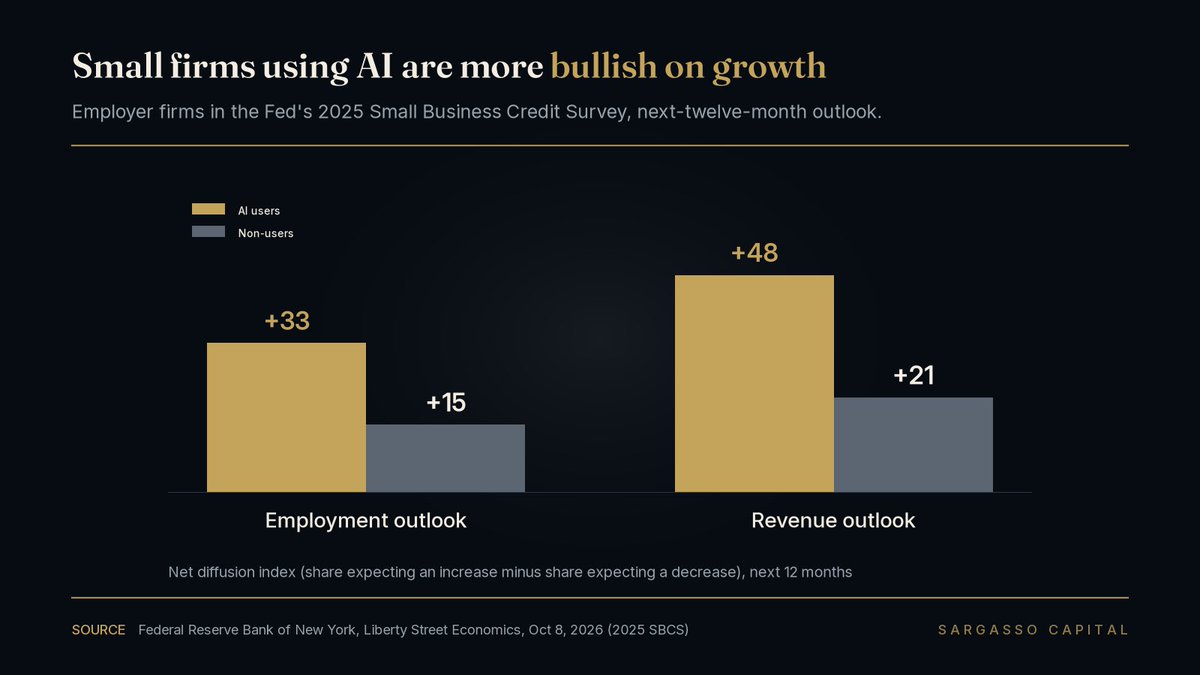
AI-using small businesses are far more optimistic about the next year than peers that skip the tools. The New York Fed's 2025 Small Business Credit Survey shows AI users with a +33 point net employment outlook and a +48 point net revenue outlook, against +15 and +21 for non-users. We think that gap says a lot about which smaller companies get out of Pilot Purgatory first.
AI-using small businesses are far more optimistic about the next year than peers that skip the tools. The New York Fed's 2025 Small Business Credit Survey shows AI users with a +33 point net employment outlook and a +48 point net revenue outlook, against +15 and +21 for non-users. We think that gap says a lot about which smaller companies get out of Pilot Purgatory first.
.Philip Clark tells @MollySOShea on @sourceryy how @ThriveCapital decides as a team & what @RayDalio taught him.
"We think about decision processes a lot more than near-term outcomes... the worst types of investments... where if the numbers changed one quarter... you would all of a sudden start to feel bad..."
AI-generated writing appeared in 29.4% of US STEM PhD dissertations filed in 2026, up from effectively zero before 2023. We think that is an early labor signal as much as a campus one. The same tools changing entry-level work are already changing how scientific expertise gets built.
AI-generated writing appeared in 29.4% of US STEM PhD dissertations filed in 2026, up from effectively zero before 2023. We think that is an early labor signal as much as a campus one. The same tools changing entry-level work are already changing how scientific expertise gets built.
EIA data show developers plan a record 86 GW of new utility-scale generating capacity in 2026, with solar and batteries making up 79% of it and natural gas about 7%. Berkeley Lab estimates data centers used 4.4% of US electricity in 2023 and could use between 6.7% and 12% by 2028.
We think the pace at which around-the-clock supply gets built will be one of the main drivers of AI compute costs over the next several years.
EIA data show developers plan a record 86 GW of new utility-scale generating capacity in 2026, with solar and batteries making up 79% of it and natural gas about 7%. Berkeley Lab estimates data centers used 4.4% of US electricity in 2023 and could use between 6.7% and 12% by 2028.
We think the pace at which around-the-clock supply gets built will be one of the main drivers of AI compute costs over the next several years.
.@PershingSquare CEO @BillAckman tells @finimize that Big Tech's AI capex isn't a balance-sheet risk. Microsoft and Amazon are spending ahead of demand they can already see, and that makes them better companies.
"What is absolutely clear is that AI is incredibly powerful, and the demand for compute is going to continue to be enormous and scale for probably decades to come. How much value can be created per dollar of compute is only improving as AI gets more and more powerful."
"Microsoft, Amazon, Google are accelerating their capex spend in anticipation of demand that they're actually seeing. They're trying to keep up with the demand for their service. And that's actually created an opportunity to buy Microsoft stock, Meta stock."
"They're just front-loading that capex spend because the demand is so great, and the evidence suggests they'll be able to price that demand to earn a very attractive return on capital. To me that's ultimately a better company that will have an even stronger market position over time. So I'm not skeptical at all about that. I think that's good.”
The AI race reads like the nuclear race, except nobody has a clear way to slow it. If the risk is someone else getting there first, the rational move is to stay in front and supervise as you go.
That's how @BillAckman put it to @finimize.
"It's a bit like we're developing a nuclear weapon, and we're competing around the world to develop that nuclear weapon. We think that technology is going to have lots of benefits for mankind, but it also has the potential to destroy mankind... I don't know how we slow AI development. There's such an incentive for China, Russia, whatever to get there before us. I'd rather be the AI leader, and have as much oversight as possible without restricting the ability of us to be the competitive leader."
China keeps releasing strong open models for free, and the logic is old. The cheap download comes with the chips, software and data centers it runs on, and whoever supplies that infrastructure holds the long-term leverage.
That is the point @reflection_ai CEO @MishaLaskin makes to @Saranormous and @EladGil on @NoPriorsPod.
"Continuing to release great open models is very geopolitically advantageous to China. As a country, you want other countries building on your stuff... Open models are Trojan horses for the infrastructure that they bring with them... A U.S.-allied country might run a Chinese model on American chips, but pretty soon, and we're seeing this already, Chinese companies like Huawei are going to be coming in and offering a full stack solution, and then locking that country into their supply... If no other country can build their own railroads and they all have to go to you, you have a lot of geopolitical leverage."
83% of S&P 500 companies now list AI as a risk. Few disclose a director with any AI expertise. Delaware has already punished boards that never built a way to hear about a mission-critical risk. I think AI oversight is next. https://t.co/BocgKSZaD2