@dlancashi@AbhiMan1601@cornell_tech@manv_sc@CommonPrefix Would love to learn more about the routing networks if you can share some papers :) That being said I agree that the common mempool assumption is a problem that the papers need to remove. These are just stepping stones in the research.
@dlancashi@AbhiMan1601@cornell_tech@manv_sc@CommonPrefix Im sorry, i didnt quite get it. The number highlighted is what Ethereum currently has and has nothing to do with what is possible. I dont have much experience with a routing network, but doesn't that involve an assumption that parties (not staked) forward and list path honestly?
Ethereum has needed a real counterparty for institutions onboarding to Ethereum. @ethereuminsti fills exactly that spot. Very excited to see them bringing launch today!
Ethereum's strength is its credible neutrality, permissionlessness, and all other core properties we've all heard about over and over again.
Institutions want these properties too. However, Ethereum upgrades sometimes need more validation to serve institutions' needs better.
At Ethlabs a top priority for me is to build strong feedback loops between the core protocol and developers, institutions, and users to make sure upgrades always hit the mark.
Very excited to work with the @ethereuminsti team to ensure Ethereum's product features are continuously designed with institutions in mind.
Announcing Ethlabs: a non-profit R&D lab for Ethereum and ETH
Our mission is to make Ethereum the settlement layer of the global economy.
The internet became global because shared protocols created a common language between networks. Private systems remained useful, but bounded. Finance is approaching a similar moment. As value, assets, and markets become digital, the world needs shared settlement infrastructure.
Ethereum is uniquely positioned to become that shared base layer, the neutral foundation on which users, institutions, and agents can transact without intermediation.
What we believe:
• We believe credible neutrality matters. Ten years of uptime and the lowest counterparty risk. Ground that cannot be pulled away by any one country, institution, company, or person.
• We believe ETH matters. The most valuable, programmable store of value. A decade of broad distribution, deep liquidity in onchain markets, and maximally trustless asset on Ethereum.
• We believe DeFi matters. Markets, liquidity, credit, exchange, and coordination, open to anyone.
• We believe adoption matters. Principles do not change the world until people benefit from them.
We sit between two worlds: real usage from the builders at the frontier, and the protocol that has to support it. We work with users, applications, wallets, L2s, infrastructure teams, institutions, ETH holders, core devs and researchers, then turn what they actually need into protocol work, shared standards, infrastructure, and shipped products.
Ethlabs is independent but Ethereum is a shared project. We are one node in a much larger network of stewards. This is the multi-node future.
We have spent the better part of the past decade contributing to Ethereum core research and development.
We are opinionated and transparent. We move with urgency, learn in public, and course-correct when we’re wrong.
We are building a lean, talent-dense team for people who want to do the most important work of their careers: [email protected]
@ittaia@OrestisAlpos@liobaheimbach@kartik1507 We have hiding that also obscures existence and identity, simultaneous release (similar to SB), and a no-free-withdrawal guarantee analogous to the accountable last look. In addition, we also model Auction Participation Efficiency (as a efficiency property).
@ittaia Really enjoyed reading. Many of these themes show up in our recent work (https://t.co/EkJBvIIgIR with @OrestisAlpos@liobaheimbach and @kartik1507) Would love to hear your thoughts.
How do onchain markets actually work?
D²’s DeFi Microstructure track covers the mechanics behind latency, fees, staking, and block building:
→ Latency races on blockchains: Brian Zhu
→ Fee mechanisms under execution uncertainty: Sarisht Wadhwa
→ Liquid staking and policy limits: Fayçal Drissi
→ EVM workloads in the wild: Jason Milionis
→ Ethereum block-building resilience: Sen Yang
Catch our very own @OrestisAlpos talking about sealed-bid on-chain auctions with bid-hiding, censorship-resistance, and participation-efficiency guarantees during the Columbia CryptoEconomics (CCE) Workshop this week. Paper: https://t.co/9t1sVOW4OH
Stakers Union has formally voted to support EIP-7805: Fork-choice enforced Inclusion Lists (FOCIL) for inclusion in the next Ethereum network upgrade, Glamsterdam.
🔗 https://t.co/pdKShsb4m4
We're thrilled to have @SarishtW (@DukeU) as our next speaker, do join his very interesting talk!
🪧Title: Security of Blockchains with Strategic Players
📅When: 11am ET, Oct 31
📷Livestream: https://t.co/cfbjEvqeg6
The Agenda for MEV-SBC'25 is live!
📍Aug 7 @ Berkeley
This annual workshop highlights MEV research and talks to illuminate a new round of problems for the community to explore in cryptography, mechanism design, data, consensus, incentives, and their intersections
During the weekend I finished building a little app I call "zkLabeler" (https://t.co/EeF1inTnDn). It's a zkTLS powered labeler for BlueSky. It's a cool application of zkTLS, and a fun learning experience of BlueSky's take on decentralization.
Registration is open for MEV-SBC'25!
📍Aug 7 @ Berkeley
This annual workshop highlights MEV research and talks to illuminate a new round of problems for the community to explore in cryptography, mechanism design, data, consensus, incentives, and their intersections
link ⬇
1st Place - Risk Aware Restaking
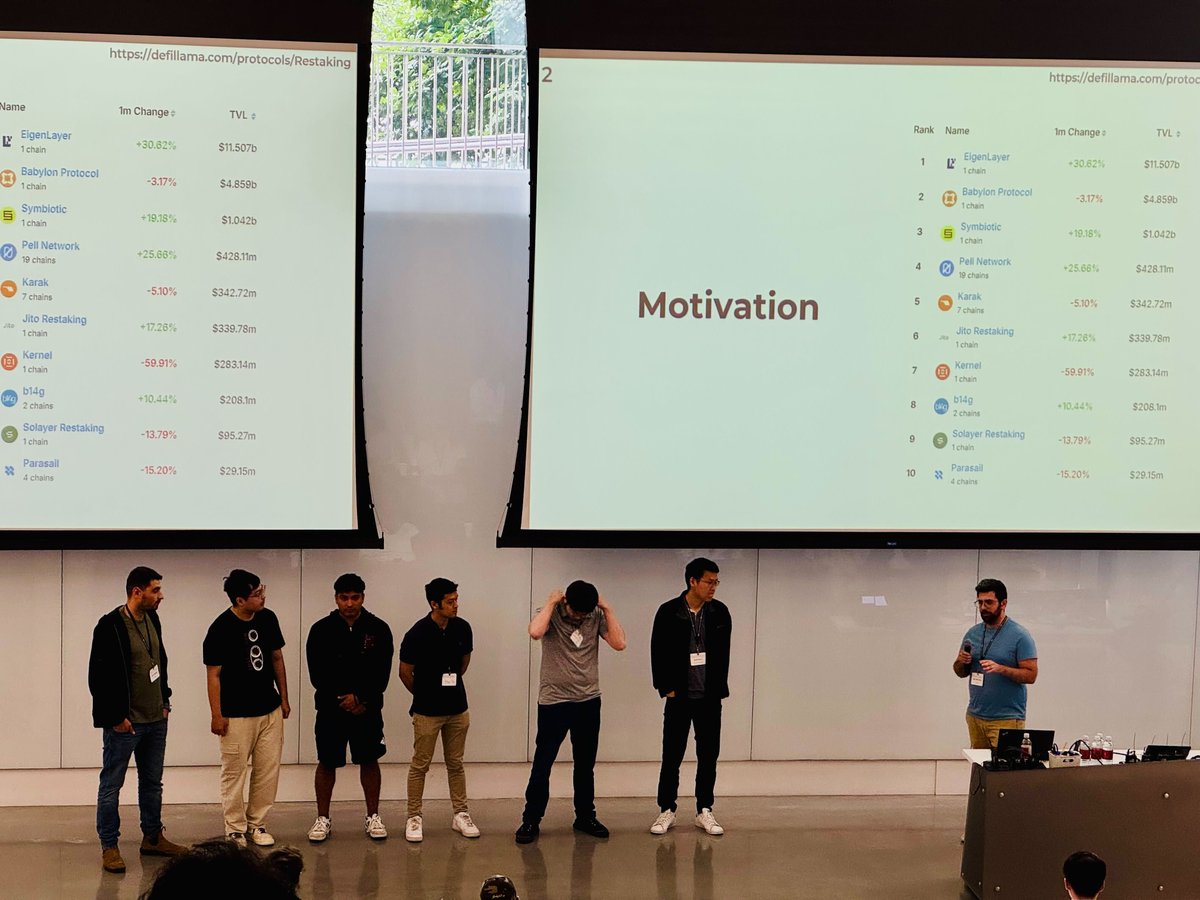
Restaking networks let validators reuse their staked assets to secure multiple blockchain services simultaneously. @roibarzur and his team analyzed scenarios where services implement risk-aware caps to limit excessive restaking participation.
This doesn't exist today, but Roi and his team say it could improve network security. Under such constraints, they proved that splitting their stake is mathematically optimal and developed algorithms to compute the best allocations across services.
🦖🦴 FOCIL for Glamsterdam 🦖🦴
In this note, we propose EIP-7805 as a headliner for a fork inclusion in Glamsterdam. We highlight why FOCIL matters, its benefits, and why we should include it now.
🧵👇
Starting today, Tim and I will be leading the work at the EF on scaling Ethereum L1.
This is part of a restructuring of the R&D group to more effectively support the three EF strategic priorities:
- scale L1
- scale L2s (i.e. blobs)
- improve UX
https://t.co/OrOkPUuNWH