Regards to the visitors. I will be sharing threads on various topics regarding stock market trading/investment/learning from well-known market participants. Happy to share informations.
One day is unusual. Two days is maybe a coincidence. Three days is a pattern that cannot be ignored.
As India's new Closing Auction Session enters its third session, the quantity clearing in the auction remains well below what these stocks traded in the same window before CAS.
Traders are watching whether participation improves and the sharp moves settle with it.
The what, why and how of CAS 🧵 (1/10)
BREAKING: AI can now analyze stocks like Wall Street analysts (for free).
Here are 8 insane Claude prompts that replace $5,000/month Bloomberg terminals (Save for later)
Regards to the visitors. I will be sharing threads on various topics regarding stock market trading/investment/learning from well-known market participants. Happy to share informations.
THE REAL REASON BEHIND THE OCTOBER 10TH CRYPTO CRASH IS FINALLY OUT.
And it’s much bigger than what people thought.
For weeks, traders kept asking the same question:
"Why did the market collapse so violently on Oct 10 when there was no macro event, no ETF news, no exchange failure, nothing?"
Now we have the missing piece and it explains a lot.
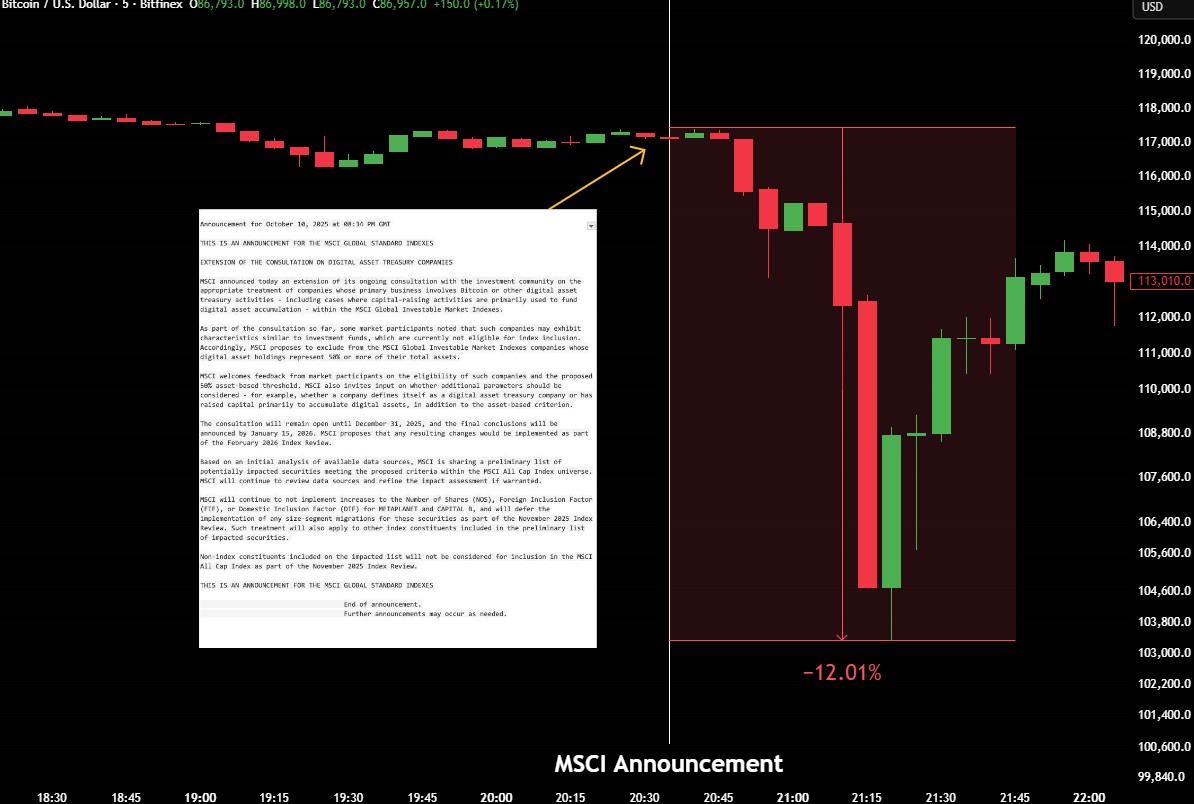
1) MSCI quietly dropped a major update on Oct 10
On the same evening the crash began, MSCI released a consultation note that almost nobody in crypto paid attention to.
MSCI said they are reviewing how to classify companies whose main business involves accumulating Bitcoin or digital assets.
Key proposal:
- If digital assets = 50% or more of a company’s total assets
- And the company’s operating activity resembles a digital asset treasury
→ That company can be excluded from MSCI global indexes.
This directly puts several Bitcoin-heavy companies at risk, especially MicroStrategy.
2) Why this matters
If MSCI excludes these companies:
• Index funds are forced to sell
Funds tracking MSCI indices must remove these stocks.
They do not get to choose. This is literal forced institutional selling.
• MicroStrategy becomes a primary target
If MSTR is labeled fund-like, MSCI indexed funds could be forced to reduce or exit positions.
• When MSTR dumps → BTC reacts immediately
Like it or not, $MSTR is treated as a leveraged Bitcoin proxy.
If the stock shows weakness: confidence drops → Bitcoin correlation increases → retail panic accelerates → liquidations start hitting → BTC falls harder.
3) How this connects to the Oct 10 crash ?
The market was already fragile:
- Trump new tariffs
- Weak Nasdaq
- High leverage in BTC markets
- Fear of 4-year cycle top
When MSCI’s note dropped, it added a new type of structural risk that traders did not expect.
The fear was simple:
"If MSTR or similar companies get removed from MSCI, large funds will be forced to sell, what happens to Bitcoin then?"
This fear hit right into an already stressed market.
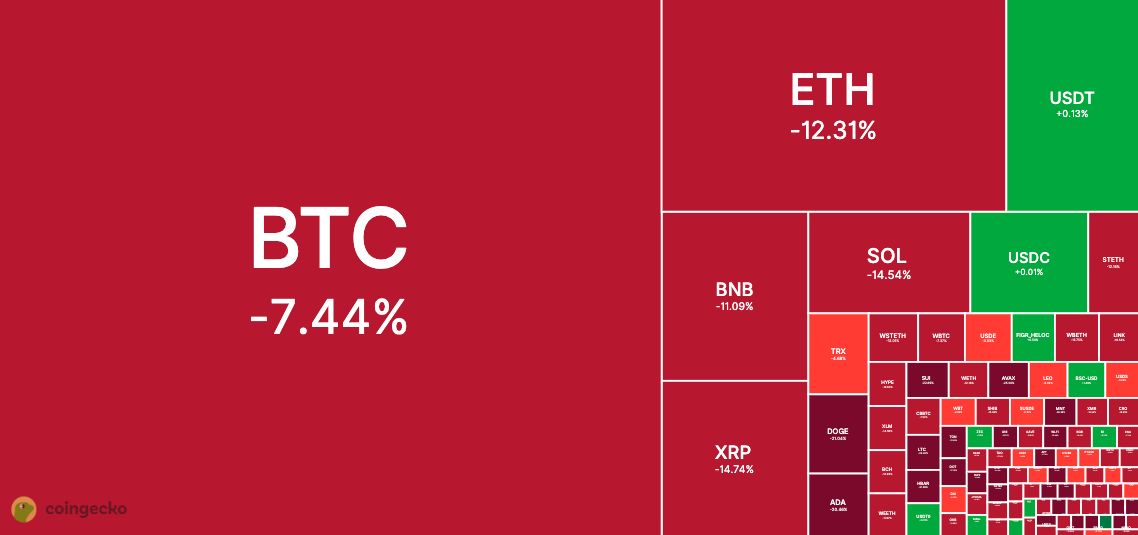
The result: one of the biggest liquidation waves in crypto history.
4) But there’s another layer: JPMorgan’s timing
3 days ago, JPMorgan published a bearish report highlighting the same MSCI risks, right when:
- MSTR was weak
- BTC was weak
- Liquidity was thin
- Sentiment was fragile
This amplified panic, causing a 14% dump in a few days.
And if you know JPMorgan’s history, you know this pattern:
They speak bearish when prices are weak.
They accumulate assets when retail is scared.
They publish bullish notes near tops.
Their timing is never random.
This is not a secret. This is standard Wall Street behavior.
5) Is JP Morgan manipulating the market?
Not illegally. But strategically, yes.
This is how big institutions operate:
- Push fear when liquidity is low
- Trigger panic
- Let weak hands sell
- Accumulate at a discount
- Turn bullish later
They’ve done it with metals. They’ve done it with bonds. They are doing it with Bitcoin.
This is not a cartel. This is Wall Street strategy.
6) Now the plot twist: Michael Saylor responds publicly
Right when MSCI fears started dominating headlines, Saylor dropped a detailed clarification:
"MicroStrategy is not a fund, not a trust, not a holding company. It is a publicly traded operating company with a $500M software business and a Bitcoin based treasury strategy."
He also highlighted:
- 5 new digital credit instruments ($STRK, $STRF, $STRD, $STRC, $STRE)
- $7.7B notional value issued this year
- Stretch ($STRC), the first Bitcoin backed variable yield credit instrument
- Ongoing software operations and financial product innovation
His message was simple:
"We are not passive holders. We are builders. We are innovating. Index labels do not define us."
7) So what does all this mean for the market?
✔ Oct 10 crash was NOT random
It aligns exactly with MSCI’s consultation release.
✔ Forced-selling fear created liquidity stress
Traders panicked because they assumed index funds might eventually dump large positions.
✔ JPMorgan amplified the fear
Their bearish note came at the perfect moment to shake markets further.
✔ Saylor finally cleared the air
His statement explained why MicroStrategy is fundamentally different from what MSCI is describing.
✔ But uncertainty remains
Final MSCI decision comes on 15 January 2026.
Policy goes into effect February 2026.
Between now and then? The market may price in more volatility.
Final Take:
The market did not crash because of a single event.
It crashed because one unexpected structural risk hit an already fragile system.
And large institutions used that moment to shape sentiment.
But the long term picture is simple:
Bitcoin adoption unchanged.
Corporate interest unchanged.
Saylor remains on track.
Institutions still building.
ETF flows will stabilize.
Liquidity cycles will return.
MSCI classification will not stop Bitcoin.
Fear creates opportunity. Narratives create volatility. But fundamentals do not change.
This is why the Oct 10 crash was violent and why it will be remembered as a technical panic, not a fundamental breakdown.
Privacy demand in crypto is exploding📈
According to @al62crypto:
- Google searches for “crypto privacy” are at record highs
- Zcash’s shielded supply is soaring past 4M $ZEC
- Tools like Railgun, Zashi, and Aleo’s USAD are driving growth
Christaino Ronaldo reaches 1.055 billion people. @Cristiano can change the world.
Total people he reaches: $1.055b
He is the only human alive whose posts are seen by more than 1 in every 8 people on Earth.
The Oct 11 Crypto Crash — What Really Happened
TL;DR:
Roughly $60–90M of $USDe was dumped on Binance, along with $wBETH and $BNSOL, exploiting a pricing flaw that valued collateral using Binance’s own order-book data instead of external oracles.
That localized depeg triggered $500M–$1B in forced liquidations, cascaded into $19B+ globally, and earned the attackers about $192M via $1.1B in BTC/ETH shorts opened on Hyperliquid hours earlier, but minutes before Trump tariff announcement.
It wasn’t a USDe failure!! It was Binance’s design flaw, timed with macro panic (Trump’s tariffs) for cover.
What looked like chaos was actually a coordinated exploitation of Binance’s internal pricing system, amplified by a macro shock and systemic leverage.
1️⃣ The Setup
Binance’s Unified Account let traders use assets like USDe, wBETH, and BNSOL as collateral.
Instead of oracle or redemption prices, Binance valued these using its own spot market - a major vulnerability.
On Oct 6, Binance announced a fix to move to oracle-based pricing, but rollout wasn’t until Oct 14, leaving an 8-day window.
2️⃣ The Exploit
During that window, sophisticated actors manipulated Binance’s order books, dumping ~$60–90M of USDe, driving it to $0.65 on Binance only (still ~$1 elsewhere).
Because the Unified Account marked collateral to internal prices, this instantly wiped margin value and triggered $500M–$1B in forced liquidations.
Then, Trump’s 100% China tariff headline hit, magnifying panic and liquidity stress.
3️⃣ The Profit Engine
The same day, fresh wallets on Hyperliquid opened $1.1B in BTC/ETH shorts, funded by $110M USDC from Arbitrum-linked sources.
As the Binance cascade unfolded, BTC and ETH cratered, those shorts netted $192M in profit before closing out at the bottom.
Timing, precision, and funding paths all suggest coordination.
4️⃣ The Contagion
Binance liquidations dumped BTC/ETH/ALTs into thin books.
Other exchanges mirrored the collapse through cross-market bots.
Market makers hedged across venues were forced to unwind everywhere.
Result: $19B+ global liquidations, with many alts down 50–70% intraday, all triggered by <$100M of manipulated collateral.
5️⃣ Who’s at fault?
Binance: design flaw + delay in oracle rollout = root cause.
Exploiters: executed and timed the manipulation, profited via external shorts.
Ethena (USDe): not at fault - protocol stayed 1:1 collateralized, redemptions normal, peg held everywhere else.
6️⃣ Aftermath
Binance admitted “platform-related issues,” promised compensation for affected margin/futures/loan users, and rolled out minimum price floors + oracle integration.
USDe remained operational, and the incident is now a case study in how exchange-side pricing errors can trigger system-wide liquidations.
Bottom line:
A ~$90M dump on Binance and a $1.1B leveraged short elsewhere sparked a $19B bloodbath.
Not a stablecoin failure, but a masterclass in exploiting flawed collateral valuation during peak macro stress.
80% of discipline issues disappear when you have an edge and risk management.
Instead of trying to be disciplined, work on finding an edge with proper risk management.
You’ll realise discipline was never the issue to start with.
🚨🇮🇳 Attention Indian #Crypto Traders: MASSIVE TAX CHANGES INCOMING!
Starting July 7, 2025, 18% GST will be added on top of the existing 30% tax and 1% TDS 😳
Here’s what it means for YOU 😱
A thread 🧵
📊 Indian Market (Apr 30, 2025):
Sensex ~79,408 (+855 pts), Nifty ~24,000. IT & banking led gains; VIX up 5% amid LoC tensions.
💰 FII: +₹50.57 Cr | DII: +₹1,792.15 Cr.
🔎 May 2 Outlook: Cautiously bullish; focus on auto & pharma. Nifty support 23,800, resistance 24,500.
Indian Market Update: April 29, 2025
Sensex surged 1,000+ pts to 80,288, Nifty closed above 24,350, driven by Reliance Q4 & global cues. Defence & realty led; IT stayed strong. FIIs bought ₹2,385.61 Cr, DIIs ₹1,369.19 Cr in cash mkt, signaling confidence.
Gift Nifty hints at positive start tmrw.
Outlook for April 30:
• Nifty may hit 24,500–24,550; support at 24,000.
• Bank Nifty eyes 55,500 breakout; support 54,500.
• Watch auto, pharma, Ather Energy IPO.
• Geopolitical risks, high valuations need caution.