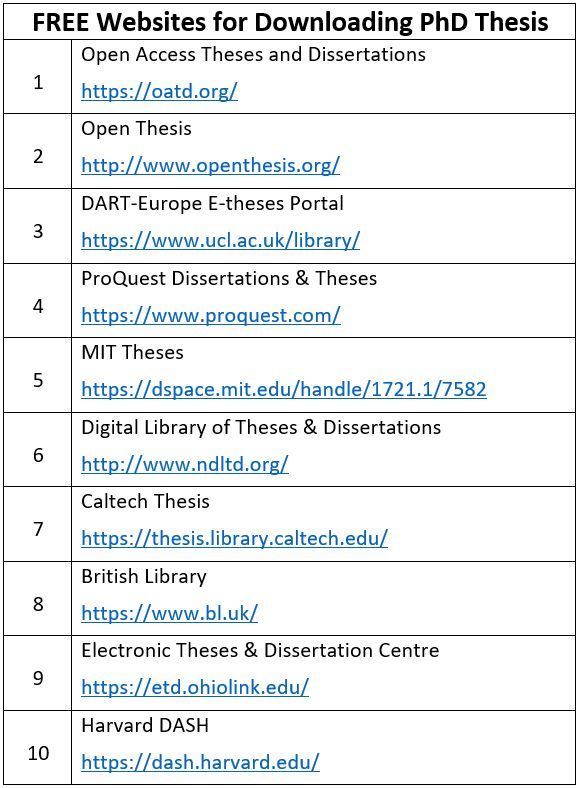
FREE Websites for Downloading PhD Thesis
1. Open Access Theses and Dissertations
https://t.co/tEFUArcsMY
2. Open Thesis
https://t.co/6MiYNaHzcj
3. DART-Europe E-theses Portal
https://t.co/InZwPUDKJ0
4. ProQuest Dissertations & Theses
https://t.co/4owg8BgsCD
5. MIT Theses
https://t.co/qRQJFeoyB3
6. Digital Library of Theses & Dissertations
https://t.co/fVAJEmCAfH
7. Caltech Thesis
https://t.co/8Jw8i4c4qX
8. British Library
https://t.co/N3fEm01YdN
9. Electronic Theses & Dissertation Centre
https://t.co/GltZz8wMAu
10. Harvard DASH
https://t.co/IVySwYe74O
Please register for my FREE webinar
Date: Friday, 14 November
Topic: How to write a research paper?
Registration Link: https://t.co/7iERT29gSw
We are actively recruiting for two positions at the interface between biology and generative design. Backgrounds of particular interest are in protein biochemistry/evolution and synthetic genomics/biology.
Please consider joining us! 1/n
2026 UM Bright Talents Scholarship in Netherlands | Fully Funded
Country: Netherlands🇳🇱
Benefits:
⭐Full Scholarship & €15,930 per year
✅Travel Costs & Accommodation
Category: Masters
Eligible: All Countries
Deadline: February 1, 2026
APPLY↙️
https://t.co/ZLeTMthqRJ
Fully Funded ANU Scholarships 2026! 🇦🇺 Study Master’s & PhD at Australia’s #1 university with tuition, stipend, airfare & more covered!
Apply: https://t.co/M9HVK3yR5u
Deadline: 15 April 2026
We are looking for: PhD Student (starting as Research Assistant) and Postdoctoral Researcher in Stem Cell Biology and Mechanobiology. Please RT💕
🔗 About our lab: https://t.co/53gtr8qx68
🎓 PhD position: https://t.co/hL3Zfk7oII
🧪 Postdoc position: https://t.co/0mVS4ZaomG
President’s PhD Scholarships – Imperial College London - 50 Fully Funded Scholarships 2026
Visit: https://t.co/1pZLM8tqdx
Open to exceptional international talent in: Engineering, Medicine, Natural Sciences, Business, Languages, Culture & Communication.
Fully funded with £26,500 yearly stipend, £2,000 consumables fund, exclusive ECRI programs, and tailored support for international and disabled students.
how to study and learn really difficult subjects:
1. don’t panic. hard just means dense. it’s not impossible, it’s just packed. unwrap it slowly.
2. get a map before diving in. watch an overview video, read the table of contents, or skim the wikipedia page. you need context first.
3. use multiple sources. one book will confuse you, two will clarify, three will enlighten.
4. build intuition, not memory. visualize it. simulate it. code it. teach it to a friend or a wall.
5. tolerate confusion. you’ll feel dumb 90% of the time; that’s the price of learning something that rewires your brain.
6. connect it to reality. every abstract thing has a real-world analog. find it. relate it. ground it.
7. revisit the same topic after a week. mastery is not about reading once; it’s about returning after your brain has “chewed” on it.
8. don’t romanticize genius. smart people aren’t born knowing it. they just survived longer in the confusion phase.
the truth is; learning hard stuff isn’t about intelligence.
it’s about endurance, humility, and curiosity.
you stay long enough in the fog until it clears.
Seeking work in a research group run by an ERC-funded researcher?
You can find more than 145 positions open for application on the #Euraxess website 👉 https://t.co/lLDDAnxi1E
#ChooseEurope#jobs#research
These Universities in the US accept and gives
📌 Full funding
📌 CGPA of 2.2
📌 HND
📌 No GRE/IELTS
📌 Application fee waived.
The list:
Ohio State University
https://t.co/CSuPPcFN23
Florida State University
https://t.co/F5JR2jYeQU
University of Kentucky
https://t.co/GN6YqaB4IC
7 types of RESEARCH GAPS every students should know and how to find yours.
1. Knowledge Gap.
Occurs when a topic has not been explored deeply enough or lacks sufficient research evidence.
How to Identify It:
Review literature reviews or meta-analyses to see what’s missing or understudied.
Look for areas frequently described as “limited research,” “underexplored,” or “needs further study.”
Ask: What aspects of this topic remain untouched or rarely examined?
2. Conceptual Gap.
Appears when key ideas, terms, or definitions lack clarity, consistency, or agreement among scholars.
How to Identify It:
Compare how different authors define or interpret core concepts.
Spot inconsistencies or vague terminologies in existing research.
Ask: Are there competing definitions or unclear conceptual boundaries?
3. Theoretical Gap.
Exists when existing theories cannot adequately explain new realities, emerging contexts, or recent data.
How to Identify It:
Examine if current theories still hold under new evidence or technological, social, or environmental changes.
Look for research calling for “new models” or “revised frameworks.”
Ask: Are current theories outdated or misaligned with present realities?
4. Empirical Gap
Happens when research data is weak, limited, outdated, or contradictory across studies.
How to Identify It:
Compare data sets and results across multiple papers.
Look for conflicting findings or small, non-representative samples.
Ask: Is the evidence consistent and strong enough to support conclusions?
5. Methodological Gap
Occurs when earlier studies used narrow, flawed, or outdated research tools, methods, or designs.
How to Identify It:
Review the methods sections of previous studies for repeated limitations.
Check if new analytical tools or technologies could yield better insights.
Ask: Could improved methods change what we know?
6. Population Gap
Appears when certain groups, contexts, or regions are missing or underrepresented in existing research.
How to Identify It:
Scan literature for recurring demographic or contextual exclusions.
Identify whether most studies focus on one country, culture, or age group.
Ask: Who or what is missing from the story?
7. Practical Gap
Arises when research findings fail to translate into real-world practice or policy.
How to Identify It:
Review studies whose recommendations are rarely implemented.
Check if results stop at theory without practical validation.
Ask: How can this research be applied or tested in real-life situations?
Finding a research gap isn’t about luck. It’s about curiosity, observation, and critical thinking.
Each of these seven gaps shows where knowledge is incomplete and where your work can make a real contribution.
Whether it’s theory, data, or practice, identifying the right gap gives your PhD (or study) direction and purpose.
Remember, research grows where questions remain, your curiosity is the bridge between what’s known and what’s next.
@Ayo_Dynamic
I am looking for an M.S. & a Ph.D. student (Spring 2026) in Quantitative Genetics & Genomics @SDStateCAFES
to work on sorghum & maize using UAV phenotyping, G×E, GWAS, and AI-based trait prediction.
Interested candidates, please apply here.
https://t.co/3Dr6G743pH
Cardiff University Scholarships in UK 2026 | Fully Funded
Country: United Kingdom🇬🇧
(i) The Cardiff University in the United Kingdom is currently inviting applications for its 2026 scholarship program.
(ii) The scholarship is available to students from all countries of the world seeking a postgraduate degree
(iii) The scholarship offers full funding and includes an annual stipend of £20,780 for the winners.
(iv) The deadline for the application is December 11, 2025
Apply:
https://t.co/84qKb7QK20
Central Queensland University RTP Scholarship 2026 - Fully Funded in Australia with $36,000/ Year
Link in Comment:
Degree: Master & Ph.D
RTP Stipend Scholarships are funded by the Australian Government. They provide funding allocated to students to assist with their living costs while undertaking a research higher degree.
Deadline: December 30, 2025