I am a member of the Norwegian Nobel Committee.
There are five of us. Five people, appointed by a parliament most of the planet could not find on a map, who decide, once a year, which human being the world has agreed to call good.
I know. I know. I think about it on the tram.
We meet in a building on Henrik Ibsens gate, a street named after a man who wrote almost exclusively about people discovering they are frauds, which nobody on the committee finds funny except me. There is a room with a long table and the portraits of the dead laureates looking down, Mandela, the Dalai Lama, a great many earnest men in spectacles, and one portrait we do not discuss, which is Kissinger, 1973, awarded while the bombs were still falling, after which two of our predecessors resigned and the satirist Tom Lehrer said political satire was now obsolete. We keep him on the wall. A reminder. Every family has the uncle.
It is October in Oslo, which means the sun gives up around four in the afternoon like a civil servant, and it rains the particular Norwegian rain that isn’t quite falling, just hanging there, judging you. I arrive with wet shoes. I always arrive with wet shoes. There is coffee, because this is Norway and there is always coffee, we drink more of it per person than almost anyone alive, and someone’s wife has sent kanelboller, the cinnamon buns, and we sit, five Norwegians, damp, caffeinated, sugared, and we decide the moral standing of the entire species.
Let me tell you how it actually works, because the world imagines a cathedral and it is, I promise you, a book club with a mandate.
287 nominations this year. 208 people, 79 organizations. Anyone can nominate, that’s the secret nobody understands: a professor, a parliamentarian, a former laureate, so the “nominee” list is meaningless, it’s a suggestion box, and every autumn some congressman nominates his own golden retriever and the press writes “SHORTLISTED.” Nobody is shortlisted. There is no short list the public ever sees. There is us, and the coffee, and the rain, and the portraits, and a Norwegian stubbornness that is older than the prize itself.
We read reports. The institute’s advisers write them, thick dull documents, and we argue. Our chairman told the BBC once that in the final meeting “there is a high temperature.” High temperature, for a Norwegian, means someone slightly raised an eyebrow and then apologized for it. We don’t do high temperature. We do a long silence, and then Kristin says “well,” and everyone knows exactly what “well” meant, and it’s settled. That’s our shouting. “Well.” You’d have to be raised here to hear the violence in it.
Now. This year. I will not say the name, because we never say the name, but you know the name.
A certain head of state wanted this prize the way a child wants a thing in a shop window, which is to say loudly, and in public, and with the full belief that wanting it was itself the argument. He said he deserved it. He said he’d ended eight wars, a number that grew most times he said it, like a fish. He had other heads of state phone us. Israel’s prime minister posted it on the internet, “Give him the Nobel.” The leaders of Cambodia and Pakistan announced they’d nominated him, as though announcing it were part of it, as though we tally mentions. A man flew around the globe collecting endorsements for a Norwegian committee the way you’d collect signatures for a petition to the council about a noisy dog.
And here, uff da, is the detail I treasure, the one that makes me smile into my coffee. The nomination deadline is the 31st of January. He took office on the 20th. So for all the phone calls, all the posts, all the gilded lobbying, the only nominations that could possibly count for this year’s prize were filed in the first eleven days of his term, before he had, by his own arithmetic, ended a single one of the eight wars. He campaigned all year for a prize whose window had shut while he was still hanging up his coat. We didn’t have to reject him. The calendar did. We just watched. Norwegians are very good at watching. We have long winters.
People think we sit there weighing his deeds. We don’t. That’s the thing I can’t make the world understand. We’re not grading his homework. We don’t owe anyone the prize for a ceasefire, however real, however loud the announcement. “He made peace” is not a sentence that ends in a medal, the way he believes it does, the way he believes every good thing ends in his name on it. The will of a dead Swede says the prize goes to whoever did the most for fraternity between nations. A dead Swede, I should add, who made his entire fortune inventing dynamite and selling arms, and spent his last years horrified at his own obituary, which called him a merchant of death, and so bought his way to immortality as a man of peace. The whole prize is one guilty arms dealer’s attempt to launder his name. We are, all of us, administering a dead man’s public relations. I find this clarifying. It keeps me humble. It should keep everyone humble, and it keeps, by my count, no one humble at all.
So who did we give it to?
An eighty-five-year-old woman. A judge. Born in Durban, under apartheid, granddaughter of a Tamil man who came to South Africa as indentured labor, a bus driver’s daughter from the poor Indian quarter, who became the first non-white woman to run a law practice in her province, who defended Mandela’s people when defending them was dangerous, who sat on the Rwanda tribunal and the court at the Hague, and who, at eighty-five, is right now a judge weighing whether a genocide is a genocide. When we told the world, our chairman said the rule of law “underpins the system we have set up to ensure peace,” and that “peace requires justice.” She wasn’t even in Oslo. She was in Nuremberg. In courtroom 600. The actual room where they tried the Nazis. You cannot stage that. God staged that, and God, it turns out, is a better satirist than any of us.
She did not phone us. She did not post. No prime minister demanded it for her on the internet. She had, as far as our deliberations are concerned, the one qualification the loud man could never manufacture, which is that she wanted the work and not the medal. The medal finds those people. It flees the ones who chase it. This is not a rule we wrote. It’s just the only pattern the hundred-odd years of our mistakes has ever shown.
The reaction from across the ocean was immediate. His spokesman posted that we “place politics over peace.” Ja. Perhaps. We’re five damp pensioners in a rainy city; of course it’s political, it was always political, it was political when we gave it to a sitting American president nine months into his first term for the promise of things he had not yet done, and we have been quietly embarrassed about that one for fifteen years, so believe me, we had a particular reason this year to prefer a woman with fifty years of verdicts behind her over a man with eight wars in front of him and a deadline already behind him.
Here is what he will never understand, the thing I’d tell him on the tram if he ever took one. We are the one prize he cannot buy, cannot post his way to, cannot have a friendly dictator phone in for him. Not because we’re incorruptible, nei, we’re as vain and wrong and human as the portraits on our wall. But because the entire point of the thing, the only power a small cold country’s book club has ever held, is that it goes to the person not performing the wanting. The moment you demand it, you’ve proven you don’t understand what it’s for, and proving that is itself the disqualification. He ran the most expensive campaign in the history of the prize and the campaign was the reason. He was never losing to Navi Pillay. He was losing to the concept.
It’s dark now. Four o’clock dark. The buns are gone. Kristin said “well” an hour ago and we all went home. I’m on the tram with my wet shoes, and somewhere across the water a very powerful man is explaining to a camera that the prize is rigged, that we’re corrupt, that he’ll win it next year, and he genuinely might, we’re only five idiots and we’ve been wrong before, Kissinger is still on the wall.
But not this year. This year an old woman in Nuremberg, in the room where the law once stared down the exact kind of man who thinks wanting a thing loudly enough should make it his, got a phone call she didn’t ask for.
That’s the job. We don’t reward the man who ends the war and announces it.
We reward the woman who spent fifty years deciding what a war was.
He’ll never see the difference. That’s rather the whole point of him.
Takk for i dag. I have to change trams.
Vehicular emissions account for 23% of Delhi's winter pollution — the single largest source according to the Commission for Air Quality Management (CAQM). Although two-wheelers comprise nearly 67% of the city's total vehicle stock, three-wheelers and light commercial cargo vehicles log a disproportionately high amount of daily mileage. By strategically targeting this specific segment, the Delhi EV Policy 2026 establishes a timely and welcome mandate for electrification, paving the way for meaningful transport decarbonisation.
As more of these vehicles take to city roads, charging infrastructure becomes critical, but most of it today is designed around passenger cars that largely charge at home, leaving public chargers at single-digit utilisation. The real demand lies in urban freight movement, and charging infrastructure must be planned around dense-city realities of high peak demand, fleet operating patterns and urban cooling requirements.
Unlocking this requires moving past generic infrastructure models and designing for real-world fleet realities. At Sattva, we are actively collaborating with CPOs, OEMs, and logistics pioneers to bridge this gap, understanding ground realities and synthesising actionable policy recommendations for high-utilisation, revenue-viable infrastructure that keeps Delhi moving cleanly.
Look forward to a comprehensive technical paper mapping out these exact execution pathways coming this Friday. Stay tuned as we help shape a reliable ecosystem for transport decarbonisation!
#EVcharging #Decarbonisation #DelhiEVPolicy #SustainableDevelopment
Urban freight electrification in India is accelerating. Electric three-wheelers and small commercial vehicles are projected to make up 76% of small commercial vehicle stock by 2030, driven by fleet economics that increasingly favours EVs over diesel.
The underutilisation of public chargers stems mainly from the fact that private vehicles predominantly charge at home. However, with the rapid electrification of commercial vehicles, the demand for public charging is growing. This shift necessitates a focus on urban charging infrastructure optimised for commercial vehicles to ensure higher utilisation.
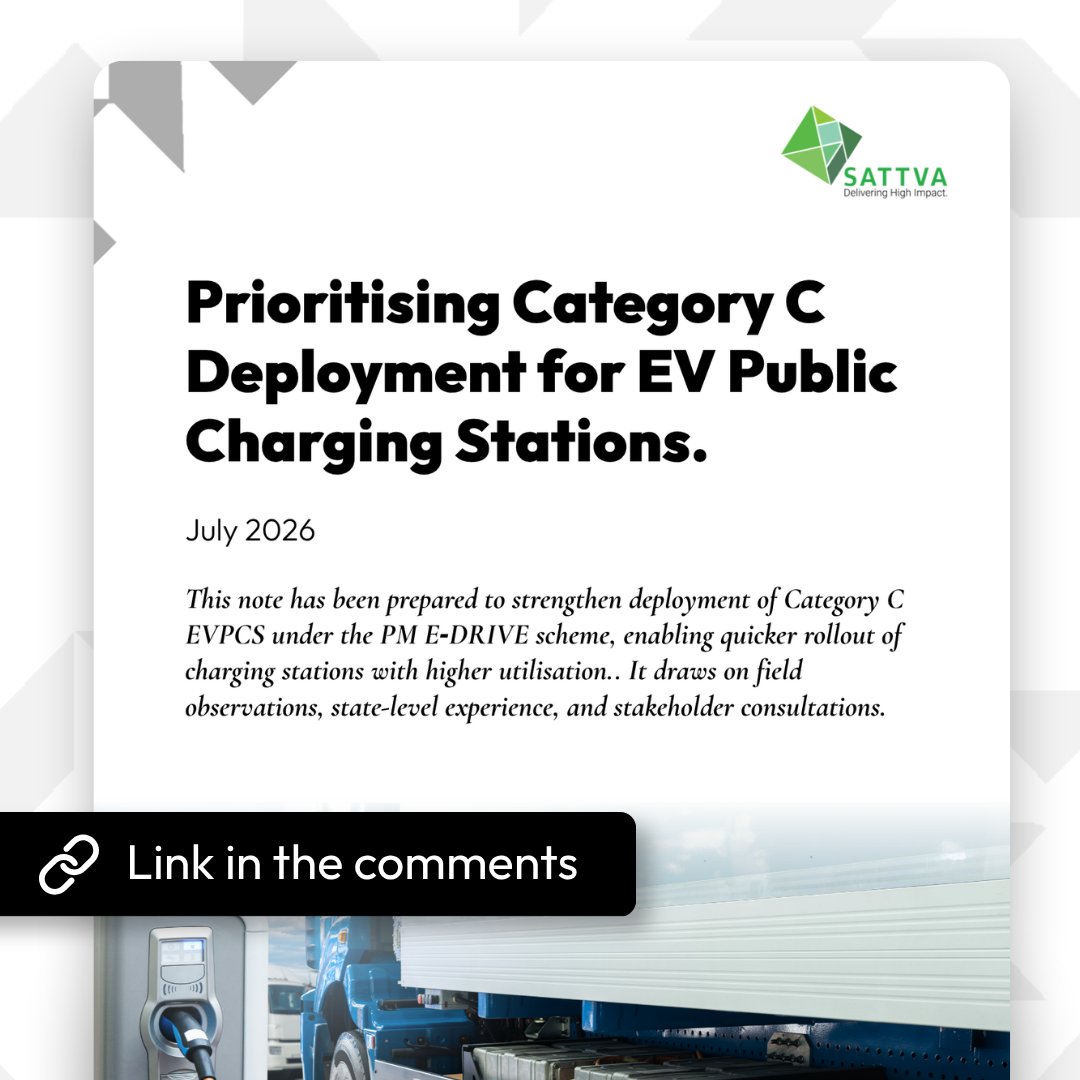
To address this shift effectively, we should plan charging infrastructure around specific fleet operating patterns and fixed logistics nodes. Our latest paper synthesises these key findings and actionable strategies, shaped by insights from industry leaders.
Explore the full report: https://t.co/FavP1udpO3
#EVinfrastructure #EVcharging #Publiccharging #ElectricFrieght #SustainableMobility
Fueled by the ₹2,000Cr PM E-DRIVE allocation, India's roll-out for Public Charging Infrastructure is gaining pace! But to make these chargers commercially viable, we must prioritize high-traffic Category C sites (logistics hubs, highway corridors, markets) where utilization is highest.
Our latest whitepaper explores this shift and and identifies five practical interventions that could unlock scale. Also poses an important question about the role of State Nodal Agencies. Rather than functioning mainly as facilitators, could they evolve into active planners that shape demand, align stakeholders, and translate policy architecture into viable market design?
Read more: https://t.co/jaqTk2bQ72
#EVcharging #Electricvehicle #Greenmobility #Freightoperators #EVIndia #SustainableTransport
According to recent reports, the deployment of EV charging infrastructure in India is accelerating exponentially but are they utilised optimally? The answer is no and the rate is much lower than most would expect. Why is that?
Sattva has worked with charge point operators, logistics service providers, fleet aggregators and battery experts to unpack why, and to lay out a five-point solution for utilisation-led deployment.
Access the full paper here: https://t.co/VdJMPAq5Pb
We are eager to hear your feedback and engage in further collaboration. Please contact [email protected] or [email protected] to connect with our team.
#PMEDrive #EVCharging #PublicCharging #FleetCharging #LogisticsParks #FreightAggregationHubs
Now-a-days Indians are so passionate about Football & when they feel their team might bring some glory in FIFA matches, then why Indian's always get robbed, Heart Break💔 for Football fan in 🇮🇳
@FIFAWorldCup are u seeing this
#QATIND#IndianFootball
Rank 34th Qatar did an open robbery against Rank 121st India even when Qatar is already qualified for 3rd round.
Seriously what a pathetic refereeing 🤡
Absolutely heartbreaking moment for Indian fans right now💔
#QATIND#IndianFootball