This 1 hour Stanford lecture on Markov Decision Processes will teach you more about the math behind systematic trading decisions than a 3 month internship at Jane Street or JPMorgan.
Bookmark & replace one movie today with this lecture, no matter what.
Jeff Bezos just explained why he laid off 30% of the Washington Post.
The criticism was simple: you're a billionaire who said this was a public trust. Why not just subsidize it?
His answer: because that would be cheating.
"If people won't pay for our product, it's not a good enough product. It would be like poetry without rhyming. It's too easy."
In other words, profitability isn't just a financial metric. It's a signal. It tells you whether you're actually providing something people value. A business that only survives on subsidy is a business that hasn't earned its relevance.
He told the Post team to follow the data on every layoff decision. Cut what isn't working. One exception: investigative reporting. That's the heart of the institution and it doesn't get touched.
Even after the cuts, the Post's newsroom is still larger than it was during Watergate and the Pentagon Papers. They just won the Pulitzer Prize for Public Service for their DOGE investigation.
This is the same logic Bezos applied at Amazon for 30 years. Don't subsidize businesses that aren't working. Cut fast, protect the core, and make the product good enough that people choose to pay for it.
“In my youth I made it a rule not to drink a drop of alcohol before lunch. Now that I am no longer young, I keep to the rule of not drinking a drop before breakfast.”
Winston Churchill was the only British Prime Minister ever awarded the Nobel Prize in Literature. Reading him, you realize that to be a brilliant writer you don’t need to write long books — and to be a true philosopher, you don’t either.
Here are some of his quotes:
One. If you’re going through hell — keep going.
Two. You have enemies? Good. That means you’ve stood up for something in your life.
Three. Every crisis is a new opportunity.
Four. A smart person doesn’t make all the mistakes himself — he gives others a chance too.
Five. The best argument against democracy is a five-minute conversation with the average voter.
Six. Success is the ability to go from one failure to another without losing enthusiasm.
Seven. A kite rises highest against the wind, not with it.
Eight. A man who never changes his mind is a fool.
Nine. When eagles are silent, parrots begin to chatter.
Ten. Power is a drug. Anyone who has tried it even once is poisoned by it forever.
Eleven. Do not wish for health and wealth — wish for luck. On the Titanic, everyone was rich and healthy, but only a few were lucky.
Twelve. A lie travels halfway around the world before the truth has a chance to get its pants on.
Thirteen. Politics is almost as exciting as war, and quite as dangerous. In war, you can only be killed once — in politics, many times.
Fourteen. My tastes are simple. I am easily satisfied with the best.
Fifteen. If you want to have the last word in an argument, tell your opponent: “You may be right.”
Sixteen. The greatest advantage comes to those who make their mistakes early enough to learn from them.
Seventeen. People are very good at keeping secrets they do not know.
Eighteen. War is when innocent people die for the interests of others.
Nineteen. The greatest lesson in life is that even fools are sometimes right.
Twenty. It is far better to bribe a person than to kill him — and far better to be bribed than killed.
Twenty-one. It is easier to rule a nation than to raise four children.
Twenty-two. We live in an age of great events and small men.
Twenty-three. Nothing earns authority like calmness.
Twenty-four. The best way to ruin a relationship is to start trying to “sort it out.”
Twenty-five. When two people fight, the third one wins.
Twenty-six. If you kill a murderer, the number of murderers does not change.
Twenty-seven. A pessimist sees difficulty in every opportunity; an optimist sees opportunity in every difficulty.
Twenty-eight. You will never reach your destination if you stop to throw stones at every barking dog.
Twenty-nine. A nation that forgets its past loses its future.
Once, during a speech, Churchill was asked:
— Isn’t it pleasing to know that every time you give a speech, the hall is packed?
He replied:
— It is, very much so. But every time I see a full hall, I cannot help thinking that if I were not giving a speech but being led to the gallows, the crowd would be twice as large.
A Carnegie Mellon professor walked onto a stage in 2007 and gave an hour-long lecture to 400 people about achieving your childhood dreams. He did not tell the room that the entire talk was actually written for his three kids, who would grow up without him.
His name was Randy Pausch. The date was September 18, 2007. The video has since passed 20 million views, and the book that followed spent more than a hundred weeks on the New York Times bestseller list.
Pausch was 46 years old, had been diagnosed with terminal pancreatic cancer a month earlier, and had been told he had three to six months of good health left.
He did not walk onto that stage to talk about dying. He walked onto it to teach a single lesson hidden inside another one.
Here is what I missed the first time I watched it.
Pausch opened by doing push-ups on stage. He told the audience he was in phenomenally good shape, in better shape than most of them, and anyone who wanted to cry or pity him was welcome to get down and match him. The room laughed. Then he said the line that sets up the entire hour to come. We cannot change the cards we are dealt. Just how we play the hand.
That was the frame. Everything after it was a demonstration.
The lecture was officially titled Really Achieving Your Childhood Dreams, and Pausch did spend the first 40 minutes working through his actual childhood list. Zero gravity. Playing in the NFL. Writing an entry in the World Book Encyclopedia. Being Captain Kirk. Becoming a Disney Imagineer.
He walked the audience through which ones he got, which ones he didn't, and what the gap between wanting and getting had actually taught him.
The framework inside those 40 minutes is the part most people remember, and it is the one Pausch delivered with the most force.
He called it the brick wall. He said the brick walls in your life are there for a reason. They are not there to keep you out. They are there to give you a chance to show how badly you want something. They are there to stop the people who do not want it badly enough. They are there to stop the other people.
Read that again slowly. He is not saying brick walls are a test you have to pass. He is saying brick walls are a filter nature uses to separate the people who actually want a thing from the people who only like the idea of wanting it. That is a completely different claim. Most people treat obstacles as unfair. Pausch argued obstacles are the mechanism by which desire gets proven, and without that mechanism the whole concept of wanting something would be meaningless. Every dream he achieved, he achieved by treating the wall as a signal that he was close, not a signal that he should stop.
The second framework he taught the audience is the one almost nobody teaches in any classroom. He called it the head fake. He pulled it from football. Coaches teach young kids to tackle by having them run drills that look like they are about tackling, but the real lesson being embedded is teamwork, grit, how to take a hit and get back up. The kid thinks they are learning football.
They are actually learning something much larger, and they will not realize it until years later. Pausch said the best teaching in the world is head fake teaching. You get people to learn the thing they need by dressing it up as the thing they already want.
This is the technique behind Alice, the programming software he built at Carnegie Mellon. Kids thought they were making animated movies and games. They were actually learning to code. Pausch said one of his proudest claims to fame was that he had taught programming to a generation of students who had no idea they were being taught programming at all.
And then, with about three minutes left in the lecture, he ran a head fake on the room.
He asked the audience if they had figured out the first head fake of the talk itself. The room went quiet. He said the lecture was never actually about how to achieve your childhood dreams. It was about how to lead your life. If you lead your life the right way, the karma takes care of itself and the dreams come to you anyway.
Then he asked if they had figured out the second head fake. Even quieter.
He said the talk was not for the four hundred people in the room.
It was for his three kids.
Dylan was six. Logan was three. Chloe was eighteen months. They would grow up without their father, and he knew it. Pausch had spent an hour on stage pretending to give career advice to strangers because he needed to record something his children could watch when they were old enough to understand who their dad had been.
The entire architecture of the lecture was a message in a bottle disguised as a keynote. The filtered brick-wall philosophy, the football stories, the dreams he chased and the ones he missed, the line about playing the hand you are dealt, all of it was something a father wanted three small children to internalize after he was no longer there to say it in person.
That is the moment the video stops being a lecture and starts being something else entirely.
Pausch died on July 25, 2008, ten months after giving it. His final sentence on stage was that he had given the talk tonight, and then he walked off. The applause lasted nearly a minute before the camera cut.
Most professors spend their entire careers trying to say one true thing their students will remember for a week.
He said one true thing his children will remember for the rest of their lives, and the rest of the world is still watching the footage.
In 1997, Steve Jobs came back to Apple and canceled 70% of the product line.
The engineers whose projects just died?
Three feet off the ground with excitement.
“They finally understood where in the heck we were going.”
He spent 20 minutes explaining how he was going to bring Apple back:
On focus:
"We looked at the product road map going out for a few years and said a lot of this doesn't make sense."
"There's way too much stuff and not enough focus."
"We got rid of 70% of the stuff on the product road map."
"You're going to see the product line get much simpler. And you're going to see the product line get much better."
On inventory:
"We've got two to three months of inventory in our manufacturing pipeline. And about an equal amount in our distribution pipeline."
"So we're having to make guesses four, five, six months in advance about what the customer wants."
"We're not smart enough to do that. I don't think Einstein's smart enough to do that."
"So we're going to get really simple. Take inventory out of those pipelines. Let the customer tell us what they want. And respond to it super fast."
On marketing:
"To me, marketing is about values."
"This is a very complicated world. A very noisy world. We're not going to get a chance to get people to remember much about us. No company is."
"So we have to be really clear on what we want them to know about us."
On brand neglect:
"Apple is one of the half dozen best brands in the whole world. Right up there with Nike, Disney, Coke, Sony."
"But even a great brand needs investment and caring if it's going to retain its relevance and vitality."
"The Apple brand has clearly suffered from neglect in the last few years."
On what not to do:
"The way to bring it back is not to talk about speeds and feeds. Not to talk about megahertz. Not to talk about why we're better than Windows."
"The dairy industry tried for 20 years to convince you that milk was good for you. It's a lie. But they tried anyway."
"Sales were going like this." [Down]
"Then they tried 'Got Milk.' Sales went like this." [Up]
"Got Milk doesn't even talk about the product. It focuses on the absence of the product."
On Nike:
"The best example of all. One of the greatest jobs of marketing the universe has ever seen is Nike."
"Nike sells a commodity. They sell shoes. Yet when you think of Nike, you feel something different than a shoe company."
"In their ads, they don't ever talk about the product. They honor great athletes. That's who they are."
On Apple's identity:
"Our customers want to know: who is Apple? What do we stand for?"
"What we're about isn't making boxes for people to get their jobs done."
"Apple at its core is that we believe people with passion can change the world for the better."
"Those people crazy enough to think they can change the world are the ones that actually do."
On death:
"For 33 years, I've looked in the mirror every morning and asked: if today were the last day of my life, would I want to do what I'm about to do today?"
"Whenever the answer has been no for too many days in a row, I know I need to change something."
"Remembering that I'll be dead soon is the most important tool I've ever encountered to help me make the big choices in life."
"Almost everything—all external expectations, all pride, all fear of embarrassment or failure—these things just fall away in the face of death."
"You are already naked. There is no reason not to follow your heart."
On time:
"Your time is limited. So don't waste it living someone else's life."
"Don't be trapped by dogma, which is living with the results of other people's thinking."
"Don't let the noise of others' opinions drown out your own inner voice."
"Have the courage to follow your heart and intuition. They somehow already know what you truly want to become."
"Everything else is secondary."
"Stay hungry. Stay foolish."
At 14, Jim Simons got a job putting away stock in a basement.
He was so bad, they demoted him to floor sweeper.
When he said he wanted to study math at MIT, his bosses laughed.
He went on to make $100+ billion in trading profits. More than Buffett, Soros, & Dalio combined.
In 2010, he spent 60 minutes at MIT explaining how a mathematician became the world's greatest trader:
"They thought that was the funniest thing they had ever heard. The guy who couldn't remember where to put the sheep manure is going to be a mathematician at MIT."
He applied to MIT. Got accepted. Studied mathematics. It went all right.
After graduating, Simons took a job at the Institute for Defense Analysis. Secret government work. Good pay. Half your time on their work, half on your own mathematics.
Then the Vietnam War happened.
General Maxwell Taylor, the head of the organization, wrote an article in the New York Times about how victory was days away.
Simons disagreed. He wrote a letter to the Times expressing that view.
"They kindly published it."
A few months later, a reporter asked to interview him about people who work for the defense department but oppose the war.
Simons agreed. Told his local boss afterward.
"He said, 'You did what?' And he picked up the phone and called General Maxwell Taylor."
Silence on the other end.
"He hung up. Looked at me. Said, 'You're fired.'"
"I said, 'I'm fired? I'm a permanent member.'"
"He said, 'I'll tell you the difference between a temporary member and a permanent member. A temporary member has a contract.'"
"It was the first time, and happily the last time, I was ever fired."
On starting Renaissance:
Simons left mathematics at 38. Frustrated. Stuck on a problem he couldn't solve.
He had some money from an investment that finally paid off. He invested that money. Found out he wasn't bad at it.
He brought in the best modeler he knew. A guy named Lenny Baum.
"Lenny started making models. But then he seemed to get less interested in models and more interested in reading the news."
"Then he started having opinions on what was going to go up and what was going to go down. And he was right enough times."
"I said okay, to hell with the modeling. Let's just try to make some money."
What happened next:
"We multiplied our investors' money by 12 in two years."
"We were incredibly lucky."
But in the back of his mind, he knew models were the answer.
"If you're doing fundamental trading, one morning you come in, you feel like a genius. Your positions are all your way. You think, God, I'm really smart."
"The next day you come in, they've gone against you, and you feel like an idiot."
"It just didn't seem like a way to live your life."
In 1988, he made the decision: 100% models. No human override.
"Some firms say they have models. What they typically mean is the model advises the trader what to do. If he likes the advice, he'll take it. If he doesn't, he won't."
"That's not science. You can't simulate that. How were you feeling when you got out of bed 13 years ago? Did you like what the model said?"
"If you're going to trade using models, you slavishly use the models. You do whatever the hell it says. No matter how smart or dumb you might think it is at that moment."
"That turned out to be a wonderful decision."
On the secret sauce:
"People always ask me, what's the secret? We're not the only quant firm in the world. But we seem to have done better than anybody."
"The real secret sauce is that we start with great scientists. First-class people who've done first-class work."
"Second, we provide people with a great infrastructure."
"The most important thing is an open atmosphere. Everybody knows what everybody else is doing. No compartmentalization."
"And people get paid based on the overall profits. Not just on your work. Everyone has an interest in everyone else's success."
"Those policies, no one of which seems so remarkable, turn out to be a pretty winning combination."
On guiding principles:
His wife told him to end with values. He said he wasn't sure he had any.
"She assured me that I had some values, if only I could think hard about them."
Here's what he came up with:
1. Do something new.
"I don't like to run with the pack. For one thing, I'm not such a fast runner."
"If you're one of n people all working on the same problem, I'd be last. But if you can think of a new problem that other people aren't working on, maybe that'll give you a chance."
2. Collaborate with the best people you possibly can.
"That gives you some reach and some scope. And it's also fun to work with terrific people."
3. Be guided by beauty.
"What's aesthetic is doing it right. Getting the right kind of people. Approaching the problem and doing it right."
"It's a beautiful thing to do something right."
4. Don't give up.
"Sometimes it's appropriate to be trying to do something for a hell of a long time."
5. Hope for some good luck.
1,000,000 views
When I published this piece three days ago, I hoped it might reach a few thousand people. A million of you read it. Ministers, ambassadors, journalists, students, traders in Karachi, doctors in Chicago, teachers in Lahore, accountants in London. Thank you for reading it, sharing it, arguing about it, and most of all for seeing yourselves in it. Pakistan deserved a proper introduction to the world. You made sure it got one.
My father always used to tell my brother:
“Never put anything in your wife’s name.”
The moment my brother registered his house in my sister-in-law’s name, her nagging started.
And just 3 months later, they got divorced.
When I asked my father why that happened,
he said:
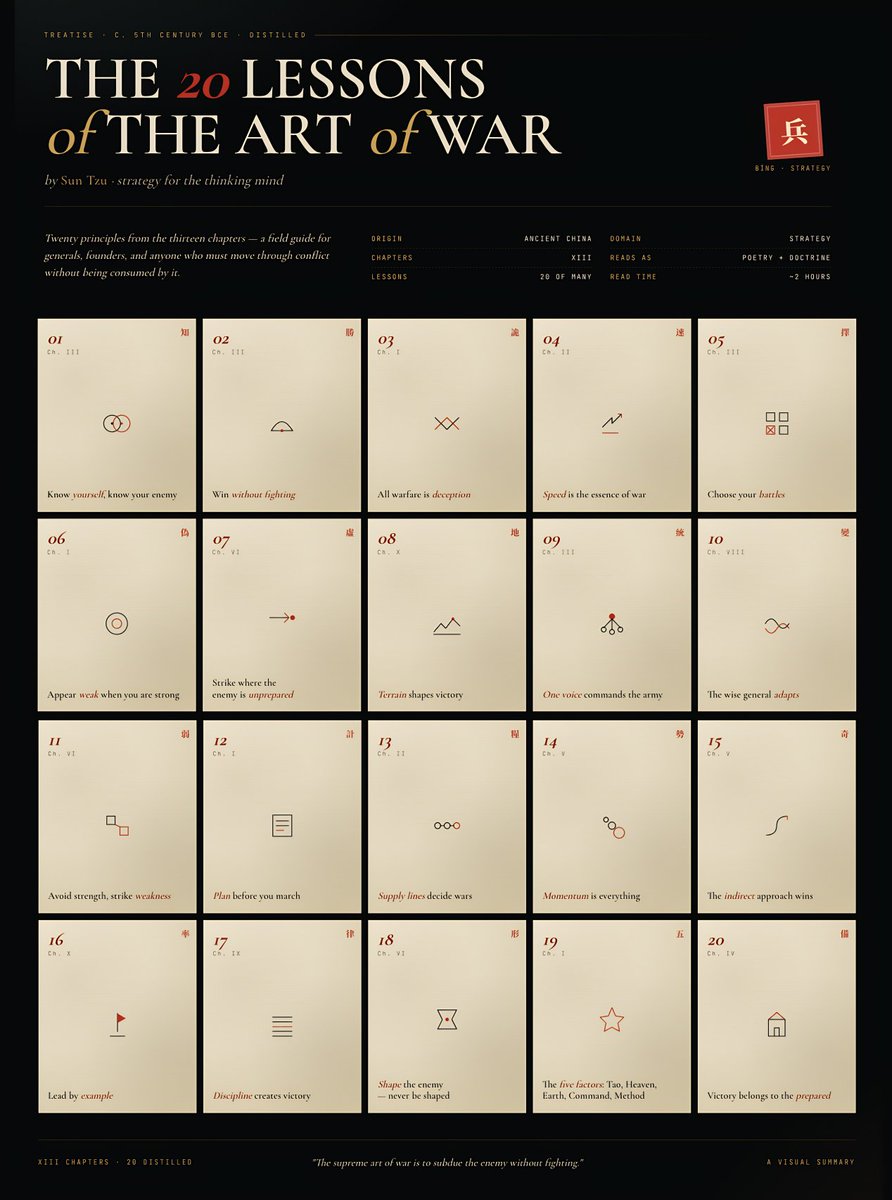
The most famous strategy book in history is not about fighting.
Most people who quote Sun Tzu have never understood that.
"The Art of War" was written by a general who believed that any battle you actually have to fight is a battle you have already half-lost. The entire point of the book is how to make fighting unnecessary.
Here is the framework he built, and why it applies to everything except war.
Sun Tzu lived in China around 500 BC, during a period historians call the Warring States era. Dozens of kingdoms were constantly collapsing into and consuming each other. Generals who lost battles did not retire. They died. Their families died. Their entire lineage was erased.
In that environment, Sun Tzu sat down and wrote something that nobody expected.
Not a manual on weapons. Not a guide to troop formations. A book about information, patience, and positioning. A book whose opening argument was that the supreme art of war is to subdue the enemy without fighting at all.
He called it wu wei. The way of winning through non-action.
Here is what that actually means in practice.
The first idea in the book is the one that most people skip because it sounds like philosophy instead of strategy. Sun Tzu says all warfare is based on deception. He does not mean lying. He means that the side that controls what the other side believes about reality controls the outcome before a single move is made.
If your competitor thinks you are weak, they underinvest in defending against you. If they think you are retreating, they move resources away from the thing you are actually targeting. The battle is won in perception long before it is won in execution.
Amazon did this for two decades. They convinced the entire retail industry they were a bookstore while quietly building the infrastructure layer that would run a third of the internet.
The second idea is the one that changed how I think about every decision with a deadline attached to it.
Sun Tzu writes that the general who wins makes many calculations in his temple before the battle is fought. The general who loses makes but few calculations beforehand.
He is not talking about overthinking. He is talking about preparation so complete that when the moment arrives, you are not deciding. You are executing a decision you already made.
Most people do the opposite. They move fast, figure it out as they go, and call it agility. Sun Tzu would call it gambling. The appearance of boldness covering the reality of unpreparedness.
The third idea is the one that I have thought about most since I read it.
He says do not repeat tactics that have won you victory before. Let your methods be regulated by the infinite variety of circumstances.
Every person who has ever had one successful year followed by a mediocre decade has violated this principle. What won the last war is almost never what wins the next one. The circumstances changed. The enemy adapted. The tactics became expected. And the general who kept running the same play lost to someone who had spent that entire time studying how to beat it.
The fourth idea is buried in Chapter 3 and most readers walk straight past it.
Sun Tzu says: if you know the enemy and know yourself, you need not fear the result of a hundred battles. If you know yourself but not the enemy, for every victory gained you will also suffer a defeat. If you know neither the enemy nor yourself, you will succumb in every battle.
This is not motivational. It is a diagnostic framework. And the middle category is where almost every ambitious person lives.
They know themselves reasonably well. Their strengths, their work ethic, their vision. What they skip is the deep study of the thing they are competing against. They assume their quality will be enough. Sun Tzu says quality is not a strategy. Knowing your enemy so well that you can predict their next move before they make it is a strategy.
The fifth idea is the one that has no equivalent in any modern business book I have read.
Sun Tzu writes that victorious warriors win first and then go to war, while defeated warriors go to war first and then seek to win.
Read that again.
Most people enter competition hoping to win. Sun Tzu's entire framework is built around the idea that hope is not a strategy. You should only enter a battle whose outcome you have already determined through preparation, positioning, and information. If you cannot see the conditions that will make you win before you start, you are not ready to start.
This is why The Art of War gets read by generals and hedge fund managers and startup founders and championship sports coaches. Not because war and business are the same thing. Because the underlying logic of competition does not change across domains.
The terrain changes. The weapons change. The opponents change.
The principles do not.
Sun Tzu wrote 6,000 words and never wasted a single one of them. Every sentence in that book is load-bearing. Every line assumes you are serious enough to apply it.
The people who quote it at dinner parties never changed their behavior.
The people who actually used it never had to fight as hard as everyone else.
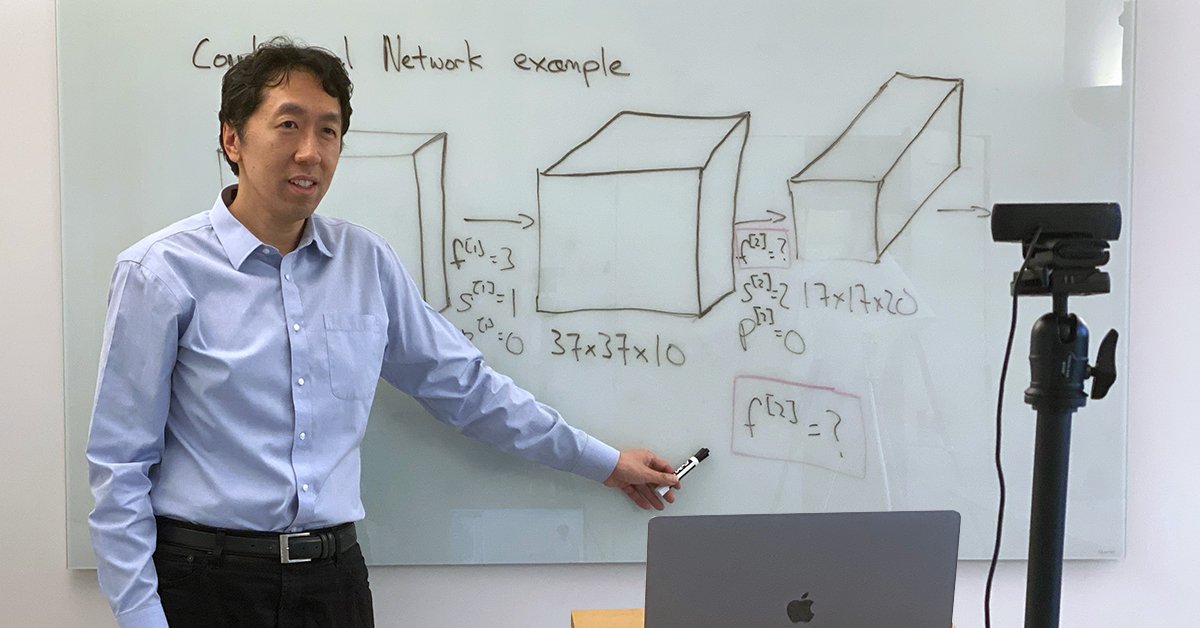
A Stanford CS professor told his class something at the start of the semester that made half the students close their laptops.
He said the skill that will separate the people who thrive in the next decade from the people who stall has almost nothing to do with coding.
His name is Andrew Ng, and he has trained more machine learning engineers than almost anyone alive.
Here is what he said, and why it changes how you should be learning right now.
He said the bottleneck is no longer writing code. It is knowing which problems are worth solving in the first place. For thirty years, being a good engineer meant being able to build what someone else defined. In the world that is arriving, every engineer has infinite leverage to build almost anything, which means the person who picks the right thing to build now wins by orders of magnitude over the person who builds the wrong thing flawlessly.
His framework for problem selection is deceptively simple. He calls it the three-question filter.
The first question is whether the problem you are working on actually matters to someone who would pay for it or use it daily. Most students fail here. They work on projects that are interesting to them and nobody else, and then wonder why the portfolio produces no offers.
The second question is whether the problem is still hard now that AI exists. If a single prompt to a hosted model solves it, the problem is no longer valuable to solve yourself. The interesting problems live in the gap between what AI can do alone and what it can do when combined with domain knowledge, careful system design, and data nobody else has access to.
The third question is the one most people skip. Can you actually ship a working version in a week. Not a polished version. A crappy, embarrassing, actually-functional version. Ng said the number one predictor of which of his students ended up building something important was not talent. It was the willingness to ship something bad fast and then improve it in public.
He said the students who kept tweaking in private for six months before showing anyone almost always produced worse final work than the students who shipped a broken version on week one and iterated based on real feedback.
The people who are actually winning right now are not the ones with the best ideas.
They are the ones who learned to pick problems that matter and ship solutions that barely work, before anyone else has even finished thinking about it.
CEO of Blackstone Stephen Schwarzman offers a surprising confession: The man who built a $1 trillion firm never made it past basic math.
"Don't think when you go into finance, it's just about numbers. I didn't even make it, you know, to calculus."
When asked how someone with such limited math skills became so successful, Schwarzman's answer cuts straight to the point:
"Because finance is not about math. It's really figuring out what makes sense."
Most people assume finance is a numbers game, where the best investors simply out-math the room.
Schwarzman disagrees entirely.
He continues:
"If a company's going to grow, why? It's not the numbers that come from it. It's the why. Why is that happening? Is that going to continue to happen? Is it going to get better or is it going to get worse?"
For Schwarzman, the real edge in finance is judgment — the ability to look beyond the numbers and understand the story behind them:
"This isn't a financial skill per se. It's judgment. It involves understanding in a general sense. It's figuring out what seems reasonable."
Schwarzman built one of the most powerful investment firms in history not by out-calculating everyone, but by out-thinking them.
This 1 hour interview with the mathematician who outperformed Buffett, Soros, and Dalio, generated $100B+, avg. 66% returns will teach you more about investing than a $200K MBA.
Bookmark this & give it 1 hour, no matter what. It’ll be the most productive thing you do this week.
In 1948, a 32-year-old at Bell Labs published a paper nobody fully understood.
Engineers found it too mathematical. Mathematicians found it too engineering-focused. One prominent mathematician reviewed it negatively.
That paper - "A Mathematical Theory of Communication", became the founding document of the digital age.
The man was Claude Shannon. Father of Information Theory.
At 21, he wrote the most important master's thesis of the 20th century.
Working at MIT on an early mechanical computer, Shannon noticed its relay switches had exactly two states - open or closed. He had just taken a philosophy course introducing Boolean algebra, which also operated on two values: true and false.
Nobody had ever connected these two things.
His 1937 thesis proved that Boolean algebra and electrical circuits are mathematically identical, and that any logical operation could be built from simple switches.
Howard Gardner called it "possibly the most important, and also the most famous, master's thesis of the century."
Every digital computer ever built traces back to this insight.
At 29, he proved that perfect encryption exists.
During WWII, Shannon worked on classified cryptography at Bell Labs. His work contributed to SIGSALY, the secure voice system used for confidential communications between Roosevelt and Churchill.
In a classified 1945 memorandum, he mathematically proved the one-time pad provides perfect secrecy, unbreakable not just computationally, but provably, permanently, against an adversary with infinite power.
When declassified in 1949, it transformed cryptography from an art into a science. It laid the foundations for DES, AES, and every modern encryption standard.
At 32, he defined what information is.
His 1948 paper introduced one equation:
H = −Σ p(x) log p(x)
Shannon entropy. The average uncertainty in a probability distribution. The minimum bits required to encode a message.
Three things followed:
> He defined the bit - the fundamental unit of all information. His colleague John Tukey coined the name.
> He proved the channel capacity theorem, every communication channel has a maximum rate of reliable transmission. You can approach it. You can never exceed it.
> He unified telegraph, telephone, and radio into a single mathematical framework for the first time.
Robert Lucky of Bell Labs called it the greatest work "in the annals of technological thought."
Where his equation lives in AI today:
Cross-entropy loss - the function training every classifier and language model, is derived directly from H. Decision tree splits use information gain, which is H applied to data. Perplexity, the standard LLM evaluation metric, is an exponentiation of cross-entropy.
Every time a neural network trains, Shannon's formula runs inside it.
He also built the first AI learning device.
In 1950, Shannon built Theseus, a mechanical mouse that navigated a maze through trial and error, learned the correct path, and repeated it perfectly. Mazin Gilbert of Bell Labs said: "Theseus inspired the whole field of AI."
That same year he published the first paper on programming a computer to play chess. He co-organized the 1956 Dartmouth Workshop, the founding event of AI as a field.
The man:
He rode a unicycle through Bell Labs hallways while juggling. He built a flame-throwing trumpet, a rocket-powered Frisbee, and Styrofoam shoes to walk on the lake behind his house.
He called his home Entropy House.
When asked what motivated him: "I was motivated by curiosity. Never by the desire for financial gain. I just wondered how things were put together."
In 1985, he appeared unexpectedly at a conference in Brighton. The crowd mobbed him for autographs. Persuaded to speak at the banquet, he talked briefly, then pulled three balls from his pockets and juggled instead.
One engineer said: "It was as if Newton had showed up at a physics conference."
He died in 2001 after a decade with Alzheimer's, the cruel irony of information slowly leaving the mind of the man who defined what information was.
Claude, the AI model, is named after Claude Shannon, the mathematician who laid the foundation for the digital world we rely on today.
MIT professor just revealed the brutal truth about communication:
You’re not ignored because you’re wrong.
You’re ignored because you’re unclear.
In minutes, he shows how to sound sharp, confident, and impossible to ignore.
Miss this—and stay invisible.
In 2007, Stanford professor Joel Peterson gave a 1 hour masterclass on how to negotiate & get what you want.
His ideas:
- Worst position is needing the deal
- Trust beats manipulation in long term
- Great negotiators think in relationships
12 lessons to negotiate better:
In 1683, a Swiss mathematician named Jacob Bernoulli asked a simple question about money.
If you deposit $1 at 100% annual interest, what happens if you compound it more and more frequently?
Once a year → $2.00
Twice a year → $2.25
Monthly → $2.613...
Daily → $2.714...
The more frequently you compound, the higher it goes, but it never grows without limit. It converges.
Bernoulli proved that limit exists:
e = lim (1 + 1/n)ⁿ as n→∞
He couldn't calculate it exactly, but showed it had to fall between 2 and 3.
That limit is e ≈ 2.71828...
He didn't name it. Fifty years later, Leonhard Euler calculated it to 18 decimal places, and the letter e stuck - appearing first in Euler's letter to Goldbach in 1731.
Why e is special:
e is the only number where the exponential function eˣ is its own derivative.
That one property sounds abstract. In practice it means: when you differentiate eˣ, you get eˣ back. The rate of change equals the value itself.
This makes the calculus clean. No extra constants, no messy chain rule artifacts.
And clean calculus is everything when you're training a neural network through millions of gradient updates.
Where e lives in every AI system you build:
1/ Sigmoid function
the S-shaped function that maps any real number to a value between 0 and 1.
σ(x) = 1 / (1 + e⁻ˣ)
Used in logistic regression and binary classification. e is what makes its derivative expressible in terms of itself - σ'(x) = σ(x) · (1 - σ(x)), which keeps backpropagation computationally clean.
2/ Softmax
the function that converts raw model output scores (logits) into a probability distribution across multiple classes.
softmax(xᵢ) = eˣⁱ / Σeˣʲ
Every token probability your LLM produces passes through this. e is used because it keeps all values positive and makes the gradients during training well-behaved.
3/ Cross-entropy loss
the loss function used to train most classifiers and language models. It uses the natural logarithm (ln), which is the inverse of e.
The full picture:
A banker's question in 1683 → a universal mathematical constant → the backbone of every neural network trained today.
Bernoulli was thinking about interest rates. He had no idea he was laying the foundation for gradient descent.
That's what makes pure mathematics dangerous. It doesn't look useful until suddenly it's everywhere.
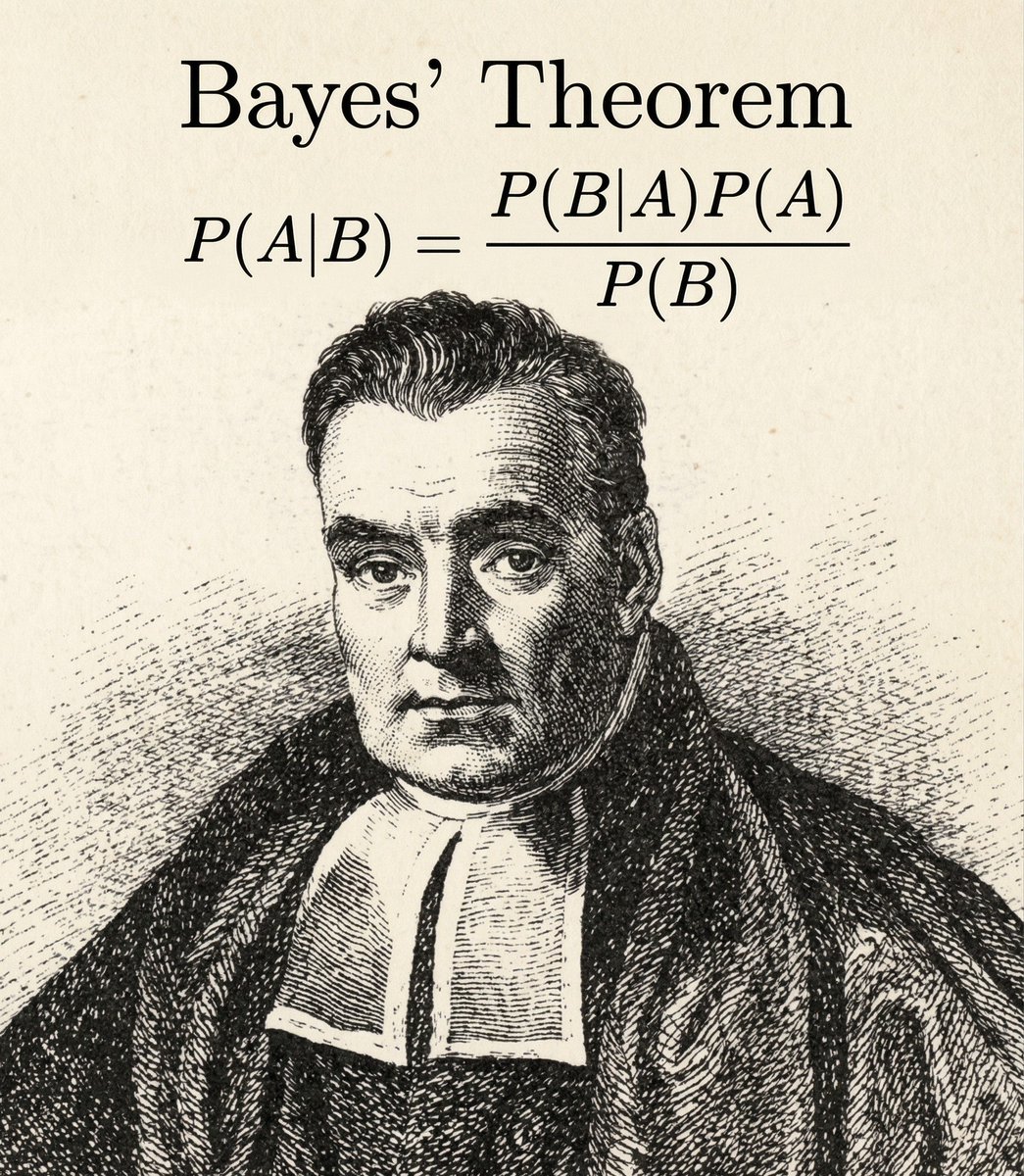
Most engineers have seen this formula.
P(A|B) = P(B|A) × P(A) / P(B)
Almost none can explain what it actually does.
Here's Bayes' Theorem in plain English, and where it's hiding inside systems you use every day.
The core idea in one sentence:
Bayes' Theorem updates your belief about something after seeing new evidence.
That's it. Four terms:
Prior → what you believed before the evidence
Likelihood → how probable the evidence is, given your hypothesis
Evidence → how common the evidence is overall
Posterior → your updated belief after seeing the evidence
A concrete example:
Say 40% of all emails are spam (your prior).
You see a new email containing the word "lottery."
10% of spam emails contain "lottery." Only 1% of legitimate emails do.
Plug into Bayes:
P(spam | "lottery") = (0.10 × 0.40) / P("lottery") ≈ 87%
The word "lottery" updated your belief from 40% → 87%.
That's Bayes in action. Prior belief + new evidence = updated belief.
Where it lives in AI:
1/ Spam filters
The Naive Bayes classifier, the algorithm behind most spam filters - applies this exact calculation word by word across an entire email. Each word shifts the probability up or down. It's called "naive" because it assumes each word is independent of the others, which isn't realistic, but works remarkably well in practice.
2/ Medical diagnosis AI
A patient has symptom X. What's the probability of disease Y? Bayes updates the base rate (how common the disease is) with the likelihood of seeing that symptom in patients who have it. Same formula, different domain.
3/ Your LLM's uncertainty
Modern language models don't just predict the next token, they assign a probability to every possible token. The sampling process (temperature, top-p) is directly working with those probability distributions. Bayesian reasoning is embedded in every response your model generates.
The insight most engineers miss:
Bayes doesn't give you certainty. It gives you a rational way to update uncertainty.
That's exactly why it's foundational to AI - real-world systems are never certain. They're always working with incomplete, noisy, probabilistic information.
Every model that learns from data is, at its core, doing some version of this:
Start with a belief. See evidence. Update the belief.
That's Bayes. That's machine learning.
Biographies every man should read:
- Hitler by Ullrich
- Life of Sulla by Plutarch
- Life of Caesar by Plutarch
- Napoleon by Andrew Roberts
- The Confessions of St. Augustine
- Titan: The Life of John Rockefeller
- Benjamin Franklin by Walter Isaacson
What else would you add?