Today, we share a breakthrough on the planar unit distance problem, a famous open question first posed by Paul Erdős in 1946.
For nearly 80 years, mathematicians believed the best possible solutions looked roughly like square grids.
An OpenAI model has now disproved that belief, discovering an entirely new family of constructions that performs better.
This marks the first time AI has autonomously solved a prominent open problem central to a field of mathematics.
Fascinating paper just published in Science.
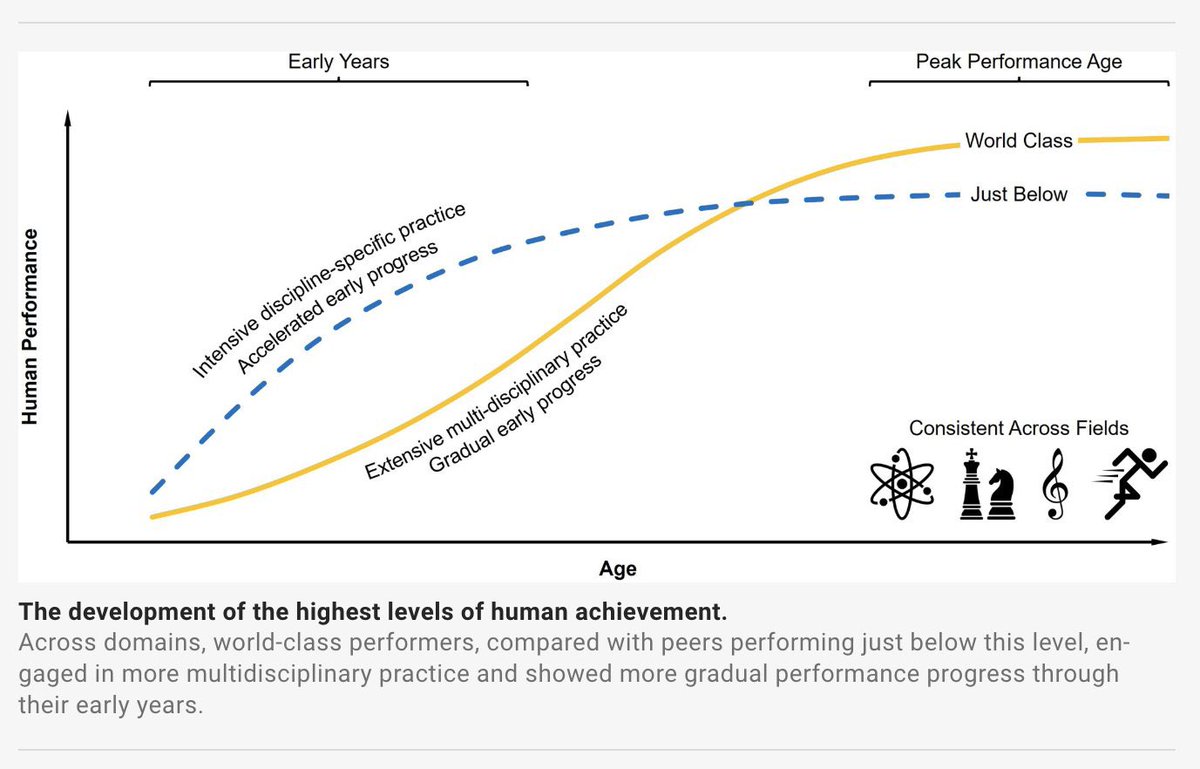
The authors analyze the career trajectories of top performers across multiple domains, including Nobel laureates, elite chess players, Olympic gold medalists, and more.
Their central finding challenges a common belief.
Intensive, single-discipline training at a young age does confer an early advantage, but this advantage fades over time.
By contrast, individuals exposed to multidisciplinary practice early in life tend to start more slowly. Yet, over the long run, they are more likely to reach world-class performance, eventually overtaking early specialists, who often plateau just below the very top.
An important reminder that breadth early on can be a powerful investment in long-term excellence.
Link to the paper in the first reply.
Individual researchers do not have attention mechanisms over the whole scientific literature. As a result, you get reinvention, even within the same subfield. It is exacerbated when the relevant was done much earlier. It is often exacerbated by the field not putting much emphasis on scholarship, and by conference reviewing, but it would happen anyway.
Really excited to share our new preprint "Geometric influences on the regional organization of the mammalian brain" with @AFornito and a superstar 17-person team! (1/n)
https://t.co/1pWlq5JAGk
The metabolic costs of cognition
Review by Sharna D. Jamadar (@SharnaJamadar), Anna Behler (@Anna_NeuroSci), Hamish Deery (@DeeryHamish), & Michael Breakspear (@DrBreaky)
Free access before March 4: https://t.co/OMVwrs5TpW
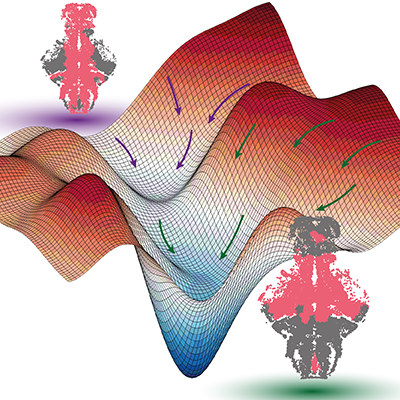
Everyone using RNNs to model the brain has their favorite activation function: sigmoid, tanh, ReLU. But does it matter which one you choose? Turns out it does! Activation functions affect representations, dynamics, and circuit solutions. https://t.co/ZOv5Seqi5z
@TolmachevPavel2
Big news! The fly connectome is featured on the cover of a special edition of Nature.
This is all possible thanks to the collaboration of 292 members of The FlyWire Consortium!
https://t.co/Mrz7Yrx1eU
Check out the thread for an overview of the 9 #flywire papers published today
A simple statistical model capturing only pairwise interactions between brain regions is sufficient to reproduce key features of whole-brain dynamics.
Read https://t.co/TCMIuw8zuS
#Complexsystems#Neuroscience
A new method of detecting criticality from time-series data outperforms conventional metrics in the presence of variable noise levels for both simulated systems and real neural recordings.
Read https://t.co/E8DVA3w19i
#PRXjustpublished#PRXopenaccess#PRXComplexSystems
The brain is metabolically hungry but most accounts of cognition do not consider the energy cost of neural activity
Here we review the metabolic budget of neural homeostasis + cognition; associated evolutionary constraints; plus disturbances in disease
https://t.co/cCnmzLUSxz
At #OHBM2024 I'll be presenting my work where I used generative network models to explore the constraints on connectome formation. Come see my poster (#1530, Wednesday/Thursday) to learn what I wish I had known 4 years ago when doing my PhD :)
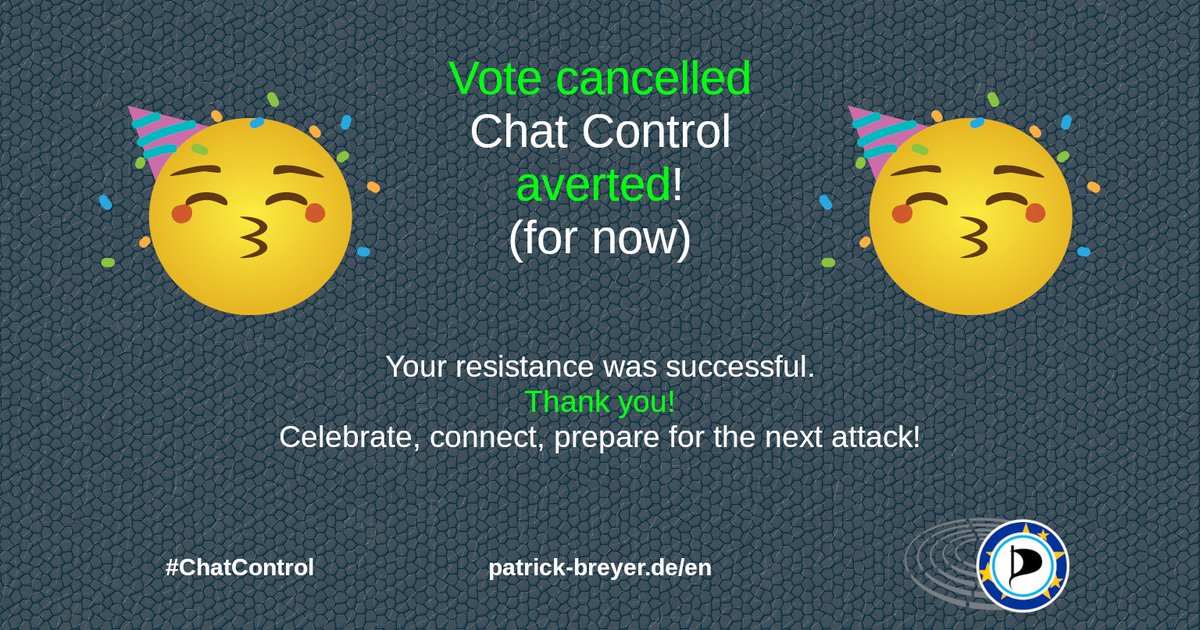
🇬🇧 Vote on #ChatControl postponed – a triumph in our fight to defend the digital privacy of correspondence and secure encryption. 💪 Thank you!
But the next attempt will come. The critical governments need to get their act together now:
https://t.co/rehi36rsxL
Nach dem Messenger Signal hat sich auch Threema deutlich gegen die #Chatkontrolle ausgesprochen. Kommt die Verordnung so, könnte er Europa verlassen https://t.co/4RXEMu1ehE
📣Official statement: the new EU chat controls proposal for mass scanning is the same old surveillance with new branding.
Whether you call it a backdoor, a front door, or “upload moderation��� it undermines encryption & creates significant vulnerabilities
https://t.co/g0xNNKqquA
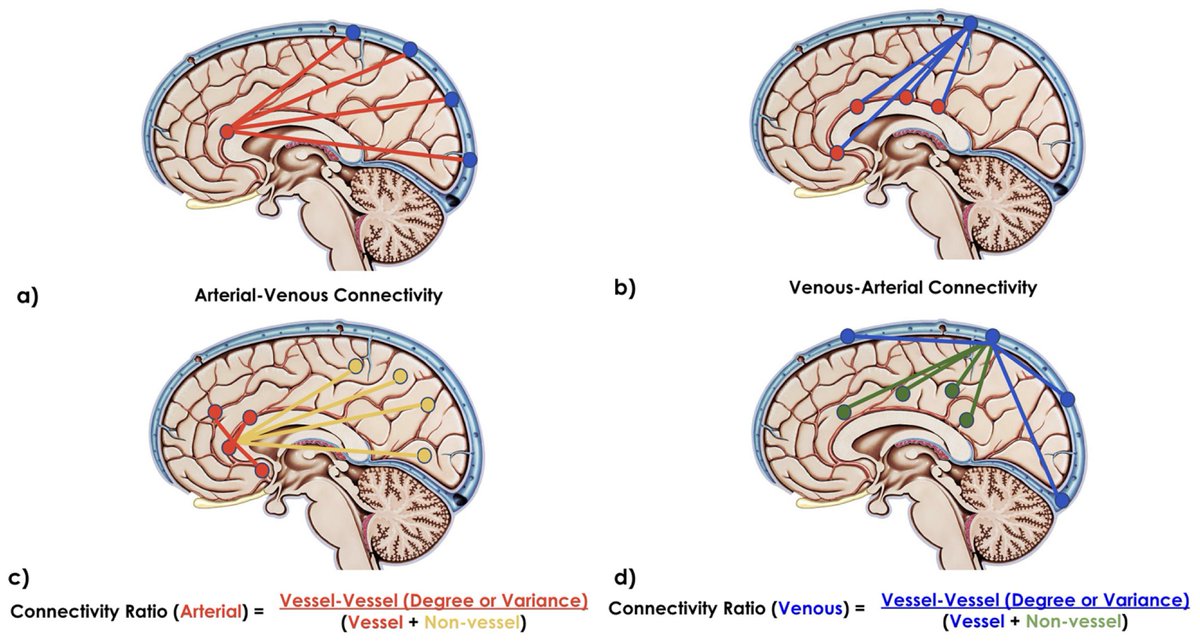
New paper in Imaging Neuroscience by Xiaole Z. Zhong, Yunjie Tong, and J. Jean Chen:
Assessment of the macrovascular contribution to resting-state fMRI functional connectivity at 3 Tesla
https://t.co/O1xtSHCw2M
By insisting that every brain-behavior association study include hundreds or even thousands of participants, we risk stifling innovation. Smaller studies are essential to test new scanning paradigms.
By Emily S. Finn
https://t.co/eg9AtTRYyb
Whole, healthy human brain data is now on the ABC Atlas!
Dataset incl. 3 million+ cells sampled from dissections from adult donors. Samples underwent snRNA sequencing and were clustered and categorized by neurotransmitter, region, and more.
ABC Atlas: https://t.co/0NJsmWCAtU
Undertaking inference on spatial brain maps?
Correspondence between maps?
Textures and other nuggets of gold buried within maps?
Spatiotemporal processes in dynamic maps (e.g. fMRI)?
Here is your method for non-parametric inference :-)
https://t.co/4dg4dCl0Bf
We're hiring! New post-doc role at @Sydney_Uni with @jlizier and @bendfulcher focussed on whole-brain neuroimaging and some cool computational methods. Full app details here: https://t.co/V4LOKH6dHv. To start in July 24. Feel free to reach out if you have Qs. Oh, and please RT!