Excited to share our new work published in @angew_chem!
We report the first isolable donor–acceptor-stabilized Si–E–Si trimetallylenes (E = Ge, Sn, Pb), exhibiting NIR absorption and enabling access to Ge(I) and Sn(I) radical anions.
https://t.co/NiDREDiBjl
Many thanks to Matthias (@DriessLab) and all co-authors. @AvHStiftung@TUBerlin
#InorganicChemistry #MainGroupChemistry #Silylene
Excited to share our last work 🥳🥳🥳. A photoexcited triplet Ge that lasts hours and, while being there, breaks a few molecules, including benzene. We hope you like it. Our feeling: there's plenty of space for discovery on low-valent MG photochemistry https://t.co/2rOkT22nn5
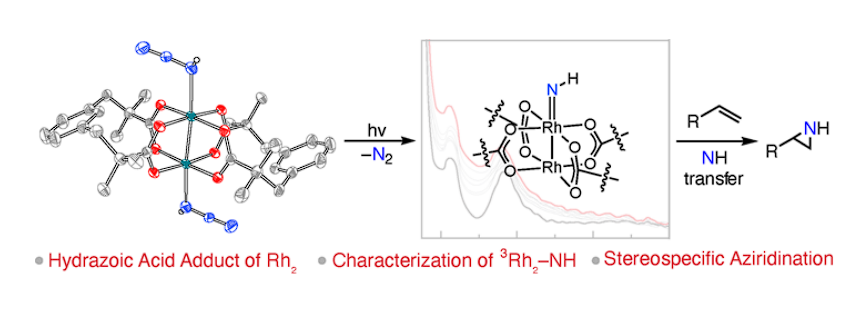
Our latest @ChemicalScience paper reports the first crystal structure of hydrazoic acid bound to a transition metal. Cryogenic photolysis reveals the elusive triplet dirhodium imidogen intermediate enabling stereospecific NH aziridination of olefins. https://t.co/cmpwOfWwP2
A 3-atom ring made entirely of bismuth can sustain aromatic ring currents—despite being a heavy-metal cluster—and its aromaticity is dominated by sigma, not the usual pi, electrons. @AdmissionsUoM @NatureChemistry https://t.co/PdANDZBqZ4 https://t.co/ujtL3grA7B
Very happy to see this finally out in print: A modular approach to unique cyclobutadienyl analogues! Congratulations to everyone involved, especially @StefanFrei1659
https://t.co/vWmF90vPsl
This exceptionally bulky ligand features trityl groups and a benzylated backbone that together create steric shielding that allows the isolation of rare low-coordinate metal complexes.
https://t.co/s9JLAN8MnK
2.5 years since we first discovered this compound and it’s finally out in @NatureChemistry! Have a read to learn about some surprisingly stable {N4} radical anions and there not so stable (and explosive) dianionic counterparts! https://t.co/0uptPJUVIP
Single-Carbon Bridged Pentacene Dimers Enable Efficient Singlet Fission and Quintet State Stabilization | Journal of the American Chemical Society https://t.co/RLM4Uvn7Pa
興味深かった,というか
📣Our new paper is out in @JACS (our very first one)!🥳
We show how a redox-active ligand unlocks C–X bond scission at an ambiphilic T-shaped Bi(III) compound. A big collaborative effort with my brilliant colleagues from Berlin.
👉https://t.co/IcAVmSAz7X