SciTech Talkies hit 1,000 YouTube subscribers! Thanks for exploring science and tech with us. If you haven’t joined yet — come see what the buzz is about: https://t.co/XhBu5TD3uk
🌱🧬 Scientists Combine Animal and Algal Cells! Could Animals One Day Use Photosynthesis? 🤯☀️
Imagine a future where animal cells could use some of the biological abilities of plants!
Sounds like science fiction?
Scientists in Japan have taken a fascinating first step! 🔬
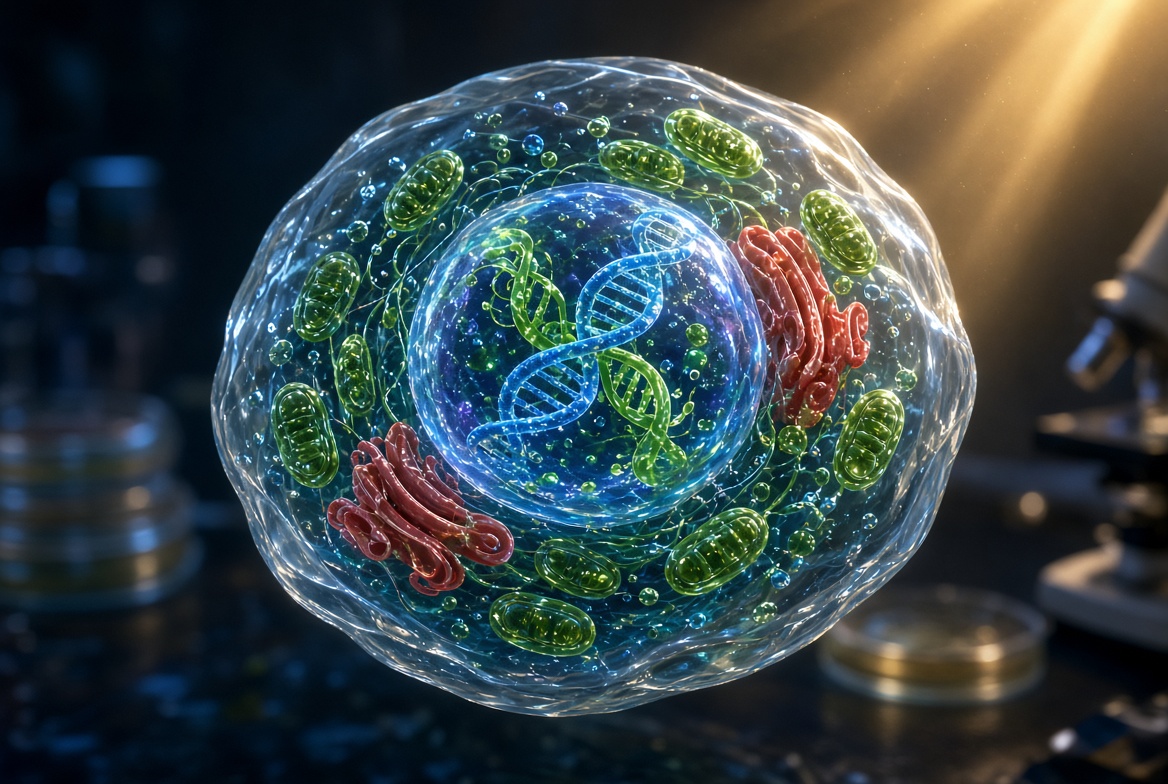
Researchers led by the University of Tokyo have created unusual hybrid cells containing genetic material from both mammals and algae.
They call them “planimal cells.” 🌱🐹
Their findings were published in Nature Communications on November 12, 2026.
🔬 What did scientists discover?
Normally, animals and algae are very different organisms.
Their cells have evolved separately for an enormous amount of time.
But the researchers tried something extraordinary!
They fused a tiny red alga with cultured mammalian cells.
And something remarkable happened! 🤯
One hamster-derived cell line retained almost the entire nuclear genome of the alga.
That means millions of letters of algal DNA remained inside the mammalian cells!
Even more surprisingly, the hybrid cells continued dividing for over 150 generations.
🧬 How was this possible?
Our DNA contains instructions for building and operating cells.
But simply adding foreign DNA does not mean those instructions will work.
The researchers discovered that most of the algal genes remained switched off.
In fact, around 96% of the transferred protein-coding genes showed no detectable expression.
The mammalian cells appeared to chemically regulate the foreign DNA, helping maintain it while keeping most of its genes inactive.
💡 Why is this important?
This experiment shows that mammalian cells can retain an unexpectedly large amount of genetic information from a very distant organism.
It could open new possibilities in biotechnology.
Scientists may eventually learn to introduce useful biological functions from algae into animal cells.
🌞 Could this mean photosynthetic animals?
Not yet!
The hybrid cells did not demonstrate photosynthesis.
They could not produce their own food from sunlight.
And the researchers did not create a new animal.
But the experiment raises an exciting question:
Could scientists eventually combine useful metabolic capabilities from very different forms of life?
🌍 The most fascinating part?
Nature has spent billions of years evolving different biological systems.
Now scientists are beginning to explore whether some of those systems can work together inside a single cell.
Sometimes, the future of biotechnology begins by questioning boundaries we thought were impossible to cross! 🌱🧬✨
📖 Official research report from the University of Tokyo:
https://t.co/98SEMnIK7M
#Biotechnology #Genetics #CellBiology #ScientificDiscovery #Photosynthesis #FutureScience #SciTechTalkies 🌱🔬🧬
🦟🤯 Why Do Mosquitoes Bite You but Ignore Your Friend? Scientists Find a Surprising Answer!
Have you ever noticed that mosquitoes seem to love some people but completely ignore others?
You might be sitting beside a friend. Both of you are outdoors. But somehow, you get all the mosquito attention! 😅
Why does this happen?
Scientists at Florida International University, USA, have discovered something fascinating.
Their research, published in iScience in August 2026, reveals that different mosquito species have different preferences for human body odors! 🔬
🧪 What did scientists discover?
Researchers recruited 119 volunteers and tested how attractive they were to three mosquito species.
These included mosquitoes capable of spreading diseases such as dengue, Zika, and West Nile fever.
And the results were surprising! 🤯
Not a single participant was highly attractive to all three species.
Each mosquito species preferred a different group of people.
But why?
🧬 The secret may be hiding on your skin!
Human skin contains millions of microorganisms.
These tiny organisms, together with our body's chemistry, influence the odors we produce.
And mosquitoes are extremely sensitive to these chemical signals.
The researchers found that different mosquito species responded to different combinations of skin chemicals and microorganisms.
For example:
🦟 The Asian tiger mosquito was particularly attracted to certain chemicals called ketones.
🦟 Another mosquito species responded strongly to differences in the microorganisms living on human skin.
So there is no single universal mosquito magnet!
💡 Why is this important?
Mosquitoes are responsible for transmitting some of the world's most dangerous infectious diseases.
Understanding what attracts different mosquito species could help scientists develop more effective repellents.
Instead of relying only on general mosquito protection, future products might target the chemical signals preferred by particular species. ��
However, this research has not yet produced a new mosquito repellent.
🌍 And here is the fascinating part!
The reason mosquitoes prefer your friend over you may have less to do with your blood and more to do with the invisible chemical world living on your skin!
Sometimes, the smallest organisms influence our everyday lives in the most surprising ways. 🦟��✨
📖 Official research report from Florida International University:
https://t.co/ZbMfUW8jCg
📚 Original scientific publication:
https://t.co/4CxZq105AC
#Mosquitoes #Biology #Microbiome #ScientificDiscovery #PublicHealth #Nature #SciTechTalkies 🦟🔬🌍
🧠😨 Why Does Your Brain Sometimes Feel Danger Even When You Are Safe? Scientists Discover Something Surprising! 🔬
Have you ever felt afraid even when there was no real danger?
Perhaps a sudden noise made your heart race. Or a familiar place reminded you of something frightening.
Why does our brain react this way? 🤔
Scientists from McGill University and the University of Toronto, Canada, have discovered something fascinating about how the brain processes fear.
Their findings were published in Nature Neuroscience in 2026. 📖
🔬 What did scientists discover?
Researchers studied how mice remember dangerous and safe environments.
They used a special experimental setup combining virtual environments with real-time brain imaging.
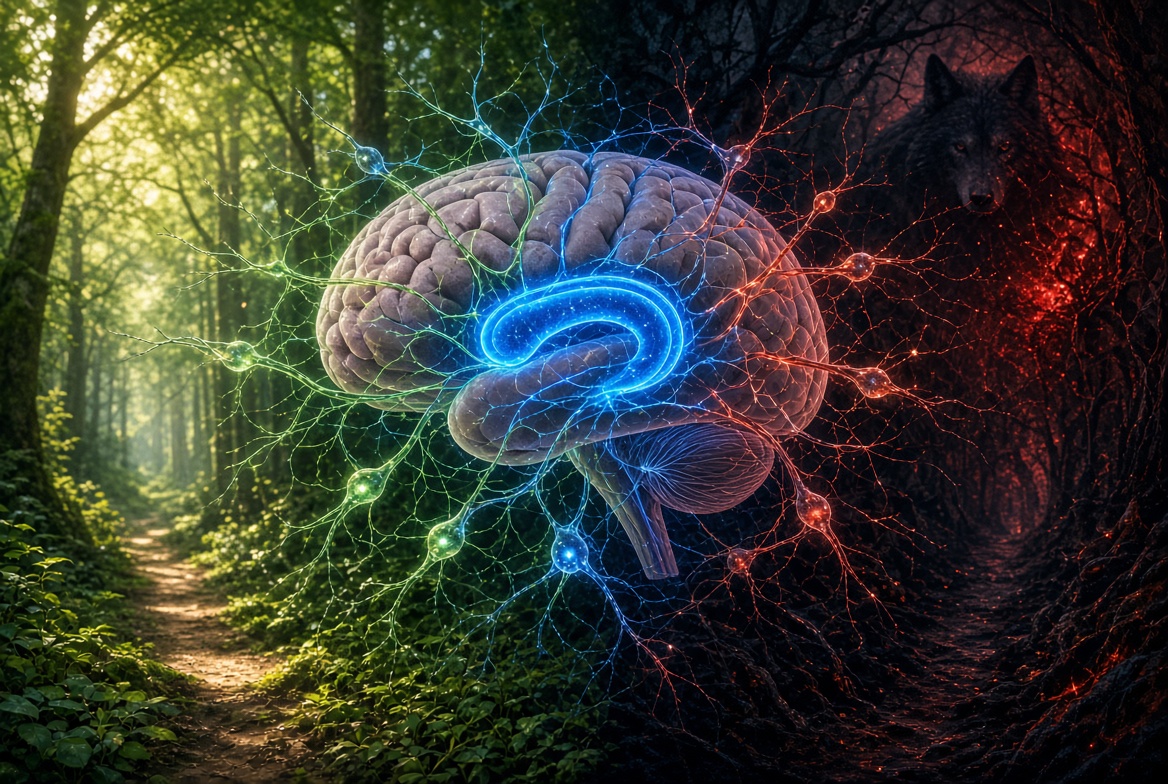
This allowed them to observe hundreds of neurons in the hippocampus, a brain region involved in memory.
And the results were surprising! 🤯
Scientists expected the brain to create clearly separated memories of danger and safety.
But they observed something different.
The brain's representations of safe and dangerous environments began to overlap!
In simple words, the brain sometimes treated safe and dangerous situations as more similar than expected.
🧠 But why would the brain do this?
The researchers suggest an interesting explanation.
Imagine walking through a forest. 🌲
You suddenly hear a noise behind you.
Is it a harmless animal? Or something dangerous?
Your brain has very little time to decide.
Reacting quickly might be more important than being perfectly accurate.
The new findings suggest that overlapping memories could help the brain retrieve information about danger faster.
It is a survival strategy!
⚠️ But there is a trade-off!
A brain that responds quickly to possible danger may sometimes produce false alarms.
This could help scientists investigate why people with anxiety or post-traumatic stress disorder (PTSD) experience intense fear in situations that are actually safe.
However, the experiments were performed in mice. Scientists still need to determine how directly these findings apply to humans.
💡 Why is this important?
Understanding how the brain connects fear and memory could eventually help researchers develop better approaches to anxiety and trauma-related disorders.
The discovery also reveals something remarkable about evolution.
Our brain is not always designed to make the most accurate decision.
Sometimes, it may prioritize making a fast decision that helps us survive! 🧠⚡
🌍 The same brain that protects us from danger may sometimes make us afraid when there is nothing to fear.
📖 Original scientific publication:
https://t.co/dwdBblB2kh
#Neuroscience #Psychology #BrainScience #Memory #ScientificDiscovery #MentalHealth #SciTechTalkies 🧠🔬✨
Chaos is deterministic behaviour that cannot be predicted in practice. The Lorenz system, ẋ = σ(y − x), ẏ = x(ρ − z) − y, ż = xy − βz, has no randomness in it, yet with σ = 10, ρ = 28 and β = 8/3 its trajectories never settle and never repeat.
The reason is sensitivity to initial conditions. Two starting points a tiny distance d₀ apart separate roughly as d(t) ≈ d₀e^(λt), where λ > 0 is the Lyapunov exponent. On a log scale the gap grows as a straight line until it reaches the size of the attractor. Any measurement error, however small, eventually swamps the prediction.
Edward Lorenz found this in 1963 in a simplified model of convection, which is why weather forecasts lose skill after about two weeks. The Rössler attractor, Chua's circuit and the logistic map at r = 3.9 show the same behaviour.
🌱☀️ Can Plants Sense Heat Through Sunlight? Scientists Discover a Surprising Connection! 🌍🔬
Plants cannot move away when the weather gets too hot.
But they have remarkable ways to respond to their environment! 🌿
Scientists at the University of Freiburg, Germany, have discovered that the way plant roots respond to rising temperatures also depends on how much light the plant receives. 🔬
🌱 What did scientists discover?
We know that roots grow underground.
They search for water and nutrients. They also respond to changes in soil temperature.
But here is the surprising part!
The amount of light reaching the plant above ground can influence how its roots respond to warmth below ground. ☀️
Researchers investigated a plant growth hormone called auxin.
Auxin helps control how plant cells grow and how roots develop.
The findings reveal an important connection between light, temperature, and the hormonal signals that guide root growth.
💡 Why is this important?
Climate change is exposing plants to increasingly unpredictable temperatures. 🌡️
For crops, healthy roots are essential.
They absorb water and nutrients. They also help plants survive environmental stress.
Understanding how light and temperature work together could help scientists develop better strategies for growing plants in a warmer world. 🌾
🌍 And here is something fascinating!
A plant's response to heat is not controlled by temperature alone.
Different environmental signals interact with one another.
That means studying just one factor may not be enough to understand how plants will respond to climate change.
This discovery does not mean scientists have created heat-resistant crops.
But it helps explain the biological mechanisms that could guide future agricultural research.
🌱 Nature is full of hidden connections. Sometimes, what happens above the ground helps determine what happens beneath it! ✨
📖 Official research source:
University of Freiburg, Centre for Integrative Biological Signalling Studies
https://t.co/dqHiSaYMfN
#PlantScience #ClimateChange #Biology #Agriculture #ScientificDiscovery #Nature #SciTechTalkies 🌱🔬🌍
🦖🩸 Scientists Discover Traces of Dinosaur Blood After 115 Million Years! 🤯🔬
Imagine finding evidence of blood inside the bones of a dinosaur that lived 115 million years ago!
Sounds unbelievable? Scientists have just reported exactly that! 🦕
An international research team led by Curtin University, Australia, made this remarkable discovery.
Their findings were published in the prestigious journal Proceedings of the National Academy of Sciences (PNAS) . 📖
🔬 What did scientists discover?
The researchers examined fossilized bones of a meat-eating dinosaur called Aratasaurus museunacionali, discovered in Brazil.
Inside tiny channels in the bones, they found mineralized structures resembling red blood cells. 🩸
But here comes the most exciting part!
Using advanced chemical analysis, scientists detected traces of heme, an iron-containing component of hemoglobin.
Hemoglobin is the protein that helps red blood cells transport oxygen around the body.
These findings provide strong evidence that chemical traces of dinosaur blood can survive for an astonishingly long time! 🤯
🧪 How is this possible?
Normally, biological materials break down after death.
But under special conditions, minerals can help preserve microscopic structures and chemical signatures.
In this case, a mineral called hausmannite may have helped protect the ancient remains.
It acted like a natural time capsule! ⏳
💡 Why is this important?
Until now, scientists had very limited evidence of how blood-related molecules could survive for millions of years.
This discovery could help researchers understand more about the biology of extinct animals.
It may also improve our understanding of how biological materials survive under extreme conditions.
And there is another exciting possibility! 🌌
Scientists searching for ancient life on Mars could learn from how biological chemical signatures survive in Earth's oldest fossils.
🌍 Does this mean we can bring dinosaurs back to life?
No! 🦖
The researchers did not discover living blood cells or dinosaur DNA.
They found fossilized cellular structures and chemical traces of ancient blood.
But that is still an extraordinary discovery!
Even after 115 million years, dinosaur fossils may preserve more information than we ever imagined. 🔬✨
📖 Official research report from Curtin University:
https://t.co/xMTUbfKorG
#Dinosaurs #Paleontology #ScientificDiscovery #Chemistry #Evolution #Fossils #SciTechTalkies 🦖🩸🔬
partial derivatives are one of the most fundamental ideas in mathematics because almost nothing in the real world depends on just one variable. the temperature of a room depends on position and time. the motion of a robot depends on joint angles, velocities and external forces. the output of a neural network depends on millions of parameters. when multiple variables influence a system, the question becomes: how does changing one variable affect the output while everything else stays fixed? that’s exactly what a partial derivative measures. it isolates one relationship inside a much larger network of dependencies.
the interesting part is what happens when you start combining these derivatives. collect the partial derivatives of a scalar function and you get a gradient, which points toward the direction of steepest increase. organize the derivatives of multiple outputs with respect to multiple inputs and you get a jacobian, which describes how small changes propagate through a system. differentiate again and you begin describing curvature through second derivatives and the hessian. the chain rule connects these relationships across multiple functions, while the total differential tells you how their combined changes affect the output. these aren’t separate mathematical tricks. they’re different ways of organizing information about how a system responds to change.
this is why partial derivatives appear everywhere in modern engineering. backpropagation uses them to calculate how neural network parameters influence a loss function. robotics uses them to understand how joint movements affect the position of an end effector. fluid dynamics uses them to describe how velocity, pressure and temperature vary through space and time. control theory uses them to linearize nonlinear systems around operating points. the deeper idea is that engineering is fundamentally about understanding dependencies. once you can mathematically describe how one variable influences another, you can begin predicting, optimizing and controlling the entire system.
🔩💧 Scientists Finally See Hydrogen Hiding Inside Metals! 🔬🤯
Did you know that hydrogen, the smallest atom in the universe, can enter solid metals and make them weaker?
And now scientists have found a new way to observe exactly where these tiny atoms hide! ⚛️✨
Researchers at the University of Sydney, Australia, have achieved an important breakthrough in materials science.
Their findings were published in the prestigious journal Nature in November 2026. 📖
🔬 What did scientists discover?
Metals may look completely solid. But at the atomic level, they contain tiny spaces between their atoms.
Hydrogen atoms are so small that they can enter these spaces.
And this can create a serious problem!
Under certain conditions, hydrogen can make metals more vulnerable to cracking and failure. Scientists call this hydrogen embrittlement. ⚠️
For decades, researchers have struggled to observe hydrogen directly inside the atomic structure of metals.
Now, the Sydney researchers have made an important advance!
They used a powerful technique called cryogenic atom probe tomography.
By using deuterium, a heavier form of hydrogen, they could identify where hydrogen was located inside different metal alloys. 🔬
The results confirmed that hydrogen can occupy spaces between metal atoms, rather than being trapped only at defects.
💡 Why is this important?
Hydrogen is expected to play an important role in future clean-energy systems. 🌱⚡
But storing and transporting hydrogen safely is a major engineering challenge.
Hydrogen can enter metal pipelines, storage tanks, and other equipment. Over time, it may contribute to unexpected material failure.
Understanding exactly where hydrogen accumulates could help scientists design stronger and more reliable metals.
🌍 And here is the exciting possibility!
Imagine hydrogen pipelines and storage systems built using materials specifically designed to resist hydrogen damage.
This discovery does not solve hydrogen embrittlement yet. But it provides valuable experimental evidence for understanding the problem at the atomic level.
Sometimes, solving a huge engineering challenge begins by finding something incredibly small! ⚛️🚀
📖 Official research report from the University of Sydney:
https://t.co/LEjut6pYU7
#MaterialsScience #Hydrogen #CleanEnergy #Engineering #ScientificDiscovery #Nanotechnology #SciTechTalkies 🔬⚛️🚀
❤️🔬 Scientists Develop a Smart Skin Patch That Can Monitor Your Heart and Breathing! 🤯✨
Imagine wearing a tiny, flexible patch on your skin that continuously monitors your heart and breathing!
No bulky equipment. No complicated setup. Just a soft electronic patch! 🩺
Researchers at the Hong Kong University of Science and Technology (HKUST) have developed an exciting new wearable technology.
Their findings were published in the scientific journal Science Advances in 2026. 📖
🔬 How does it work?
The researchers developed a special electronic patch called HELP.
Unlike conventional rigid electronic devices, this patch uses a flexible liquid-metal technology.
It can comfortably follow the movements of human skin.
The patch contains tiny electronic structures that detect signals associated with heart activity and breathing. ❤️🫁
This allows the device to monitor both functions at the same time!
💡 Why is this important?
Heart and respiratory diseases affect millions of people worldwide.
Monitoring these conditions often requires specialized equipment or visits to healthcare facilities.
But what if patients could be monitored continuously while staying at home? 🏠
Smart wearable devices could help doctors follow changes in a patient's condition over time.
They might also make it easier to identify unusual patterns that deserve medical attention.
🌍 And here is the exciting possibility!
Imagine a future where a comfortable patch continuously tracks your heart and breathing while you sleep, work, or relax.
Such technology could become particularly useful for older people and patients with chronic illnesses. 👵❤️
The technology is still being developed. More clinical validation will be needed before it becomes a routine medical device.
But it demonstrates how advances in materials science and electronics could transform future healthcare. 🚀✨
Sometimes, the next big medical innovation might be something as small as a patch on your skin!
📖 Official research report from HKUST:
https://t.co/WZo7PFkoxr
#MedicalTechnology #WearableTech #Healthcare #BiomedicalEngineering #ScientificDiscovery #FutureTechnology #SciTechTalkies ❤️🔬🚀
🪐🔭 Scientists Discover a Possible New Dwarf Planet Beyond Pluto! 🌌✨
Did you know that scientists are still discovering large objects in our own Solar System? 🤯
And now, astronomers have found something exciting beyond Pluto!
Researchers using the Vera C. Rubin Observatory in Chile have discovered a large, distant object called 2026 ED138.
Scientists believe it could be a previously unknown dwarf planet! 🪐
The discovery was announced on 27 October 2026.
🔬 What did scientists discover?
The object was identified using observations collected by the Rubin Observatory between March and July 2026.
It travels around the Sun far beyond Neptune, in a distant region of our Solar System.
Initial observations suggest that it may be among the largest and brightest objects discovered in this region. 🌌
But scientists still need more observations to determine its exact size and physical properties.
💡 Why is this important?
When we think about the Solar System, we usually imagine eight planets orbiting the Sun.
But our Solar System extends much farther!
Beyond Neptune lies a vast region containing icy worlds, dwarf planets, and countless smaller objects. ❄️🪐
These distant objects preserve important clues about how our Solar System formed billions of years ago.
By studying their orbits, scientists can better understand how planets migrated and how gravity shaped the early Solar System.
🌍 And here is something amazing!
The Rubin Observatory is designed to repeatedly scan enormous regions of the sky.
It will help astronomers discover objects that were previously too faint or difficult to detect.
Imagine how many unknown worlds may still be waiting beyond Pluto! 🤯🔭
The newly discovered object is only a dwarf planet candidate. Its classification still needs confirmation.
But discoveries like this remind us that even our own cosmic neighbourhood contains mysteries waiting to be explored! 🚀✨
📖 Official discovery announcement from Vera C. Rubin Observatory:
https://t.co/Mzc0tlPL8h
#Astronomy #SolarSystem #Pluto #SpaceDiscovery #RubinObservatory #ScientificDiscovery #SciTechTalkies 🪐🔭🚀
🕷️💤 Do Spiders Dream? Scientists Discover Something Amazing! 🧠✨
Have you ever wondered whether spiders sleep? And if they sleep, could they also dream like humans? 🤔
Scientists have now discovered something fascinating!
Researchers at the University of Bonn, Germany, have found strong evidence that jumping spiders experience different stages of sleep, including one that resembles REM sleep in humans. 🔬
The findings were published in the prestigious journal PNAS in October 2026. 📖
🔬 What did scientists discover?
The researchers studied a jumping spider called Portia fimbriata.
Using infrared cameras, they observed the spiders sleeping at night.
And something surprising happened! 🤯
The spiders showed rapid movements of their retinal structures, twitching legs, and other small body movements.
These behaviours resemble REM sleep, the stage during which humans often experience vivid dreams. 💤
But the scientists went further!
They deliberately interrupted the spiders' sleep.
The following night, the spiders showed more REM-like sleep activity, as if they were making up for lost sleep! 🕷️
💡 Why is this important?
Sleep is essential for humans. It supports memory, learning, and many other biological functions.
But scientists still do not fully understand why different stages of sleep evolved.
Discovering similar sleep patterns in spiders suggests that some features of sleep may be much more widespread in the animal kingdom than previously understood. 🌍
🧠 So, do spiders actually dream?
We still don't know!
Scientists have observed REM-like behaviour, but this does not prove that spiders experience dreams.
Perhaps one day, researchers will discover whether these tiny creatures replay their hunting experiences while sleeping! 🕷️✨
🌍 Sometimes, studying the smallest animals helps us answer the biggest questions about life!
📖 Official research report from the University of Bonn:
https://t.co/YILrVldBhY
📚 Original scientific publication:
https://t.co/cdiWb2YdJ3
#Spider #SleepScience #Neuroscience #AnimalBehaviour #ScientificDiscovery #Biology #SciTechTalkies 🕷️🧠🔬
🧲🤯 Scientists Confirm a Third Type of Magnetism! ⚛️✨
We all know that magnets can attract or repel each other. But did you know that scientists have now confirmed a fascinating new form of magnetism? 🔬
Researchers at Stanford University and SLAC National Accelerator Laboratory, USA, have provided strong experimental evidence for a third type of magnetic order called altermagnetism.
Their findings were published in the prestigious journal Science in October 2026. 📖
🔬 What did scientists discover?
For decades, scientists studied two major types of magnetic order in materials.
🧲 Ferromagnetism: Tiny magnetic moments inside a material align in the same direction. This produces the familiar magnetism we see in refrigerator magnets.
⚛️ Antiferromagnetism: Neighboring magnetic moments point in opposite directions. Their effects cancel, producing no overall magnetization.
But altermagnetism is different!
In these materials, magnetic moments also point in opposite directions. However, the arrangement of atoms creates unusual electronic properties.
The researchers studied a material called manganese telluride (MnTe).
Using powerful X-rays, they detected a special magnetic signature that provides strong evidence for altermagnetism. 🤯
💡 Why is this important?
Modern computers use electrical charges to process and store information.
But scientists are exploring another possibility: using a property of electrons called spin.
This technology is known as spintronics. 💻⚡
Altermagnetic materials could offer exciting advantages.
They may combine the stability of antiferromagnets with useful electronic properties associated with ferromagnets.
This could eventually help engineers develop faster and more energy-efficient electronic devices.
🌍 And here is the exciting part!
Imagine future computers that use less electricity while processing enormous amounts of information! 🤖
Such advances could become especially important as AI systems and data centers demand more computing power.
Practical applications still require substantial research. But confirming this new magnetic order is an important step toward understanding and controlling these materials.
Sometimes, a discovery about something as familiar as magnetism can open entirely new possibilities for future technology! 🚀✨
📖 Official research report from Stanford University:
https://t.co/pUXUgo1QAS
#Physics #Magnetism #QuantumPhysics #Spintronics #ScientificDiscovery #FutureTechnology #SciTechTalkies 🧲⚛️🚀
🪐🛡️ Scientists Discover a Surprising Secret Behind Jupiter's Invisible Shield! 🚀✨
Did you know that Jupiter has an enormous invisible shield that interacts with powerful particles coming from the Sun? 🤯☀️
And scientists have just discovered that this shield is much more complicated than previously understood!
Researchers at the University of Iowa, USA, used data from NASA's Juno spacecraft to study how Jupiter responds to the solar wind.
Their findings were published in Nature Communications in 2026. 🔬📖
🌌 How does it work?
The Sun constantly releases streams of electrically charged particles. This is called the solar wind.
When these particles approach Jupiter, they encounter the planet's enormous magnetic environment.
A boundary called the bow shock slows down and heats the incoming particles. ⚡
Earth also has a bow shock. But Jupiter's system is much larger and more complicated!
Scientists discovered that Jupiter's bow shock contains complex plasma waves and multiple smaller shock structures.
These waves help transfer energy between particles and change how the solar wind interacts with the planet. 🪐
💡 Why is this important?
Understanding Jupiter's magnetic environment helps scientists learn how planets interact with their stars.
But the implications go far beyond our solar system!
Similar physical processes occur in other environments, including shock waves associated with exploding stars. 💥⭐
By studying Jupiter, scientists can test ideas about how energy moves through plasma across the universe.
🌍 And here is something fascinating!
Jupiter is not just the largest planet in our solar system.
It is also a natural laboratory for studying some of the most powerful physical processes in space! 🔭✨
Every new discovery from NASA's Juno mission helps us understand our solar system and the wider universe a little better. 🚀🌌
📖 Original scientific research:
https://t.co/2fo8OixAjJ
#Jupiter #NASA #JunoMission #SpaceScience #Astronomy #ScientificDiscovery #SciTechTalkies 🪐🔭🚀
Each box is a system of just three equations, and none of them ever repeats. The path stays inside a fixed region but never closes and never crosses itself.
Three is the minimum. In a flat plane a smooth flow cannot be chaotic, a result known as the Poincaré-Bendixson theorem, so chaos needs a third dimension. Otto Rössler found his shape in 1976 and said he got the idea from watching taffy being pulled and folded.
Start two copies 0.00000001 apart and the gap grows steadily in all four. The pitch of each tone follows its x coordinate.
The Taylor series of f at a is ∑ f⁽ⁿ⁾(a)(x − a)ⁿ/n!, built from the derivatives of f at one point.
Cut at degree n, it matches f and its first n derivatives at a, with error shrinking like (x − a)ⁿ⁺¹. For eˣ the coefficients are 1/n!; for sin x only odd powers survive, with alternating signs.
Smoothness is not enough: e^(−1/x²), set to 0 at 0, has every derivative 0 there, so its series is 0. Functions equal to their series are called analytic.
Complexity dissolves when we map the hidden architecture of state variables.
By chaining partial derivatives, abstract thermodynamic chaos transforms into an orderly tree of measurable quantities like volume and temperature.
Every macroscopic state is an interconnected web.
A 2×2 matrix A makes the plane flow by x′ = Ax, and each flow is one of nine kinds: points sink, escape, spiral, circle or settle on a line.
The kind is set by the eigenvalues of A, the roots of λ² − (tr A)λ + det A = 0. det A < 0 gives a saddle. Above det A = (tr A)²/4 they are complex: spirals, or a centre if tr A = 0. Below it, nodes; on it, star and degenerate node.
The stable spiral here has tr A = −1, det A ≈ 2.65, so λ = −0.5 ± 1.55i.
🎵🍫 Can Music Make Your Food Taste Sweeter? Scientists Say Yes! 🧠✨
Have you ever noticed that food seems to taste better when you are listening to your favourite music? 🤔🎶
Scientists have now found a fascinating connection between music and taste!
Researchers at the University of Copenhagen, Denmark, have discovered that music can influence how our brains process flavour. 🔬
The findings were published in Scientific Reports in 2026.
🔬 What did scientists discover?
The researchers studied 28 participants using brain scans.
Participants tasted sweet and sour solutions while listening to different types of music.
The results were surprising! 🤯
Certain brain regions became more active when participants experienced music and taste together.
Previous research also suggests that soft, harmonious music can make sweet flavours seem more intense. 🍬🎵
💡 Why is this important?
We often think that taste comes entirely from our tongue.
But flavour is actually created by our brain using information from several senses.
What we hear can influence how we experience what we eat! 🧠
This discovery could have interesting applications.
🍽️ Restaurants might use music to improve dining experiences.
🏥 Hospitals could explore music as a simple way to make food more enjoyable for patients.
🥗 It might even help people enjoy healthier foods without changing their ingredients.
Of course, more research is needed before these applications can be confirmed.
🌍 Next time you eat your favourite dessert, try playing some music!
Your ears might influence what your tongue tastes! 🎶🍰✨
https://t.co/7WjXLABxwB
#ScienceNews #FoodScience #Neuroscience #Music #ScientificDiscovery #SciTechTalkies 🎵🧠🔬