Bringing you the most interesting & important science news that you need, summarised & sourced directly to your feed.
Also will call out stuff others don't.
Each word you say is planned by a small patch of brain above your left ear, about a quarter of a second before you say it. It sits in a temporal lobe region textbooks describe as only for listening. Our paper today in @ScienceMagazine: https://t.co/EXOgl3YsNI
@UCSF@NeurosurgUCSF
About 90% of RNA molecules in our cells are tRNAs. To date, we have mostly been blind to their abundance and regulation in single-cell sequencing. Today, I’m excited to share a new manuscript from my MD/PhD work
https://t.co/pQqVF7tAZI
Our new paper, “Simply Aging,” is out in @PNASNews!
What is aging, when does it begin, how do we measure it, and what would it take to extend lifespan? We tackle these questions directly and simply.
📄 Read: https://t.co/N9DO4p0mny
💬 Discuss: https://t.co/gbq73aLXhb
New Anthropic research: How AI agents shape experts' judgment calls
When experts delegate work to an agent, do they still make the key decisions? We tested this in a randomized trial with 50 professional data analysts.
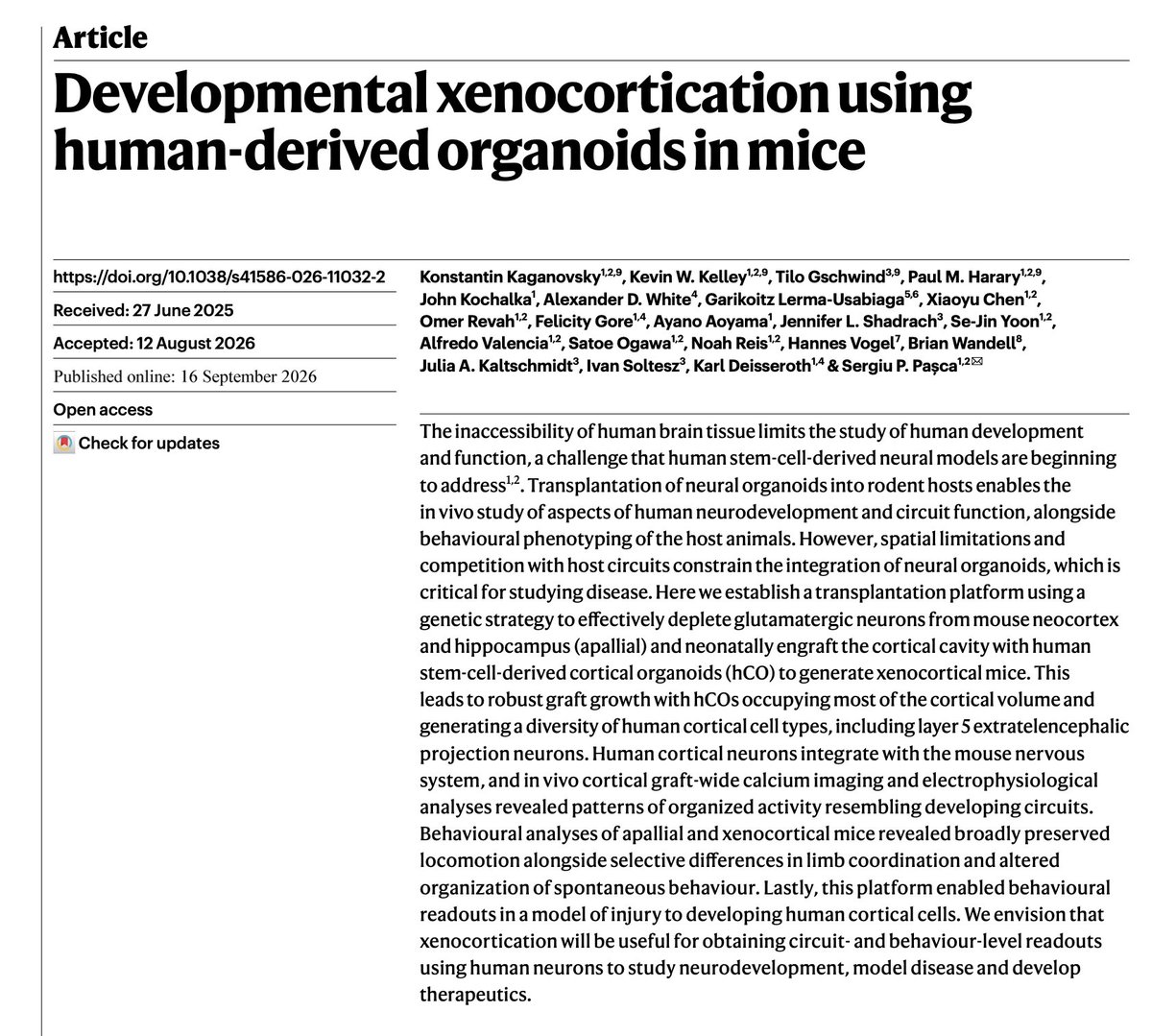
An extraordinary @Nature paper has just landed from the lab of @Sergiu_P_Pasca at @Stanford - led by Konstantin Kaganovsky. They have found a way to create "xenocortical mice" which have ~92% of their cortex occupied by a cortical organoid derived from human stem cells. This human-derived cortical graft integrates deeply with the host nervous system, supporting organised neural activity and behaviour.
This study is a milestone in synthetic biology and chimera research. It has the potential to generate multiple medical breakthroughs by providing an enhanced biological model of human brain tissue that allows behavioural as well as neural and genetic assays.
The Stanford team have been exceptionally thorough and proactive in addressing ethical concerns that comes from this frontier work. But their pioneering work nonetheless raises many open questions: are the xenocortical mice conscious? Do they have any human-like properties of consciousness or cognition?
@NitaFarahany and I will be addressing some of these questions in a forthcoming commentary - where we'll also offer an ethically-informed roadmap to guide this important research as it progresses. In this context, "pacing the frontier" really does make sense 😉
Read the Stanford @nature paper here, and buckle up. It's wild. https://t.co/Ky9HFb9nYI
Why is glutathione, rather than cysteine, the major cellular thiol? Our new work by @ToshiNakamura51 suggests unlike other amino acids, excess cysteine is intrinsically toxic to mammalian cells via mitochondrial iron accumulation. @RockefellerUniv
https://t.co/JYyu5eAoVu
It is clear that people are using AI to review papers and grants. Often as a tool, not as an off the bottle answer for review (though some do). One of the signs of this is the detail of the negative comments and the errors, often minor and irrelevant to the conclusions.🧵
AlphaFold: predicting the protein structure from amino acid sequence for >200 million proteins (awarded @NobelPrize)
Today
Alpha Genome Atlas: predicting the molecular impact of all 9 billion variants of the human genome
https://t.co/DkEtZofJ8s
Change the textbooks. Trans-splicing as a means to diversify the proteome. Many congrats to Ruaidhri Jackson and Olivia Venezia on this remarkable discovery.
https://t.co/gER6ME71AH
Science is moving at such a crazy speed
Nature paper showing global transcriptional profiling of living cells
How did i miss this ?
https://t.co/yn8UWAjUYV
As someone coming from a computational background to biology, a big culture shock is realizing just how much *improvisation* happens in the lab.
Small observations like the viscosity of the liquid, firmness of the pellet, resistance while pipetting can all drive on-the-fly adjustments: spin a little longer, mix a few more times, or aspirate with a bit more force…
These details are critical to troubleshooting and data interpretation - and can make the difference between signal and noise. But they’re rarely recorded.
Without knowing the messy physical reality of experiment execution, the AI scientist, no matter how brilliant, flies blind. This observability gap decouples AI progress from scientific progress.
Excited to see this great team take on one of the most important problems in science!