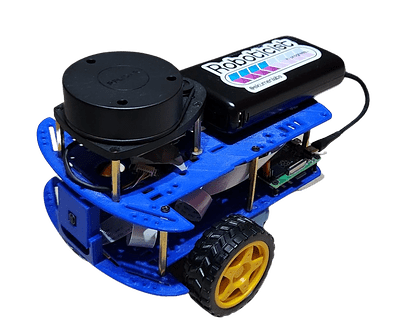
In the future, I can see myself working in the field of robotics! I hope so! finger-crossed! I just love robots so much! ❤
"Robotics is the future" 🤗 #robotics#AI
[RNN] by Hand ✍️ - Spreadsheet 👉 https://t.co/9TpR81JSwW
This is a customizable spreadsheet version of my RNN representation. You can enter your own values, watch the calculations, and even read the equations. I also provide a typical RNN graphical diagram to help you see the correspondences between RNN's matrix representation (left) and the graphical representation (right).
Hope you find this helpful!
Our company is looking for skilled professionals for positions mentioned below. Join us now at FPT Automotive
Feel free to send DM or send directly your CV's to the email below.
🤖 Dream of designing robots that explore other planets or perform life-saving surgeries? Our latest career guide breaks down the 5-step path to becoming a #RoboticsEngineer.
👉 Read on to start building the future today! https://t.co/dbJPuI07rA
#robotics#robots#tech
Explores the roles of ROS2 and robotics principles with respect to company's requirements.
- Significance of ROS2
- Focusing on knowledge
- Innovation in the field of Robotics.
🎥Watch Full Video : https://t.co/hTDHpqcxg7
#ROS2#Robotics#edtech
So you've understood the basics of Docker - but simple things aren't working and the Dockerfiles you see online seem so complicated 😔
In this video we see how to get networking, graphics, user permissions and more working in Docker!
https://t.co/mL83ePTB45
Artificial intelligence vs. human brain - a love-hate relationship
As AI models (neural networks) have become more performant they have surpassed the human brain at multiple tasks
Neural networks are fundamentally modeled on the human brains.
Here is how they are similar
Neurons vs. Nodes -
Biological neurons - The brain receive signals from other neurons through dendrites, processes them, and then passes them on through axons.
Artificial neurons - Nodes in the network receive inputs, add some mathematical transformation and produce an output. So the fundamental workflow is the same.
Learning mechanisms are similar -
Brain Learning: When we learn, the strengths of the neuron connections (synapses) change. For example, if you touch a flame and get burned, your brain strengthens the "fire = hot & painful" connection.
Network Learning: Neural networks adjust their weights (connections) based on errors in prediction
Layered architecture -
Brain's Hierarchical Processing: The human brain processes information in a hierarchical manner. Different parts of the brain are responsible for different functions.
Layers in Neural Networks: Neural networks, especially deep networks, also employ a hierarchical structure. The initial layers often capture low-level features (like edges in images), and deeper layers capture high-level abstract features.
But while they share these basic concepts, this is where the similarity ends!
AI models excel at
Specific tasks - on narrow defined tasks, AI models can easily outpace the human brain. For example, AI can search the entire web and recollect information from the web way better than the brain
Games - AI models have outplayed humans in some games like Chess and Go
Processing Speed: AI models can crunch numbers and process data much faster than the human brain
However, they are still very behind the human brain in these key abilities
Learning and Generalization - The human brain needs very few examples to learn and can easily apply the learning from one context to another. AI needs thousands of examples to learn and can't easily generalize the learning
Energy Consumption - AI models consume way more energy than the human brain. Your brain only uses about 20 watts, which is like a dim light bulb. Yet, you still get bright ideas!
The Super Cool Stuff - No, GPT-4 is not secretly in love with you! AI models don't have feelings, dreams, consciousness or intuition. This is what makes us human, AI models have none of this!
In summary, the human brain is versatile, creative and adaptable while AI models are brilliant at specialized tasks.
Lately, there has been a lot of hate, fear and loathing of AI models, with some people claiming that AI threatens our very existence
In reality, the human brain is far more sophisticated and complex than AI and we should embrace and love AI models whose creation have been inspired by our brains. They can be great tools that can transform our lives for the better and unlock the mysteries of the universe
The #kinematic model of a #holonomic robot describes its motion without considering its dynamics. 💻🤖️https://t.co/NJrsn2wcN3 Join this open class to understand the kinematic model of a holonomic robot, enabling you to predict and control its motion accurately.
Missed the ROS Developers Day 2023? Check out the incredible presentation by @Yadunund (@OpenRoboticsOrg@IntrinsicAI), one of the OpenRMF developers! He showed a fascinating #ROS project on "Building #multi-fleet simulations using #OpenRMF."
Watch now 📺 https://t.co/KLanAEyADR
The Segment Anything Model has been explored for 3D object detection using a BEV processing pipeline, showing promising results on the Waymo open dataset.
SAM3D: Zero-Shot 3D Object Detection via Segment Anything Model
https://t.co/tpOrEBp7N7
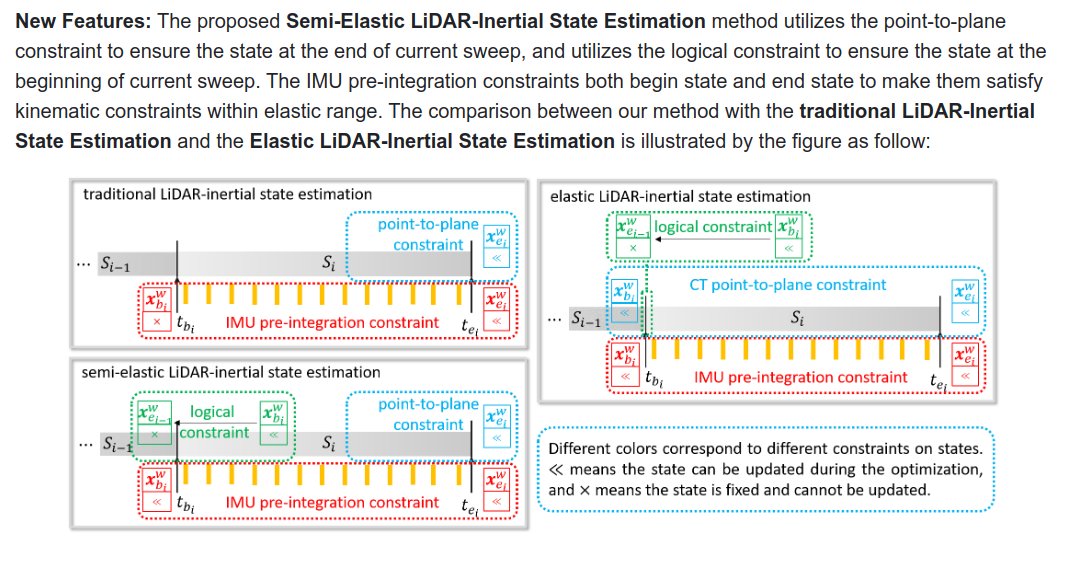
Existing LiDAR-inertial state estimation methods equate the state at the beginning of the current sweep with the state at the end of the previous sweep. This paper introduces a semi-elastic method to correct inconsistencies like zigzag trajectories.
https://t.co/zRxj9SjJmC
What is a 𝗩𝗲𝗰𝘁𝗼𝗿 𝗗𝗮𝘁𝗮𝗯𝗮𝘀𝗲?
With the rise of Foundational Models, Vector Databases skyrocketed in popularity. The truth is that a Vector Database is also useful outside of a Large Language Model context.
When it comes to Machine Learning, we often deal with Vector Embeddings. Vector Databases were created to perform specifically well when working with them:
➡️ Storing.
➡️ Updating.
➡️ Retrieving.
When we talk about retrieval, we refer to retrieving set of vectors that are most similar to a query in a form of a vector that is embedded in the same Latent space. This retrieval procedure is called Approximate Nearest Neighbour (ANN) search.
A query here could be in a form of an object like an image for which we would like to find similar images. Or it could be a question for which we want to retrieve relevant context that could later be transformed into an answer via a LLM.
Let’s look into how one would interact with a Vector Database:
𝗪𝗿𝗶𝘁𝗶𝗻𝗴/𝗨𝗽𝗱𝗮𝘁𝗶𝗻𝗴 𝗗𝗮𝘁𝗮.
1. Choose a ML model to be used to generate Vector Embeddings.
2. Embed any type of information: text, images, audio, tabular. Choice of ML model used for embedding will depend on the type of data.
3. Get a Vector representation of your data by running it through the Embedding Model.
4. Store additional metadata together with the Vector Embedding. This data would later be used to pre-filter or post-filter ANN search results.
5. Vector DB indexes Vector Embedding and metadata separately. There are multiple methods that can be used for creating vector indexes, some of them: Random Projection, Product Quantization, Locality-sensitive Hashing.
6. Vector data is stored together with indexes for Vector Embeddings and metadata connected to the Embedded objects.
𝗥𝗲𝗮𝗱𝗶𝗻𝗴 𝗗𝗮𝘁𝗮.
7. A query to be executed against a Vector Database will usually consist of two parts:
➡️ Data that will be used for ANN search. e.g. an image for which you want to find similar ones.
➡️ Metadata query to exclude Vectors that hold specific qualities known beforehand. E.g. given that you are looking for similar images of apartments - exclude apartments in a specific location.
8. You execute Metadata Query against the metadata index. It could be done before or after the ANN search procedure.
9. You embed the data into the Latent space with the same model that was used for writing the data to the Vector DB.
10. ANN search procedure is applied and a set of Vector embeddings are retrieved. Popular similarity measures for ANN search include: Cosine Similarity, Euclidean Distance, Dot Product.
Some popular Vector Databases: Qdrant, Pinecone, Weviate, Milvus, Faiss, Vespa.
--------
Follow me to upskill in #MLOps, #MachineLearning, #DataEngineering, #DataScience and overall #Data space.
Also hit 🔔to stay notified about new content.
𝗗𝗼𝗻’𝘁 𝗳𝗼𝗿𝗴𝗲𝘁 𝘁𝗼 𝗹𝗶𝗸𝗲 💙, 𝘀𝗵𝗮𝗿𝗲 𝗮𝗻𝗱 𝗰𝗼𝗺𝗺𝗲𝗻𝘁!
Join a growing community of Data Professionals by subscribing to my 𝗡𝗲𝘄𝘀𝗹𝗲𝘁𝘁𝗲𝗿: https://t.co/qgNCnGtF4A
MIT offers free courses in following areas:
- Python
- Machine Learning
- Deep Learning
- Probability & Statistics
- Linear Algebra
A comprehensive curriculum where you get to learn from the best!
Read more...👇
Looking for an affordable ROS 2 robot for education?
Our friends at @ekumenlabs have created Andino, an open-source diff drive robot based on ROS 2 that costs less than $300 to build.
https://t.co/yz8R4FpaTR
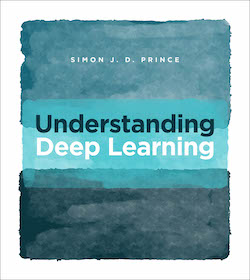
Are you (or is someone you know) teaching AI / ML / Deep Learning this year? My forthcoming book (freely available at https://t.co/hqRA1xUPkk) will save you a lot of time. This thread will show you why.
Lab4D is a 4D reconstruction tool using monocular videos, incorporating neural implicit representations, various deformation fields, and several priors. It supports multi-GPU training and dual-quaternion operations.
https://t.co/kLwRWOt3sb
I am also joining USC as an assistant professor next month and building a new research group. I will be hiring at all levels at USC as well (visiting students/PhDs/PostDocs). Let me know if you’re interested.