@deanwball So far I don’t see a consensus against (or for) use of Fable inside enterprises. It will probably end up being a nuanced decision based on the type of data being worked with, without blanket approval or denial across even individual enterprises.
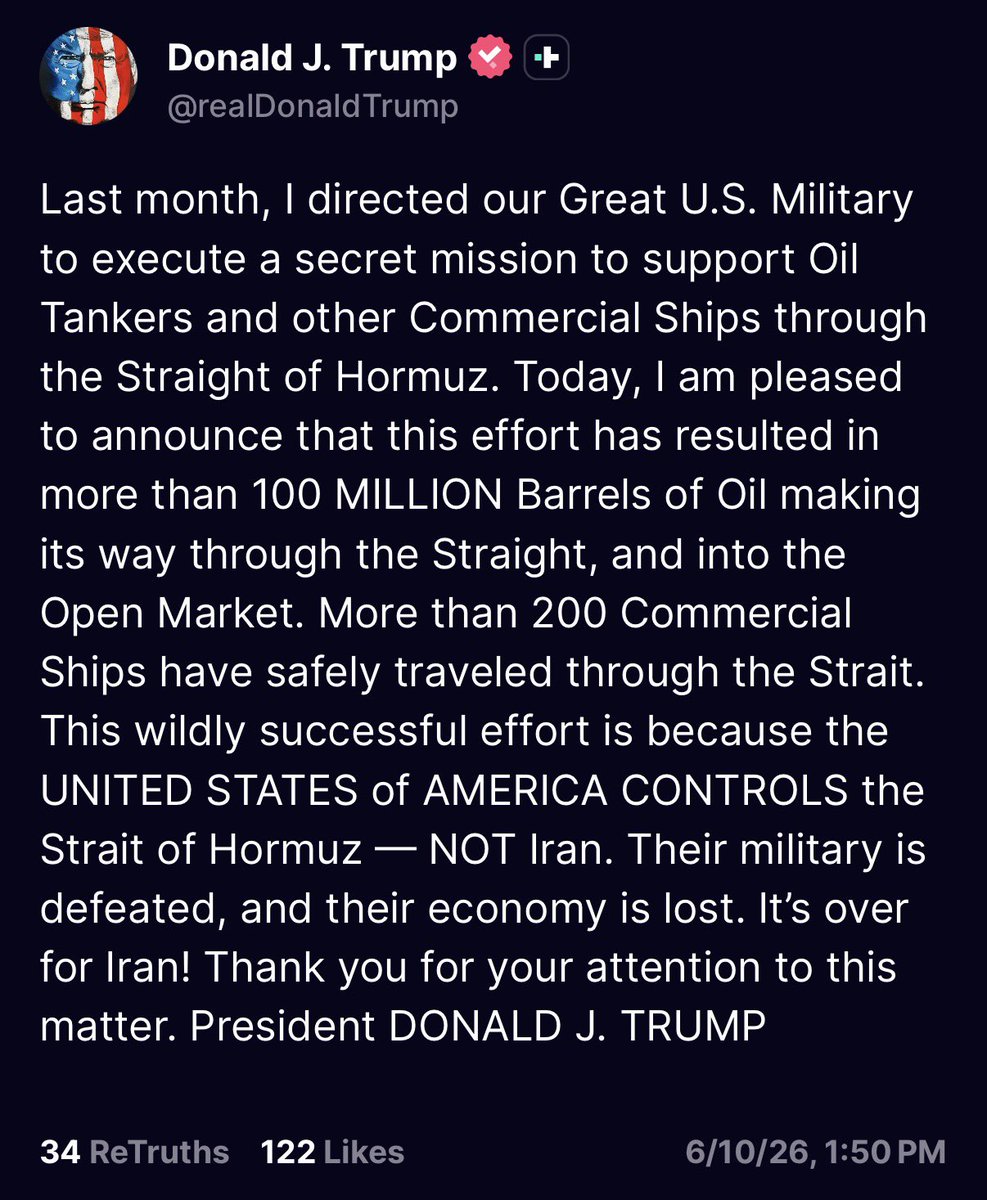
President Trump has posted that 100 Million barrels of oil are making its way through the Strait.
This appears to be what is happening.
⚓️President Trump and @CENTCOM announced Project Freedom to escort ships through the Strait. The US evacuated two US ships but then curtailed the operation.
⚓️It appears that the US resumed the operation using autonomous vehicles, aircraft and drones to escort ships through the southern part of the Strait, near the coast of Oman.
⚓️Iran has responded with targeting of some ships, these include HMM Namu and CMA CGM San Antonio. The US has responded with airstrikes against Iran.
⚓️ What has transpired is tankers, including Very Large Crude Carriers are exiting the Persian Gulf. Then, per @TankerTrackers, the VLCCs are conducting ship-to-ship (STS) transfers to other tankers in the Gulf of Oman.
⚓️The empty tankers, which ran the Strait with their AIS, run back through the Strait to pick up a new load of oil from the UAE, Saudi Arabia, Bahrain, Qatar or Iraq.
⚓️The Apache helicopter that recently crashed was probably a part of this operation.
⚓️This explains why we have not seen an appreciable drop in the number of ships stuck in the Persian Gulf. By running the same ships, war risk insurance, potentially provided by the US through the Development Finance Corporation (DFC) through a pool of approximately of $40 billion, could be covering these ships making the transits.
⚓️This would also explain the recent announcement by Kuwait to fix new contracts for its oil.
⚓️The question is how long is this sustainable and at what level is oil moving daily. With current pipelines through Saudi Arabia and the UAE, this system would need to move approximately 12-14M barrels/day through the Strait.
This analysis is based on open source material, but big shout out to @TankerTrackers@Kpler@MarineTraffic@LloydsList@gCaptain for their postings and research.
Fable 5 launches alongside Mythos 5 (available only through Glasswing) — the exact same underlying model, just without those classifier blocks.
The blocks fire in only ~5% of Fable 5 sessions. So 95% of the time, Fable 5 is the exact same experience as Mythos 5.
There’s a new good study on what dose of gluten exposure triggers an immune response in people with celiac. I wrote about that and how it helps me refine my ‘algorithm’ for deciding what to eat as a person with celiac: https://t.co/40Lb1g2v7K
Anthropic says Recursive Self Improvement is approaching faster than they expected.
Quoting from the blog:
'What should we do?
If it were possible to effectively slow the development of this technology to give ourselves more time to deal with its immense implications, we think that would likely be a good thing. But if a slowdown simply lets the least cautious actors catch up technologically, it could leave everyone less safe. Without a global coordination mechanism, companies and governments will have to make difficult decisions about safety while under competitive and geopolitical pressures.
We believe it would be good for the world to have the option to slow or temporarily pause frontier AI development to enable societal structures and alignment research to keep up with the advance of the technology. The Anthropic Institute will conduct research—in collaboration with many others—and take actions to help build the systems that a credible slowdown or pause would require. These systems would enable frontier AI developers to verify that others globally have actually stopped or slowed, and that a bad actor could not use the auspices of a coordinated slowdown to jump ahead in secret. If such systems existed, we expect that we would slow down or temporarily pause, if other developers at or near the frontier also did so in a verifiable manner.
A meaningful slowdown or pause would require multiple well-resourced labs at or near the frontier, in multiple countries, agreeing to stop under the same conditions. It would also require that each can verify that the others have actually stopped. Due to the unique characteristics of AI systems, the detectability (a lower standard than verifiability) element of this arms control problem is much more challenging than with other technologies. Training runs are far easier to conceal than missile silos, their inputs are general-purpose, and the incentive to defect quietly is enormous, because whoever continues while others pause could inherit the lead. A credible pause also has to specify what triggers it, what lifts it, and who adjudicates.
None of this is necessarily impossible in principle—the world has built verification regimes for other complex technologies (e.g., the Intermediate-Range Nuclear Forces Treaty)—but those regimes took decades to build both the infrastructure and the trust. We don’t have that long. A unilateral pause by one lab, by contrast, is achievable immediately, but accomplishes much less: it would change who the front-runner is, but it would not create the wider deliberative process that is currently missing.
In the coming months, we will organize conversations where policymakers, researchers, civil society, and other AI companies can help answer some of the questions this piece raises, especially around full recursive self-improvement and how to create better options for coordination and deliberation. We’ll publish what comes out of it. The window to investigate the questions together is here, and people outside AI companies should be involved in this deliberation.'
Rolling out for both Pro and Plus users this morning. Real memory changes a lot of things.
'Today, we are launching a significantly more capable and compute-efficient memory architecture built on top of dreaming.
The memories synthesized by dreaming are reviewable through a summary of them made visible in the memory summary page. From the memory summary, you can quickly glean the highlights of what ChatGPT knows about you, add or update information about yourself, and provide instructions on what topics ChatGPT should bring up and when. If you want to drill down into a particular area to learn more, just chat with the model.'
'@BrianCAlbrecht writes a very good post on why a tax on compute, an idea I think is worthy of consideration, is bad based on economic theory. I trust Brian's reading of the econ literature. That said, tax policy is not just maximization of economic benchmarks. That process led us to the globalization era that grew the pie but created a lot of 2nd order effects and proved politically unsustainable.
I think you have to add stability, equity, distributional concerns and social cohesion, among others, to the list of criteria on which to judge tax policy. We can try to get cute by maximizing the pie and redistributing, but the record on that isn't great.
I would not tax compute today; the industry is still in its infancy. Policymakers should wait to see how much AI augments vs displaces work. And, it's not clear if a compute tax could be administered with any integrity. That said, AI maximalists think disruption could happen very quickly so we should start debating potential responses.
Brian writes, "The current U.S. tax code already implicitly penalizes labor relative to machines." We fully agree there. Every idea to address AI will have tradeoffs. We need to be having those debates. I'm not wed to a compute tax or equalizing tax rates on labor and capital, though they should be in the quiver.
Other ideas include UBI, wage insurance, large scale workforce retraining, shorter workweeks, expanded social insurance, and giving people equity in AI. There are problems with all of these. Each has tradeoffs or limited efficacy if the AI maximalists are right. And if they are, and they've mostly been right thus far, doing nothing will not be an option.
Good to see this out before the Bipartisan Commission @Biodefensecomm meeting on AI-bio today. The technical solution exists; we need mandates with robust red-teaming & teeth. It shouldn't be easy to buy DNA sufficient to make infectious 1918 influenza.
https://t.co/SITVcBCQJG
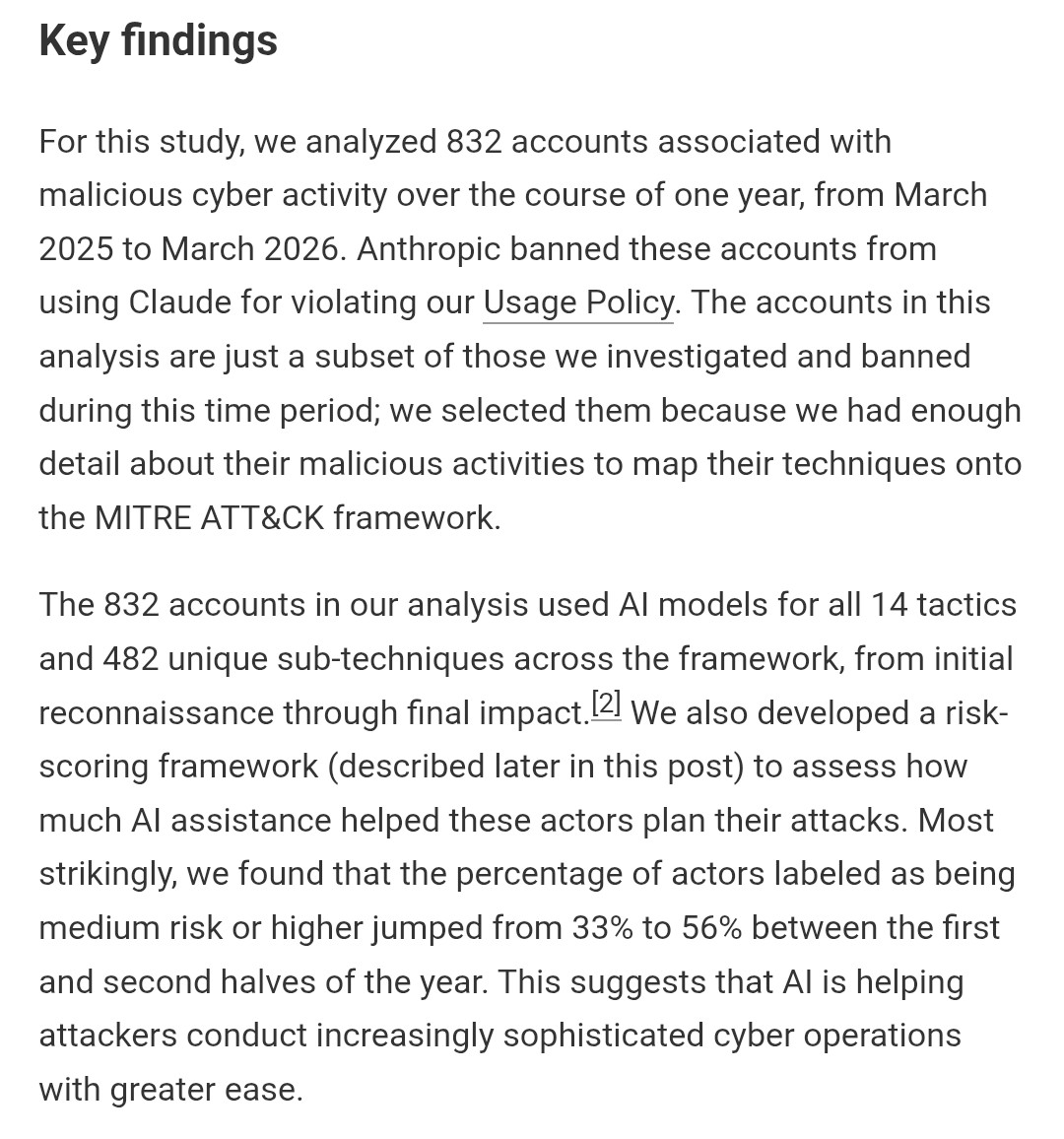
From the Anthropic red team blog:
'Most strikingly, we found that the percentage of actors labeled as being medium risk or higher jumped from 33% to 56% between the first and second halves of the year. This suggests that AI is helping attackers conduct increasingly sophisticated cyber operations with greater ease.
- The number of actors using AI for cyber operations is growing, and their actions carry higher risk
-Agentic scaffolding will make it possible for cyberattacks to be far more autonomous
- The MITRE ATT&CK framework doesn’t yet cover the autonomous actions that make these actors so dangerous.'
Stanford Medicine researchers and their colleagues invented a new vaccine that shows potential to protect against respiratory viruses, bacteria and allergens — the closest yet to a universal vaccine.
https://t.co/ypukWUmJKv
Notes on 100+ Recent Technical Interviews
I interview a ton of engineers. Recruiting is the single most important technical CEO activity. Here are a bunch of impressions
1. There is a severe ZIRP engineering overhang that is currently washing out. They're getting laid off, managed out, etc. after having been massively overhired around 2020-2022. This is worst for Tier-2 big tech (think PayPal, Bill, etc.) but also FAANGs. These are overwhelmingly bad engineers.
2. This flood of unqualified but good-on-paper candidates makes this the hardest SF hiring market I have ever seen, due to the amount of nominally strong-looking candidates that you need to grind through.
3. I am highly skeptical of "AI as a cause for engineering layoffs". I think this is a large-scale polite fiction -- the companies don't want to admit they overhired, the engineers don't want to admit they are bad at their jobs. Everyone's blaming AI when it's really just the market rectifying itself.
4. Many of these engineers appear never to have had a real engineering function at their corporations. They're sitting in meetings, "making decisions about technology" but are unable to write software. I leave many interviews baffled by what exactly they were doing for so many years, let alone what their manager was doing.
5. I have interviewed some engineers from FAANG companies so shockingly nontechnical that I am forced to conclude that there is either (1) a lot of resume fraud going on or (2) that there are kickback grifts within those organizations -- people hiring their cousins and splitting the pay, that kind of thing. I have no other explanation.
6. There's a fun side-effect where after interviewing 20+ people from certain small but public companies, I actually feel like I am gaining a short sellers' advantage: there are financial technology companies out there that, knowing what I now know, I would never deposit a single dollar into.
8. Based on this "exhaust" data, and extrapolating a little bit, maybe aggressively so: I think folks like @pmarca are basically right when they say that ~every tech company is overstaffed by a factor of 2-4x. Whatever the reason -- staffing ahead of need, monopolizing certain engineer types (Google-style), headcount-driven promotion incentives, the reality is that a lot of these companies are not being run for the shareholders. The aggregate SBC expense is insane, and I expect this is going to get rectified eventually.
I'm sure that AI will play a role in rectifying this -- but I fear that people are going to blame AI for taking people's jobs when the reality is that the jobs were already long-gone, possibly always useless, but the highly-paid butts-in-seats remained. People will be mad at AI for taking away their lucrative sinecures. Maybe that's the same effect from a public policy perspective, but it feels different morally.